Eastlake, Ohio

Last updated

Eastlake, Ohio
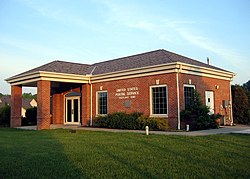
Eastlake Post Office.jpg
Eastlake Post Office
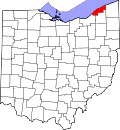
EASTLAKE locator, Cleveland, 2021.svg
Location of Eastlake in Greater Cleveland
USA Ohio relief location map.svg
Red pog.svg
Eastlake
Usa edcp relief location map.png
Red pog.svg
Eastlake
Coordinates: 41°38′30″N81°26′17″W / 41.64167°N 81.43806°W / 41.64167; -81.43806
Country United States
State Ohio
County Lake
Incorporated1948
Government
   Mayor David Spotton (R) [1]
Area
[2]
  Total
6.54 sq mi (16.93 km2)
  Land6.41 sq mi (16.59 km2)
  Water0.13 sq mi (0.34 km2)
Elevation
[3]
620 ft (190 m)
Population
 (2020)
  Total
17,670
  Estimate 
(2023) [4]
17,363
  Density2,758.1/sq mi (1,064.91/km2)
Time zone UTC-5 (Eastern (EST))
  Summer (DST) UTC-4 (EDT)
ZIP codes
44095, 44097
Area code 440
FIPS code 39-23618 [5]
GNIS feature ID1086416 [3]
Website eastlakeohio.com

Eastlake is a city in Lake County, Ohio, United States. It takes its name from its location northeast of Cleveland, following along the shore of Lake Erie. [6] The population was 17,670 at the 2020 census. The 2003 North America blackout stemmed from an Eastlake generating station going offline.

Contents

History

America Remembers 9/11 Memorial in Eastlake America Remembers 9.11 Memorial 2.jpg
America Remembers 9/11 Memorial in Eastlake

The single largest blackout in North American history on August 14, 2003, was traced back to a FirstEnergy generating plant in Eastlake that went offline at 1:31 P.M. EDT amid high electrical demand. It caused 50 million people to lose power in eight U.S. states and southeastern Canada. [8] [9]

Geography

According to the United States Census Bureau, the city has a total area of 6.53 square miles (16.91 km2), of which 6.40 square miles (16.58 km2) is land and 0.13 square miles (0.34 km2) is water. [10] [11]

Eastlake is about 19 miles northeast of Cleveland, Ohio, along the shore of Lake Erie, and is part of Greater Cleveland.

Demographics

94.3% spoke English and 2.9% spoke Croatian. [12]

Historical population
CensusPop.Note
1950 4,700
1960 12,467165.3%
1970 19,69057.9%
1980 21,95411.5%
1990 21,161−3.6%
2000 20,255−4.3%
2010 18,577−8.3%
2020 17,670−4.9%
2023 (est.)17,363 [4] −1.7%
Sources: [5] [13] [14] [15]

2020 census

As of the 2020 census, Eastlake had a population of 17,670. The median age was 45.9 years. 17.5% of residents were under the age of 18 and 21.1% of residents were 65 years of age or older. For every 100 females there were 96.8 males, and for every 100 females age 18 and over there were 94.6 males age 18 and over. [16]

100.0% of residents lived in urban areas, while 0.0% lived in rural areas. [17]

There were 7,996 households in Eastlake, of which 22.6% had children under the age of 18 living in them. Of all households, 40.0% were married-couple households, 22.0% were households with a male householder and no spouse or partner present, and 29.4% were households with a female householder and no spouse or partner present. About 33.9% of all households were made up of individuals and 14.3% had someone living alone who was 65 years of age or older. [16]

There were 8,391 housing units, of which 4.7% were vacant. The homeowner vacancy rate was 1.4% and the rental vacancy rate was 5.4%. [16]

Racial composition as of the 2020 census [18]
RaceNumberPercent
White 15,75489.2%
Black or African American 6513.7%
American Indian and Alaska Native 420.2%
Asian 1600.9%
Native Hawaiian and Other Pacific Islander 10.0%
Some other race970.5%
Two or more races 9655.5%
Hispanic or Latino (of any race)3371.9%

2010 census

As of the census [19] of 2010, there were 18,577 people, 7,841 households, and 5,056 families residing in the city. The population density was 2,902.7 inhabitants per square mile (1,120.7/km2). There were 8,280 housing units at an average density of 1,293.8 per square mile (499.5/km2). The racial makeup of the city was 95.9% White, 1.4% African American, 0.1% Native American, 1.0% Asian, 0.3% from other races, and 1.2% from two or more races. Hispanic or Latino of any race were 1.4% of the population.

There were 7,841 households, of which 28.3% had children under the age of 18 living with them, 46.4% were married couples living together, 12.4% had a female householder with no husband present, 5.7% had a male householder with no wife present, and 35.5% were non-families. 29.7% of all households were made up of individuals, and 11.2% had someone living alone who was 65 years of age or older. The average household size was 2.37 and the average family size was 2.93.

The median age in the city was 42.7 years. 20.6% of residents were under the age of 18; 8.3% were between the ages of 18 and 24; 24.4% were from 25 to 44; 31.3% were from 45 to 64; and 15.4% were 65 years of age or older. The gender makeup of the city was 49.3% male and 50.7% female.

2000 census

As of the census [5] of 2000, there were 20,255 people, 8,055 households, and 5,557 families residing in the city. The population density was 3,166.5 inhabitants per square mile (1,222.6/km2). There were 8,310 housing units at an average density of 1,299.1 per square mile (501.6/km2). The racial makeup of the city was 97.44% White, 0.54% African American, 0.16% Native American, 0.97% Asian, 0.01% Pacific Islander, 0.15% from other races, and 0.73% from two or more races. Hispanic or Latino of any race were 0.70% of the population. 17.1% were of German, 16.4% Italian, 15.1% Irish, 7.5% Polish, 6.1% Slovene and 5.7% English ancestry according to Census 2000.

There were 8,055 households, out of which 30.6% had children under the age of 18 living with them, 53.3% were married couples living together, 11.4% had a female householder with no husband present, and 31.0% were non-families. 26.3% of all households were made up of individuals, and 9.3% had someone living alone who was 65 years of age or older. The average household size was 2.51 and the average family size was 3.07.

In the city the population was spread out, with 23.8% under the age of 18, 8.1% from 18 to 24, 30.3% from 25 to 44, 25.7% from 45 to 64, and 12.1% who were 65 years of age or older. The median age was 38 years. For every 100 females, there were 95.3 males. For every 100 females age 18 and over, there were 94.4 males.

The median income for a household in the city was $43,297, and the median income for a family was $52,039. Males had a median income of $37,557 versus $27,135 for females. The per capita income for the city was $19,905. About 3.7% of families and 5.0% of the population were below the poverty line, including 6.4% of those under age 18 and 6.2% of those age 65 or over.

Government

Eastlake has a mayor-council system of government. As of 2024, the mayor is David Spotton, a Republican. The City Council consists of seven members, who are elected for four-year terms. Three members are elected by the city at-large, and four members are elected from wards. As of 2024, the members of the City Council are as follows: [20]

Eastlake City Council
SeatNameParty
Council-at-LargeChris A. Krajnyak Republican
Council-at-LargeAngela Schmidt Republican
Council-at-LargeMichael Semick Republican
Ward 1James Overstreet Republican
Ward 2John Meyers Republican
Ward 3Jason Kasunick Democrat
Ward 4Danyeill Kostelnik Republican

Culture

The Boulevard of 500 Flags, purported to be "the world's largest permanent display of American flags", is located in Eastlake. [21] [22] [23]

Eastlake is served by a branch of the Willoughby-Eastlake Public Library. [24]

Sports

North High School North High School, Eastlake, OH.jpg
North High School

Eastlake is home to Classic Park, the home field of the Lake County Captains, a Class A minor league baseball team affiliated with the Cleveland Guardians. Classic Park's construction included controversy involving finances. [25]

Education

Eastlake is part of the Willoughby-Eastlake City School District, which includes North and South high schools, three middle schools, and five elementary schools. [26]

Notable people

References

  1. "Elected Officials" (PDF). Retrieved August 1, 2024.
  2. "ArcGIS REST Services Directory". United States Census Bureau. Retrieved September 20, 2022.
  3. 1 2 U.S. Geological Survey Geographic Names Information System: Eastlake, Ohio
  4. 1 2 "Annual Estimates of the Resident Population for Incorporated Places in Ohio: April 1, 2020 to July 1, 2023". United States Census Bureau. Retrieved June 20, 2024.
  5. 1 2 3 "U.S. Census website". United States Census Bureau . Retrieved January 31, 2008.
  6. Overman, William Daniel (1958). Ohio Town Names. Akron, OH: Atlantic Press. p. 40.
  7. "America Remembers 9-11 Memorial". 500flags.org. Archived from the original on August 31, 2018. Retrieved May 31, 2017.
  8. "The 12 Biggest Electrical Blackouts In History". Mental Floss. November 9, 2015. Archived from the original on March 5, 2016. Retrieved February 27, 2016.
  9. "BLACKOUT 2003: The timeline". cleveland.com. August 14, 2013. Archived from the original on March 7, 2016. Retrieved February 27, 2016.
  10. "US Gazetteer files 2010". United States Census Bureau. Archived from the original on January 25, 2012. Retrieved January 6, 2013.
  11. "US Gazetteer files: 2010, 2000, and 1990". United States Census Bureau. February 12, 2011. Retrieved April 23, 2011.
  12. "Data Center Results". www.mla.org. Retrieved October 12, 2018.
  13. "Number of Inhabitants: Ohio" (PDF). 18th Census of the United States. U.S. Census Bureau. 1960. Retrieved April 24, 2020.
  14. "Ohio: Population and Housing Unit Counts" (PDF). U.S. Census Bureau. Archived (PDF) from the original on January 9, 2014. Retrieved November 22, 2013.
  15. "Eastlake city, Ohio". census.gov. Retrieved June 29, 2022.
  16. 1 2 3 "2020 Decennial Census Demographic Profile (DP1)". United States Census Bureau. 2021. Retrieved February 2, 2026.
  17. "2020 Decennial Census Demographic and Housing Characteristics (DHC)". United States Census Bureau. 2023. Retrieved February 2, 2026.
  18. "2020 Decennial Census Redistricting Data (Public Law 94-171)". United States Census Bureau. 2021. Retrieved February 2, 2026.
  19. "U.S. Census website". United States Census Bureau . Retrieved January 6, 2013.
  20. "Elected Officials" (PDF). Retrieved August 21, 2024.
  21. "Boulevard of 500 Flags". 500flags.org. Archived from the original on May 23, 2017. Retrieved May 31, 2017.
  22. Husted, Simon (May 22, 2015). "Eastlake's Boulevard of 500 Flags gathering help to enforce flagpoles". The News-Herald . Retrieved May 31, 2017.
  23. "Boulevard of 500 Flags Photograph". Ohio History Connection . Ohio Memory Collection. 2003. Retrieved May 31, 2017.
  24. "Locations and Hours". Willoughby-Eastlake Public Library. Archived from the original on January 12, 2017. Retrieved May 31, 2017.
  25. Glasier, David S. (June 18, 2012). "Dark days, then rays of hope: A windfall relieves some of Eastlake's pain from stadium debt". The News-Herald . Retrieved May 31, 2017.
  26. "Schools". Willoughby-Eastlake City Schools. Retrieved May 7, 2023.