 Example of pentagonal dextro (right-handed) form | |
| Faces | 6n triangles 2n squares 2 n-gons |
|---|---|
| Edges | 16n |
| Vertices | 6n |
| Symmetry group | Dn, [n,2]+, (n22) |
| Rotation group | Dn, [n,2]+, (n22) |
| Properties | convex, chiral |
In geometry, the gyroelongated bicupolae are an infinite sets of polyhedra, constructed by adjoining two n-gonal cupolas to an n-gonal antiprism. The triangular, square, and pentagonal gyroelongated bicupola are three of five Johnson solids which are chiral, meaning that they have a "left-handed" and a "right-handed" form.
Adjoining two triangular prisms to a square antiprism also generates a polyhedron, but not a Johnson solid, as it is not convex. The hexagonal form is also a polygon, but has coplanar faces. Higher forms can be constructed without regular faces.
| Image cw laevo | Image ccw dextro | Name | Faces |
|---|---|---|---|
 |  | Gyroelongated digonal bicupola | 12 triangles, 4 squares |
 |  | Gyroelongated triangular bicupola (J44) | 18+2 triangles, 6 squares |
 | 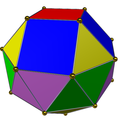 | Gyroelongated square bicupola (J45) | 24 triangles, 8+2 squares |
 |  | Gyroelongated pentagonal bicupola (J46) | 30 triangles, 10 squares, 2 pentagons |
| Gyroelongated hexagonal bicupola | 36 triangles, 12 squares, 2 hexagons |
