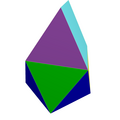
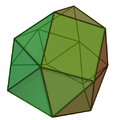
| Set of gyroelongated cupolae | |
|---|---|
 Example of a pentagonal form | |
| Faces | 5n triangles n squares 1 n-gon 1 2n-gon |
| Edges | 11n |
| Vertices | 5n |
| Symmetry group | Cnv, [n], (*nn) |
| Rotational group | Cn, [n]+, (nn) |
| Dual polyhedron | |
| Properties | convex |
In geometry, the gyroelongated cupolae are an infinite set of polyhedra, constructed by adjoining an n-gonal cupola to a 2n-gonal antiprism.
Contents
There are three gyroelongated cupolae that are Johnson solids made from regular triangles, squares, and pentagons. Higher forms can be constructed with isosceles triangles. Adjoining a triangular prism to a square antiprism also generates a polyhedron, but has adjacent parallel faces, so is not a Johnson solid. The hexagonal form can be constructed from regular polygons, but the cupola faces are all in the same plane. Topologically other forms can be constructed without regular faces.