Related Research Articles
Ho is a Munda language of the Austroasiatic language family spoken primarily in India by about 2.2 million people per the 2001 census. Ho is a tribal language. It is spoken by the Ho, Munda, Kolha and Kol tribal communities of Odisha, Jharkhand, Bihar, Chhattisgarh, West Bengal, Assam and is written with the Warang Citi script. Devanagari, Latin script, Odia script and Telugu script are sometimes used, although native speakers are said to prefer a Ho script. The latter script was invented by Ott Guru Kol Lako Bodra.

West Singhbhum or Pashchimi Singhbhum is one of the 24 districts of Jharkhand state, India. It came into existence on 16 January 1990, when the old Singhbhum district was bifurcated. Chaibasa is the district headquarters.

Seraikela-Kharsawan district or Saraikella and Kharaswan district is one of the twenty-four districts of Jharkhand state in eastern India. Seraikela town is the district headquarters of Saraikela Kharsawan district. The district is well known for Seraikela Chhau, one of the three distinctive styles of the chhau dance. This district was carved out from West Singhbhum district in 2001. The district was formed from the Odia princely states of Seraikela and Kharaswan, after the independence of India.

The Munda people are an Austroasiatic-speaking ethnic group of the Indian subcontinent. They speak Mundari as their native language, which belongs to the Munda subgroup of Austroasiatic languages. The Munda are found mainly concentrated in the south and East Chhotanagpur Plateau region of Jharkhand, Odisha and West Bengal. The Munda also reside in adjacent areas of Madhya Pradesh as well as in portions of Bangladesh, Nepal, and the state of Tripura. They are one of India's largest scheduled tribes. Munda people in Tripura are also known as Mura.

Azamgarh district is one of the three districts of Azamgarh division in the Indian state of Uttar Pradesh.
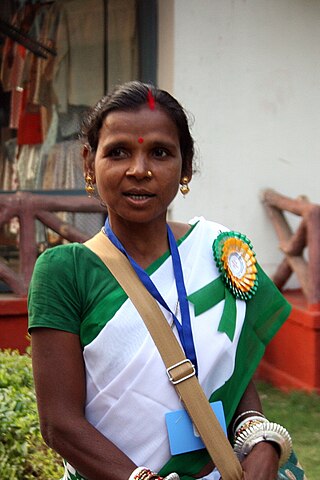
The Ho people are an Austroasiatic Munda ethnic group of India. They call themselves the Ho, Hodoko and Horo, which mean 'human' in their own language. Officially, however, they are mentioned in different subgroups like Kolha, Mundari, Munda, Kol and Kolah in Odisha. They are mostly concentrated in the Kolhan region of Jharkhand and Odisha where they constitute around 10.7% and 7.3% of the total Scheduled Tribe population respectively, as of 2011. With a population of approximately 700,000 in the state in 2001, the Ho are the fourth most numerous Scheduled tribe in Jharkhand after the Santals, Kurukhs, and Mundas. Ho also inhabit adjacent areas in the neighboring states of Odisha, West Bengal and Bihar bringing the total to 806,921 as of 2001. They also live in Bangladesh and Nepal.

Ram Dayal Munda, known as R. D. Munda, was an Indian scholar and regional music exponent. He was awarded the Padma Shri of the year 2010 for his contribution to the field of art.
Usha Kiran Khan is a writer who works in the Hindi and Maithili languages. She is also a retired academic historian.

S. Ballesh Bhajantri is a popular Indian classical Hindustani shehnai player. He is a disciple of shehnai player Ustad Bismillah Khan, he is benares gharana shehnai player and a patiala gharana hindustani vocalist, ghazal singer, Indian playback singer and musician, Ballesh is credited with popularizing the shehnai, a reeded woodwind instrument. He is also a Prasar Bharati's All India Radio (AIR) and Doordarshan artist.

Naheed Abidi is an Indian scholar of Sanskrit and writer. In 2014, she was honoured with Padma Shri, the fourth highest civilian award, for her contributions to the field of literature by the Government of India.
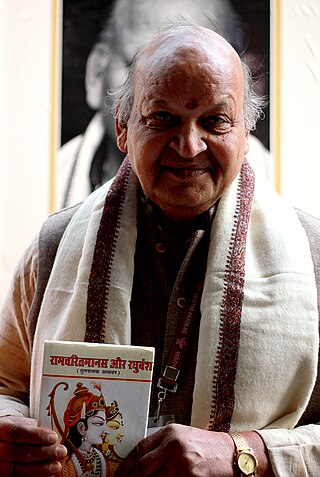
Rama Kant Shukla was an Indian scholar of Sanskrit and Hindi languages. The Government of India honoured him, in 2013, by awarding him the Padma Shri, the fourth highest civilian award, for his contributions to the fields of literature.
Deviprasad Dwivedi is an Indian writer and teacher, known for his scholarship in Sanskrit literature. The Government of India honoured Sharma in 2011, with the fourth highest Indian civilian award of the Padma Shri and followed it up with Padma Bhushan, the third-highest civilian award, in 2017.

Bulu Imam is an environmental activist working for the protection of tribal culture and heritage in Jharkhand. On 12 June 2012, he received the Gandhi International Peace Award, 2011 at the House of Lords in London. He is also a recipient of the Padma Shri (2019). He is the grandson of Syed Hasan Imam, who was a leading Barrister and Judge of Calcutta High Court (1912–1916), and the President of the Indian National Congress. His daughter, Cherry is married to Kunwar Ashish Bir Singh Tekari of Tekari Raj.

Champions of Change (COC) is an Indian award for promoting Indian values like community service, social development, healthcare, education and national unity, selected by constitutional jury members headed by K. G. Balakrishnan, the Former Chief Justice of India and Former Chairman NHRC and Justice Gyan Sudha Misra, Former Judge, Supreme Court of India. The awards are organised annually and usually presented by the President of India, Vice President of India, former President of India, former Vice president of India or any leading political figure of India.

Mukund Nayak, is an Indian artist. He is a folk singer, songwriter and dancer. Nayak is an exponent of Nagpuri folk dance Jhumar. He is recipient of the Padma Shri and Sangeet Natak Akademi Award.
Padma Shri Piyong Temjen Jamir was a noted Hindi scholar and littérateur from Longsa village under Mokokchung district in Nagaland state of India. He was conferred the Padma Sri honour by the President of India, Ram Nath Kovind, in 2018 for the promotion of Hindi language and social work.

Digamber Hansda was an Indian academic and tribal activist who worked for the social and economic advancement of the underprivileged communities in West Bengal, Jharkhand, and Odisha. He was a founding member of the Santhal Sahitya Akademi and was considered a pioneer of Santhali language literature.

Jamuna Tudu is an Indian environmental activist. She and five other women prevented illegal felling of trees near her village and this later expanded into an organisation. She is called ‘Lady Tarzan’ for taking on the Timber mafias and Naxals in Jharkhand.

Vishwamurti Shastri is a Sanskrit scholar with knowledge of Vedic literature and related subjects. He served as a principal of Rashtriya Sanskrit Sansthan, Jammu. He was appointed to Amarnathji Shrine Board (SASB) in 2019. He is director of Shri Mata Vaishno Devi Gurukul, Katra. He also serves as the chairman of J&K Dharmarth Trust Advisory Committee.
Girdhari Ram Gonjhu was a prominent scholar of the Nagpuri language. He was former chairman of the Tribal-Regional Language Department at Ranchi University in state of Jharkhand. He was awarded Padma Shri for his contribution in the field of literature and education in the Jharkhand posthumously in 2022.
References
- ↑ "Padma Shri for 72-year-old Ho language scholar from Jharkhand's Kolhan". The Times of India. 26 January 2023. ISSN 0971-8257 . Retrieved 18 September 2023.
- ↑ Kant, Vishal (26 January 2023). "Jharkhand professor gets Padma Shri for preservation of tribal language Ho". Hindustan Times. Retrieved 18 September 2023.
- ↑ "Padma Awards 2023 announced". www.pib.gov.in. Retrieved 18 September 2023.
- ↑ "Padma Awards". www.padmaawards.gov.in. Retrieved 18 September 2023.
- ↑ "Jamshedpur: Padma Shri for Jharkhand's Ho scholar Dr Janum Singh Soy". The Avenue Mail. 25 January 2023. Retrieved 18 September 2023.
- ↑ "Padma Shri nominee Janum Singh Soy's second novel on Ho tribal language to hit the stands soon". Lagatar English. 27 January 2023. Retrieved 18 September 2023.
- ↑ "Hamare Padma: Dr Janum Singh Soy gets Padma Shri Award for preserving Ho language". YouTube (in Hindi). DD News . Retrieved 18 September 2023.
Ethnicity mentioned between 2:10 to 2:15