You can help expand this article with text translated from the corresponding article in Italian. Click [show] for important translation instructions.
Machine translation, like DeepL or Google Translate, is a useful starting point for translations, but translators must revise errors as necessary and confirm that the translation is accurate, rather than simply copy-pasting machine-translated text into the English Wikipedia.
Consider adding a topic to this template: there are already 351 articles in the main category, and specifying|topic= will aid in categorization.
Do not translate text that appears unreliable or low-quality. If possible, verify the text with references provided in the foreign-language article.
You must provide copyright attribution in the edit summary accompanying your translation by providing an interlanguage link to the source of your translation. A model attribution edit summary is Content in this edit is translated from the existing Italian Wikipedia article at [[:it:Campagna italiana di Suvorov]]; see its history for attribution.
You may also add the template {{Translated|it|Campagna italiana di Suvorov}} to the talk page.
Following the 1798 French invasion of Switzerland, Russia, an ally of the Austrians, sent an army to liberate the Swiss territories occupied by the French, who controlled the Alpine passes to Italy from that country and directly threatened the Habsburg Empire. The allies insisted that the Austro-Russian troops be led by Field Marshal Suvorov, who, however, had fallen into disgrace at home for having criticized Emperor Paul I; the latter therefore decided to rehabilitate him and sent him with 20,000 men to Italy, where the Austrians appointed him Field Marshal of the Holy Roman Empire.[12][13]
Field Marshal Suvorov's participation was decisive: the Russians emerged victorious in the decisive battles, defeating and forcing two French armies to retreat to the hills around Genoa,[14] and causing the collapse of French predominance in Italy. With his Austro-Russian army of 48,500 men (in the vicinity of the Adda River),[15] attacking a strong position in numerical superiority compared to the approximately 27,000–28,000 French available on the Adda, as part of the Army of Italy, Suvorov first forced generals Barthélemy Louis Joseph Schérer and Jean Victor Marie Moreau to abandon the defence of the Adda and retreat westwards; the French evacuated the Milanese area and concentrated the remains of their forces in Alessandria, while the Austro-Russians re-invaded the Cisalpine Republic and entered Milan on 29 April.[13] Meanwhile, the French Army of Naples led by General Étienne Macdonald was approaching from the south, in an attempt to rejoin General Moreau; Suvorov managed to block his path in the Battle of the Trebbia (17–20 June 1799), forcing him to retreat along the coast and reach Genoa, where the forces of General Moreau soon converged, who, having learned of Macdonald's defeat, had also retreated. It was for the Battle of the Trebbia that Suvorov received the title князь Италийский, 'Prince of Italy (Knyaz of Italia)'.[16][17]
Having also occupied Turin and defeated the last French army in the subsequent Battle of Novi, Suvorov remained at a certain point in control of the situation in northern Italy and even decided to march towards France, but the divisions and rivalries of the coalition powers would soon favour a recovery of the revolutionary armies: fearing that Russian influence in Italy would become excessive, the allies, also taking advantage of Paul I's ambitions to present himself as the liberator of Switzerland,[18] obtained that the Tsarist troops interrupted their operations and were redeployed in the Helvetic Republic, leaving the initiative in the peninsula to the Austrians.[19] Suvorov was then ordered to march north, through the St. Gotthard Pass to meet up with the other body of Russian troops just led across the Limmat by General Alexander Mikhailovich Rimsky-Korsakov and then face the army of General André Masséna.[20]
The political and military precursors of the campaign
After the surprising victories of General Napoleon Bonaparte in Italy in 1796–1797 the Austrian Empire had been forced to conclude the Treaty of Campo Formio, following which revolutionary France with its representatives dominated the new sister republics and could further direct its new ambitions towards Switzerland, the Papal States and the Kingdom of Naples,[21][22] aiming to subject the whole Italian peninsula to its influence. At the beginning of 1798 General Louis-Alexandre Berthier occupied Rome and on 15 February the Roman Republic was proclaimed, while Pope Pius VI was taken prisoner and transferred to Siena;[23] at the end of another year, on 23 January 1799, the Neapolitan Republic was proclaimed;[24] at first the Kingdom of Sardinia was spared and the Directory limited itself to installing a French garrison in the citadel of Turin on 27 June 1798,[25] but finally the pretext of war in Naples was used to declare war also on King Charles Emmanuel IV, considered to be conniving with the enemies of the Republic: the kingdom was occupied by French troops and the sovereign Charles Emmanuel IV of Savoy fled to Sardinia.[26] Without giving space to independence currents, the Directory itself had a popular petition voted in February 1799 in favour of the annexation of Piedmont to France.[27]
Great Britain, Austria and Russia, worried by French expansionism, then joined the Second Coalition; the British financed the Russian and Austrian armies with huge capital,[28] but the lack of effective cohesion between the great powers and the persistent conflicts linked to the divergent war objectives weakened the solidity of this alliance from the beginning. The Austrian Chancellor Johann Amadeus von Thugut did not conclude any precise agreement with the allies, however he began vast war preparations and authorised Russian troops to cross Austrian territory: this event triggered the reaction of the Directory, which decided to take the initiative and declare war on Austria on 22 Ventose Year VII (12 March 1799) and also invade Tuscany, chasing out Ferdinand III, Grand Duke of Tuscany.[29]
The opposing armies faced each other on a very wide front that stretched from Bavaria, to Switzerland and up to the former Republic of Venice.[30] The French had mobilised nearly 390,000 soldiers against some 250,000 Austrians, 80,000 Russians and over 20,000 British, but the situation for France was very precarious as the Directory was constantly busy dealing with plots and countering conspiracies aimed at overthrowing it; but above all because its best general, Napoleon Bonaparte, and his most experienced troops were engaged in a daring expedition into Egypt. Hostilities proper began at the end of March when the French General Jean-Baptiste Jourdan decided to attack in Germany while at the same time General Barthélemy Louis Schérer in Italy was moving eastwards towards Verona.[31]
The initial forces in the field in Italy
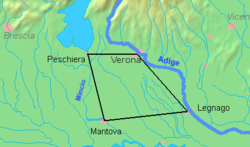
At the beginning of the campaign in 1799, Austria deployed in north-eastern Italy (between the Adige, Verona and Venice), Istria and Illyria about 69,000 infantry, 12,000 cavalry and 3,000 artillerymen for a total of 84,000 men under the command of General Paul Kray von Krajowa,[32] against whom General Barthélemy Louis Schérer, commander-in-chief of the Army of Italy, could oppose six divisions for a maximum of about 46,400 men (57,800–58,000 including garrisons and detached units); but the aforementioned Kray's forces, as is known, were not only located in Italy. In Italy, he had only about 50,700 men, and the Russian corps then had 20,000 men.[2][33] Schérer suffered several reverses: after reaching the Adige River on 26 March, that same day he fought a drawn encounter against the Austrians at Verona and was finally repulsed at Magnano (5 April);[34] to defend the connecting routes to Milan, on 15 April he had to retreat to the left bank of the Adda river, where he was cautiously pursued by General Kray: the French army left garrisons in the fortresses of the "Quadrilateral" (see on a map; Peschiera del Garda, Mantua, Legnago, Verona), between the Mincio, the Po and the Adige. Although the French command still formally remained with Schérer, strategic control passed to General Jean Victor Moreau who organised a "cordon defence" of the Adda line.[35]
The arrival of Field Marshal Suvorov and the beginning of the offensive
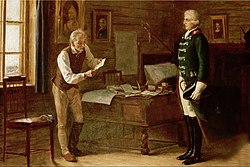
Marshal Suvorov, in exile at Konchanskoye near Veliky Novgorod, receives the imperial order to command the troops in the fight against Napoleone di Buonaparte
Only following the pressing requests of Emperor Francis II of Habsburg-Lorraine and the intrigues of the Moscow ambassador in Vienna Andrey Kirillovich Razumovsky, Emperor Paul I of Russia assigned the command of the allied troops in Italy to Field Marshal Alexander Suvorov, who was particularly disliked by him.[36] A great admirer of Empress Catherine the Great to whom he had always remained faithful and known for his lack of tact and the brusque manners he used even towards the rulers of the time, Field Marshal Suvorov had sarcastically criticised in public the military projects and innovations of the new Emperor which had in fact cancelled out the works of his mother, refusing to apply them with his troops.[37] Regarding Paul I's obsession with imitating the clothing of Frederick the Great's Prussian troops, for example by imposing the typical hairstyles with braided ponytails and curls, the caustic general had publicly blurted out:
"Wig powder is not gunpowder, curls are not cannons, and ponytails are not bayonets!"
Only the great prestige he enjoyed and the importance of the services he rendered to the Russian Empire spared him from deportation to Siberia and procured him only a sort of exile in his estates in Konchanskoye, a village in the countryside east of Veliky Novgorod; it was here that, albeit reluctantly, in February 1799 Paul I sent him the order of reinstatement in the Russian army and entrusted him with the command of the expedition to Italy.[39][40]
On March 25, Suvorov arrived in Vienna, where Francis II welcomed him with all honours and conferred upon him the rank of field marshal of the Austrian armies,[41] and took command of the Russian troops, which numbered about 22,600 men, although the actual strength did not exceed 17,000.[42][43] On April 13, he reached Vicenza and on the 15th Verona[44] whose inhabitants, carried away by enthusiasm, unhooked the horses from his carriage and carried him into the city shouting loudly: "Long live our liberator."[45] On 17 April, General Pyotr Ivanovich Bagration, who had gained Suvorov's esteem during the seventh Russo-Turkish war against the Ottoman Empire (in particular in the Siege of Ochakov) and during the Polish campaign of 1794, also arrived in the city.[46] Faithful to his habits of direct participation in operations on the battlefield, Suvorov personally assumed command of two infantry regiments and two Cossack regiments and ordered Bagration to cross the Mincio to begin the march.[47]
Suvorov, according to his tactical habits, proceeded by forced marches, despite flooded rivers and terrible weather conditions.[48] It is very difficult to provide an average marching speed for infantry in the Napoleonic era, but most contemporary European armies reasonably covered 20 to 30 kilometers (12 to 18 mi) a day; the Austro-Russian army, at whose head General Suvorov constantly rode, almost always proceeded by forced marches, covering more than 50 kilometers (31 mi) on some days.[48] His infantry marched even in temperatures of 35ºC (95°F) and with a total weight of weapons and ammunition that reached 20 kilograms (44 lbs.); it is said that his soldiers once managed to cover 90 kilometers (56 mi) in thirty-six hours. His motto was "The head does not wait for the tail, [it attacks] suddenly, like a bolt from the sky";[47] however many fighters remained behind and the same fate often befell the Austrian troops, inevitably disrupting the cohesion of the Allied forces.[46]
On 19 April the first column, under the command of General Yakov Ivanovich Povalo-Shveikovsky, forded the river near Valeggio sul Mincio and, after a halt on the 20th, on the 21st Suvorov decided to prepare for the offensive.[49] Shveikovsky's troops (29,000 Austrians and 11,000 Russians) then crossed the river Chiese, dividing into three columns and marching towards Brescia in a pincer movement;[50] the second column under the command of General of Division Ivan Ivanovich Förster followed waiting to reach the vanguard. The allied forces were estimated at around 48,500 men. Faced with overwhelming odds, French General Schérer had previously decided to retreat with 28,000 men to more defensible positions,[51] leaving about 1,300 in Peschiera del Garda and 10,000 in Mantua, also abandoning thirty cannons in Crema.[52] Meanwhile, Prince of Hohenzollern crossed the Oglio and captured Cremona.[53] The main army heading for Brescia encountered little resistance and captured the French stronghold under General Bourget on 21 April, defeating the garrison of just 1,100 men after twelve hours of intense artillery fire. Three days later two Cossack regiments entered Bergamo, capturing men and cannons.[54]
The attack on the Adda and the capture of Milan
The disposition of the armies
Troops in the field around April 24, 1799, at the time of the attack on the Adda
On 24 April the main force of the army crossed the Oglio River and the following day Suvorov deployed his forces on the Adda, where the French finally seemed determined to give battle and stop the advance of the Austro-Russian allies. The Russian general divided his forces into three columns along the river: on the right Andrei Rosenberg with 9,000 men and Josef Philipp Vukassovich with 7,000, between Caprino and Brivio, the latter with the aim of restoring the bridge previously destroyed by General Jean-Mathieu-Philibert Sérurier in his retreat[55] and opening the way to Lake Garlate on the route to Lecco;[56] in the centre the divisions of Johann Zopf and Peter Karl Ott von Bátorkéz near Vaprio d'Adda, with 5,000 men each, who were to advance towards Trezzo sull'Adda; finally General Michael von Melas, with 13,000 men on the left wing towards Treviglio, who was ordered to attack the main French position at Cassano d'Adda. Meanwhile Brigadier General Friedrich von Seckendorff occupied Crema with 1,500 men, pursuing the French up to the bridge to Lodi, the Prince of Hohenzollern was stationed at Pizzighettone and the vanguard of General Bagration, with 3,000 men divided into three infantry battalions and three Cossack regiments, was pressing the French near Lecco. Overall, the Austro-Russian allies had fielded approximately 48,500 men.[15]
The French, stationed on the opposite bank waiting for reinforcements and already outnumbered, scattered along the river, further weakening themselves:[57] Sérurier with 8,000 men was to cover the front from Lecco to Trezzo, generals Paul Grenier and Claude-Victor Perrin (with the same number of men) were to hold respectively the front between Vaprio and Villa Pompeiana and the one from Villa to the south of Lodi; Pierre Garnier de Laboissière, stationed on the Po in front of Pizzighettone with 4,000 men, brought the French force to a total of 28,000. Taking advantage of Schérer's incompetence, who scattered his already inferior forces along the river, general Suvorov concentrated the bulk of his forces between Lecco and Cassano with 42,000 Austro-Russians against only 12,000 French.[58] On the 26th Schérer temporarily left the command to General Moreau who would officially and definitively take over the command the following day.[59]
Suvorov's plans called for crossing the Adda in force between Trezzo and Cassano, while Seckendorff (also Seckendorf) and Prince of Hohenzollern would launch two diversionary attacks at Lodi and Pizzighettone. General Bagration, on the other hand, after crossing the river at Lecco, would conduct a rapid encircling manoeuvre to surprise the French from behind using chasseurs and mounted Cossacks. On 26 April the Allies prepared to cross the river in force.[58]
The Allied attack and the assumption of command by General Moreau
At 08:00 General Bagration attacked the outskirts of Lecco, defended by General Soyez with 5,000 soldiers and twelve guns placed in fortified emplacements. After twelve hours of hard fighting, the Russian general, although wounded in the thigh in the assault, managed to take the city while the French retreated on the other side of the Adda, but prevented the Russians from crossing in their turn.[60]
Meanwhile, after Vukassovich had rstored the bridge at Brivio, the Austrian engineer-chief Johann Gabriel Chasteler de Courcelles managed to throw another bridge not far from Trezzo, in a section of the river not manned by the French,[61] allowing Zopf and Ott to cross and surprise generals Grenier and Sérurier at the village of Pozzo d'Adda, take Brigadier General Nicolas Léonard Beker prisoner and force them to split up and retreat, the first towards Vaprio the second towards Verderio.
Suvorov, having realised that it was not possible for Bagration to cross at Lecco, where the republicans had sung victory by singing La Marseillaise,[62] changed strategy and on the 27th moved towards San Gervasio to prepare to cross at Trezzo.[63] In the meantime, having learnt that the French command of the Army of Italy had passed from Schérer to Moreau,[64] he commented as follows (one of the translation options):
"There was little glory in defeating a charlatan [Schérer]; the laurels [of victory] we will wrest from Moreau will be greener."
General Moreau immediately sought to remedy the mistakes of his predecessor: he concentrated his troops and sent Grenier to Vaprio, General Victor to Cassano and marched Laboissière north towards Lodi. Sérurier was ordered to abandon positions at Lecco and Brivio and concentrate his divisions on Trezzo. Reinforcements were recalled from Milan, bringing his effective fighting strength to 27,000 men.[65]
For his part, General Melas, on the left wing, had personally led the assault of three Austrian battalions against the French, who had entrenched themselves behind a bridgehead on the left bank of the Adda near the Ritorto canal (on the road from Treviglio): the Austrian commander, after having repelled them, also overtook the next position that they still maintained at Cassano,[66] after having quickly restored an arch of the bridge over the river that the French had managed to damage.[67] Previously, Moreau had understood that the attack at Brivio had only been a diversion and that the main attack would take place at Trezzo where he had sent Sérurier; to avoid the risk of his being routed, he sent him a new order to hold position at Verderio and, to avoid further dispersing his forces, he ordered Victor to accelerate the march and divert towards Vaprio to join up with Grenier.[68]
The French commander, who was near Cassano, did not have time to effectively reorganise his forces as he found himself attacked simultaneously on the left and in the rear by the Austro-Russians who, led by Marshal Suvorov, had crossed with the bulk of their troops at Trezzo and San Gervasio. Overwhelmed by superior enemy forces, Moreau was forced to fight hard to avoid being surrounded by the enemy's grip;[69][70] Jean Sérurier, left inactive and isolated in Verderio, was instead surrounded by Vukassovich and finally forced to surrender.[71] The French general obtained the condition that the soldiers remained prisoners and that the officers could return to France on solemn promise that they would not fight again during the campaign; It seems that on that occasion Suvorov, convinced of his imminent invasion of France, had told him: "See you in Paris!".
In three days of fighting the French had left on the battlefields about 10,000 men between dead, wounded and prisoners and at least 100 cannons with their gunners. General Moreau had suffered his first defeat in Italy,[72] largely Schérer's fault; Moreau was forced to retreat on 28 April first to Milan (where he left a small garrison of 1,300 men) and then to Turin, retreating in three columns: the right from Lodi to Piacenza, the centre from Pavia to Voghera and the left from Vigevano to the Savoy capital, Turin.[73] Having reached Novara on the 30th, he received with disappointment the news of Sérurier's surrender.[74]
The retreat west of the Ticino by the last French troops inevitably caused the fall of the Cisalpine Republic which had been established on 29 June 1797.[75]
Suvorov's entry into Milan
Field Marshal Suvorov enters Milan at the head of the Austro-Russian forces on 29 April 1799. Painting by Adolf Iosifovich Charlemagne
Milan was only the first of a series of weak garrisons left, often without any tactical plan, in the fortresses of the cities that the French were gradually forced to abandon: "...it is not understood how the French decided to leave so many garrisons in the fortresses of the abandoned towns; it was evident that they would have been forced to capitulate, especially since most of them were not defensible for a long time."[76] In fact, on 29 April, Suvorov made his triumphal entry into the Lombard capital without encountering any resistance, solemnly celebrated by the clergy, welcomed by the ancient magistrate of the General Council of the sixty decurions and applauded by the people, while the members of the Cisalpine Republic who were able to do so fled.[66] The provisional government was entrusted to General Melas in the name of the Emperor Francis II.[77]
Suvorov received praise and congratulations from all the governments of the Second Coalition: in just ten days, exceeding all the most optimistic forecasts, he had marched for almost 100 kilometres (62 mi), crossed five rivers (Chiese, Mella, Oglio, Serio and Adda), repeatedly defeated the French and reconquered Lombardy, even if the fortresses of Peschiera and Mantua were still resisting. The Russian general was then ordered to conquer them, however he did not agree at all, believing that it was much more urgent to give the "coup de grace" to the routed, demoralised and weakened French armies. He was in any case forced to disperse part of his forces to complete the occupation of the former Cisalpine Republic, continuing in the meantime to push General Moreau back towards Piedmont. His impatience to return to the fray was however explicit:[77]
"If I stay another day [in Milan], I'll choke on incense. It's time to get back into action!"
The Russian field marshal's impatience was soon satisfied: while General Moreau was retreating before him, Suvorov received news that General Étienne Jacques Macdonald (aka MacDonald) was coming up from Naples with 40,000 men to help the retreating French troops. Sensing the danger deriving from a possible reunion of the French forces, he decided to move immediately and attack Macdonald before turning again against Moreau: his plan was to march towards Piedmont crossing the Po with the bulk of his forces, defeat the arriving general and then quickly return towards Turin to face Moreau.[78]
Suvorov then sent Vukassovich to the Ticino River near Boffalora while he himself headed for Melegnano with the main army of 44,000 men dividing it into two columns: on the right wing the Russians towards Parpanese, on the left the Austrians towards Lodi and Piacenza with the order to try to advance as far as Parma and the Modena area. In the absence of bridges over the Po at Piacenza and Parpanese, Suvorov decided to cross near Mezzana Corti and Pavia, where he sent his Cossacks under the command of Bagration to occupy the city: the latter arrived there on 3 May and quickly repaired the bridge over the Ticino which he had found damaged.[79] On 4 May the Field Marshal arrived in Pavia and was informed that the French had abandoned Tortona on the Scrivia, so he sent Bagration there to capture the fortress and continue towards Novi Ligure and Gavi. Bagration found that the information was incorrect and that the French actually still occupied the town with at least 4,000 men, but were apparently unable to use their guns due to lack of ammunition. He then received orders to wait for the Commander-in-Chief at Voghera.[80]
On 7 May Rosenberg crossed the Ticino and reached Dorno, while Suvorov left the bulk of his forces and joined Bagration at Voghera. Here the Russian commander reorganised his forces, sending Prince Pyotr to cut French communications between Tortona and Genoa and placing his armies on both banks of the Po, with Rosenberg between Dorno and Lomello, Melas at Castel San Giovanni and Bagration marching towards Pozzolo Formigaro. The previous day Kray had captured Peschiera and moved towards Mantua. General Ott was ordered to station himself between Parma and Modena to observe Macdonald's movements.[81]
At this point in the campaign the Allied soldiers began to suffer from a lack of supplies and the Russians in particular often fought hungry: supplies were the responsibility of the Austrians and the intendants were not always able to organize them properly. This was the cause of friction with the local populations: indeed, on May 3, Bagration, after three days of fasting for his troops, seized the bread supplies by force.
"General Suvorov enjoying a fricassee of French heads." English caricature from 1799.
The French meanwhile were reorganising: Moreau managed to concentrate around 20,000 men between Valenza and Alessandria at the strategic confluence of the Po, the Tanaro and the Bormida, which also gave him a clear tactical advantage. Strategically, Moreau thus controlled the southern part of Piedmont and the main communication routes with the Italian Riviera, he was able to act quickly on both banks of the Po and blocked the access routes to Turin: if Macdonald had arrived in time to attack the allies, he could have engaged them from behind, forcing them to fight on two fronts. Tactically, his flanks were covered by the fortresses of Valenza and Alessandria and, moreover, the northern bank of the river, on which the French were fortified, was in an elevated position compared to the southern one from which Moreau expected to be attacked, granting him a dominant position.
The advance of the Allies continued however. On 10 May Bagration occupied Marengo and at the same time the Austrian general Chasteler attacked the fortress of Tortona, from which the French garrison bombarded the city. Bagration reached Novi and verified that the French garrison had already retreated towards Genoa, leaving large quantities of provisions and as many as 70 wagons of ammunition destined for the main army.[82]
To further complicate the situation of the French troops, the discontent of the local populations was added. Once their initial enthusiasm had worn off, they realised that the revolutionaries, instead of bringing the promised freedom and national glory, had established a permanent state of war for three years, perpetrated outrages against religion, stripped museums, monuments and churches of works of art and caused all kinds of extortion and abuse, appearing more like invaders than liberators: the imminent arrival of the imperial troops was therefore the occasion for many cities and villages to rise up against the French garrisons.[83] Bagration himself informed Suvorov that he had received letters from the city authorities of Oneglia, Asti and Acqui Terme, which described the revolts against the French and offered support to the allied armies.[84]
Between 11 and 12 May Suvorov made his move and, giving credence to initial erroneous information, which said the French were retreating from Valenza, ordered Rosenberg to move from Lomello and cross the Po at Mugarone to attack the French on the left flank.[85] Immediately afterwards, having learned the falsity of the previous news, he ordered him to turn back. Rosenberg however crossed anyway and, having set out towards Bassignana with 10,000 men, chose to head towards an area between Valenza and the Tanaro; in the meantime he had another 4,000 men under the command of General Nikolay Andreyevich Chubarov cross, positioning them on a large river island located near Mugarone.[86]
Chubarov, eager to attack, crossed with all his troops but ran into the French division of Grenier, 4,000 strong, which, coming from Valenza, under the command of General Colli, attacked him on the right flank and inflicted heavy losses, forcing him to retreat in disorder to the islet from which he had just forded, in an extremely chaotic situation with scattered men and immobilized wagons, under constant fire from French rifles and without the possibility of retreating quickly beyond the Po, as the cable to reach the left bank by hand had broken. Nevertheless, the Russian soldiers of Bagration's brigade held their position for eight hours, resisting until after sunset; under cover of darkness all of Rosenberg's troops finally managed to recross the river and march to rejoin Suvorov, leaving behind on the field at least 1,500 men, one general, fifty-eight officers and two guns. The French lamented the loss of 600 men.[87][88]
Suvorov, furious, immediately called Rosenberg to report to him to account for the defeat, threatening him with a court martial; in the meantime he decided to move his headquarters to Castelnuovo Scrivia.[89] Meanwhile, on May 11th, the fortress of Pizzighettone had surrendered after a day of shelling.[9] Contemporary sources tell that, although overwhelmed, Russian cavalry and infantry allowed themselves to be killed in vain even at Bassignana rather than surrender, because Suvorov had the habit of terrorising his men by telling them the macabre and obviously false details of the alleged tortures that the revolutionary republicans inflicted on the soldiers who fell into their hands: the prisoners were stripped naked, tied up, laid on a grill and roasted; or their noses, hands and ears were cut off. A chronicler of the French army reported that 800 Russians preferred to throw themselves into the Po rather than be captured.[90]
By mid-May the Russo-Austrians were firmly established on the southern bank of the Po: Austrian troops at Torre, Förster at Sale, Bagration at Novi with his Russian troops deployed between Scrivia and Bormida in support of Major General Andreas Karaczay at Marengo. Suvorov now had about 36,000 men at his disposal, of whom 17,500 were Russian, not counting Vukassovich's 5,000 men at Boffalora; he had to face only about 25,000 French, who, however, were very well placed because they enjoyed an advantageous position, made even more formidable by the swollen rivers.[91] The Russian field marshal had to admit that he was not in a position to attack them successfully.
I am unable to launch any operation [against Alexandria] due to the lack of boats.
In reality, Moreau was in a difficult situation: the Directory was not able to send him any reinforcements, Bagration was making communications with Genoa very difficult for him and the revolts in Piedmont were threatening the supply routes from France. General Catherine-Dominique de Pérignon, who controlled the passes to the Riviera, was in danger of being easily crushed, causing him to lose not only the last communication route with France,[92] but also with the Apennine Mountains and the army of the approaching Macdonald. Furthermore, he had the problem of bringing home a large number of wagons with the proceeds of the looting of precious works of art stolen in Italy.[93]
The French commander then decided to reinforce General Pérignon with a part of his troops, to protect himself on the left with another contingent and to set out on the road from Turin to Nice by the Col de Tende, crossing Cuneo, preparing to retreat to the Apennines with the ultimate aim, without too much difficulty and at the right moment, of rejoining Macdonald, who at that moment had reached the border with Tuscany. Nevertheless, intelligence reports suggested to Moreau that Rosenberg's failed attempt to cross Bassignana and news of Vukassovich's subsequent bombardment of Casale Monferrato heralded a surge of Suvorov's Russian troops along the Po. He imagined that the Allies were concentrating their forces by moving north, leaving only a few Austrian troops to besiege Tortona, and so decided to take action with a surprise counterattack between the Bormida and Scrivia rivers that would allow him to liberate the fortress and keep open the Bocchetta Pass to Genoa.[94]
Moreau gathered two divisions near Alessandria and on the night of 15-16 May he had a bridge built over the Bormida between Marengo and San Giuliano Vecchio, allowing General Victor's division (5,000 infantry and 2,000 cavalry) to cross it, while Grenier's unit held its position on the river.[95][96] The attack was initially successful and threw Kaim's and Lusignan's troops into disarray as they advanced as far as San Giuliano. There he encountered Fröhlich's division, which had arrived in haste to take command of General Lusignan, and General Bagration's brigade: the two officers commanded a total of eleven battalions and nine squadrons and successfully resisted until they pushed Victor back across the river.[97] Finally Moreau, having spotted other enemy troops rushing from Tortona, understood that his attempt had failed and ordered a general retreat; at 18:00 the last grenadier recrossed the Bormida. The French suffered losses of up to 1,500 men killed, wounded, captured or missing, while the Allied losses amounted to 720 and Suvorov, given the uncertain progress of the day, did not dare to claim his forty-second victory.[98][95]
The capture of Turin
Even if the battle of Marengo had not been decisive, on 18 May Moreau decided to abandon his safe position between Valenza and Alessandria to retreat towards Turin, sending Victor instead southwards towards the western Liguria n coast, in the hope of being able to join Macdonald there; in the meantime he managed to get the stolen works to France through Mont Cenis pass. Suvorov, unaware of these manoeuvres, continued to march on the north bank of the Po towards Turin, moving the base of operations to Candia Lomellina. Politically the hope was to continue to encourage the Piedmontese population to arm themselves and rise up against the revolutionary troops and against the Jacobins, with the promise of the restoration of the Kingdom and the previous order; strategically the allies aimed to occupy the city for its position and the sure capture of a large number of weapons, ammunition and war material.[99] In fact, the Piedmontese armed themselves and attacked the revolutionaries, especially in Canavese and in Carmagnola, and there were regular reports of massacres perpetrated in reprisal by the French against the civilian population.[100]
While the engineers were throwing bridges over the river for a new crossing, Suvorov received the news that Moreau's troops had left Alexandria and sent a division there to occupy it and besiege the fortress which was still garrisoned.[101] At this point Suvorov was perplexed by the continuous "disappearances" of the French troops before his eyes and by his inability to predict their moves: despite having at his disposal a large number of horsemen and scouts, in fact, he was never able to set up an effective espionage service. This was due in part to the poor knowledge of the territory by the Cossacks and their difficulty in interacting with the local populations, in part to the ineptitude of many Russian officers, who did not organize adequate reconnaissance, so that the French often managed to get away undisturbed; finally, Suvorov's own habit of taking every simple rumour as reliable, wasting time and resources, further complicated the situation.[102]
On 22 May the bridges were ready and, based on the information available on the French, the Russian general continued his approach to Turin, under whose walls Bagration and Vukassovich arrived first on the 26th, without encountering any resistance because Moreau had retreated to Cuneo. The French garrison consisted of 3,400 men under the command of General Pascal Antoine Fiorella,[103] overwhelmed by forces ten times superior and strongly disliked by the population. The allies asked for their unconditional surrender but Fiorella refused, preparing to resist until the last man.[104] They then prepared to set up batteries on a nearby hill to bombard the city, while Vukassovich attacked the Porta di Po, 'Po Gate', with his cannons on the night of the 27th. However, the intervention of the armed citizens who had risen up proved decisive. That same night they attacked the French guards at the site and joyfully opened the gate to the allies. The event was repeated at the Porta di Palazzo, 'Palace Gate', and the city was taken with ease. The allies seized 384 cannons, 20,000 muskets and large quantities of gunpowder. Suvorov entered the city at 3 pm, receiving acclamations for himself and for the emperors Paul I and Francis II.[105]
General Fiorella still retained possession of the fortified citadel and, in retaliation against the population, ordered the bombardment of the city, ceasing only after the promise that the garrison would not be attacked.[106] On 18 June, however, the allies stormed it under intense artillery fire and, having forced their way through two breaches in the fortification, forced it to capitulate on the 19th.[107]
Suvorov's entry into the Piedmontese capital was even more solemn and triumphal than in Milan[108] and, as promised, he reconstituted the government in the name of the king of Sardinia, appointing a council with Carlo Thaon di Sant'Andrea as governor, he worked to reorganise the royal regiments by promising an amnesty to the soldiers who had supported the French and had a few hundred patriots who had not had time to escape imprisoned.[109][110] Shortly afterwards he sent for King Charles Emmanuel IV from his exile in Sardinia but his reinstatement on the throne was opposed by the Austrians:[111] this was a precursor of the first frictions between Russia, Austria and the other allied powers on the policy to be applied and the new order to be defined in Northern Italy at the end of the war.[112]
While the Allies had denounced French reprisals in Piedmont against the civilian population, the French stigmatized Suvorov's excessive fury and anti-Jacobin exaltation, which bordered on religious fanaticism with the promise that whoever killed a revolutionary would earn himself paradise. The Piedmontese ended up fearing his power: again according to French sources, he granted to anyone who wanted it the written permission to kill Jacobins (real or presumed) and to plunder their homes and he also imprisoned and flogged simple citizens who were bold enough to denounce the illegalities committed by Cossacks and Austrian knights, "...left without restraint to rage like savages through the fields."[113]
Meanwhile, the forced inactivity was beginning to spread discontent among the Allied troops, sparking dangerous rivalries and triggering recriminations on both sides: the Russians mocked the Austrians for having had to ask for their help without which "...they would have been driven back by the Republicans to Vienna, with blows from the flat of their sabres"; Melas' Austrians remembered the reverses suffered by the Russians at Valenza and San Giuliano at the hands of Moreau: simple mockery was followed by insults, then duels. Only the increasingly insistent news of Macdonald's dangerous arrival gave Suvorov the opportunity to reconcile the Austro-Russians and to once again coordinate their efforts against the common enemy.[114]
Once the French had been driven out of Turin, Suvorov prepared to occupy the rest of Piedmont and above all to protect the passes from France towards the city, sending strong contingents of troops to all the valleys between Mont Cenis and Pinerolo. At the same time he continued to threaten Moreau's positions in order to prevent his possible junction with Macdonald: he therefore occupied Cherasco, Alba and Asti and arranged for detachments to be sent from Alessandria and Tortona up to Cairo Montenotte to close off any possibility of communication with Genoa. Meanwhile, friction continued with the Austrian high command which, worried about Suvorov's successes and a dangerous Russian interference in Italy, began to push for the general to leave the field in Piedmont and return towards Verona to besiege the fortresses of the Quadrilateral. This provoked harsh and angry criticism from Suvorov who, although sending reinforcements to besiege the fortress of Mantua, did not bow to these orders which he considered absurd.[115]
For his part, Moreau had managed to slip through the meshes of the Allied network by crossing the Ellero, had avoided Ceva, had penetrated the Corsaglia valley and then had looked out onto the western coast.[116]
Meanwhile, both sides were receiving reinforcements: with the arrival of General Heinrich von Bellegarde from Switzerland, Suvorov had under his command about 100,000 men including the various garrisons. At the same time, Moreau, having received fresh forces transported by the French navy and arrived by land from the border along the coast, now commanded 26,000 men in Liguria; General Joseph Hélie Désiré Perruquet de Montrichard was stationed on the Apennines as far as Bologna and General Gauthier in Tuscany waiting for Macdonald, who arrived in Florence on 24 May. The latter, having joined his forces with those of Gauthier, encamped in Pistoia and sent a division to occupy Pontremoli, where Moreau had sent Victor as reinforcements, while in the meantime sending La Poype to occupy Bobbio with a mixed Franco-Ligurian division.[117]
The strategies of the two French commanders soon revealed themselves to be different if not contradictory. From the beginning Moreau's intention was to face the Russo-Austrians in a place near the fortresses of Alessandria and Tortona, easily reachable both for those arriving from Liguria through the Bocchetta pass, and for those arriving from Tuscany descending from the Trebbia and Taro valleys: he had therefore established that the best place to join the two armies for the decisive battle was in the vicinity of Voghera.[118] To this end he had instructed Victor to invite Macdonald to descend towards the Trebbia through the Magra valley, while he would stop the allies on the Bormida, would pass Tortona and they would then join up after Bobbio. General Macdonald, however, had a different opinion, as he would have preferred that Moreau himself should go to Pontremoli and descend the Taro valley, while he would have marched towards Modena, reuniting the two armies between Parma and Piacenza: his intention was to take advantage of the great dispersion of the allied forces (a large part engaged in the siege of Mantua, a part with Johann von Klenau between the Ferrara and Bologna areas, another with the Prince of Hohenzollern in the Modena area, Ott on the Apennines, Bellegarde involved in the siege of Tortona and Alessandria, Suvorov still busy in Turin restoring order).[119] They would then have succeeded in cutting the opposing forces in two, which would have had no other solution than to retreat towards Pavia, exposing their right flank, and to push decisively towards the east until they freed Mantua from the siege, recovering what had been lost in Lombardy.[120] The two commanders, however, failed to reach an agreement and acted independently.[121]
The French maneuvers did not escape Suvorov, who prepared to react by gathering thirty-two battalions, eighteen squadrons and four Cossack regiments. On 11 June he marched towards Asti under torrential rain; he then crossed the Tanaro and on the 13th he camped near Alessandria on the banks of the Bormida, after having covered over 90 kilometers in less than three days. The advance had been far too rapid: the Austrians were not able to supply the 30,000 men that the Russian general had brought with him and some of them had to return to Asti.[121]
On June 7, without waiting for Moreau, Macdonald had already moved with the 15,000 men under the command of Olivier and Watrin from Pistoia towards Modena, with on their left Dąbrowski and Victor from Pontremoli towards Reggio Emilia with 3,500 men and on their right Montrichard and Rusca towards Bologna with another 11,000.[122] On June 12, they attacked von Klenau's troops near Bologna, pushing him back to Ferrara. Macdonald then invested the Prince of Hohenzollern near Modena and forced him to take refuge on the opposite bank of the Po, after having inflicted losses of over 2,200 men out of the 4,000 he commanded;[123] Ott also had to withdraw from his positions and retreated towards Alessandria, where Suvorov was located. Macdonald, although wounded in the clash by two sabre thrusts,[124] now threatened the allied troops besieging Mantua.[125] On the 14th he gathered all his forces at Reggio, on the 15th he reached Parma and the following day Piacenza; on the 17th finally he pushed his vanguard up to the Tidone and further pushed back Ott who was between this river and the Trebbia.[126]
Having overcome the initial surprise at Macdonald's lightning-fast actions, Suvorov reacted promptly: having learned the false news that Moreau was about to receive reinforcements for a total of 27,000 soldiers,[127][128] he wanted to concentrate the greatest possible number of troops to annihilate those of Moreau and Macdonald, reducing the number of men engaged in the siege of the fortresses still in French hands; to this end he ordered Ott to head towards Alessandria to reinforce Bellegarde and General Kray to temporarily give up the siege of Mantua (leaving it only to eight squadrons of light cavalry and the garrisons of Legnago, Verona and Peschiera) and move towards Piacenza. This would have guaranteed a reinforcement of 12,000 well-trained men to the troops that were in the Alessandria area and the availability of a mass of about 65,000 men near Tortona.[129] But once again the particular political interests of the Austrians prevailed over Suvorov's strategic decisions: more interested in securing possession of the Italian strongholds than in widening the circle of the Field Marshal's conquests, Emperor Francis II ordered General Kray not to abandon the siege of Mantua under any circumstances. Suvorov therefore had no choice but to march towards Piacenza himself, determined to face Macdonald with the bulk of his forces, pushing his vanguard back beyond the Tidone which on the night of the 17th was now the last natural barrier between the two armies.[130]
The morning of 17 June saw the two generals face each other with about 33,000 men each. Suvorov arranged his army in four columns: two on the left under the command of Melas, with the order to move towards Piacenza, two on the right, composed of the Russian divisions under his direct command, in the direction of Rivalta Trebbia and San Giorgio Piacentino on the Nure torrent; finally he sent about 2,000 men to retake the position on Bobbio. Macdonald, still suffering from the wound received in the fighting at Modena, was closer to the Trebbia than to the Tidone and deployed Olivier on the right towards the Po with Salme's cavalry, Montrichard and Victor in the centre and on the left the Poles of Dąbrowski, with Watrin in reserve.[131] According to some sources, Watrin, Olivier and Montrichard's forces spent that day marching and thus had no opportunity to participate in the main action, thus reducing Macdonald's active forces to 19,000 men. Having crossed the Tidone, the Allies initially found themselves with a considerable numerical advantage and rushed on the enemy's left wing, overwhelming the Poles, before being temporarily stopped by the advancing victory.[132]
Meanwhile, the French retreated first on the right, then in the center; a counterattack by Bagration's Cossacks again on the left finally forced the French to retreat in disarray beyond the Trebbia.[133] As the riverbed was almost dry, the fighting continued long after sunset, and only around 11 p.m. did the commanders manage to put an end to what had been a pointless slaughter.[134][135] The outcome of the first day's fighting had certainly been disadvantageous for the French: their left wing had suffered severely and had been pushed back from the battlefield and pushed back to the right bank of the Trebbia, but in reality it had not been a decisive defeat at all, and not a single gun had been lost.[136] However, Macdonald, suffering from his wounds and feverish, began to believe that Moreau had abandoned him and that this could cause the disaster of the Army of Naples the next day.[137]
Second day
Despite the failure on the Tidone on 17 June and his precarious health conditions, on the 18th Macdonald reorganised himself to attack again, bringing about 22,000 men to the left bank of the Trebbia; Suvorov had however received reinforcements and could count on about the same number.[d] Holding the position in the centre under the fire of the Russian guns, only at 10:00 did Macdonald advance the wings with the intention of pushing the enemy back to the Po and the relief.[138] On the left Dąbrowski and Rusca immediately got the better of Bagration's exhausted troops and forced the Russians to retreat until they took Casaliggio.[139] But the success was only temporary: at 10 pm the Austrians under Dalheim arrived to the aid of the Russians with a large reinforcement, then Rosenberg with light artillery. The Poles resisted strenuously until their legion was cut to pieces, but the losses on the other side were also very heavy.[140]
On the 19th the clash was equally bloody: despite Melas' heavy artillery fire, the French had crossed the Trebbia, attacking Ott and victoriously pressing along the Po with their cavalry against the imperials' extreme left wing, composed of infantry; only the intervention of Prince Louis I of Liechtenstein's cavalry saved the allied left flank from rout, first attacking the French infantry and then stopping its cavalry.[141][142] Although the counterattack of Olivier's light artillery (seriously wounded) succeeded shortly afterwards in throwing the rescuers into confusion,[143] the French infantry did not take advantage of it and, overwhelmed for a second time by the offensive, the revolutionary troops were forced to retreat once again to this side of the Trebbia. In the center, things did not go any better for the French: after the first volleys of rifle fire, they crossed the river and began hand-to-hand fighting with bayonets and sabres, without one side managing to gain the upper hand over the other; the fight was resolved by an Austrian cavalry battalion under the command of Colonel Lownehwer, who attacked the flank of Montrichard's cavalry, disorganizing its ranks and pushing it back across the river. Around 18:00 Suvorov intervened and attacked Victor with impetus, who however managed to retreat in an orderly fashion as far as circumstances allowed.[144]
Macdonald's last hope was General Lapoype who was coming down from Bobbio: he had received the order from Macdonald to join the fighting only at 11:00, but during the late approach march he was surprised by the Russians, previously sent there by Suvorov, and forced to disperse his men on the nearby hills to avoid being captured. At sunset both sides found themselves in the same positions as the night before and with heavy losses: 2,000 dead, at least 7,000 wounded (including two division generals) and over 3,000 soldiers taken prisoner among the French ranks (total casualties amounted to at least 16,000), 5/6,000 dead among the allies and very few prisoners. Macdonald's situation, who had only 10,000 able-bodied men left against Suvorov's over 30,000, was critical.[145]
Macdonald's retreat
Late in the evening of the 19th, Macdonald, under cover of darkness and leaving some volunteers on the banks of the Trebbia to light dozens of fires to make the enemy believe that he was still encamped,[146][147] began to retreat towards the Nure, putting an end to the two days of hard battle on the Trebbia River. He directed a column towards Lucca passing through the Taro valley, another towards Pistoia passing through the Modena area. Only at dawn on the 20th of June did Suvorov notice this and immediately ordered the pursuit:[148]
"Hunt down and annihilate the enemy with cold steel."
—Suvorov's order to the army of June 20, 1799[149]
The Russian field marshal moved the Austrians under Melas towards Piacenza and the Russians under Rosenberg towards San Giorgio. Suvorov himself took part in the pursuit with the light cavalry, forcing half of Victor's brigade to surrender after a further, but useless, resistance. In Piacenza Melas found several thousand wounded French soldiers and captured four generals and 354 officers. Contemporary sources report that Suvorov, having taken lodging in the city at Palazzo Scotti, visited the wounded and dying of both sides who were being treated in precarious conditions in the Basilica of St. Augustine, which had been transformed into a hospital, praising the courage of the defeated, and was initially welcomed by the population with cries of "Long live the victor!"; then annoyed by the citizens' complaints about the harassment and robberies at their expense by the Cossacks, he seems to have allowed the sacking of the city between 23 and 24 June. These crimes and abuses were later effectively covered up by the Austrian authorities.[150]
Only the waters of the overflowing Arda river, which Macdonald had luckily managed to cross, finally stopped the pursuit, allowing him to gather his exhausted forces, divide them into three divisions under the command of Dąbrowski, Montrichard and Watrin and cross the Apennines to take refuge in Tuscany near Lucca, with the intention of then reaching the eastern Ligurian coast and finally rejoining Moreau.[151] On 8 July Macdonald left Lucca with the bulk of his forces, sent the heavy artillery by sea and the light artillery with a mule train towards Genoa and, protected on the Apennines by the troops of Montrichard and Victor, marched towards the Ligurian city where he arrived on 17 July with 14,000 men, who were however in very poor physical and moral conditions.[152]
Meanwhile, Suvorov's generals took Parma, Reggio and Modena, while Bologna would fall on July 30th under Klenau's attack.[153] The battle of the Trebbia, one of the most important of the whole campaign, ended with the total defeat of the republicans.[154]
While Macdonald was busy on the Trebbia, Moreau had not remained inactive and had gathered 14,000 men between Voltaggio and Gavi and organised them into two divisions under the command of Grenier (about 9,500 soldiers) and Grouchy (4,500 men).[155] On 17 June he had marched with Grouchy on the main road to Novi, while Grenier followed a secondary road along the Serravalle Scrivia valley from where on 18 June he had driven out the Austrians. On 19 June he had then advanced towards Tortona and on the 20th he had defeated Bellegarde at Marengo, causing him to lose 3,000 men and pushing him back beyond the Bormida,[156] then he had freed Tortona itself from the siege.[157] At the same time, a courier from Lapoype reached him with the news of Macdonald's defeat and his complete retreat and so Moreau abandoned any remaining hope of being able to rejoin him. In any case, he chose to temporarily remain in his positions to at least try to distract Suvorov's attention and encourage Macdonald's retreat. He would later recall:[158]
"I was convinced that my alleged intention to invade Piedmont would have disturbed Suvorov, because this general, whom I place on the same level as Napoleon, had a poor ability to react promptly to all my diversionary maneuvers"
The French general's predictions were correct: Suvorov in fact left Ott to monitor Macdonald's moves and went back towards Scrivia and Bormida, determined to completely eradicate the threat represented by Moreau:
"Moreau is advancing against Count Bellegarde on the Bormida. I'm going to give him the same treatment I gave Macdonald."
At this point in the campaign the French had lost seven pitched battles, the fortresses of Peschiera and Pizzighettone, Milan, Turin and all of Italy from Naples to Milan. They retained Tortona, Alessandria, Cuneo but above all the fortress of Mantua, conquered two years earlier by General Bonaparte , with a garrison of 10,000 men which at the time represented the only hope of a future reconquest of Northern Italy.
On June 25th Suvorov reached Scrivia, on the 27th he camped on the Orba and occupied Novi and Ovada, he rearranged the siege on Tortona and ordered Bellegarde, in command of about 20,000 men and with 130 pieces of heavy artillery, to begin the siege on Alessandria, garrisoned by General Gardanne with 2,200 French and 400 Cisalpine soldiers; under intense bombardment lasting for days, the latter would surrender only on 22 July with less than 1,000 men surviving. Meanwhile on 26 June Suvorov understood that Moreau had escaped him again and had taken refuge behind the Apennines. The possibility of a decisive pitched battle having faded, he concentrated on the fortress of Mantua and the other enemy garrisons in the territories he occupied.
In reality, Suvorov would have liked to continue the offensive up to Genoa, convinced that the French were no longer capable of effectively opposing his army and that he could also drive them from the Ligurian Riviera and then march towards Nice and Provence. However, the intentions of the Russian commander continued to be thwarted by interference from Vienna: already in a letter dated 21 June, Emperor Francis II had ordered him to stop his advance, ordering him to concentrate instead on the Lombard fortresses. Despite Suvorov's triumphal reports to Vienna on the victories obtained and his advice to march southwards, defeat the weak revolutionary forces and turn towards France, on 10 July he received a sort of ultimatum which prevented him from further using the Austrian armies for any task other than that of reconquering the fortresses still in French hands:
Any further offensive project towards Savoy or the French passes must be abandoned as I had already [previously] ordered (...), I will also not allow, under any circumstances, that any of my troops be employed to liberate Rome and Naples, unless I myself give specific instructions to that effect
—Francis II of Habsburg-Lorraine
The Austrian emperor's aim was clear: to thwart Suvorov's (and Russia's) plans to further his own hegemonic policy in Northern Italy.
The field marshal submitted and increased Kray's besieging forces in Mantua, already 29,000 strong, to 40,000. The Austrian general was also able to avail himself of some of the cannons taken from the Turin arsenal and of a fleet, taken from the French on Lake Garda and sent down from the Mincio specifically to contribute to the bombardments, deploying a total of 600 guns. The bombardment of the French garrison, 11,000 strong began on 10 July and was very intense until the 21st, when Kray again ordered the French to surrender, demonstrating to them that any resistance was now useless, because they could no longer expect any help from Macdonald's armies, now sheltered beyond the Apennines. On July 28, the French commander Foissac-Latour signed the capitulation.
The surrender of Mantua allowed Suvorov to recall Kray with 20,000 men back to the Bormida to give battle to the French. In the meantime, on 5 August he strengthened the siege of the fortress of Tortona and on the 7th he took that of Serravalle, in a strategic position on the Scrivia in order to reach the Apennines via the Bocchetta pass.
Reactions in France and Joubert's dispatch to Italy
The defeat in Italy caused a real political earthquake in France with accusations of treason, insinuations of corruption of the generals, recriminations on the military conduct, suspicions of a lack of revolutionary enthusiasm even in the person of Moreau; public opinion could not understand how the constant and numerous victories of the previous years could have been followed by such a series of stinging defeats. To counter the allies who threatened the very borders of the Republic, the Directory, in what was remembered as the "Coup d'état of 30 Prairial, Year VII", on 18 June 1799, replaced three of its five quinquevirs with the addition of Louis-Jérôme Gohier, Roger Ducos and Jean-François-Auguste Moulin, considered faithful republicans and more tied to the Jacobin party; he resorted to a new compulsory conscription, enlisting 500,000 men; he dismissed all the old army commanders, replacing them with generals deemed capable of continuing the war with greater energy.
General Jean-Baptiste Bernadotte became Minister of War, General Jean-Étienne Championnet was acquitted of charges for his previous conduct in Naples and placed in charge of the 50,000 men foreseen for the Army of the Alps, General Barthélemy Catherine Joubert took over command of the Army of Italy and of the 70,000 men who were to be sent to Genoa, replacing General Moreau who, however, at Joubert's express wish, was to remain with the army as advisor and deputy commander. Finally, General André Masséna was sent to Switzerland with the promise of commanding 90,000 soldiers. In reality, the number of men assigned to the generals for the operations turned out to be significantly lower than that guaranteed and many men turned out to be inexperienced in military practices as well as lacking in training.
General Joubert left Paris on 15 July and arrived in Genoa between 5 and 6 August and, although the number of troops was not as promised by the Directory and their state was in many ways disastrous, he still found himself in command of a considerable number of men: he found in fact the veterans of Moreau, the 13,000 that Macdonald had managed to bring from Tuscany and reinforcements from the Vendée and Brest brought by the French fleet, for a total of about 45,000 soldiers. The army was however lacking in supplies, horses and ammunition; moreover the men had not been paid for months and the desertions would gradually further weaken the revolutionary army. The Directory's orders were peremptory: Joubert had to liberate Tortona and turn left while Championnet would descend from the Alps to attack Turin, the two armies would then have to reunite at Cuneo. Joubert reconfirmed his will to keep Moreau at his side as an advisor and appointed Louis-Gabriel Suchet as chief of staff.
Having learned the news of the fall of Mantua only on 12 August but considering it unfounded, on 13 August General Joubert decided to move immediately. He divided his forces into three columns, crossed the Apennines from the Bocchetta pass, pushed back the first Austro-Russian vanguards of Bellegarde near Acqui, occupied Serravalle and, having reunited his forces, positioned himself firmly in Novi occupying its squares and streets: his centre was protected by the walls of the city itself, on the right wing the 17,000 soldiers of General Laurent de Gouvion Saint-Cyr were defended by the reliefs of Gavi (Monterotondo), on the left the 18,000 of Pérignon by the steep banks of the Lemme torrent; to these forces had to be added the approximately 3,500 men of Miollis stationed on the eastern part of the Ligurian coast. On the other hand, food supplies were scarce and the troops began to suffer from hunger.
Suvorov was initially unaware of the French advance and received only scant information about their incursions on the Scrivia but, after the first reports from Bellegarde, he became convinced that after months of inactivity the French were preparing to face him in a new battle and had therefore managed to lure them to his preferred field, artfully making Bagration's Cossacks retreat right between Tortona and Novi, without engaging the enemy. He himself moved with the bulk of his forces and on the evening of the 14th, on the plain between the Orba and the Scriva, he presented to the surprised Joubert a force of about 50,000 men against the approximately 35,000 French ready for combat, but above all he enjoyed a great superiority in cavalry: 9,000 against 2,000. The Russian commander placed Bellegarde and Kray on the right, the Russian divisions with Bagration and Förster in the center, and Melas on the left.
That same night the French held a council of war to decide whether to give battle or retreat to Genoa. Having ascertained the overwhelming enemy force, generals Saint-Cyr and Pérignon were of the opinion that it was necessary to return to the coast and, as per initial plans, coordinate with Championnet's troops who were to descend from the Alps. Moreau spoke last, observing that the unbridgeable numerical inferiority of the French cavalry compared to the allied one, especially on a flat and large battlefield like the one on which they were about to face the enemy, could transform itself into a total defeat the next day. Joubert, who had sworn to his wife that he would return only victorious or dead, decided to take his time and postpone his decision until the following morning: the result was that on the morning of the 15th the French troops found themselves without clear orders and precise plans for the battle. Suvorov, as was his nature, had had no doubts and during the night he had already arranged his troops to give battle as soon as dawn broke, encouraging his commanders as follows:
"Long live the sword and the bayonet! No disgusting retreats! The front line [of the French] must be annihilated with bayonets, the rest must be dispersed."
—Suvorov orders to the Austrian troops, 14 August 1799
At 05:00 on 15 August, Kray's right wing, with 27,000 men divided into two columns, with Bellegarde on the right and Ott on the left, moved towards the French but was initially repelled twice by General of Division Pérignon. Joubert himself had in the meantime reached the fighting zone to encourage his men but was almost immediately hit in the chest and killed by a rifle ball, fired according to contemporary sources by a Tyrolean hunter, while on horseback, at the head of the troops, he was giving the order to advance. The news of his death was kept secret from the French army; command passed to General Moreau who immediately requested reinforcements from Saint-Cyr and despite a momentary success, for fear of being surrounded, prevented the Austrians from being pursued.
The battle remained balanced at least until 08:00 and almost inactive in the centre and on the other wing. Around 09:00 Suvorov decided to attack with Russian troops the French positions in the centre near Novi, also in order to relieve the pressure on Kray's left, but the three bloody assaults conducted by the ten battalions of Bagration and Mikhail Andreyevich Miloradovich were repelled by the tenacious resistance of the Republicans. In the afternoon, after seven hours of bitter fighting, the allies had still not managed to break through the French lines, until the field marshal gave the order to Melas to abandon his position at Rivalta and assault the right flank of the French, while in the centre Bagration's Cossacks would renew the attack on Novi and Kray would counterattack on the left flank.
This was the decisive moment of the battle: after an initial phase of great uncertainty, during which Suvorov himself feared he was about to be defeated, Melas arrived on the battlefield with his 14,000 men: leaving part of his forces in the centre, he marched on the banks of the Scrivia and managed to outflank the French, taking possession of the camp at Serravalle. Finally, he divided his forces into three columns and attacked them from the front, flank and rear, routing them. In the meantime, Bagration also finally managed to break through, spreading towards Novi, capturing many prisoners and threatening to cut off the French right wing definitively; however, several hundred French formed numerous pockets of resistance, fighting house to house until late at night.
By 6:00 pm Bagration had secured control of the town, while the remnants of the French army fled in disarray, abandoning weapons, cannons and supplies under direct artillery fire. Sources report that during this violent fighting the Russians also killed those who surrendered and took no prisoners. Later, after a vain resistance, Generals of Division Grouchy and Pérignon, Generals of Brigade Louis Partouneaux and Colli and at least 4,000 Frenchmen were wounded and captured. Losses on both sides were later estimated at around 25,000 dead, wounded and prisoners and, as a testimony to the strenuous resistance of the French, the victims were mostly among the Austrian ranks and a higher number among the Russians. The French army had nevertheless suffered a complete defeat: the right wing had been totally dispersed, of the left only scattered groups remained, the commander in chief had been killed and four generals captured; the French left on the field thirty-seven guns and twenty-eight wagons of ammunition and gunpowder, at least 1,500 dead and 8,000 wounded and prisoners, that is between a quarter and a third of the strength.
Moreau's retreat
Moreau had no choice but to order a general retreat, but in the meantime the Prince of Liechtenstein, Louis I, had cut off the escape routes from Novi towards Gavi and only Saint-Cyr managed to retreat in good order towards the impervious paths of Pasturana and Tassarolo. Suvorov wrote:
"The darkness of night hides the enemy's humiliation. But the glory of this victory will shine forever!"
—Suvorov to Paul I
The following day Moreau managed to reorganise the surviving ranks of his army and positioned himself between Millesimo and the Bocchetta. Suvorov would have liked to resume the pursuit of the French, but he could not help but take note of the fact that his troops were totally exhausted and incapable of advancing further; moreover he was worried by the arrival from the Alps of General Championnet, who now threatened his rearguard, even if on the morning of 17 August in Gavi a brief battle took place between the remains of the retreating French army and the Russian vanguard of General Andrei Grigoryevich Rosenberg and 130 Frenchmen were captured. Moreau was then able to take advantage of the halt of the Russian forces and managed to cross the pass in the Apennines undisturbed, returning to the Ligurian coast with the men he had left. The Russian commander then concentrated on taking the fortress of Tortona which, despite a timid relief attempt by Moreau on 7 September, would fall on the 10th of the same month.
↑Strategically and politically, also affected Southern and Central Italy.
↑The instructions of the Hofkriegsrat particularly limited the actions of Suvorov, who was forced to wage a large-scale siege war.[1]
↑Kray was primarily engaged in the siege of Mantua (for a certain time). Without him: 49,097 + an unknown number of Austrian gunners and technicians + 12,000 reinforcements from Tyrol[3]
Duffy, Christopher (1999). Eagles over the Alps: Suvorov in Italy and Switzerland, 1799. Chicago, Ill.: Emperor's Press. ISBN1-883476-18-6. OCLC42694091.
Mikhailovsky-Danilevsky, Alexander; Miliutin, Dmitri (1852). Istoriia voiny Rossii s Frantsiei v 1799 godu (in Russian). St. Petersburg: Tipografiia Shtaba voenno-uchebnykh zavedenii.
Orlov, Nikolaj Aleksandrovič (1892). Suvorov: Razbor voennych dejstvij Suvorova v Italii v 1799 godu (in Russian). St. Petersburg: Trenke i Fjusno.
This page is based on this Wikipedia article Text is available under the CC BY-SA 4.0 license; additional terms may apply. Images, videos and audio are available under their respective licenses.


 Barthélemy Louis Joseph Schérer
  Alexander Suvorov
  Paul Kray