Ampullariidae belongs to the superfamily Ampullarioidea and is also its type family.[4] According to the current classification accepted by WoRMS, it comprises two well-established subfamilies: Ampullariinae (5 genera) and Pomaceinae (4 genera). The six extinct genera of Ampullariidae still have an undefined position within the family (Ampullariidae incertae sedis, meaning "of uncertain placement") as of 2026.[5] The sister group of Ampullariidae has not yet been clearly identified as of 2009.[1]
Genera
The following cladogram proposed by Jørgensen and colleagues in 2008 shows phylogenic relations of 6 genera belonging to Ampullariidae:[6]
EffusaJousseaume, 1889: synonym of PomaceaPerry, 1810 (junior synonym)
PomellaGray, 1847: synonym of PomaceaPerry, 1810
AmpullariaLamarck, 1799: synonym of PilaRöding, 1798
AmpullariusMontfort, 1810: synonym of PilaRöding, 1798 (invalid: unjustified emendation of Ampullaria)
Ampulloidead'Orbigny, 1841: synonym of Asolened'Orbigny, 1838 (unnecessary substitute name for Asolene)
† AmpullopsisRepelin, 1902: synonym of PilaRöding, 1798 (junior subjective synonym)
CeratodesGuilding, 1828: synonym of Marisa (gastropod)Gray, 1824 (junior objective synonym of Marisa)
Subfamily Lanistinae Starobogatov, 1983: synonym of Ampullariidae Gray, 1824
LeroyaGrandidier, 1887: synonym of LanistesMontfort, 1810
LimnopomusDall, 1904: synonym of PomaceaPerry, 1810
MeladomusSwainson, 1840: synonym of LanistesMontfort, 1810
PachychilusPhilippi, 1851: synonym of PilaRöding, 1798 (unjustified emendation of Pachylabra)
PachylabraSwainson, 1840: synonym of PilaRöding, 1798 (unnecessary nom. nov. pro PachystomaGuilding, 1828)
PachystomaGuilding, 1828: synonym of PilaRöding, 1798
PomusGray, 1847: synonym of PilaRöding, 1798
Tribe Sauleini Berthold, 1991: synonym of Ampullariidae Gray, 1824
TurbinicolaAnnandale & Prashad, 1921: synonym of PilaRöding, 1798
Origin and Distribution
Ampullariidae are probably of Gondwanan origin, and the diversification of Ampullariidae probably started after the separation of the African and South Americancontinental plates. The genera Asolene, Felipponea, Marisa, and Pomacea are New World genera that are native to South America, Central America, the West Indies and the Southern United States. The genera Afropomus, Lanistes, and Saulea are found in Africa. The genus Pila is native to both Africa and Asia.[1]
Ecology
Apple snails are exceptionally well adapted to tropical regions characterized by periods of drought alternating with periods of high rainfall. This adaptation is reflected in their life style; they are moderately amphibious.[7] They have an operculum which enables the snail to seal the shell entrance to prevent drying out while they are buried in the mud during dry periods.[8]
One of the more typical adaptations of apple snails is branchial respiration. The snail has a system comparable to the gills of a fish (at the right side of the snail body) to breathe under water as well as a lung (at the left side of the body) to respire air. This lung/gill combination expands the action radius of the snail in search for food.[9] Many species in this family are filter feeders that use a specialized mucus net to trap phytoplankton and detritus from the water column, consuming the particles suspended in the water.
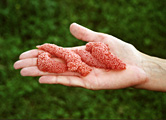
Several apple snail genera (Pomacea, Pila and Asolene/Pomella) deposit eggs above the waterline in calcareous clutches that can be recognized by their light pink color.[10] This strategy protects the eggs against predation by fish and other aquatic inhabitants. Another anti-predator adaptation in the apple snail genera Pomacea and Pila is the tubular siphon, used to breathe air while submerged, reducing vulnerability to attacking birds. The apple snail's usual enemies are the birds limpkin and snail kite.[11]
Apple snails inhabit various ecosystems: ponds, swamps and rivers. Although they occasionally leave the water, they spend most of their time under water. Unlike the pulmonate snail families, apple snails are not hermaphroditic, but gonochoristic; i.e. they have separate sexes.[12]
Apple snails are popular aquarium pets because of their attractive appearance and size.[citation needed] When properly cared for,[clarification needed] some apple snail species can reach 15cm (5.9in) diameter.[citation needed] Apple snails include species that are the biggest living freshwater snails on Earth.
The most common apple snail in aquarium shops[citation needed] are Pomacea bridgesii and Pomacea diffusa, (both called mystery snails or spike-topped apple snails, among other things). These species come in different colours from brown to albino or yellow and even blue, purple, pink, and jade, with or without banding. Another common apple snail is Pomacea canaliculata; this snail is bigger, rounder and is more likely to eat aquatic plants, which makes it less suitable for most aquaria.[citation needed] This species can also have different shell and body colours. The "giant ramshorn snail" (Marisa cornuarietis) although not always recognized as an apple snail due to its discoidal shape, is also a popular aquatic pet.[citation needed] Occasionally, the Florida apple snail (Pomacea paludosa) is found in the aquarium trade and these are often collected in the wild from ditches and ponds in Florida.[citation needed] The giant Pomacea maculata is rarely used as an aquarium species.[citation needed]
Apple snails are often sold under the name "golden (ivory, blue, black...) mystery snail" and they are given incorrect names like Ampullarius for the genus instead of Pomacea and wrong species names like gigas instead of maculata.[citation needed]
Temperature
The optimal aquarium water temperature for apple snails is between 18 and 28°C (64 and 82°F).[citation needed] Apple snails are more active and lively in the higher part of this temperature range. In these higher temperatures, the snails tend to eat, crawl and grow faster.[citation needed] At the lower end of the temperature range, 18°C or 64°F, the snails may become inactive.[citation needed]
As a pest
In the 1980s, Pomacea canaliculata was introduced in Taiwan to start an escargot industry.[13] It was thought that such food culture could provide valuable proteins for farmers, who primarily live on a rice diet. However, the snails did not become a culinary success. Additionally, the imported snails (like the native apple snail population, Pila) were able to transfer a parasite called Angiostrongylus cantonensis (rat lungworm). This parasite can infect humans if snails are eaten that have not been thoroughly cooked first.
Instead of becoming a valuable food source, the introduced snails escaped and became a serious threat to rice production and the native ecosystems. During the 1980s the introduced snails rapidly spread to Indonesia, Thailand, Cambodia,[14]Hong Kong, southern China, Japan and the Philippines.
Hawaii experienced the same introduction of Pomacea for culinary purposes, and its taro industry is now suffering because of it.
Genera Marisa, Pila and Pomacea (except Pomacea diffusa and native Pomacea paludosa) are already established in the US, and are considered to represent a potentially serious threat as a pest which could negatively affect agriculture, human health or commerce. Therefore, it has been suggested that these genera be given top national quarantine significance in the US.[15]
Nevertheless, apple snails are considered a delicacy in several regions of the world, and they are often sold in East and Pacific Asian markets for consumption.
As a bio-control agent
Pomacea and Marisa species have been introduced to Africa and Asia in an attempt to control other medically problematic snails in the family Planorbidae: Bulinus species and Biomphalaria species, which serve as intermediate hosts for trematodaparasites.[16] These parasites can cause swimmers itch and schistosomiasis, a disease that affects over 200 million people in tropical regions. One of the species introduced as bio-agent is Marisa cornuarietis; this snail competes with other snails and also directly preys on other species.[citation needed]
As food
In Veracruz, Mexico, there is a subspecies of apple snail known as Pomacea patula catemacensis Baker, 1922. This subspecies is endemic to Lake Catemaco.[17] This large snail is locally known as "tegogolo" and is prized as a nutritious food item, with approximately 12 grams of protein per 100 grams of apple snail flesh according to the apple snail nutritional information. They are also low in fat and high in minerals and are considered an aphrodisiac. Only wild or specifically cultured apple snails are fit for human consumption; those found in domestic aquaria may be unsuitable.[citation needed]
↑Jørgensen A., Kristensen T. K. & Madsen H. (2008). "A molecular phylogeny of apple snails (Gastropoda, Caenogastropoda, Ampullariidae) with an emphasis on African species". Zoologica Scripta37(3): 245–252. doi:10.1111/j.1463-6409.2007.00322.x.
↑Albrecht, E. A., N. B. Carreno, and A. Castro-Vazquez. "A quantitative study of copulation and spawning in the South American apple-snail." Veliger 39.2 (1996): 142–147.
↑Jahn G. C.; Pheng S.; Khiev B.; Pol C. (1998). "Pest potential of the golden apple snail in Cambodia". Cambodian Journal of Agriculture. 1: 34–35.
↑Cowie R. H., Dillon R. T., Robinson D. G. & Smith J. W. (2009). "Alien non-marine snails and slugs of priority quarantine importance in the United States: A preliminary risk assessment". American Malacological Bulletin27: 113–132. PDFArchived 16 June 2016 at the Wayback Machine .
↑Ruiz-Ramírez, Rafael; Espinosa-Chávez, Félix; Martínez-Jerónimo, Fernando (2007). "Growth and Reproduction of Pomacea patula catemacensis Baker, 1922 (Gastropoda: Ampullariidae) When Fed Calothrix sp. (Cyanobacteria)". Journal of the World Aquaculture Society. 36 (1): 87–95. doi:10.1111/j.1749-7345.2005.tb00134.x.
Further reading
Baldia JP, Pantastico JB (1991). "Environmental impact of the golden snail (Pomacea sp.) on rice farming systems in the Philippines". Wallaceana. 65: 14–6.
Bieler R (1993). "Book Review (Vergleichende anatomie ... Berthold, T, 1991) and Cladistic Re-analysis". The Veliger. 36 (3): 291–7.
Cazzaniga NJ (April 2002). "Old species and new concepts in the taxonomy of Pomacea (Gastropoda: Ampullariidae)". Biocell. 26 (1): 71–81. PMID12058383.
This page is based on this Wikipedia article Text is available under the CC BY-SA 4.0 license; additional terms may apply. Images, videos and audio are available under their respective licenses.