Disputatio nova contra mulieres, qua probatur eas homines non esse (English translation: A new argument against women, in which it is demonstrated that they are not human beings) is a satirical misogynistic Latin-language treatise first published in 1595 and subsequently reprinted several times, particularly throughout the 17th and 18th centuries. Disputatio was written anonymously, although it has been attributed to Valens Acidalius, a 16th-century German critic.
Despite the fact that the treatise was meant to parody the Socinian Anabaptist belief that Jesus of Nazareth was not divine, it has also been "used as a serious text to pour ridicule on women". [1] Disputatio proved to be unusually provocative in its time for a publication of its size, which eventually led to the Catholic Holy See listing the manuscript in its Index Librorum Prohibitorum (List of Prohibited Books) on multiple occasions.
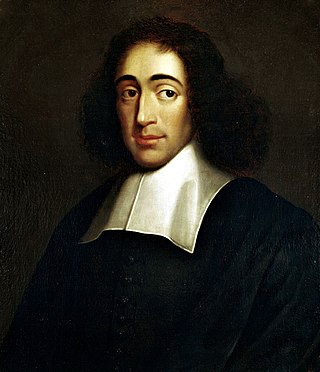
Baruch (de) Spinoza, also known under his Latinized pen name Benedictus de Spinoza, was a Dutch-Jewish philosopher. As a forerunner of the Age of Reason, Spinoza significantly influenced modern biblical criticism, 17th-century Rationalism, and contemporary conceptions of the self and the universe, establishing himself as one of the most important and radical philosophers of the early modern period. He was influenced by Stoicism, Maimonides, Niccolò Machiavelli, René Descartes, Thomas Hobbes, and a variety of heterodox Christian thinkers of his day.
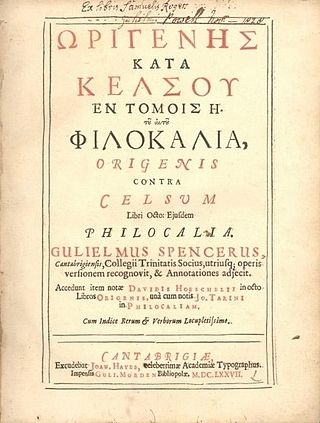
Celsus was a 2nd-century Greek philosopher and opponent of early Christianity. His literary work, The True Word, survives exclusively in quotations from it in Contra Celsum, a refutation written in 248 by Origen of Alexandria. The True Word is the earliest known comprehensive criticism of Christianity.
Valens Acidalius, also known as Valtin Havekenthal, was a German critic and poet writing in the Latin language.

Richard Rolle was an English hermit, mystic, and religious writer. He is also known as Richard Rolle of Hampole or de Hampole, since at the end of his life he lived near a Cistercian nunnery in Hampole, now in South Yorkshire. In the words of Nicholas Watson, scholarly research has shown that "[d]uring the fifteenth century he was one of the most widely read of English writers, whose works survive in nearly four hundred English ... and at least seventy Continental manuscripts, almost all written between 1390 and 1500." In many ways, he can be considered the first English author, insofar as his vernacular works were widely considered to have considerable religious authority and influence soon after his death, and for centuries afterwards.

Angelus Silesius, OFM, born Johann Scheffler, was a German Catholic priest, physician, mystic and religious poet. Born and raised a Lutheran, he began to read the works of medieval mystics while studying in the Netherlands and became acquainted with the works of the German mystic Jacob Böhme through Böhme's friend, Abraham von Franckenberg. Silesius's display of his mystic beliefs caused tension with Lutheran authorities and led to his eventual conversion to Catholicism in 1653, wherein he adopted the name Angelus and the epithet Silesius ("Silesian"). He took holy orders under the Franciscans and was ordained a priest in 1661. Ten years later, in 1671, he retired to a Jesuit house where he remained for the rest of his life.
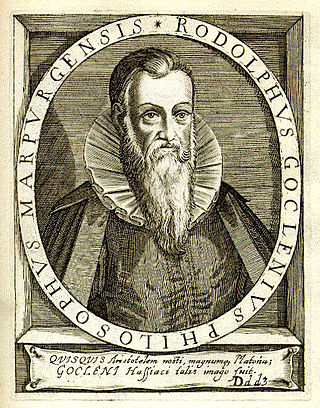
Rudolph Goclenius the Elder was a German scholastic philosopher. Gockel is often credited with coining the term psychology in 1590, though the term had been used by Marko Marulić at least 66 years earlier. Gockel had extensive backing, and made significant contributions to the field of ontology. He extended the development of many ideas from Aristotle. Several of Gockel's ideas were published and built upon by later philosophers.
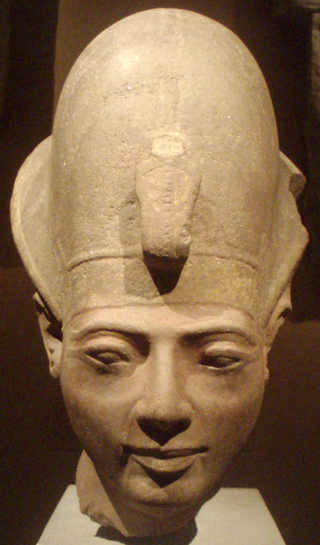
Amenmesse was the fifth pharaoh of the Nineteenth Dynasty in Ancient Egypt, possibly the son of Merneptah and Queen Takhat. Others consider him to be one of the innumerable sons of Ramesses II. Very little is known about this pharaoh, who ruled Egypt for only three to four years. Various Egyptologists date his reign between 1202 BC–1199 BC or 1203 BC–1200 BC with others giving an accession date of 1200 BC. Amenmesse means "born of or fashioned by Amun" in Egyptian. Additionally, his nomen can be found with the epithet Heqa-waset, which means "Ruler of Thebes". His royal name was Menmire Setepenre.
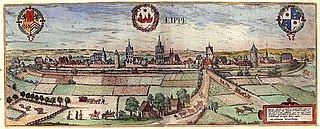
Anton Praetorius was a German Calvinist pastor who spoke out against the persecution of witches and against torture.
A porism is a mathematical proposition or corollary. It has been used to refer to a direct consequence of a proof, analogous to how a corollary refers to a direct consequence of a theorem. In modern usage, it is a relationship that holds for an infinite range of values but only if a certain condition is assumed, such as Steiner's porism. The term originates from three books of Euclid that have been lost. A proposition may not have been proven, so a porism may not be a theorem or true.
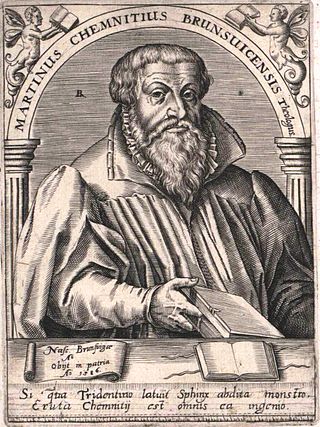
Martin Chemnitz was an eminent second-generation German, Evangelical Lutheran, Christian theologian, and a Protestant reformer, churchman, and confessor. In the Evangelical Lutheran tradition he is known as Alter Martinus, the "Second Martin": Si Martinus non fuisset, Martinus vix stetisset goes a common saying concerning him. He is listed and remembered in the Calendar of Saints and Commemorations in the Liturgical Church Year as a pastor and confessor by both the Evangelical Lutheran Church in America and Lutheran Church–Missouri Synod.

Heinrich Khunrath, or Dr. Henricus Khunrath as he was also called, was a German physician, hermetic philosopher, and alchemist. Frances Yates considered him to be a link between the philosophy of John Dee and Rosicrucianism. His name, in the spelling "Henricus Künraht" was used as a pseudonym for the 1670 publisher of the Tractatus Theologico-Politicus of Baruch Spinoza.
Summa and its diminutive summula was a medieval didactics literary genre written in Latin, born during the 12th century, and popularized in 13th century Europe. In its simplest sense, they might be considered texts that 'sum up' knowledge in a field, such as the compendiums of theology, philosophy and canon law. Their function during the Middle Ages was largely as manuals or handbooks of necessary knowledge used by individuals who would not advance their studies any further.

Anarchism in Mexico, the anarchist movement in Mexico, extends from Plotino Rhodakanaty's organization of peasant workers in the 1890s, to Ricardo Flores Magón's activism prior to the Mexican Revolution, to the punk subcultures of the 1990s.
Hervaeus Natalis, also known as de Nédellec, was a Dominican theologian, the 14th Master of the Dominicans, and the author of a number of works on philosophy and theology. His many writings include the Summa Totius Logicae, an opusculum once attributed to Thomas Aquinas.

Matthias Joseph Scheeben was a German Catholic theological writer and mystic. "The generations that followed Scheeben regarded him as one of the greatest minds of modern Catholic theology."

Hans Lipps was a German phenomenological and existentialist philosopher.
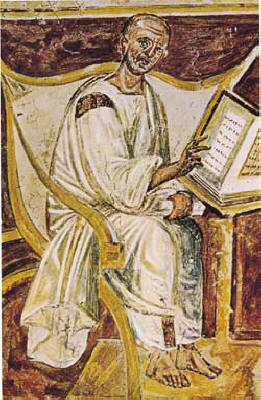
In the Gaulish language, Dusios was a divine being among the continental Celts who was identified with the god Pan of ancient Greek religion and with the gods Faunus, Inuus, Silvanus, and Incubus of ancient Roman religion. Like these deities, he might be seen as multiple in nature, and referred to in the plural (dusioi), most commonly in Latin as dusii. Although the Celtic Dusios is not described in late-antique sources independently of Greek and Roman deities, the common functionality of the others lay in their ability to impregnate animals and women, often by surprise or force. Dusii continue to play a role in the magico-religious belief systems of Gaul and Francia as a type of incubus in early-medieval paganism and Christianity.
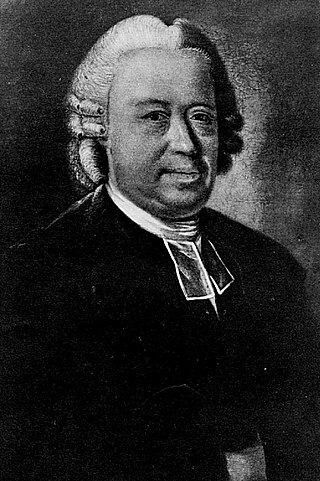
Christian Wilhelm Franz Walch was a protestant German theologian and professor of theology from Göttingen. He authored numerous books.

Maria Gaetana Agnesi was an Italian mathematician, philosopher, theologian, and humanitarian. She was the first woman to write a mathematics handbook and the first woman appointed as a mathematics professor at a university.
Christian Heinrich Erndel was a Royal Polish and Electoral Saxon Personal Physician of August the Strong. He was also a botanist and meteorologist in Dresden and Warsaw.
| Bible (Scriptures) | |||||||||
|---|---|---|---|---|---|---|---|---|---|
| Foundations | |||||||||
| History (timeline) (spread) |
| ||||||||
| Denominations (list, members) |
| ||||||||
| Theology | |||||||||
| Philosophy | |||||||||
| Other features |
| ||||||||
 | This article about a manuscript is a stub. You can help Wikipedia by expanding it. |


