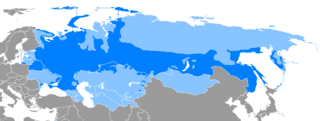
Russian is an East Slavic language, which is official in the Russian Federation, Belarus, Kazakhstan and Kyrgyzstan, as well as being widely used throughout Eastern Europe, the Baltic states, the Caucasus and Central Asia. It was the de facto language of the Soviet Union until its dissolution on 25 December 1991. Although, nowadays, nearly three decades after the breakup of the Soviet Union, Russian is used in official capacity or in public life in all the post-Soviet nation-states, as well as in Israel and Mongolia, the rise of state-specific varieties of this language tends to be strongly denied in Russia, in line with the Russian World ideology.
Old Style (O.S.) and New Style (N.S.) are terms sometimes used with dates to indicate that the calendar convention used at the time described is different from that in use at the time the document was being written. There were two calendar changes in Great Britain and its colonies, which may sometimes complicate matters: the first was to change the start of the year from Lady Day to 1 January; the second was to discard the Julian calendar in favour of the Gregorian calendar. Closely related is the custom of dual dating, where writers gave two consecutive years to reflect differences in the starting date of the year, or to include both the Julian and Gregorian dates.
A navigator is the person on board a ship or aircraft responsible for its navigation. The navigator's primary responsibility is to be aware of ship or aircraft position at all times. Responsibilities include planning the journey, advising the ship's captain or aircraft commander of estimated timing to destinations while en route, and ensuring hazards are avoided. The navigator is in charge of maintaining the aircraft or ship's nautical charts, nautical publications, and navigational equipment, and he/she generally has responsibility for meteorological equipment and communications. With the advent of GPS, the effort required to accurately determine one's position has decreased by orders of magnitude, so the entire field has experienced a revolutionary transition since the 1990s with traditional navigation tasks being used less frequently.
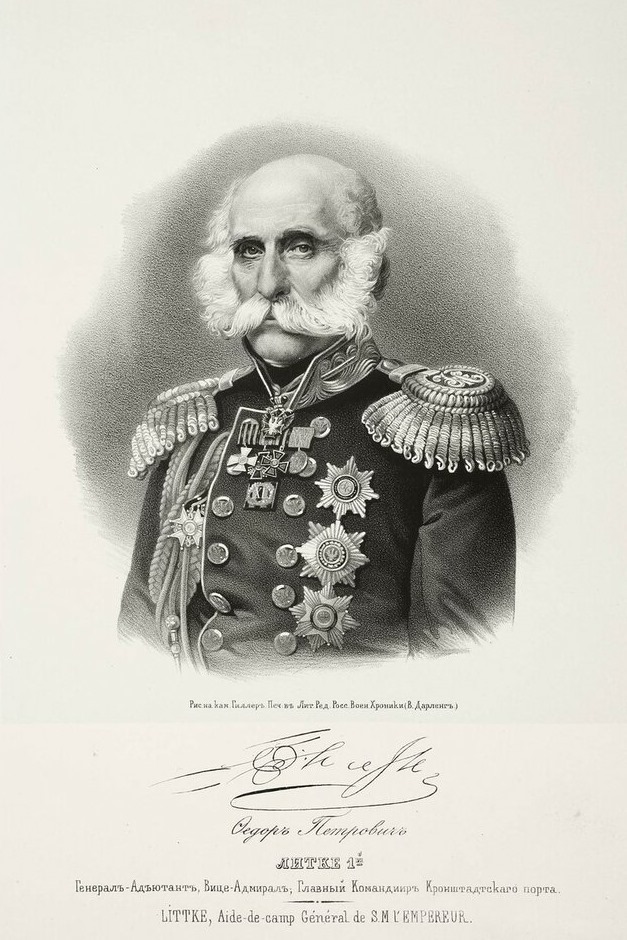
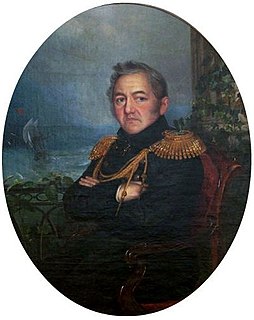
Count Lütke (Russified in Fyodor or Fedor Litke) came from a family of Baltic Germans. Count Lütke’s grandfather was Johann F. von Lütke, a German Lutheran preacher and writer on physical science and theology. In 1745, Johann von Lütke went from Germany to Moscow as pastor of a Lutheran parish in order to spread Protestantism to Russia and Baltic provinces. As a youth, Friedrich attended a Lutheran German-speaking school. His maternal language was German and he always spoke Russian with a German accent. He remained a practicing Lutheran.
A book, in English, about Count Lütke, published in 1996 by The University of Alaska, entitled Fedor Petrovich Litke by A.I. Alekseev, ISBN0-912006-86-2, is a 262-page biography of this 19th-century Russian scientist. This book was originally published in Russian in Moscow in 1970.
The International Standard Book Number (ISBN) is a numeric commercial book identifier which is intended to be unique. Publishers purchase ISBNs from an affiliate of the International ISBN Agency.
The Imperial Russian Navy was the navy of the Russian Empire. It was formally established in 1696 and lasted until being dissolved during the February Revolution of 1917. It developed from a smaller force that had existed prior to Czar Peter the Great's founding the regular Russian Navy during the Second Azov campaign. It was expanded in the second half of the 18th century and by the early part of the 19th century, it reached its peak strength, behind only the British and French fleets in terms of size.
Vasily Mikhailovich Golovnin 19 April [O.S. 8 April] 1776, Gulyniki, Ryazan Oblast, Russia 11 July [O.S. 29 June] 1831, Saint Petersburg, Russia, was a Russian navigator, Vice Admiral, and corresponding member of the Russian Academy of Sciences (1818).
Exploration is the act of searching for the purpose of discovery of information or resources. Exploration occurs in all non-sessile animal species, including humans. In human history, its most dramatic rise was during the Age of Discovery when European explorers sailed and charted much of the rest of the world for a variety of reasons. Since then, major explorations after the Age of Discovery have occurred for reasons mostly aimed at information discovery.
During this voyage he described the western coastline of the Bering Sea, the Bonin Islands off Japan, and the Carolines, although he discovered only one new island (Eauripik, the expedition is noted for having visited every inhabited island in the Caroline Islands (with the exception of Yap) and for compiling an extensive ethnographic account. In particular, the expedition spent three weeks in the Nomoi Islands, which had been last visited by Pedro Quiros in 1565. The team collected over 8000 plant, animal and mineral samples.[2]
The Bering Sea is a marginal sea of the Pacific Ocean. It comprises a deep water basin, which then rises through a narrow slope into the shallower water above the continental shelves.
The Bonin Islands, also known as the Ogasawara Islands, or, Yslas del Arzobispo, are an archipelago of over 30 subtropical and tropical islands, some 1,000 kilometres directly south of Tokyo, Japan. The name "Bonin Islands" comes from the Japanese word bunin, meaning "no people" or "uninhabited". The only inhabited islands of the group are Chichijima (父島), the seat of the municipal government, and Hahajima (母島).
Japan is an island country in East Asia. Located in the Pacific Ocean, it lies off the eastern coast of the Asian continent and stretches from the Sea of Okhotsk in the north to the East China Sea and the Philippine Sea in the south.
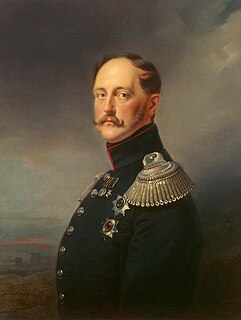
Nicholas I reigned as Emperor of Russia from 1825 until 1855. He was also the King of Poland and Grand Duke of Finland. He has become best known as a political conservative whose reign was marked by geographical expansion, repression of dissent, economic stagnation, poor administrative policies, a corrupt bureaucracy, and frequent wars that culminated in Russia's defeat in the Crimean War of 1853–56. Nicholas had a happy marriage that produced a large family; seven children survived childhood. His biographer Nicholas V. Riasanovsky says that Nicholas displayed determination, singleness of purpose, and an iron will, along with a powerful sense of duty and a dedication to very hard work. He saw himself as a soldier—a junior officer totally consumed by spit and polish. A handsome man, he was highly nervous and aggressive. Trained as an engineer, he was a stickler for minute detail. In his public persona, says Riasanovsky, "Nicholas I came to represent autocracy personified: infinitely majestic, determined and powerful, hard as stone, and relentless as fate." He was the younger brother of his predecessor, Alexander I. Nicholas inherited his brother's throne despite the failed Decembrist revolt against him and went on to become the most reactionary of all Russian leaders.
Lütke was the first one to come up with the idea of a recording tide measurer (1839). They were built and installed along the coastlines of the Arctic Ocean and the Pacific Ocean in 1841. Lütke was one of the organizers of the Russian Geographic Society and its president in 1845–1850 and 1857–1872. He was appointed Chairman of the Naval Scientific Committee in 1846. Lütke was a commander-in-chief and a military governor of the ports of Reval (today's Tallinn) and later Kronstadt in 1850–1857. In 1855, Litke became a member of the Russian State Council (Государственный совет in Russian; a legislative entity that predated the Duma, which came into existence only in 1906).
A tide gauge is a device for measuring the change in sea level relative to a vertical datum.
The Arctic Ocean is the smallest and shallowest of the world's five major oceans. The International Hydrographic Organization (IHO) recognizes it as an ocean, although some oceanographers call it the Arctic Mediterranean Sea or simply the Arctic Sea, classifying it a mediterranean sea or an estuary of the Atlantic Ocean. It is also seen as the northernmost part of the all-encompassing World Ocean.
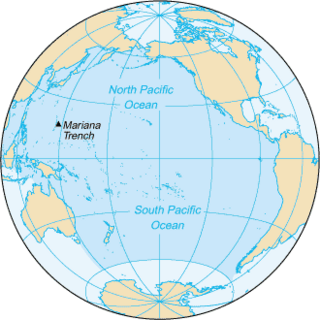
The Pacific Ocean is the largest and deepest of Earth's oceanic divisions. It extends from the Arctic Ocean in the north to the Southern Ocean in the south and is bounded by Asia and Australia in the west and the Americas in the east.
After finally returning to Kronstadt Litke published a 3-volume account of his explorations with atlases in Russian and in French, the latter being published in Paris and entitled Voyage autour du monde,: exécuté par ordre de sa majesté l’empereur Nicolas Ier, sur la corvette Le Séniavine, dans les années 1826, 1827, 1828 et 1829, par Frédéric Lutké, ... commandant de l’expédition. Partie historique, avec un atlas, litographié d’après les dessins originaux d’Alexandre Postels et du baron Kittlitz. Traduit du russe sur le manuscrit original, sous les yeux de l’auteur, par le conseiller d’état F. Boyé. Tome I–III. Very few copies were printed and especially the Russian original work with its nautical part became an extremely rare item.
The nautical volume contains hydrographic and geographic details on the then little-known Bering Sea and Alaska obtained not only from Lütke's own work but also from various previously unpublished Russian sources. Even though there were errors and delays in the publication that didn't satisfy the author, Lütke's work is a valuable source of information on the evolution of geographic knowledge of Alaska and the Bering Sea. When W. H. Dall published an index for the book, Lütke's name was given as "Lutke", which reflects the spelling under which the book was published in Paris.[4]
Otto von Kotzebue was a Baltic German officer and navigator in the Imperial Russian Navy. He was born in Reval. He was known for his explorations of Oceania.
Friedrich Heinrich, Freiherr von Kittlitz was a German artist, naval officer, explorer and naturalist. He was a descendant of a family of old Prussian nobility.
Ferdinand Friedrich Georg Ludwig Freiherr von Wrangel was a Baltic German explorer and seaman in the Imperial Russian Navy, Honorable Member of the Saint Petersburg Academy of Sciences, a founder of the Russian Geographic Society. He is best known as chief manager of the Russian-American Company, in fact governor of the Russian settlements in present-day Alaska.
Admiral Mikhail Petrovich Lazarev was a Russian fleet commander and an explorer.
Mikhail Andrianovich Lavrov (1799–1882) was a Russian rear-admiral and Arctic explorer.
Yuri Fyodorovich Lisyansky was an officer in the Imperial Russian Navy and explorer of Ukrainian origin.
Litke Strait is a strait in the Bering Sea, located off the northeastern coast of the Kamchatka Peninsula, in Kamchatka Krai of the Russian Far East.
Salm Island is a roughly round-shaped island in Franz Josef Land, Arkhangelsk Oblast, Russia.
The icebreaker Fyodor Litke was active in the Soviet era in the Arctic, until the late 1950s. It was built in 1909 in England for the Saint Lawrence River service and initially named CGC Earl Grey after Albert Grey, Governor General of Canada. After four years in Canada it was sold to the Russian government and eventually renamed Fyodor Litke in honour of the Arctic explorer Fyodor Petrovich Litke.
Alexander Filippovich Postels, was a Baltic German of Russian citizenship naturalist, mineralogist and artist.
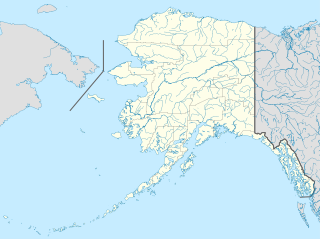
The Kudobin Islands are a group of small islands in the Bering Sea, near the coast of Alaska, 13 miles (21 km) West of Port Moller; Bristol Bay Low. The group includes a cluster of other small coastal islands, Walrus and Kritskoi Islands, forming a geographical whole.
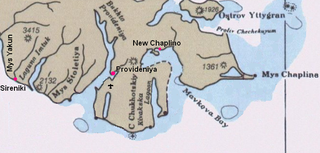
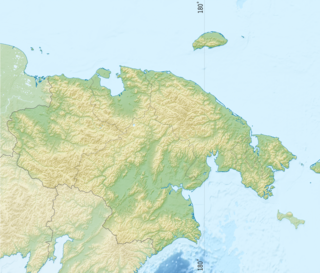
Cape Chaplin or Cape Chaplino is a cape pointing eastward in the Bering Sea in the Chukotka Autonomous Okrug of the Russian Federation.
Mikhail Nikolayevich Vasilyev was a Russian explorer and vice admiral of the Imperial Russian Navy. He is reputed for having surveyed the then little-known coast of Alaska as navigator. Vasiliev was sent by the Russian Imperial Hydrographic Service in 1819 to explore the northern parts of the Pacific Ocean and particularly the area around the Bering Strait. Certain geographic features of the Alaskan coast, like the Lindenberg Peninsula and Sealion Island were named by him in the maps that were subsequently published.
The Saint Lawrence Bay is a bay in the Bering Sea on the eastern coast of the Chukotka Peninsula, Russian Federation.
Cape Lutke is a headland on Unimak Island, the largest island in the Aleutian Islands chain of the U.S. state of Alaska. It is located on the southern central coast of the island.
The first Russian circumnavigation of the Earth took place from August 1803 to August 1806. It was sponsored by Count Nikolay Rumyantsev, funded by the Russian-American Company, and was headed by Adam Johann von Krusenstern. In addition to its exploratory goals, the expedition was also meant to help establish diplomatic and economic relations between Russia and Japan, for which the party included a large diplomatic delegation headed by Court Chamberlain and Ambassador Nikolai Rezanov.
Karl Heinrich Mertens, was a German botanist and naturalist, and son of the botanist Franz Carl Mertens.
Adam Johann von Krusenstern was a Baltic German admiral and explorer, who led the first Russian circumnavigation of the globe.
References
↑ Regarding personal names: Until 1919, Graf was a title, translated as Count, not a first or middle name. The female form is Gräfin. In Germany since 1919, it forms part of family names.
1 2 Quanchi, Max (2005). Historical Dictionary of the Discovery and Exploration of the Pacific Islands. The Scarecrow Press. p.100. ISBN0810853957.
This page is based on this Wikipedia article Text is available under the CC BY-SA 4.0 license; additional terms may apply. Images, videos and audio are available under their respective licenses.