List of Hawaiian species extinct in the Holocene

Last updated

Location of Hawaii in the Pacific Ocean. Hawaii on the globe (French Polynesia centered).svg
Location of Hawaii in the Pacific Ocean.
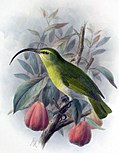
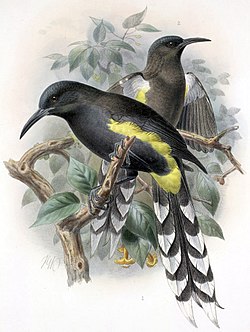
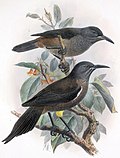
The O'ahu 'o'o (Moho apicalis) is among dozens of bird species that became extinct after the human settlement of Hawaii. Moho apicalis-Keulemans.jpg
The O'ahu 'ō'ō (Moho apicalis) is among dozens of bird species that became extinct after the human settlement of Hawaii.

This is a list of Hawaiian animal species extinct in the Holocene that covers extinctions from the Holocene epoch, a geologic epoch that began about 11,650 years before present (about 9700 BCE) [a] and continues to the present day. [1]

Contents

The Hawaiian Islands include the eight major islands (the Windward Islands) and the small islands and atolls of the Northwestern Hawaiian Islands. They are all part of the U.S. state of Hawaii, except Midway Atoll, which is a separate U.S. territory. [2]

The islands of East Polynesia (including New Zealand, Hawaii, and Easter Island) were among the last habitable places on earth colonized by humans. [3] Estimates for the timing of Polynesian settlement in Hawaii have been uncertain, [4] but a 2010 study based on radiocarbon dates of more reliable samples suggests that Hawaii was first settled by humans roughly between 1219 and 1266 CE. [3] In 1778, British explorer James Cook became the first recorded European to arrive in Hawaii. An influx of European and American explorers, traders, and whalers arrived shortly after. Hawaii was annexed by the United States in 1898 and became a state in 1959. [5]

Numerous species have disappeared from Hawaii as part of the ongoing Holocene extinction, driven by human activity. Human contact, first by Polynesians and later by Europeans, had a significant impact on the environment. Both the Polynesians and Europeans cleared native forests and introduced non-indigenous species for agriculture (or by accident), driving many endemic species to extinction. Fossil finds in caves, lava tubes, and sand dunes have revealed that Hawaii once had a native eagle, [6] two raven-size crows, several bird-eating owls, and giant ducks known as moa-nalo. Today, many of Hawaii's remaining endemic species of plants and animals are considered endangered. Hawaii has more endangered species and has lost a higher percentage of its endemic species than any other U.S. state. [7] The endemic plant Brighamia now requires hand pollination because its natural pollinator is presumed to be extinct. [8]

This list of extinct species only includes the indigenous biota of Hawaii, not domestic animals like the Hawaiian Poi Dog. Many extinction dates are unknown due to a lack of relevant information.

Mammals (class Mammalia)

Bats (order Chiroptera)

Vesper bats (family Vespertilionidae)

Scientific nameRangeComments
Synemporion keana Kauai, Oahu, Molokai, Maui, and Hawaii (island) [9] Might have become extinct around the 10th century. [10]

Birds (class Aves)

Waterfowl (order Anseriformes)

Ducks, geese, and swans (family Anatidae)

Common nameScientific nameRangeCommentsPictures
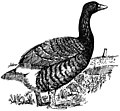
Nēnē-nui Branta hylobadistesMaui, possibly Oahu and KauaiMost recent remains dated to 1046-1380. [11]
Giant Hawaiʻi goose Branta rhuaxHawaii (island)Most recent remains dated to 1380-1500. [12] Big Island Goose.jpg
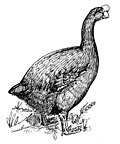
Turtle-jawed moa-nalo Chelychelynechen quassusKauai [13] Only known from subfossil remains. [14] Chelychelynechen quassus.jpg
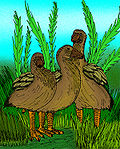
Small-billed moa-nalo Ptaiochen pauMaui [13] Known from subfossil remains. It was possibly restricted to montane habitat, while the lowlands were occupied by the Maui Nui large-billed moa-nalo. Likely disappeared due to a combination of hunting and predation or competition with introduced mammals. [14] Moa Nalo Maui Nui.JPG
Kauaʻi mole duck Talpanas lippaKauaiMost recent remains dated to 3540-3355 BCE. [15] Being a flightless, nocturnal, almost-blind species convergent with New Zealand's kiwi, it was likely very vulnerable to hunting and predation by introduced animals. [14]
Oʻahu moa-nalo Thambetochen xanionOahuMost recent remains dated to 440-639 CE. [11] It possibly disappeared due to a combination of hunting, habitat loss, and nest-predation by introduced mammals. [14] Thambetochen xanion.jpg
Maui Nui large-billed moa-nalo Thambetochen chauliodousMaui and MolokaiMost recent remains dated to 1057-1375. [11] It occupied low altitudes while the small-billed moa-nalo lived at higher elevations. It likely disappeared due to hunting, and nest predation by Polynesian rats. [14] Moa Nalo Maui Nui.JPG
Giant Oʻahu goose Anatidae sp. et gen. indet.OahuPrehistoric[ citation needed ]
Long-legged shelduck Anatidae sp. et gen. indet.Kauai

Rails and cranes (order Gruiformes)

Rails (family Rallidae)

Common nameScientific nameRangeCommentsPictures
Kepler's crake Zapornia keplerorumMauiKnown from subfossil remains. [14]
Molokai crake Zapornia menehuneMolokai
Laysan rail Zapornia palmeri Laysan Disappeared from Laysan in 1923 after feral rabbits ate all the vegetation in the island. Previously, the species was introduced to other islands in an attempt to save it from extinction, establishing successful populations in Midway (Eastern and Sand islands). In 1943, military construction in Midway accidentally introduced black rats, which exterminated the rails by either June 1944 or June 1945. [14] Laysanralle.jpg
Hawaiian rail Zapornia sandwichensisHawaii (island)Last collected in 1864; claims of further survival are unsubstantiated. The nominate subspecies Z. s. sandwichensis lived on the leeward side of the island of Hawaii and the subspecies Z. s. millsi on the windward side. It coexisted peacefully with the Polynesian rat but might have been driven to extinction by the black rat. Mongooses were blamed by some authors, but they were not introduced to the island until 1883. Hunting, deforestation, predation by pigs, cats, and dogs, and introduced diseases from poultry may have been contributing factors to its extinction. [14] Hawaiirail.jpg
Great Maui crake Porzana severnsiMauiEarly 12th century/150 C.E.
Great Oʻahu crake Porzana ralphorumOʻahuEarly 11th century/200 C.E. Known from subfossil remains. It was apparently limited to lowland areas while Ziegler's crake occupied the highlands, which would make it even more vulnerable to human settlement than other flightless rails. [14]
Small Oʻahu crake Zapornia ziegleri [14] Most recent remains dated to 650-869 CE. [11]
Great Hawaiian crake "Porzana" sp.Hawaii (island)All prehistoric.[ citation needed ]
Great Kauaʻi crake "Porzana" sp.Kauai
Medium Kauaʻi crake "Porzana" sp.
Medium Maui crake "Porzana" sp.Maui
Small Hawaiian crake "Porzana" sp.Hawaii (island)

Shorebirds (order Charadriiformes)

Gulls, terns, and skimmers (family Laridae)

Common nameScientific nameRangeComments
Kauaʻi gull Larus sp.KauaiKnown from mid-Holocene remains. There are no resident gull species in Kauai's modern fauna, though the laughing gull and others occur accidentally. [16]

Albatrosses and petrels (order Procellariiformes)

Petrels and shearwaters (family Procellariidae)

Common nameScientific nameRangeComments
Oʻahu petrel Pterodroma jugabilisHawaii (island) and OahuKnown from subfossil remains found in archaeological assemblages, because of this it is believed that it was hunted by people. It has no close living relatives. [17]

Pelicans, herons, and ibises (order Pelecaniformes)

Ibises and spoonbills (family Threskiornithidae)

Common nameScientific nameRangeCommentsPictures
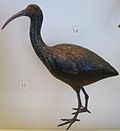
Maui highland ibis Apteribis brevisMauiMost recent remains dated to 170 BCE - 370 CE. [18] Apteribis sp. (5212794163).jpg
Molokaʻi ibis Apteribis glenosMolokai [17] Prehistoric
Maui lowland ibis Apteribis sp.Maui [17]
Lānaʻi ibis Apteribis sp. Lanai [19]

Hawks and relatives (order Accipitriformes)

Hawks, eagles, kites, harriers and Old World vultures (family Accipitridae)

Common nameScientific nameRangeComments
Wood harrier Circus dossenusMolokai and Oahu [17] Prehistoric
Hawaiian eagle Haliaeetus sp.Oahu, Molokai, and Maui [20] Holocene eagle fossils have been found on Oahu, Molokai, and Maui. The absence of eagle fossils from other Hawaiian islands might represent a true gap in distribution or a deficiency in the fossil record. Based on DNA research, these fossils represent the white-tailed eagle (Haliaeetus albicilla) or a very close relative. The Hawaiian eagle was an isolated, resident population in Hawaii for more than 100,000 years, where it was the largest terrestrial predator. Its extinction could have been related to human-induced ecological changes, although there is currently no direct evidence for temporal overlap with humans. [20]

Owls (order Strigiformes)

True owls (family Strigidae)

Common nameScientific nameRangeComments
Kauaʻi stilt-owl Grallistrix aucepsKauaiMost recent remains dated to 744-202 BCE. [11]
Maui stilt-owl Grallistrix erdmaniMauiMost recent remains dated to 1057-1440 CE. [11]
Molokaʻi stilt-owl Grallistrix gelechesMolokai [17] Prehistoric
Oʻahu stilt-owl Grallistrix orionOahu [17]

Perching birds (order Passeriformes)

Crows and relatives (family Corvidae)

Common nameScientific nameRangeCommentsPictures
High-billed crow Corvus impluviatusOahu [21] Prehistoric Corvus impluviatus andor Corvus viriosus.jpg
Robust crow Corvus viriosusOahu and Molokai [21] NMNH-USNM PAL 386435 Corvus viriosus.jpg
Extinct in the wild, crows and relatives (family Corvidae)
Common nameScientific nameRangeCommentsPictures
Hawaiian crow Corvus hawaiiensisHawaii (island) and MauiHistorically recorded on the island of Hawaii, where it was persecuted as a nuisance during the 19th century. Fossils indicate that this species or a very similar one was also found on Maui before European contact. The last wild pairs bred on the slopes of the Mauna Loa in 1992, by which time there were only 11 or 12 individuals left. One egg was laid in 1996 but didn't hatch, and the last pair was sighted in 2002. A captive population exists, but a release program in 1993-1999 ended in failure. [22] Corvus hawaiiensis FWS.jpg

Reed warblers (family Acrocephalidae)

Common nameScientific nameRangeCommentsPictures
Laysan millerbird Acrocephalus familiaris familiarisLaysanLast recorded in 1913. It likely disappeared due to habitat destruction caused by feral rabbits, which were introduced in 1904 and destroyed the vegetation almost completely by 1920. [14] Acrocepahlus familiaris, Rothsch..jpg

Hawaiian honeyeaters (family Mohoidae)

Common nameScientific nameRangeCommentsPictures
Kioea Chaetoptila angustiplumaHawaii (island), Oahu, and MauiThe last individual was collected on the island of Hawaii in 1859. Fossils indicate that this species or a very similar one was also found on Maui and Oahu before European contact. Deforestation, hunting, and introduced predators likely contributed to its extinction. [23] Chaetoptila angustipluma.jpg
Narrow-billed kioea ?Chaetoptila sp.MauiKnown from subfossil remains. The species coexisted with the Hawaiian kioea, but had a much narrower bill. [21]
Oʻahu ʻōʻō Moho apicalisOahuLast recorded in 1837. Presumably extinct due to habitat destruction and the introduction of disease-carrying mosquitos. [24] Moho apicalis-Keulemans.jpg
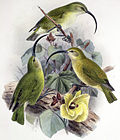
Bishop's ʻōʻō Moho bishopiMaui, Lanai, and MolokaiLast recorded on Molokai in 1904, with unconfirmed reports lasting until 1915. A bird thought to be this species was observed on Maui in 1981. It declined due to habitat destruction for agriculture and grazing feral mammals, before being wiped out by introduced black rats and diseases carried by mosquitos. [25] Moho bishopi.jpg
Kauaʻi ʻōʻō Moho braccatusKauaiThough common before the 1890s, it became restricted to the Alakaʻi Wilderness Preserve by the 1970s, and a single pair survived by 1981. The female disappeared when Hurricane Iwa struck Kauai in 1982, and the male was recorded singing in solitary until 1987. The species likely declined due to habitat destruction, predation by introduced black rats and feral pigs, as well as disease-carrying mosquitos. [26] Moho braccatus.jpg
Hawaiʻi ʻōʻō Moho nobilisHawaii (island)Last seen in 1934. Presumably disappeared due to habitat destruction and disease. [27] Moho nobilis-Keulemans.jpg

Thrushes (family Turdidae)

Common nameScientific nameRangeCommentsPictures
Kāmaʻo Myadestes myadestinusKauaiLast reliably sighted in 1985, with unconfirmed sightings until 1991. Likely causes of extinction include disease carried by introduced mosquitos, deforestation and degradation of forests by feral pigs. [28] Phaeornis myadestina Stejn, Bishop Museum, Honolulu.JPG
ʻĀmaui Myadestes woahensisOahu [29] Known from a single individual collected in 1825 and fossil remains. The cause of extinction is unknown, though habitat destruction and avian malaria are suspected. [29]
Possibly extinct, thrushes (family Turdidae)
Common nameScientific nameRangeCommentsPictures
Olomaʻo Myadestes lanaiensisMaui, Lanai and MolokaiPossibly disappeared from Maui in the 19th century. It was last seen in Lanai in 1933, and the last reliable sighting in Molokai happened in 1980 though there were unconfirmed reports in 1988, 1994, and 2005. It could have been driven extinct by diseases spread by introduced mosquitos and habitat destruction. [30] Zzzolomao.jpg

True finches (family Fringillidae)

Common nameScientific nameRangeCommentsPictures
Oʻahu icterid-like gaper Aidemedia chascaxOahuPrehistoric [21]
Maui Nui icterid-like gaper Aidemedia lutetiaeMaui and Molokai
Sickle-billed gaper Aidemedia zanclopsOahu
Oʻahu ʻakialoa Akialoa ellisianaThe species is known from only two specimens collected in 1837, although there were undocumented reports in 1937 and 1940. Thought to have been driven to extinction by habitat destruction and disease. [31] Hemignathus ellisianus1.jpg
Maui Nui ʻakialoa Akialoa lanaiensisMaui, Lanai and Molokai [32] Named from three individuals collected on Lanai in 1892; fossils have also been found on Molokai and Maui. The species is thought to have been driven to extinction by habitat destruction, disease, and possibly introduced species. [32] Akialoa lanaiensis.jpg
Lesser ʻakialoa Akialoa obscuraHawaii (island)Last reported in 1940. Likely extinct due to deforestation and introduced diseases. [33] Hemignathus obscurus (Gmel.), female, Bishop Museum, Honolulu.JPG
Kauaʻi ʻakialoa Akialoa stejnegeriKauaiLast reported in 1969. Extinct due to forest clearance and introduced disease. [34] Akialoa stejnegeri, Bishop Museum, Honolulu.JPG
Hoopoe-billed ʻakialoa Akialoa upupirostrisOahu and KauaiPrehistoric [21]
Giant ʻakialoa Akialoa sp.Hawaii (island)
Akialoa sp. Maui
Kona grosbeak Chloridops konaHawaii (island)Restricted to about four square miles by the time of its discovery in the late 19th century, it was last collected in 1894. The reasons of extinction are unknown, but may include habitat destruction, introduced mammalian predators, and avian malaria. [35] Chloridops kona Wilson, Bishop Museum, Honolulu.JPG
King Kong grosbeak Chloridops regiskongiOahuPrehistoric [21]
Wahi grosbeak Chloridops wahiMaui and OahuPrehistoric. Might include the Kauaʻi grosbeak (Chloridops sp.). [21]
Kauaʻi grosbeak Chloridops sp.KauaiPrehistoric. Might be synonymous with the Wahi grosbeak (Chloridops wahi). [21]
Maui grosbeak Chloridops sp.MauiPrehistoric [21]
ʻUla-ʻai-hawane Ciridops annaHawaii (island)Last collected in 1892, there was an unconfirmed sighting in 1937. The causes of extinction are unknown, but deforestation, malaria, and predation by introduced rats may have been contributing factors. [36] Ciridops anna Dole (Ulaaihawane), Bishop Museum, Honolulu.JPG
Stout-legged finch Ciridops tenaxKauaiKnown from subfossil remains. Likely extinct due to habitat destruction and hunting for feathers by Polynesians. [14]
Molokaʻi ʻula-ʻai-hawane Ciridops cf. annaMolokaiPrehistoric [21]
Oʻahu ʻula-ʻai-hawane Ciridops sp.Oahu
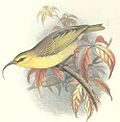
Black mamo Drepanis funereaMaui and MolokaiLast collected in Molokai in 1907; fossils are known from Maui. It probably disappeared due to destruction of its understorey habitat by introduced cattle and deer, and predation by rats and mongooses. [37] Drepanis funerea-Keulemans.jpg
Hawaiʻi mamo Drepanis pacificaHawaii (island)Last recorded in 1898. Although heavily trapped for its feathers, it was likely driven to extinction ultimately by habitat destruction and disease. [38] Drepanis pacifica-Keulemans.jpg
Lānaʻi hookbill Dysmorodrepanis munroiLanaiOnly known from a single specimen collected in 1913 and single sightings in 1916 and 1918. Presumably driven to extinction by clearing forests for pineapple plantation, predation by cats and rats. [39] Dysmorodrepanis.svg
Oʻahu nukupuʻu Hemignathus lucidusOahuThe last two preserved individuals were collected either during an expedition in 1838 or another in 1840-1841, though native accounts suggest it was still present in 1860. A second-hand report from 1939 is "doubtlessly incorrect". [40] Zzznukupuulucidus.jpg
Giant nukupuʻu Hemignathus vorpalisHawaii (island)Only known from fossils younger than c. 1000 BCE - 500 CE. [41]
Laysan honeycreeper Himatione fraithiiLaysanDisappeared after almost the entire vegetation cover of the island was eaten by introduced feral rabbits. The last three individuals were killed in a storm in 1923. [42] Himatione fraithii.jpg
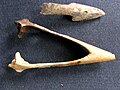
Kauaʻi palila Loxioides kikuchiKauaiKnown from two fossil jaws dated to 1375-1610 CE. [43]
Oʻahu ʻakepa Loxops wolstenholmeiOahuLast recorded in 1930. Probably driven to extinction by habitat destruction and disease. [44] Oahu Akepa.jpg
Poʻouli Melamprosops phaeosomaMauiLast two individuals recorded in 2004; one died shortly after being captured. The precise causes of decline are unknown. Suggestions include habitat destruction and modification, spread of disease-carrying mosquitos, pig activity, predation by rats, cats, and small Indian mongooses; and the decline of native Hawaiian snails as a result of predation by rats and the garlic snail Oxychilus alliaricus . [45] Po`ouli.jpg
Highland finch Orthiospiza howarthiPrehistoric [21]
Kākāwahie Paroreomyza flammeaMolokaiLast recorded in 1961-1963. Presumed to have disappeared due to habitat destruction and disease. [46] Paroreomyza.flammea.jpg
Lānaʻi ʻalauahio Paroreomyza montana montanaLanaiExtinct since 1937. [47] Paroreomyza montana montana.jpg
Lesser koa finch Rhodacanthis flavicepsHawaii (island)Seemed to have been driven to extinction by habitat destruction, and not by climatic variation nor mosquito-vectored diseases. Koa finches were likely driven out of lowland habitat before or shortly after the time of western contact in 1778. The two species from the island of Hawaii persisted until the late 19th century, when their upland refugium was degraded by logging, ranching, and intensified predation by the black rat. [48] The lesser koa finch was last recorded in 1891. [49] According to the IUCN red list, "this or a similar species is also known from the fossil record of O'ahu and Maui" [49] apparently referring to the primitive koa finch (Rhodacanthis litotes). [50] Telespiza flaviceps3.jpg
Scissor-billed koa finch Rhodacanthis forfexMaui and Kauai [50] Known from fossils on Maui and Kauai. Based on its disjunct distribution, the species might have occurred on all main islands except the island of Hawaii, although more fossils are needed for confirmation. [50] The koa finches seem to have been driven to extinction by habitat destruction, and not by climatic variation nor mosquito-vectored diseases. Koa finches were likely driven out of lowland habitat before or shortly after the time of western contact in 1778. The two species from Maui might have survived in an upland refugium until the late 19th century, paralleling the fate of the two species from the island of Hawaii. However, the only verified records are from fossils at a lower elevation. [48]
Primitive koa finch Rhodacanthis litotesMaui and Oahu [50] Known from fossils on Maui and Oahu. Based on its disjunct distribution, the species might have occurred on all main islands except the island of Hawaii and perhaps Kauai, although more fossils are needed for confirmation. [50] The primitive koa finch populations from Oahu and Maui might represent two distinct species, but more fossils or genetic data are necessary. [50] The koa finches seem to have been driven to extinction by habitat destruction, and not by climatic variation nor mosquito-vectored diseases. Koa finches were likely driven out of lowland habitat before or shortly after the time of western contact in 1778. The two species from Maui might have survived in an upland refugium until the late 19th century, paralleling the fate of the two species from the island of Hawaii. However, the only verified records are from fossils at a lower elevation. [48]
Greater koa finch Rhodacanthis palmeriHawaii (island)Last collected in 1896. The causes of extinction are unknown, but habitat destruction and introduced avian malaria are likely responsible. [51] Telespiza palmeri1.jpg
Kauaʻi finch Telespiza persecutrixOahu and KauaiMost recent remains were found in cave deposits dated to 1425-1660. [11]
Maui Nui finch Telespiza ypsilonMaui and MolokaiPrehistoric [21]
Maui finch Telespiza cf. ypsilonMaui
Strange-billed finch Vangulifer mirandus
Thin-billed finch Vangulifer neophasis
Greater ʻamakihi Viridonia sagittirostris Wailuku River, Hawaii (island)Last recorded in 1901. Its only known forest habitat was cleared to plant sugar cane. [52] Viridonia sagittirostris (greater 'amakihi), Bishop Museum, Honolulu.JPG
Cone-billed finch Xestospiza conicaKauaiPrehistoric [21]
Ridge-billed finch Xestospiza fastigialisOahu, Molokai, and Maui
Drepanidini gen. et sp. indet. MauiAt least three different species, all prehistoric. [21]
Drepanidini gen. et sp. indet. OahuPrehistoric [21]
Possibly extinct, true finches (family Fringillidae)
Common nameScientific nameRangeCommentsPictures
Maui nukupuʻu Hemignathus affinisMauiLast confirmed sighting in 1896, though several "unconfirmed detections" happened in 1986-1998, and a single male was seen by qualified observers in the same area in 1995. The species's forest habitat has been eliminated for cattle ranching or otherwise degraded by introduced ungulates, which also spread alien plants and disease-carrying mosquitos. Predation and competition with introduced birds and insects has also been suggested. [53] Hemignathus lucidus affinis.jpg
Kauaʻi nukupuʻu Hemignathus hanapepeKauaiLast confirmed sighting in 1899, with unconfirmed records in 1984-1998 and 2007. The more recent observations could actually belong to the Kauaʻi ʻamakihi. It possibly declined due to habitat degradation by introduced ungulates, disease, predation and competition with exotic birds and insects. [54] Hemignathus lucidus hanapepe.jpg
Maui ʻakepa Loxops ochraceusMauiLast recorded in 1988, with some dubious audio taken afterward. It could have declined due to habitat loss, invasive diseases, and conflict and competition with introduced species. [55] Loxops ochracea Roths, male (Maui 'akepa), Bishop Museum, Honolulu.JPG
Oʻahu ʻalauahio Paroreomyza maculataOahuLast collected in 1968 and last well-documented observation, of two birds, in 1985. It may have been driven extinct by disease spread by introduced mosquitos. [56] Paroreomyza maculata.jpg
ʻŌʻū Psittirostra psittaceaHawaii (island), Maui, Molokai, Lanai, Oahu, and KauaiLast recorded with certainty in Hawaii in 1987, and in Kauai in 1989, though there were some unconfirmed sightings after 1995. It disappeared from Oahu, Maui, Molokai, and Lanai between 1899 and 1931. It may have been driven extinct by habitat loss, introduced rats, and malaria spread by exotic mosquitos. [57] Psittirostra psittacea deppei1.jpg

Incertae familiae

Common nameScientific nameRangeComments
Slender-billed Kauaʻi passerine Passeriformes gen. et sp. indet.KauaiPrehistoric [21]
Tiny Kauaʻi passerine

Insects (class Insecta)

Dragonflies and damselflies (order Odonata)

Narrow-winged damselflies (family Coenagrionidae)

Possibly extinct
Common nameScientific nameRangeComments
Maui upland damselfly Megalagrion jugorumMaui and Lanai [58] Last seen in 1917. [58]

Grasshoppers, locusts, and crickets (order Orthoptera)

True crickets (family Gryllidae)

Extinct in the wild
Common nameScientific nameRange
Oʻahu deceptor bush cricket Leptogryllus deceptorOahu [59] [60]

True bugs (order Hemiptera)

Mealybugs (family Pseudococcidae)

Scientific nameRange
Clavicoccus erinaceus Oahu [61]
Phyllococcus oahuensis Unspecified range within the Hawaiian Islands [62]

Beetles (order Coleoptera)

True weevils (family Curculionidae)

Common nameScientific nameRangeComments
Dryophthorus distinguendus Nearly all of the Hawaiian Islands [63] Last seen in 1961. [63]
Laysan weevil Oodemas laysanensisLaysan [64] [65] Last seen in 1964. [64]
Rhyncogonus bryani Last seen in 1911. [65]

Butterflies and moths (order Lepidoptera)

Pyralid moths (family Pyralidae)

Scientific nameRangeComments
Genophantis leahi Maui, Oahu, Molokai and Hawaii (island) Last seen in the early 1900s. [66]

Owlet moths (family Noctuidae)

Common nameScientific nameRangeComments
Confused moth Helicoverpa confusaUnspecified range within the Hawaiian IslandsExtinct after 1927. [67]
Minute noctuid moth Helicoverpa minutaLast seen before 1911. [68]
Laysan dropseed noctuid moth Hypena laysanensisLaysanLast seen in 1911. [69]
Hilo noctuid moth Hypena newelliHawaii (island)Date of last observation unknown, possibly before 1923. [70] [b] [71]
Lovegrass noctuid moth Hypena plagiotaKauai, Oahu, and MauiLast seen before 1960, date unknown. [72] [73]
Kaholuamano noctuid moth Hypena seniculaKauaiDate of last collection unknown, possibly before 1923. [74] [c] [75]
Possibly extinct, owlet moths (family Noctuidae)
Common nameScientific nameRangeCommentsPictures
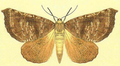
Midway noctuid moth Agrotis fasciata Midway Atoll [76] Last seen before 1960, date unknown. [77] [76] Agrotis-fasciata.jpg
Kona agrotis noctuid moth Agrotis panopliasHawaii (island) [78] [78] Euxoa panoplias.JPG
Poko noctuid moth Agrotis crinigeraKauai, Oahu, Molokai, Lanai, Maui, Hawaii (island), and Laysan [79] Last seen in 1926. [79]
Kerr's noctuid moth Agrotis kerri French Frigate Shoals [80] Last seen in 1923. [80]
Procellaris agrotis noctuid moth Agrotis procellarisLaysan [81] Last seen in 1912. [81]
Maui agrotis noctuid moth Agrotis cremataOahu and Maui [82] Last seen in 1912. [82]
Laysan noctuid moth Agrotis laysanensisLaysan [83] Last seen in 1911. [83] Agrotis-laysanensis.jpg
Microreas agrotis noctuid moth Agrotis microreasHawaii (island) [84] Last seen in 1925. [84] Agrotiphila microreas.JPG
Light-loving noctuid moth Agrotis photophilaOahu [85] Last seen in 1900. [85]
Data deficient, owlet moths (family Noctuidae)
Common nameScientific nameRangeComments
Kauai agrotis noctuid moth Agrotis tephriasKauai, Maui, and possibly Hawaii (island) [86] Last seen in 1985. [86]

Geometer moths (family Geometridae)

Common nameScientific nameRangeCommentsPictures
Kona giant looper moth Scotorythra megalophyllaUnspecified range within the Hawaiian Islands [87] Last seen in the early 1900s. [87] Scotorythra megalophylla-Fauna Hawaiiensis1899 flipped.png
Koʻolau giant looper moth Scotorythra nesiotesOahuLast seen in the early 1900s. [88]
ʻOlaʻa peppered looper moth Tritocleis microphyllaUnspecified range within the Hawaiian Islands [89] Last seen in the 1890s. [89]

True flies (order Diptera)

Long-legged flies (family Dolichopodidae)

Common nameScientific nameRangePictures
Koʻolau spurwing long-legged fly [90] Campsicnemus mirabilisUnspecified range within the Hawaiian Islands [91] Emperoptera mirabilis.jpg

Fruit flies and relatives (family Drosophilidae)

Common nameScientific nameRangeComments
Lanai pomace fly [92] Drosophila lanaiensisLanai and possibly Oahu [93] Last seen in 1893. [92] [94]

Snails and slugs (class Gastropoda)

Order Stylommatophora

Family Achatinellidae

Scientific nameRangeCommentsPictures
Achatinella abbreviata Oahu [95] [96] [97] [98] [99] [100] [101] [102] [103] [104] [105] [106] [107] [108] [109] Last seen in 1963 [110] Achatinella abbreviata both.jpg
Achatinella apexfulva Last individual died in captivity in 2019. [111] Zoological Illustrations Achatinella pica.jpg
Achatinella buddii Last seen in the early 1900s. [112] Naturalis Biodiversity Center - RMNH.MOL.239208 - Achatinella buddii Newcomb, 1854 - Achatinellidae - Mollusc shell.jpeg
Achatinella caesia Last seen in the early 1900s. [113]
Achatinella casta [114] Naturalis Biodiversity Center - ZMA.MOLL.373456 - Achatinella casta Newcomb, 1854 - Achatinellidae - Mollusc shell.jpeg
Achatinella decora Last seen in the early 1900s. [115] Zoological Illustrations Achatinella perversa.jpg
Achatinella dimorpha Recorded in 1951 and 1967. [101] Naturalis Biodiversity Center - ZMA.MOLL.373497 - Achatinella dimorpha Gulick, 1858 - Achatinellidae - Mollusc shell.jpeg
Achatinella elegans Last seen in 1952. [116]
Achatinella juddii Last seen in 1958. [117]
Achatinella juncea One post-1945 record, no recent records. [103]
Achatinella lehuiensis Last seen in 1922. [118]
Achatinella livida Collected six times between 1981 and 1993. [105] Zoological Illustrations Achatinella livida.jpg
Achatinella papyracea Last seen in 1945. [119]
Achatinella spaldingi Last seen in 1938. [120]
Achatinella thaanumi Last seen in the early 1900s. [121]
Achatinella valida Last seen in 1951. [122] Naturalis Biodiversity Center - ZMA.MOLL.373594 - Achatinella valida Pfeiffer, 1855 - Achatinellidae - Mollusc shell.jpeg
Auriculella expansa Maui [123] [124] Last observed in 1960. [123]
Auriculella uniplicata Last observed in 1946. [124]
Newcombia philippiana Unspecified range within the Hawaiian Islands. [125] [126] Last collected in 1964. [126]
Partulina crassa Lanai [127] Last seen in 1914. [128] Naturalis Biodiversity Center - ZMA.MOLL.373646 - Partulina crassa (Newcomb, 1854) - Achatinellidae - Mollusc shell.jpeg
Partulina montagui Unspecified range within the Hawaiian Islands. [129] Last seen in 1913. [129]
Perdicella fulgurans Maui [130] [131] [132] [133] No post-1945 sightings. [130] [131] [132] [133]
Perdicella maniensis
Perdicella zebra
Perdicella zebrina

Family Amastridae

Scientific nameRangeCommentsPictures
Amastra albolabris Oahu [134] [135] [136] [137] [138]
Amastra cornea [139] Amastra cornea.jpg
Amastra crassilabrum Last observed in 1951. [136] Amastra crassilabrum.jpg
Amastra elongata [140] Zoological Illustrations Achatinella acuta.jpg
Amastra forbesi Unspecified range within the Hawaiian Islands. [141] [141]
Amastra pellucida Oahu [142] [143]
Amastra porcus Unspecified range within the Hawaiian Islands. [144] [144]
Amastra reticulata Oahu [145] [146]
Amastra subrostrata [147]
Amastra subsoror Maui [148] [149] Last observed in 1946. [148] Amastra subsoror.jpg
Amastra tenuispira [150]
Amastra umbilicata Unspecified range within the Hawaiian Islands. [151] [151]
Carelia anceophila Kauai [152] [153] [154] Last seen in 1930. [155]
Carelia bicolor Last seen in 1970. [156] Naturalis Biodiversity Center - RMNH.MOL.239413 - Carelia bicolor (Jay, 1839) - Amastridae - Mollusc shell.jpeg
Carelia cochlea Last observed in 1952. [154] Carelia cochlea (5126873778).jpg
Carelia cumingiana Unspecified range within the Hawaiian Islands. [157] Last seen in 1930. [157]
Carelia dolei Kauai [158] [159] [160] [161] [162] [163] [164] [165] [166] [167] [168] [169] [170] [171] Last observed in 1952. [158] [159] Carelia dolei (5213222236).jpg
Carelia evelynae
Carelia glossema Last seen in 1930. [172]
Carelia hyattiana [173]
Carelia kalalauensis Last seen between 1945 and 1947. [174]
Carelia knudseni Last seen in 1930. [175]
Carelia lirata No post-1945 historic sightings. [164]
Carelia lymani [176]
Carelia mirabilis No post-1945 historic sightings. [166] [167]
Carelia necra
Carelia olivacea Last seen in 1930. [177] [178] [179]
Carelia paradoxa
Carelia periscelis
Carelia pilsbryi No post-1945 historic sightings. [171]
Carelia sinclairi Unspecified range within the Hawaiian Islands. [180] [180]
Carelia tenebrosa Kauai [181] [182] Last seen in 1930. [183] [184]
Carelia turricula Carelia turricula (5212624317).jpg

Family Pupillidae

Scientific nameRangeComments
Lyropupa perlonga Oahu [185] Last observed in 1980. [185]

Plants (kingdom Plantae)

Order Arecales

Palm trees (family Arecaceae)

Common nameScientific nameRangeCommentsPictures
Laysan fan palm Pritchardia sp. "Laysan"LaysanLast recorded in 1891. [186] LaysanPrichardia.png

Order Asterales

Sunflowers (family Asteraceae)

Scientific nameRangeComments
Argyroxiphium virescens Haleakalā crater, MauiThe last pure individual was collected in 1946, and the last hybrid died in 1996. Extinct due to predation by introduced goats, pigs, and cattle. [187]

Bellflowers (family Campanulaceae)

Common nameScientific nameRangeComments
Clermontia multiflora West Maui and the Koolau Mountains of OahuLast collected in 1871. [188]
Cyanea arborea Northwestern Haleakala, MauiLast collected in 1928. [189]
Cyanea comata Southern slope of Haleakala, MauiLast collected in 1874. Likely extinct due to deforestation. [190]
Cyanea cylindrocalix Hawaii (island)Only known from the holotype collected in 1909. [191]
Haha Cyanea dolichopodaKauaiLast recorded in 1992. The last individuals were likely killed by a landslide. [192]
Cyanea eleeleensis KauaiLast recorded in 1977. [193]
Cyanea giffardi Glenwood, Puna, Hawaii Only known from the type collected in 1917. [194]
Cyanea linearifolia Wahiawa Mountains, KauaiOnly known from the type collected in 1957. Probably extinct due to invasive species. [195]
Cyanea mauiensis MauiLast collected in 1870. Probably extinct due to habitat degradation by invasive plants and animals. [196]
Cyanea minutiflora Near Ka Loko Reservoir, KauaiLikely extinct due to habitat degradation by introduced plants and feral ungulates. [197]
Cyanea parvifolia Waioli Valley, KauaiLikely extinct due to introduced species. [198]
Cyanea pohaku Puunianiau, north-west slope of Haleakala, east Maui [199]
Cyanea pycnocarpa Kohala Mountains, Hawaii (island)Only known from the type material. [200]
Oakleaf cyanea Cyanea quercifoliaHaleakala volcano, Maui [201]
Cyanea sessilifolia Northern Ko'olau Mountains, OahuLast recorded in 1946. Likely extinct due to competition with introduced plants, predation by introduced pigs, rats, slugs, and snails, and climate change. [202]
Delissea niihauensis NiihauLast recorded in 1870. [203]
Delissea subcordata Koʻolau Mountains, OahuLast recorded in 1934. Likely extinct due to invasive weeds, ungulates, rats, and slugs. [204]
Undulata delissea Delissea undulataMauiLast recorded in 1888. Likely extinct due to invasive plants, animals, and habitat loss because of clearance for agriculture and increasing frequency of fires. [205]
Extinct in the wild
Common nameScientific nameRangeCommentsPictures
Sharktail cyanea Cyanea pinnatifidaOahuLast wild plant died in 2001. Survives in captivity at the Lyon Arboretum and the National Tropical Botanical Garden. [206] Cyanea pinnatifida.jpg
Superb cyanea Cyanea superbaNorthern Waianae Mountains and southern Koolau Mountains, OahuLast recorded in the wild around 2000. Declined due to competition with invasive plants, predation by introduced pigs, rats and slugs, and wildfires generated by activities in a nearby military firing range. [207]
Cyanea superba subsp. superba (4743389694).jpg

Order Caryophyllales

Amaranths (family Amaranthaceae)

Common nameScientific nameRangeComments
Hawaiʻi chaff flower Achyranthes atollensis Kure Atoll, Midway Atoll, Pearl and Hermes Atoll, and Laysan IslandLast recorded in 1964. Declined due to habitat destruction for military development, predation by introduced animals, and competition with introduced plants. [208]
Amaranthus brownii Nihoa Last recorded in 1983. Declined due to competition by introduced plant species, landslides, fires, and predation and habitat degradation by introduced animals. [209]

Order Gentianales

Dogbanes (family Apocynaceae)

Scientific nameRangeCommentsPictures
Ochrosia kilaueaensis Hawaii (island)Last recorded in 1927. Its habitat was degraded by introduced plants, goats, and fire. [210] Ochrosia kilaueaensis.jpg

Order Lamiales

Gesneriads (family Gesneriaceae)

Scientific nameRangeComments
Cyrtandra olona Wahiawa Mountains, KauaiOnly known from the holotype collected in 1909. Likely extinct due to habitat degradation and predation by introduced ungulates and plants. [211]

Mints (family Lamiaceae)

Possibly extinct
Common nameScientific nameRangeComments
Hillebrand's phyllostegia Phyllostegia hillebrandiiWestern and southern flanks of Haleakala, MauiLast collected in the 19th century. Most of its original range is now deforested, but it could still survive in the remaining forest. If alive, it could be threatened by introduced pigs, cattle, deer, goats, and plants. [212]

Order Malvales

Mallows (family Malvaceae)

Common nameScientific nameRangeCommentsPictures
Kawaihae hibiscadelphus Hibiscadelphus bombycinus Kawaihae, Hawaii Only known from the holotype collected before 1868. [213] Hibiscadelphus bombycinus K000659911.jpg
Lava hau kuahiwi Hibiscadelphus crucibracteatusPuhielelu Ridge, LanaiOnly known from a tree discovered in 1981, which has died since.[ when? ] Seeds were collected but have not been germinated. [214]
Maui hau kuahiwi Hibiscadelphus wilderianusMaui [215] Hibiscadelphus Wilderianos.jpg
Wailupe Valley treecotton Kokia lanceolataMakaku, Koko Head, and Wailupe Valley, Oahu [216]
Extinct in the wild
Common nameScientific nameRangeCommentsPictures
Kilauea hau kuahiwi Hibiscadelphus giffardianus Mauna Loa, Hawaii (island)Last wild individual died in 1930, possibly due to predation by introduced rats, and introduced diseases. Rewilding captie individuals is hampered by the extinction of its probable natural pollinator, a Hawaiian honey-creeper. [217]
Hibiscadelphus giffardianus (1).jpg
Molokaʻi treecotton Kokia cookeiMahana, western MolokaiLikely exterminated from the wild by grazing sheep. [218] Kokia cookei (4743890657).jpg

Order Rosales

Roses (family Rosaceae)

Common nameScientific nameRangeComments
Liliwai Acaena exiguaMaui and KauaiLast individual died in 2000. [219]

Order Sapindales

Rues and citrus trees (family Rutaceae)

Common nameScientific nameRangeComments
Kaholuamanu melicope Melicope macropus Waimea, KauaiLast collected in the Nuʻololo stream in 1995. Extinct due to predation and habitat destruction by introduced feral goats, pigs, and deer, and competition with introduced plants like Rubus rosifolius , R. argutus , Hedychium garderianum , and Kalanchoe pinnata . [220]
Makawao melicope Melicope obovataMaui?Only known from the holotype, of uncertain procedence. [221]

See also

Notes

  1. The source gives "11,700 calendar yr b2k (before CE 2000)". But "BP" means before 1950 CE. Therefore, the Holocene began 11,650 BP. Doing the math, that is c. 9700 BCE.
  2. This source from 2003 says, that "the last observed date [is] given as unknown, but according to Frank Howarth was more than 80 years ago." Thus, the date of last observation is unknown, but possibly before 1923.
  3. This source from 2003 says, that "the last observed date [is] given as unknown but according to Frank Howarth the last collection was more than 80 years ago." Thus, the date of last collection is unknown, but possibly before 1923.

References

  1. Walker, Mike; Johnsen, Sigfus; Rasmussen, Sune Olander; Popp, Trevor; Steffensen, Jorgen-Peder; Gibrard, Phil; Hoek, Wim; Lowe, John; Andrews, John; Bjo Rck, Svante; Cwynar, Les C.; Hughen, Konrad; Kersahw, Peter; Kromer, Bernd; Litt, Thomas; Lowe, David J.; Nakagawa, Takeshi; Newnham, Rewi; Schwander, Jakob (2009). "Formal definition and dating of the GSSP (Global Stratotype Section and Point) for the base of the Holocene using the Greenland NGRIP ice core, and selected auxiliary records" (PDF). Journal of Quaternary Science . 24 (1): 3–17. Bibcode:2009JQS....24....3W. doi: 10.1002/jqs.1227 . Archived (PDF) from the original on November 4, 2013. Retrieved April 24, 2022.
  2. "MODIS Web: Home >> Images >> Midway Islands". modis.gsfc.nasa.gov. Archived from the original on June 4, 2022. Retrieved April 21, 2021.
  3. 1 2 Wilmshurst, Janet M.; Hunt, Terry L.; Lipo, Carl P.; Anderson, Atholl J. (December 27, 2010). "High-precision radiocarbon dating shows recent and rapid initial human colonization of East Polynesia". Proceedings of the National Academy of Sciences. 108 (5): 1815–1820. doi: 10.1073/pnas.1015876108 . ISSN   0027-8424. PMC   3033267 . PMID   21187404.
  4. Kirch, Patrick (2011). "When did the Polynesians Settle Hawaii? A review of 150 years of scholarly inquiry". Hawaiian Archaeology. 12: 3–26.
  5. "[USC02] 48 USC Ch. 3: Front Matter". uscode.house.gov. Archived from the original on October 29, 2018. Retrieved October 28, 2019.
  6. Fleischer, Robert; Olsen, Storrs; James, Helen; Cooper, Alan (October 2000). "Identification of the Extinct Hawaiian Eagle (Haliaeetus) by mtDNA Sequence Analysis" (PDF). The Auk. 117 (4): 1051–1056. doi: 10.1093/auk/117.4.1051 . Retrieved May 23, 2018.
  7. Howard Youth. "Hawaii's Forest Birds Sing the Blues". Archived from the original on March 18, 2007. Retrieved October 31, 2008.
  8. "Hawaiian Native Plant Propagation Database". Archived from the original on November 28, 2014. Retrieved December 15, 2013.
  9. Ziegler, Alan C.; Howarth, Francis G.; Simmons, Nancy B. (March 21, 2016). "A Second Endemic Land Mammal for the Hawaiian Islands: A New Genus and Species of Fossil Bat (Chiroptera: Vespertilionidae)". American Museum Novitates (3854): 1–52. doi:10.1206/3854.1. hdl:2246/6641. ISSN   0003-0082. S2CID   56234957.
  10. Ziegler, A. C., Howarth, F. G., & Simmons, N. B. (2016). A second endemic land mammal for the Hawaiian Islands: a new genus and species of fossil bat (Chiroptera, Vespertilionidae). American Museum novitates, nº 3854.
  11. 1 2 3 4 5 6 7 Turvey, Sam (2009). Holocene Extinctions. Oxford University Press. ISBN   978-0-19-953509-5 . Retrieved February 29, 2012.
  12. Paxinos, Ellen E., et al. (2002) mtDNA from fossils reveals a radiation of Hawaiian geese recently derived from the Canada goose (Branta canadensis). Proceedings of the National Academy of Sciences, vol. 99, no 3, p. 1399-1404.
  13. 1 2 Young, H. G., Tonge, S. J., & Hume, J. P. (1996). Review of Holocene wildfowl extinctions. Wildfowl, 47(47), 167-181.
  14. 1 2 3 4 5 6 7 8 9 10 11 12 Hume, J.P. (2017) Extinct Birds. Bloomsbury Publishing, 560 pages.
  15. Iwaniuk, A.N., Olson, S.L., & James, H.F. (2009). Extraordinary cranial specialization in a new genus of extinct duck (Aves: Anseriformes) from Kauai, Hawaiian Islands. Zootaxa.
  16. Burney, D. A., James, H. F., Burney, L. P., Olson, S. L., Kikuchi, W., Wagner, W. L., ... & Nishek, R. (2001). Fossil evidence for a diverse biota from Kaua'i and its transformation since human arrival. Ecological Monographs, 71(4), 615-641.
  17. 1 2 3 4 5 6 Olson, Storrs; James, Helen (1991). "Descriptions of Thirty-Two New Species of Birds from the Hawaiian Islands Part I. Non-Passeriformes". Ornithological Monographs. 7 (45): 1–88. doi:10.2307/40166794. JSTOR   40166794.
  18. James, H. F., Stafford, T. W., Steadman, D. W., Olson, S. L., Martin, P. S., Jull, A. J., & McCoy, P. C. (1987). Radiocarbon dates on bones of extinct birds from Hawaii. Proceedings of the National Academy of Sciences, 84(8), 2350-2354.
  19. Dove, Carla J.; Olson, Storrs L. (September 2011). "Fossil Feathers from the Hawaiian Flightless Ibis (Apteribis sp.): Plumage Coloration and Systematics of a Prehistorically Extinct Bird". Journal of Paleontology. 85 (5): 892–897. Bibcode:2011JPal...85..892D. doi: 10.1666/10-133.1 . ISSN   0022-3360. S2CID   86084047.
  20. 1 2 Hailer, Frank; James, Helen F.; Olson, Storrs L.; Fleischer, Robert C. (2015). "Distinct and Extinct: Genetic Differentiation of the Hawaiian Eagle" (PDF). Molecular Phylogenetics and Evolution. 83: 40–43. doi:10.1016/j.ympev.2014.11.005. PMID   25463753.
  21. 1 2 3 4 5 6 7 8 9 10 11 12 13 14 15 16 James, Helen F.; Olson, Storrs L (1991). "Descriptions of Thirty-Two New Species of Birds from the Hawaiian Islands: Part II. Passeriformes" . Ornithological Monographs. 46 (46). American Ornithologists' Union: 39–43. doi:10.2307/40166713. JSTOR   40166713.
  22. BirdLife International (2016). "Corvus hawaiiensis". IUCN Red List of Threatened Species . 2016 e.T22706052A94048187. doi: 10.2305/IUCN.UK.2016-3.RLTS.T22706052A94048187.en .
  23. BirdLife International (2016). "Chaetoptila angustipluma". IUCN Red List of Threatened Species . 2016 e.T22704348A93964400. doi: 10.2305/IUCN.UK.2016-3.RLTS.T22704348A93964400.en . Retrieved November 18, 2021.
  24. BirdLife International (2017). "Moho apicalis". IUCN Red List of Threatened Species . 2017 e.T22704329A111776064. doi: 10.2305/IUCN.UK.2017-1.RLTS.T22704329A111776064.en . Retrieved November 18, 2021.
  25. BirdLife International (2016). "Moho bishopi". IUCN Red List of Threatened Species . 2016 e.T22704335A93963979. doi: 10.2305/IUCN.UK.2016-3.RLTS.T22704335A93963979.en . Retrieved November 18, 2021.
  26. BirdLife International (2016). "Moho braccatus". IUCN Red List of Threatened Species . 2016 e.T22704323A93963628. doi: 10.2305/IUCN.UK.2016-3.RLTS.T22704323A93963628.en .
  27. BirdLife International (2016). "Moho nobilis". IUCN Red List of Threatened Species . 2016 e.T22704342A93964244. doi: 10.2305/IUCN.UK.2016-3.RLTS.T22704342A93964244.en . Retrieved November 18, 2021.
  28. BirdLife International (2016). "Myadestes myadestinus". IUCN Red List of Threatened Species . 2016 e.T22708559A94165256. doi: 10.2305/IUCN.UK.2016-3.RLTS.T22708559A94165256.en . Retrieved November 18, 2021.
  29. 1 2 BirdLife International (2017). "Myadestes woahensis". IUCN Red List of Threatened Species . 2017 e.T22708564A111775767. doi: 10.2305/IUCN.UK.2017-1.RLTS.T22708564A111775767.en . Retrieved November 18, 2021.
  30. BirdLife International (2019). "Myadestes lanaiensis". IUCN Red List of Threatened Species . 2019 e.T22708574A155254449. doi: 10.2305/IUCN.UK.2019-3.RLTS.T22708574A155254449.en . Retrieved November 18, 2021.
  31. BirdLife International (2017) [amended version of 2017 assessment]. "Akialoa ellisiana". IUCN Red List of Threatened Species . 2017 e.T103823212A119549725. doi: 10.2305/IUCN.UK.2017-3.RLTS.T103823212A119549725.en . Retrieved July 4, 2022.
  32. 1 2 BirdLife International (2017). "Akialoa lanaiensis". IUCN Red List of Threatened Species . 2017 e.T103823431A119549974. doi: 10.2305/IUCN.UK.2017-3.RLTS.T103823431A119549974.en . Retrieved January 15, 2018.
  33. BirdLife International (2017). "Akialoa obscura". IUCN Red List of Threatened Species . 2017 e.T22728910A119550231. doi: 10.2305/IUCN.UK.2017-3.RLTS.T22728910A119550231.en . Retrieved November 18, 2021.
  34. BirdLife International (2017). "Akialoa stejnegeri". IUCN Red List of Threatened Species . 2017 e.T103823250A119550506. doi: 10.2305/IUCN.UK.2017-3.RLTS.T103823250A119550506.en . Retrieved January 14, 2018.
  35. BirdLife International (2016). "Chloridops kona". IUCN Red List of Threatened Species . 2016 e.T22728825A94998118. doi: 10.2305/IUCN.UK.2016-3.RLTS.T22728825A94998118.en . Retrieved November 18, 2021.
  36. BirdLife International (2016). "Ciridops anna". IUCN Red List of Threatened Species . 2016 e.T22720840A94686158. doi: 10.2305/IUCN.UK.2016-3.RLTS.T22720840A94686158.en . Retrieved November 18, 2021.
  37. BirdLife International (2016). "Drepanis funerea". IUCN Red List of Threatened Species . 2016 e.T22720852A94686803. doi: 10.2305/IUCN.UK.2016-3.RLTS.T22720852A94686803.en . Retrieved November 18, 2021.
  38. BirdLife International (2016). "Drepanis pacifica". IUCN Red List of Threatened Species . 2016 e.T22720848A94686625. doi: 10.2305/IUCN.UK.2016-3.RLTS.T22720848A94686625.en . Retrieved November 18, 2021.
  39. BirdLife International (2017). "Dysmorodrepanis munroi". IUCN Red List of Threatened Species . 2017 e.T22720738A111776369. doi: 10.2305/IUCN.UK.2017-1.RLTS.T22720738A111776369.en . Retrieved November 18, 2021.
  40. Pyle, R.L., and P. Pyle. (2017). The Birds of the Hawaiian Islands: Occurrence, History, Distribution, and Status. B.P. Bishop Museum, Honolulu, HI, U.S.A. Version 2 (1 January 2017)
  41. James, H. F., & Olson, S. L. (2003). A giant new species of nukupuu (Fringillidae: Drepanidini: Hemignathus) from the island of Hawaii. The Auk, 120(4), 970-981.
  42. BirdLife International (2017). "Himatione fraithii". IUCN Red List of Threatened Species . 2017 e.T103829706A119553201. doi: 10.2305/IUCN.UK.2017-3.RLTS.T103829706A119553201.en .
  43. James, H. F., & Olson, S. L. (2006). A new species of Hawaiian finch (Drepanidini: Loxioides) from Makauwahi Cave, Kaua'i. The Auk, 123(2), 335-344.
  44. BirdLife International (2017) [amended version of 2016 assessment]. "Loxops wolstenholmei". IUCN Red List of Threatened Species . 2017 e.T103824105A117232993. doi: 10.2305/IUCN.UK.2017-3.RLTS.T103824105A117232993.en . Retrieved January 15, 2018.
  45. BirdLife International (2019). "Melamprosops phaeosoma". IUCN Red List of Threatened Species . 2019 e.T22720863A153774712. doi: 10.2305/IUCN.UK.2019-3.RLTS.T22720863A153774712.en . Retrieved November 18, 2021.
  46. BirdLife International (2017). "Paroreomyza flammea". IUCN Red List of Threatened Species . 2017 e.T22720823A119118273. doi: 10.2305/IUCN.UK.2017-3.RLTS.T22720823A119118273.en . Retrieved November 18, 2021.
  47. BirdLife International (2023). "Paroreomyza montana". IUCN Red List of Threatened Species . 2023 e.T22720818A224944120. doi: 10.2305/IUCN.UK.2023-1.RLTS.T22720818A224944120.en . Retrieved June 1, 2024.
  48. 1 2 3 James, Helen F.; Johnathan P. Prince (May 2008). "Integration of palaeontological, historical, and geographical data on the extinction of koa-finches". Diversity & Distributions. 14 (3): 441–451. Bibcode:2008DivDi..14..441J. doi:10.1111/j.1472-4642.2007.00442.x. S2CID   40057425.
  49. 1 2 BirdLife International (2016). "Rhodacanthis flaviceps". IUCN Red List of Threatened Species . 2016 e.T22720745A94681389. doi: 10.2305/IUCN.UK.2016-3.RLTS.T22720745A94681389.en . Retrieved November 18, 2021.
  50. 1 2 3 4 5 6 James, Helen F.; Storrs L. Olson (2005). "The diversity and biogeography of koa-finches (Drepanidini: Rhodacanthis) with descriptions of two new species" (PDF). Zoological Journal of the Linnean Society . 144 (4). Linnean Society of London: 527–541. doi: 10.1111/j.1096-3642.2005.00173.x .[ permanent dead link ]
  51. BirdLife International (2016). "Rhodacanthis palmeri". IUCN Red List of Threatened Species . 2016 e.T22720749A94681538. doi: 10.2305/IUCN.UK.2016-3.RLTS.T22720749A94681538.en . Retrieved November 18, 2021.
  52. BirdLife International (2016). "Viridonia sagittirostris". IUCN Red List of Threatened Species . 2016 e.T22720784A94682950. doi: 10.2305/IUCN.UK.2016-3.RLTS.T22720784A94682950.en . Retrieved November 18, 2021.
  53. BirdLife International (2016). "Hemignathus affinis". IUCN Red List of Threatened Species . 2016 e.T103823664A104234257. doi: 10.2305/IUCN.UK.2016-3.RLTS.T103823664A104234257.en . Retrieved December 17, 2022.
  54. BirdLife International (2018). "Hemignathus hanapepe". IUCN Red List of Threatened Species . 2018 e.T103823616A125584125. doi: 10.2305/IUCN.UK.2018-2.RLTS.T103823616A125584125.en . Retrieved December 16, 2022.
  55. BirdLife International (2016). "Loxops ochraceus". IUCN Red List of Threatened Species . 2016 e.T103824084A104236054. doi: 10.2305/IUCN.UK.2016-3.RLTS.T103824084A104236054.en . Retrieved January 15, 2018.
  56. BirdLife International (2016). "Paroreomyza maculata". IUCN Red List of Threatened Species . 2016 e.T22720827A94685115. doi: 10.2305/IUCN.UK.2016-3.RLTS.T22720827A94685115.en . Retrieved December 16, 2022.
  57. BirdLife International (2018). "Psittirostra psittacea". IUCN Red List of Threatened Species . 2018 e.T22720734A126791352. doi: 10.2305/IUCN.UK.2016-3.RLTS.T22720734A126791352.en . Retrieved December 16, 2022.
  58. 1 2 Polhemus, D.A. (2020). "Megalagrion jugorum". IUCN Red List of Threatened Species . 2020 e.T12953A510761. doi: 10.2305/IUCN.UK.2020-1.RLTS.T12953A510761.en . Retrieved November 12, 2021.
  59. "NatureServe Explorer 2.0". explorer.natureserve.org. Retrieved December 17, 2022.
  60. Orthopteroid Specialist Group (1996). "Leptogryllus deceptor". IUCN Red List of Threatened Species . 1996 e.T11690A3301867. doi: 10.2305/IUCN.UK.1996.RLTS.T11690A3301867.en . Retrieved May 10, 2020.
  61. World Conservation Monitoring Centre (1996). "Clavicoccus erinaceus". IUCN Red List of Threatened Species . 1996 e.T4961A11102700. doi: 10.2305/IUCN.UK.1996.RLTS.T4961A11102700.en . Retrieved December 16, 2022.
  62. World Conservation Monitoring Centre (1996). "Phyllococcus oahuensis". IUCN Red List of Threatened Species . 1996 e.T17120A6799402. doi: 10.2305/IUCN.UK.1996.RLTS.T17120A6799402.en . Retrieved December 16, 2022.
  63. 1 2 Lyal, C. (2014). "Dryophthorus distinguendus". IUCN Red List of Threatened Species . 2014 e.T6862A21424260. doi: 10.2305/IUCN.UK.2014-1.RLTS.T6862A21424260.en . Retrieved December 16, 2022.
  64. 1 2 Lyal, C. (2014). "Oodemas laysanensis". IUCN Red List of Threatened Species . 2014 e.T15144A21424379. doi: 10.2305/IUCN.UK.2014-1.RLTS.T15144A21424379.en . Retrieved December 16, 2022.
  65. 1 2 Lyal, C. (2014). "Rhyncogonus bryani". IUCN Red List of Threatened Species . 2014 e.T19724A21424429. doi: 10.2305/IUCN.UK.2014-1.RLTS.T19724A21424429.en . Retrieved December 16, 2022.
  66. World Conservation Monitoring Centre (1996). "Genophantis leahi". IUCN Red List of Threatened Species . 1996 e.T9000A12948738. doi: 10.2305/IUCN.UK.1996.RLTS.T9000A12948738.en . Retrieved December 16, 2022.
  67. World Conservation Monitoring Centre (1996). "Helicoverpa confusa". IUCN Red List of Threatened Species . 1996 e.T9808A13018419. doi: 10.2305/IUCN.UK.1996.RLTS.T9808A13018419.en . Retrieved December 16, 2022.
  68. World Conservation Monitoring Centre (1996). "Helicoverpa minuta". IUCN Red List of Threatened Species . 1996 e.T9809A13018521. doi: 10.2305/IUCN.UK.1996.RLTS.T9809A13018521.en . Retrieved December 16, 2022.
  69. World Conservation Monitoring Centre (1996). "Hypena laysanensis". IUCN Red List of Threatened Species . 1996 e.T10637A3206838. doi: 10.2305/IUCN.UK.1996.RLTS.T10637A3206838.en . Retrieved December 16, 2022.
  70. "NatureServe Explorer 2.0". explorer.natureserve.org. Retrieved December 17, 2022.
  71. World Conservation Monitoring Centre (1996). "Hypena newelli". IUCN Red List of Threatened Species . 1996 e.T10641A3207144. doi: 10.2305/IUCN.UK.1996.RLTS.T10641A3207144.en . Retrieved December 16, 2022.
  72. "NatureServe Explorer 2.0". explorer.natureserve.org. Retrieved December 17, 2022.
  73. World Conservation Monitoring Centre (1996). "Hypena plagiota". IUCN Red List of Threatened Species . 1996 e.T10639A3206940. doi: 10.2305/IUCN.UK.1996.RLTS.T10639A3206940.en . Retrieved December 16, 2022.
  74. "NatureServe Explorer 2.0". explorer.natureserve.org. Retrieved December 17, 2022.
  75. World Conservation Monitoring Centre (1996). "Hypena senicula". IUCN Red List of Threatened Species . 1996 e.T10640A3207041. doi: 10.2305/IUCN.UK.1996.RLTS.T10640A3207041.en . Retrieved December 16, 2022.
  76. 1 2 Walker, A. & Medeiros, M.J. (2021). "Agrotis fasciata". IUCN Red List of Threatened Species . 2021 e.T705A189702927. doi: 10.2305/IUCN.UK.2021-3.RLTS.T705A189702927.en . Retrieved December 16, 2022.
  77. "NatureServe Explorer 2.0". explorer.natureserve.org. Retrieved December 17, 2022.
  78. 1 2 Walker, A.; Medeiros, M.J. (2021). "Agrotis panoplias. The IUCN Red List of Threatened Species 2021: e.T188988592A189703162". IUCN Red List of Threatened Species . 2021. doi: 10.2305/IUCN.UK.2021-3.RLTS.T188988592A189703162.en . Retrieved December 16, 2022.
  79. 1 2 Walker, A. & Medeiros, M.J. (2021). "Agrotis crinigera". IUCN Red List of Threatened Species . 2021 e.T704A189702899. doi: 10.2305/IUCN.UK.2021-3.RLTS.T704A189702899.en . Retrieved December 16, 2022.{{cite journal}}: CS1 maint: multiple names: authors list (link)
  80. 1 2 Walker, A. & Medeiros, M.J. (2021). "Agrotis kerri". IUCN Red List of Threatened Species . 2021 e.T706A189702955. doi: 10.2305/IUCN.UK.2021-3.RLTS.T706A189702955.en . Retrieved December 16, 2022.{{cite journal}}: CS1 maint: multiple names: authors list (link)
  81. 1 2 Walker, A. & Medeiros, M.J. (2021). "Agrotis procellaris". IUCN Red List of Threatened Species . 2021 e.T709A189703039. doi: 10.2305/IUCN.UK.2021-3.RLTS.T709A189703039.en . Retrieved December 16, 2022.{{cite journal}}: CS1 maint: multiple names: authors list (link)
  82. 1 2 World Conservation Monitoring Centre (2021). "Agrotis cremata". IUCN Red List of Threatened Species . 2021 e.T188974686A189703107. doi: 10.2305/IUCN.UK.2021-3.RLTS.T188974686A189703107.en . Retrieved December 16, 2022.
  83. 1 2 Walker, A. & Medeiros, M.J. (2021). "Agrotis laysanensis". IUCN Red List of Threatened Species . 2021 e.T707A189702983. doi: 10.2305/IUCN.UK.2021-3.RLTS.T707A189702983.en . Retrieved December 16, 2022.{{cite journal}}: CS1 maint: multiple names: authors list (link)
  84. 1 2 Walker, A. & Medeiros, M.J. (2021). "Agrotis microreas". IUCN Red List of Threatened Species . 2021 e.T188988510A189703157. doi: 10.2305/IUCN.UK.2021-3.RLTS.T188988510A189703157.en . Retrieved December 16, 2022.{{cite journal}}: CS1 maint: multiple names: authors list (link)
  85. 1 2 Walker, A. & Medeiros, M.J. (2021). "Agrotis photophila". IUCN Red List of Threatened Species . 2021 e.T708A189703011. doi: 10.2305/IUCN.UK.2021-3.RLTS.T708A189703011.en . Retrieved November 16, 2021.
  86. 1 2 Walker, A. & Medeiros, M.J. (2020). "Agrotis tephrias". IUCN Red List of Threatened Species . 2021 e.T188989484A189703177. doi: 10.2305/IUCN.UK.2021-3.RLTS.T188989484A189703177.en . Retrieved December 16, 2022.{{cite journal}}: CS1 maint: multiple names: authors list (link)
  87. 1 2 World Conservation Monitoring Centre (1996). "Scotorythra megalophylla". IUCN Red List of Threatened Species . 1996 e.T20074A9144387. doi: 10.2305/IUCN.UK.1996.RLTS.T20074A9144387.en . Retrieved December 16, 2022.
  88. World Conservation Monitoring Centre (1996). "Scotorythra nesiotes". IUCN Red List of Threatened Species . 1996 e.T20075A9144489. doi: 10.2305/IUCN.UK.1996.RLTS.T20075A9144489.en . Retrieved December 16, 2022.
  89. 1 2 World Conservation Monitoring Centre (1996). "Tritocleis microphylla". IUCN Red List of Threatened Species . 1996 e.T22209A9365407. doi: 10.2305/IUCN.UK.1996.RLTS.T22209A9365407.en . Retrieved December 16, 2022.
  90. "NatureServe Explorer 2.0". explorer.natureserve.org. Retrieved December 17, 2022.
  91. World Conservation Monitoring Centre (1996). "Campsicnemus mirabilis". IUCN Red List of Threatened Species . 1996 e.T3719A10034887. doi: 10.2305/IUCN.UK.1996.RLTS.T3719A10034887.en . Retrieved December 16, 2022.
  92. 1 2 "NatureServe Explorer 2.0". explorer.natureserve.org. Retrieved December 17, 2022.
  93. E. H. Bryan Jr. (1934). "A review of the Hawaiian Diptera, with descriptions of new species" (PDF). Proceedings of the Hawaiian Entomological Society . 8 (3): 399–468.
  94. World Conservation Monitoring Centre (1996). "Drosophila lanaiensis". IUCN Red List of Threatened Species . 1996 e.T6844A12810403. doi: 10.2305/IUCN.UK.1996.RLTS.T6844A12810403.en . Retrieved December 16, 2022.
  95. "NatureServe Explorer 2.0". explorer.natureserve.org. Retrieved December 18, 2022.
  96. "NatureServe Explorer 2.0". explorer.natureserve.org. Retrieved December 18, 2022.
  97. "NatureServe Explorer 2.0". explorer.natureserve.org. Retrieved December 18, 2022.
  98. "NatureServe Explorer 2.0". explorer.natureserve.org. Retrieved December 18, 2022.
  99. "NatureServe Explorer 2.0". explorer.natureserve.org. Retrieved December 18, 2022.
  100. "NatureServe Explorer 2.0". explorer.natureserve.org. Retrieved December 18, 2022.
  101. 1 2 "NatureServe Explorer 2.0". explorer.natureserve.org. Retrieved December 18, 2022.
  102. "NatureServe Explorer 2.0". explorer.natureserve.org. Retrieved December 18, 2022.
  103. 1 2 "NatureServe Explorer 2.0". explorer.natureserve.org. Retrieved December 18, 2022.
  104. "NatureServe Explorer 2.0". explorer.natureserve.org. Retrieved December 18, 2022.
  105. 1 2 "NatureServe Explorer 2.0". explorer.natureserve.org. Retrieved December 18, 2022.
  106. "NatureServe Explorer 2.0". explorer.natureserve.org. Retrieved December 18, 2022.
  107. "NatureServe Explorer 2.0". explorer.natureserve.org. Retrieved December 18, 2022.
  108. "NatureServe Explorer 2.0". explorer.natureserve.org. Retrieved December 18, 2022.
  109. "NatureServe Explorer 2.0". explorer.natureserve.org. Retrieved December 18, 2022.
  110. Mollusc Specialist Group (1996). "Achatinella abbreviata". IUCN Red List of Threatened Species . 1996 e.T167A13037866. doi: 10.2305/IUCN.UK.1996.RLTS.T167A13037866.en . Retrieved November 13, 2021.
  111. "Lonely George – A Hawaiian Tree Snail – Has Died, Taking His Species with Him". January 9, 2019.
  112. Mollusc Specialist Group (1996). "Achatinella buddii". IUCN Red List of Threatened Species . 1996 e.T170A13040003. doi: 10.2305/IUCN.UK.1996.RLTS.T170A13040003.en . Retrieved November 15, 2021.
  113. Mollusc Specialist Group (1996). "Achatinella caesia". IUCN Red List of Threatened Species . 1996 e.T173A13041958. doi: 10.2305/IUCN.UK.1996.RLTS.T173A13041958.en . Retrieved November 14, 2021.
  114. Mollusc Specialist Group (1996). "Achatinella casta". IUCN Red List of Threatened Species . 1996 e.T174A13042788. doi: 10.2305/IUCN.UK.1996.RLTS.T174A13042788.en . Retrieved November 17, 2021.
  115. Mollusc Specialist Group (1996). "Achatinella decora". IUCN Red List of Threatened Species . 1996 e.T179A13044905. doi: 10.2305/IUCN.UK.1996.RLTS.T179A13044905.en . Retrieved November 14, 2021.
  116. Mollusc Specialist Group (1996). "Achatinella elegans". IUCN Red List of Threatened Species . 1996 e.T181A13045735. doi: 10.2305/IUCN.UK.1996.RLTS.T181A13045735.en . Retrieved November 15, 2021.
  117. Mollusc Specialist Group (1996). "Achatinella juddii". IUCN Red List of Threatened Species . 1996 e.T184A13047419. doi: 10.2305/IUCN.UK.1996.RLTS.T184A13047419.en . Retrieved November 17, 2021.
  118. Mollusc Specialist Group (1996). "Achatinella lehuiensis". IUCN Red List of Threatened Species . 1996 e.T186A13047687. doi: 10.2305/IUCN.UK.1996.RLTS.T186A13047687.en . Retrieved November 17, 2021.
  119. Mollusc Specialist Group (1996). "Achatinella papyracea". IUCN Red List of Threatened Species . 1996 e.T192A13048363. doi: 10.2305/IUCN.UK.1996.RLTS.T192A13048363.en . Retrieved November 15, 2021.
  120. Mollusc Specialist Group (1996). "Achatinella spaldingi". IUCN Red List of Threatened Species . 1996 e.T198A13049179. doi: 10.2305/IUCN.UK.1996.RLTS.T198A13049179.en . Retrieved November 17, 2021.
  121. Mollusc Specialist Group (1996). "Achatinella thaanumi". IUCN Red List of Threatened Species . 1996 e.T202A13049902. doi: 10.2305/IUCN.UK.1996.RLTS.T202A13049902.en . Retrieved November 16, 2021.
  122. Mollusc Specialist Group (1996). "Achatinella valida". IUCN Red List of Threatened Species . 1996 e.T204A13050607. doi: 10.2305/IUCN.UK.1996.RLTS.T204A13050607.en . Retrieved November 15, 2021.
  123. 1 2 "NatureServe Explorer 2.0". explorer.natureserve.org. Retrieved December 18, 2022.
  124. 1 2 "NatureServe Explorer 2.0". explorer.natureserve.org. Retrieved December 18, 2022.
  125. Mollusc Specialist Group (1996). "Newcombia philippiana". IUCN Red List of Threatened Species . 1996 e.T14746A4459826. doi: 10.2305/IUCN.UK.1996.RLTS.T14746A4459826.en . Retrieved November 15, 2021.
  126. 1 2 "NatureServe Explorer 2.0". explorer.natureserve.org. Retrieved December 18, 2022.
  127. "NatureServe Explorer 2.0". explorer.natureserve.org. Retrieved December 18, 2022.
  128. Mollusc Specialist Group (1996). "Partulina crassa". IUCN Red List of Threatened Species . 1996 e.T16351A5610123. doi: 10.2305/IUCN.UK.1996.RLTS.T16351A5610123.en . Retrieved November 17, 2021.
  129. 1 2 Mollusc Specialist Group (1996). "Partulina montagui". IUCN Red List of Threatened Species . 1996 e.T16353A5612122. doi: 10.2305/IUCN.UK.1996.RLTS.T16353A5612122.en . Retrieved January 8, 2023.
  130. 1 2 "NatureServe Explorer 2.0". explorer.natureserve.org. Retrieved January 9, 2023.
  131. 1 2 "NatureServe Explorer 2.0". explorer.natureserve.org. Retrieved January 9, 2023.
  132. 1 2 "NatureServe Explorer 2.0". explorer.natureserve.org. Retrieved January 9, 2023.
  133. 1 2 "NatureServe Explorer 2.0". explorer.natureserve.org. Retrieved January 9, 2023.
  134. "NatureServe Explorer 2.0". explorer.natureserve.org. Retrieved December 18, 2022.
  135. "NatureServe Explorer 2.0". explorer.natureserve.org. Retrieved December 18, 2022.
  136. 1 2 "NatureServe Explorer 2.0". explorer.natureserve.org. Retrieved December 18, 2022.
  137. "NatureServe Explorer 2.0". explorer.natureserve.org. Retrieved December 18, 2022.
  138. Mollusc Specialist Group (1996). "Amastra albolabris". IUCN Red List of Threatened Species . 1996 e.T989A13100821. doi: 10.2305/IUCN.UK.1996.RLTS.T989A13100821.en . Retrieved November 17, 2021.
  139. Mollusc Specialist Group (1996). "Amastra cornea". IUCN Red List of Threatened Species . 1996 e.T990A13100871. doi: 10.2305/IUCN.UK.1996.RLTS.T990A13100871.en . Retrieved November 16, 2021.
  140. Mollusc Specialist Group (1996). "Amastra elongata". IUCN Red List of Threatened Species . 1996 e.T992A13100971. doi: 10.2305/IUCN.UK.1996.RLTS.T992A13100971.en . Retrieved November 15, 2021.
  141. 1 2 Mollusc Specialist Group (1996). "Amastra forbesi". IUCN Red List of Threatened Species . 1996 e.T993A13101021. doi: 10.2305/IUCN.UK.1996.RLTS.T993A13101021.en . Retrieved November 15, 2021.
  142. "NatureServe Explorer 2.0". explorer.natureserve.org. Retrieved December 18, 2022.
  143. Mollusc Specialist Group (1996). "Amastra pellucida". IUCN Red List of Threatened Species . 1996 e.T994A13101071. doi: 10.2305/IUCN.UK.1996.RLTS.T994A13101071.en . Retrieved November 14, 2021.
  144. 1 2 Mollusc Specialist Group (1996). "Amastra porcus". IUCN Red List of Threatened Species . 1996 e.T995A13101121. doi: 10.2305/IUCN.UK.1996.RLTS.T995A13101121.en . Retrieved November 18, 2021.
  145. "NatureServe Explorer 2.0". explorer.natureserve.org. Retrieved December 18, 2022.
  146. Mollusc Specialist Group (1996). "Amastra reticulata". IUCN Red List of Threatened Species . 1996 e.T996A13101171. doi: 10.2305/IUCN.UK.1996.RLTS.T996A13101171.en . Retrieved November 17, 2021.
  147. Mollusc Specialist Group (1996). "Amastra subrostrata". IUCN Red List of Threatened Species . 1996 e.T997A13101221. doi: 10.2305/IUCN.UK.1996.RLTS.T997A13101221.en . Retrieved November 14, 2021.
  148. 1 2 "NatureServe Explorer 2.0". explorer.natureserve.org. Retrieved December 18, 2022.
  149. "NatureServe Explorer 2.0". explorer.natureserve.org. Retrieved December 18, 2022.
  150. Mollusc Specialist Group (1996). "Amastra tenuispira". IUCN Red List of Threatened Species . 1996 e.T999A13101316. doi: 10.2305/IUCN.UK.1996.RLTS.T999A13101316.en . Retrieved November 14, 2021.
  151. 1 2 Mollusc Specialist Group (1996). "Amastra umbilicata". IUCN Red List of Threatened Species . 1996 e.T1000A3153045. doi: 10.2305/IUCN.UK.1996.RLTS.T1000A3153045.en . Retrieved November 17, 2021.
  152. "NatureServe Explorer 2.0". explorer.natureserve.org. Retrieved December 18, 2022.
  153. "NatureServe Explorer 2.0". explorer.natureserve.org. Retrieved December 18, 2022.
  154. 1 2 "NatureServe Explorer 2.0". explorer.natureserve.org. Retrieved December 18, 2022.
  155. Mollusc Specialist Group (1996). "Carelia anceophila". IUCN Red List of Threatened Species . 1996 e.T3875A10147634. doi: 10.2305/IUCN.UK.1996.RLTS.T3875A10147634.en . Retrieved November 16, 2021.
  156. Mollusc Specialist Group (1996). "Carelia bicolor". IUCN Red List of Threatened Species . 1996 e.T3876A10148280. doi: 10.2305/IUCN.UK.1996.RLTS.T3876A10148280.en . Retrieved November 15, 2021.
  157. 1 2 Mollusc Specialist Group (1996). "Carelia cumingiana". IUCN Red List of Threatened Species . 1996 e.T3878A10144285. doi: 10.2305/IUCN.UK.1996.RLTS.T3878A10144285.en . Retrieved November 17, 2021.
  158. 1 2 "NatureServe Explorer 2.0". explorer.natureserve.org. Retrieved December 18, 2022.
  159. 1 2 "NatureServe Explorer 2.0". explorer.natureserve.org. Retrieved December 18, 2022.
  160. "NatureServe Explorer 2.0". explorer.natureserve.org. Retrieved December 18, 2022.
  161. "NatureServe Explorer 2.0". explorer.natureserve.org. Retrieved December 18, 2022.
  162. "NatureServe Explorer 2.0". explorer.natureserve.org. Retrieved December 18, 2022.
  163. "NatureServe Explorer 2.0". explorer.natureserve.org. Retrieved December 18, 2022.
  164. 1 2 "NatureServe Explorer 2.0". explorer.natureserve.org. Retrieved December 18, 2022.
  165. "NatureServe Explorer 2.0". explorer.natureserve.org. Retrieved December 18, 2022.
  166. 1 2 "NatureServe Explorer 2.0". explorer.natureserve.org. Retrieved December 18, 2022.
  167. 1 2 "NatureServe Explorer 2.0". explorer.natureserve.org. Retrieved December 18, 2022.
  168. "NatureServe Explorer 2.0". explorer.natureserve.org. Retrieved December 18, 2022.
  169. "NatureServe Explorer 2.0". explorer.natureserve.org. Retrieved December 18, 2022.
  170. "NatureServe Explorer 2.0". explorer.natureserve.org. Retrieved December 18, 2022.
  171. 1 2 "NatureServe Explorer 2.0". explorer.natureserve.org. Retrieved December 18, 2022.
  172. Mollusc Specialist Group (1996). "Carelia glossema". IUCN Red List of Threatened Species . 1996 e.T3881A10149985. doi: 10.2305/IUCN.UK.1996.RLTS.T3881A10149985.en . Retrieved November 16, 2021.
  173. Mollusc Specialist Group (1996). "Carelia hyattiana". IUCN Red List of Threatened Species . 1996 e.T3882A10151012. doi: 10.2305/IUCN.UK.1996.RLTS.T3882A10151012.en . Retrieved November 16, 2021.
  174. Mollusc Specialist Group (1996). "Carelia kalalauensis". IUCN Red List of Threatened Species . 1996 e.T3883A10151996. doi: 10.2305/IUCN.UK.1996.RLTS.T3883A10151996.en . Retrieved November 16, 2021.
  175. Mollusc Specialist Group (1996). "Carelia knudseni". IUCN Red List of Threatened Species . 1996 e.T3884A10152693. doi: 10.2305/IUCN.UK.1996.RLTS.T3884A10152693.en . Retrieved November 17, 2021.
  176. Mollusc Specialist Group (1996). "Carelia lymani". IUCN Red List of Threatened Species . 1996 e.T3886A10149243. doi: 10.2305/IUCN.UK.1996.RLTS.T3886A10149243.en . Retrieved November 17, 2021.
  177. Mollusc Specialist Group (1996). "Carelia olivacea". IUCN Red List of Threatened Species . 1996 e.T3889A10151425. doi: 10.2305/IUCN.UK.1996.RLTS.T3889A10151425.en . Retrieved November 17, 2021.
  178. Mollusc Specialist Group (1996). "Carelia paradoxa". IUCN Red List of Threatened Species . 1996 e.T3890A10154081. doi: 10.2305/IUCN.UK.1996.RLTS.T3890A10154081.en . Retrieved November 17, 2021.
  179. Mollusc Specialist Group (1996). "Carelia periscelis". IUCN Red List of Threatened Species . 1996 e.T3891A10155066. doi: 10.2305/IUCN.UK.1996.RLTS.T3891A10155066.en . Retrieved November 14, 2021.
  180. 1 2 Mollusc Specialist Group (1996). "Carelia sinclairi". IUCN Red List of Threatened Species . 1996 e.T3893A10157468. doi: 10.2305/IUCN.UK.1996.RLTS.T3893A10157468.en . Retrieved November 17, 2021.
  181. "NatureServe Explorer 2.0". explorer.natureserve.org. Retrieved December 18, 2022.
  182. "NatureServe Explorer 2.0". explorer.natureserve.org. Retrieved December 18, 2022.
  183. Mollusc Specialist Group (1996). "Carelia tenebrosa". IUCN Red List of Threatened Species . 1996 e.T3895A10158690. doi: 10.2305/IUCN.UK.1996.RLTS.T3895A10158690.en . Retrieved November 17, 2021.
  184. Mollusc Specialist Group (1996). "Carelia turricula". IUCN Red List of Threatened Species . 1996 e.T3896A10154389. doi: 10.2305/IUCN.UK.1996.RLTS.T3896A10154389.en . Retrieved December 18, 2022.
  185. 1 2 "NatureServe Explorer 2.0". explorer.natureserve.org. Retrieved December 18, 2022.
  186. Lamoureux, C. H. (1963). The flora and vegetation of Laysan Island. Atoll Research Bulletin.
  187. Bruegmann, M.M.; Caraway, V. (2003). "Argyroxiphium virescens". IUCN Red List of Threatened Species . 2003 e.T44078A10848934. doi: 10.2305/IUCN.UK.2003.RLTS.T44078A10848934.en . Retrieved November 17, 2021.
  188. https://www.iucnredlist.org/species/44126/10861706
  189. https://www.iucnredlist.org/species/34005/9826972
  190. https://www.iucnredlist.org/species/44101/10855528
  191. https://www.iucnredlist.org/species/44093/10851418
  192. https://www.iucnredlist.org/species/44094/83790763
  193. https://www.iucnredlist.org/species/44094/83790763
  194. https://www.iucnredlist.org/species/30919/9590372
  195. https://www.iucnredlist.org/species/91172297/91172324
  196. https://www.iucnredlist.org/species/91172297/91172324
  197. https://www.iucnredlist.org/species/91172490/91172534
  198. https://www.iucnredlist.org/species/91172805/91172818
  199. https://www.iucnredlist.org/species/33554/9793135
  200. https://www.iucnredlist.org/species/30921/9591046
  201. World Conservation Monitoring Centre (1998). "Cyanea quercifolia". IUCN Red List of Threatened Species . 1998 e.T34035A9833077. doi: 10.2305/IUCN.UK.1998.RLTS.T34035A9833077.en . Retrieved November 12, 2021.
  202. https://www.iucnredlist.org/species/78777637/115496789
  203. https://www.iucnredlist.org/species/34039/79862750
  204. https://www.iucnredlist.org/species/79862904/79863496
  205. https://www.iucnredlist.org/species/34040/183183404
  206. https://www.iucnredlist.org/species/44109/10856873
  207. https://www.iucnredlist.org/species/44135/10863009
  208. Bruegmann, M.M.; Caraway, V. (2003). "Achyranthes atollensis". IUCN Red List of Threatened Species . 2003 e.T44074A10847953. doi: 10.2305/IUCN.UK.2003.RLTS.T44074A10847953.en . Retrieved November 17, 2021.
  209. Bruegmann, M.; Caraway, V.L.; Keir, M. (2018). "Amaranthus brownii". IUCN Red List of Threatened Species . 2018 e.T44077A83794603. doi: 10.2305/IUCN.UK.2018-2.RLTS.T44077A83794603.en . Retrieved November 19, 2021.
  210. Keir, M. (2020). "Ochrosia kilaueaensis". IUCN Red List of Threatened Species . 2020 e.T33562A83804687. doi: 10.2305/IUCN.UK.2020-3.RLTS.T33562A83804687.en . Retrieved November 17, 2021.
  211. https://www.iucnredlist.org/species/91178520/91178537#threats
  212. https://explorer.natureserve.org/Taxon/ELEMENT_GLOBAL.2.159937/Phyllostegia_hillebrandii
  213. World Conservation Monitoring Centre (1998). "Hibiscadelphus bombycinus". IUCN Red List of Threatened Species . 1998 e.T30774A9577547. doi: 10.2305/IUCN.UK.1998.RLTS.T30774A9577547.en . Retrieved November 18, 2021.
  214. World Conservation Monitoring Centre (1998). "Hibiscadelphus crucibracteatus". IUCN Red List of Threatened Species . 1998 e.T33556A9793280. doi: 10.2305/IUCN.UK.1998.RLTS.T33556A9793280.en . Retrieved November 17, 2021.
  215. World Conservation Monitoring Centre (1998). "Hibiscadelphus wilderianus". IUCN Red List of Threatened Species . 1998 e.T30397A9536660. doi: 10.2305/IUCN.UK.1998.RLTS.T30397A9536660.en . Retrieved November 17, 2021.
  216. World Conservation Monitoring Centre (1998). "Kokia lanceolata". IUCN Red List of Threatened Species . 1998 e.T30777A9577749. doi: 10.2305/IUCN.UK.1998.RLTS.T30777A9577749.en . Retrieved November 17, 2021.
  217. World Conservation Monitoring Centre (1998). "Hibiscadelphus giffardianus". IUCN Red List of Threatened Species . 1998 e.T30396A9536230. doi: 10.2305/IUCN.UK.1998.RLTS.T30396A9536230.en . Retrieved November 14, 2021.
  218. World Conservation Monitoring Centre (1998). "Kokia cookei". IUCN Red List of Threatened Species . 1998 e.T30932A9593744. doi: 10.2305/IUCN.UK.1998.RLTS.T30932A9593744.en . Retrieved November 19, 2021.
  219. Torres-Santana, Christian; Bruegmann, Marie; Zablan, Marilet A.; Shultz, Gina. "Acaena exigua (Liliwai) 5-Year Review Summary and Evaluation" (PDF). United States Fish and Wildlife Service. Archived from the original (PDF) on November 11, 2012. Retrieved August 12, 2024.
  220. Clark, M. (2020). "Melicope macropus". IUCN Red List of Threatened Species . 2020 e.T33670A183183123. doi: 10.2305/IUCN.UK.2020-3.RLTS.T33670A183183123.en . Retrieved November 16, 2021.
  221. World Conservation Monitoring Centre (1998). "Melicope obovata". IUCN Red List of Threatened Species . 1998 e.T33673A9801837. doi: 10.2305/IUCN.UK.1998.RLTS.T33673A9801837.en . Retrieved November 16, 2021.