"Currently, PAS seeks to strengthen the politics of Malay-Islam and we are obliged to lead the way by providing support and cooperation to unite the Malays through Islam. The aim is to restore the power of the Malay-Muslim leadership with the agenda of leading the unity of the people."
During the political crisis in 2020, some politicians tried to establish an ethnic Malay-centric coalition government.[8] They accomplished it through the withdrawal of Malaysian United Indigenous Party (BERSATU) from Pakatan Harapan (PH) coalition as well as several members of parliament (MP) from the People's Justice Party (PKR) led by its deputy president, Azmin Ali. Prime Minister Mahathir Mohamad then resigned, creating a power vacuum. The Pakatan Harapan government was replaced by Perikatan Nasional (PN) coalition government led by Prime Minister Muhyiddin Yassin, reasserting predominant Malay-Muslim rule over Malaysia after 22 months. However, the PN government lost power as UMNO withdrew its support. UMNO vice-president Ismail Sabri Yaakob was subsequently appointed the new prime minister and governed for 20 months, until UMNO presidentAhmad Zahid Hamidi urged Ismail Sabri to dissolve parliament and hold snap elections.
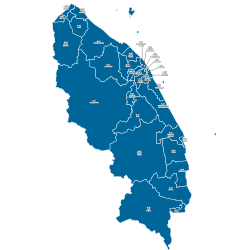
PAS' electoral base is largely centered around Peninsular Malaysia's rural and conservative northern and eastern coasts, particularly in the states of Kelantan, Kedah, Perlis, Terengganu and Pahang. They also gained significant support in the rural areas of Perak and Malacca. PAS helped the coalition sweep the northwestern and eastern coastal states of Peninsular Malaysia in a landslide, winning every parliamentary seat in the states of Perlis, Kelantan and Terengganu, and all but Sungai Petani in Kedah.
Key people
Muhammad Sanusi Md Nor and Abdul Hadi Awang, two important figures responsible for the Green Wave in Malaysian politics (particularly in Peninsula Malaysia).
"BN's victory shows that the coalition has blocked the "green wave" that the other coalition (PN) has been promoting and championing for several months."
Some critics argued that green wave is a tactical move meant to put fear in the hearts of people, especially non-Malays, by bringing up images of radical fundamentalism.[13] Perikatan Nasional information chief Azmin Ali has claim that the reason PN did well in the 2022 general election was because their policies benefit the people of every race when they were the ruling coalition from 2020 until 2021.[14]Lim Guan Eng, former Secretary-General and current Chairman of Democratic Action Party (DAP), said that the green wave is very dangerous and that they will demolish Indian temples and forbid people from going to concerts. He subsequently denied the claims by saying that his statement was misinterpreted and twisted by the media.[15][16] Many opposition politicians, including PAS Secretary-General Takiyuddin Hassan condemned his statements and said that decisive action should be taken by the authorities and Home Ministry of Malaysia on Lim.[17] After BN victory in Pelangai seat, BN Pahang's chief, Wan Rosdy Wan Ismail said that the "green wave" was blocked by BN and the community didn't support the PN coalition despite they played up various sentiments, perceptions and slander like 3R issues (religion, race and royalty).[18]
The co-operation between Pakatan Harapan and Barisan Nasional left many supporters of both alliances disillusioned. Malay voters who had previously voted for Barisan Nasional and UMNO in particular, dissatisfied with UMNO president Ahmad Zahid Hamidi and the party's cooperation with the Chinese-dominated Democratic Action Party transferred their votes to Perikatan Nasional.
During the 2022 general election, Pakatan Harapan and Barisan Nasional combined won 35% of the Malay vote; Perikatan Nasional 65%. In the 2023 state elections, the ratio had shifted further in favour of Perikatan Nasional; 30% to 70%. The state elections also left UMNO with no elected representatives at the state level in Kedah and Terengganu; PAS had won all 32 seats in the state, for the first time in its history.[19]
Social media and the youth vote
The 2022 general election was the first to be held following the constitutional amendment that lowered the voting age from 21 to 18 was passed in 2019, resulting in 6 million new voters. Of the 21.1 million eligible voters in total, 1.4 million were aged between 18 and 20.[20] Social media is generally understood to have played a considerable role in the election, being employed by political parties as a method of courting first-time voters.[21]
A post-election study by Malaysiakini found that young voters aged between 18 and 39 were more supportive of Perikatan Nasional at 37%, than Pakatan Harapan at 35%, and Barisan Nasional at 23%, and attributed the Green Wave to youth votes.[22] Similarly, political analyst Bridget Welsh attributed part of Perikatan Nasional's success in the election to its use of social media and TikTok in particular,[23] though political scientist Ooi Kok Him noted that Perikatan Nasional relied on content ostensibly coming from third-parties.[21]
Impact on the 2022 Malaysian general election and state elections
Results for 2022 general election. PN swept all the seats in northeast and northwest Peninsular Malaysia except Sungai Petani.
The Perikatan Nasional (PN) coalition, comprising the Malaysian Islamic Party (PAS), Malaysian United Indigenous Party (BERSATU) and Malaysian People's Movement Party (GERAKAN), won 74 seats in the Malaysian lower house, becoming the second largest coalition in Dewan Rakyat after PH. PAS had the most number of elected members in the Dewan Rakyat with 43 members, while BERSATU had 31 members. Most of the seats that had been captured by PN have more than 70% registered Malay voters.
In the state level, PN won all but one seat in Perlis, denied the BN dominance in Pahang and won the most seats in Perak.
The incumbent Barisan Nasional (BN) coalition faced a historic wipeout for first time in Perlis and second time in national level,[note 1] winning no seats. The PN coalition won 14 of the 15 seats, achieving a supermajority and formed the first ever non-BN government in the state's history. PH won the remaining seat and became the sole opposition.
The election resulted in a hung assembly with PN winning 17 seats, the same number of seats won by the incumbent BN coalition. It ended BN's dominance in the state. PH won the remaining 8 seats.
The election resulted in a hung assembly. Although PN won 26 seats, it did not have enough seats to form a majority. PH won 24 seats and the incumbent BN coalition won the remaining 9 seats.
The Perikatan Nasional (PN) coalition won 146 seats out of 245 seats that were contested in 2023 state elections. The coalition won all seats in Terengganu, and gained a supermajority in Kedah and Kelantan. It also denied the PH-BN coalition's supermajority in Selangor, and became the main opposition for the first time in Negeri Sembilan.
The Barisan Nasional (BN)–Pakatan Harapan (PH) electoral pact won the election by capturing 34 of 56 seats, with PH winning 32 of those seats and BN winning 2 seats. The Perikatan Nasional (PN) coalition won the remaining 22 seats to become the main opposition in the state assembly.
The governing PN coalition led by Malaysian Islamic Party (PAS) won 43 of 45 seats, achieving a supermajority and continuing PAS's dominance in the state since 1990. The BN–PH electoral pact won the remaining two seats, with BN and PH each winning one seat and becoming the main opposition in the state assembly.
The PN coalition led by PAS won all 32 seats, recording the first clean sweep in the state's history since 1978. BN lost all the 10 seats it had prior to the election. This left the state assembly with no elected opposition representatives.
The BN–PH electoral pact won 31 of 36 seats, achieving a supermajority, with PH winning 17 of those seats and BN winning 14 seats. Although neither coalition had a majority, their electoral pact allowed them to form the majority. The PN coalition won the remaining 5 seats and became the main opposition in the state assembly.
The governing PN coalition led by PAS won 33 of 36 seats, achieving a supermajority. PH won the remaining three seats for the BN–PH electoral pact. This meant for the first time in the state's history, BN would have no representation in the state assembly. PH took BN's place as the state's main opposition.
The BN–PH electoral pact won 29 of 40 seats, with PH winning 27 of those seats and BN winning 2 seats. The PN coalition won the remaining 11 Malay-majority seats to become the main opposition in the state assembly.
The PH candidates for both seats managed to defend the seats in a straight contest with PN. However, PN managed to reduce the majority of votes won by PH.[24][25]
This page is based on this Wikipedia article Text is available under the CC BY-SA 4.0 license; additional terms may apply. Images, videos and audio are available under their respective licenses.