The party is a founding and principal component of the then governing Perikatan Nasional (PN) coalition which came to power amid the 2020–21 Malaysian political crisis. The party governs either solely or as coalition partners in the states of Kelantan, Terengganu, Kedah and Perlis. In the past, it was a coalition partner in the state governments of Penang and Selangor as part of the federal opposition between 2008 and 2018.
Since the 2022 general election, the party holds 43 of the 222 seats in the federal Dewan Rakyat, being the largest individual party, and has elected parliamentarians or state assembly members in 11 of the country's 13 states. Internationally, PAS is affiliated with the Muslim Brotherhood.[4]
History
Origins
The post-World War II period, while Malaya was still under British colonial rule, saw the emergence of the country's first formal Islamic political movements. The Malay Nationalist Party (MNP), a left-wing nationalist organisation, was formed in October 1945 and led by Burhanuddin al-Helmy, who would later become the third president of PAS. Out of the MNP arose the Pan Malayan Supreme Islamic Council (Majlis Agama Tertinggi Sa-Malaya or MATA) in 1947, and MATA in turn formed the party Hizbul Muslimin (Muslim People's Party of Malaya) in 1948. The central aim of Hizbul Muslimin was the establishment of an independent Malaya as an Islamic state.[7] However, the party did not live beyond 1948. The Malayan Emergency of that year, while a British–Communist dispute, saw the colonial administration arrest a number of the party's leaders, and the nascent group disbanded. Nevertheless, the party served as a forerunner to PAS, supplying both the ideology upon which PAS was formed and some of PAS's key leaders in its early years.[8]
Party formation
the old PAS logo before it was banned by The Registry of Societies Malaysia (ROS) in 1971
PAS was founded on 24 November 1951, as the Persatuan Islam Sa-Malaya (Pan Malayan Islamic Union) at a meeting in Butterworth, Penang. Shortly after it was renamed Persatuan Islam sa-Tanah Melayu (Tanah Melayu means "Land of the Malays" and was used instead of Malaya as "Malaya" had colonial connotations).[9][10] In English, it became known as the Pan Malayan Islamic Party (PMIP) before the 1955 election as the registrar of society required it to incorporate the word "party" into its name.[11] Its acronym PAS, originally used in Malay but became more widely adopted in the 1970s, is based the written form in Jawi (ڤاس).[12]
The formation of the party was the culmination of a growing desire among Muslim clerics within the United Malays National Organisation to formalise a discrete Islamic political organisation. However, the lines between UMNO and the new party were initially blurred. PAS allowed dual membership of both parties, and many of its early senior leaders were also UMNO members. The party's first president was Ahmad Fuad Hassan, an UMNO cleric. He lasted in the position only until 1953, when he fell out of favour with the party, which was now developing a more distinct identity, and returned to the UMNO fold. Fuad's departure coincided with the end of dual membership.[13] The party turned to Abbas Alias, a Western-educated medical doctor, as its second president, although he did not play an active role in the party and was little more than a nominal figurehead.[14]
The party's first electoral test was the pre-independence 1955 election to the Federal Legislative Council, the body that preceded the national parliament. 52 single-member seats were up for election; PAS fielded 11 candidates. Hampered by a lack of funds and party organisation, PAS succeeded in having only one candidate elected: Ahmad Tuan Hussein, a teacher at an Islamic school in Kerian, Perak. He was the only opposition member of the council; the other 51 seats were won by members of the Alliance coalition between UMNO, the Malaysian Chinese Association and the Malaysian Indian Congress. PAS' performance in the election weakened its hand in negotiations with the British over the terms of Malayan independence. Its advocacy for the protection of Malay and Muslim rights, including the recognition of Islam as the country's official religion, was ignored. Alias stepped down from the presidency in 1956, handing it voluntarily to the radical nationalist Burhanuddin al-Helmy.[15] This change exemplified a broader trend among PAS's leadership in the late 1950s: the party's upper echelons gradually became filled with nationalists and long-time UMNO opponents, replacing the UMNO clerics who had initially led the party.[16]
Left-wing Islamism
Burhanuddin al-Helmy, a prominent anti-colonialist, steered PAS in a socialist and nationalist direction and set about strengthening the party's internal structure and geographic reach. In the 1959 election, Malaya's first since independence, the party's focus on rural constituencies, especially in the north, paid off. Thirteen PAS candidates were elected to the 104-member House of Representatives, and the party took control of the legislative assemblies of the northern states of Kelantan and Terengganu.[17][18]
However, Burhanuddin's leftist pan-Islamism, under which PAS sought greater ties between the Muslim peoples of Malaya and the Indonesian archipelago, soon led the party into a wedge. The Indonesia–Malaysia confrontation of 1963–66 turned popular Malayan opinion against Indonesia. PAS's attacks on Tunku Abdul Rahman's Alliance government for seeking Western assistance during the confrontation, and the party's continued support for Southeast Asian pan-Islamism, led to a loss of support in the 1964 election. The party's parliamentary cohort was reduced to nine.[19] The party became further marginalised the following year, when Burhanuddin was detained without trial under the Internal Security Act on allegations that he had collaborated with Indonesia.[20]
Political circumstances in the country had changed by the 1969 election. The Konfrontasi had ended, Burhanuddin had been released from custody but was too ill to campaign actively, and the Alliance coalition was suffering from internal division as well as unpopularity. PAS' vote rose to over 20 percent of the national electorate, netting the party 12 seats in Parliament.[21] However, the parliament would not convene until 1971 as the 13 May race riots resulted in the declaration of a state of emergency. The country would be run by a National Operations Council for the following two years. In the meantime, Burhanuddin died in October 1969 and was replaced as PAS' president by his deputy, Asri Muda.[22]
Pivot to Malay nationalism
Asri came to the presidency having been PAS's de facto leader during Burhanuddin's long illness.[23] But this did not mean a seamless transition for the party. While Burhanuddin had been sympathetic to left-wing causes and parties in Malaysia, Asri was first and foremost a Malay nationalist, and was hostile to leftist politics. One of his first acts as President of PAS was to part ways with the party's opposition allies on the left, such as the Malaysian People's Party. Ideologically, Asri's presidency would see the party shift markedly away from the pan-Islamism of Burhanuddin. The party became principally concerned with the protection and advancement of the rights of ethnic Malays.[24] The party's activities also became solely focused on party politics, as reflected in the change of its Malay name in 1972 from the "Persatuan Islam sa-Tanah Melayu " (Pan-Tanah Melayu Islamic Association) to the "Parti Islam Se-Malaysia" (Pan-Malaysian Islamic Party, but commonly referred to as Parti Islam, or PAS).[25][10]
However, Asri's most radical change was still to come. In January 1972, he announced that PAS would be joining the Alliance coalition (which would soon rebrand itself as Barisan Nasional) as a junior partner to its main rival UMNO. The move was controversial within PAS, and some of its members and senior leaders either left the party or were purged by Asri. Asri's principal justification for joining UMNO in a coalition government was that after the 1969 race riots, Malay unity was paramount, and that this required a partnership between the country's two ethnic-Malay political parties. Asri himself was given a ministerial position in the cabinet of prime minister Abdul Razak Hussein.[26]
The 1974 election saw PAS competing under the Barisan Nasional banner for the first and only time. The party won 14 parliamentary seats to UMNO's 62, cementing PAS's position as the junior of the coalition partners. PAS also found itself governing in coalition in Kelantan, which it had previously governed in its own right. PAS's vote in its northern strongholds was weakened by a loss of support to both its former opposition allies and renegade PAS candidates running on anti-Barisan Nasional tickets.[27] Ultimately, it was Kelantan, Asri's home state and the base of political power, that would trigger the downfall of the UMNO–PAS partnership. After a conflict between Asri and the UMNO-favoured chief minister of the state, Mohamed Nasir, over investigations that Nasir initiated into Asri's financial dealings, Asri mobilised the PAS members of the Kelantan State Legislative Assembly to move a no-confidence motion against Nasir. The UMNO assemblymen staged a walk-out, abandoning Asri, driving an irreparable wedge through the coalition and causing a political crisis in the state. The federal government declared an emergency in the state, allowing it to take control. Asri withdrew PAS from Barisan Nasional in December 1977.[28]
The 1978 election underscored how disastrous PAS's foray into the Barisan Nasional had been. The party was reduced to five parliamentary seats and, in separate state-level elections in Kelantan, was routed by UMNO and the Pan-Malaysian Islamic Front (BERJASA), which Nasir had founded after leaving PAS. The party's fortunes in the Kelantan election were not helped by a ban on public election rallies; while the Barisan Nasional was able to campaign through a compliant mass media, public talks were the principal way in which PAS could reach voters.[29] PAS fared little better in the 1982 election. In the face of a new prime minister, Mahathir Mohamad, and the decision of the popular Islamist youth leader Anwar Ibrahim to join UMNO instead of PAS, the party was unable to improve on its five parliamentary seats and failed to regain government in Kelantan. Meanwhile, the 1978 to 1982 period coincided with the rise of a new generation of leaders within the party, including foreign-educated Muslim clerics (or "ulama") such as Nik Abdul Aziz Nik Mat and Abdul Hadi Awang. This group sought to reorient PAS as an Islamist party and were fundamentally hostile to UMNO, whose Malay nationalist focus they saw to be at the expense of Islam.[30] In 1980 the group succeeded in electing Yusof Rawa to the deputy presidency of the party, ousting the Asri loyalist Abu Bakar Omar.[31] By the time of PAS's 1982 assembly, it was clear to Asri that the ulama faction had the numbers to defeat him. He resigned on the floor of the assembly, and subsequently attacked the party through the media, leading to his expulsion and the formation of splinter party, Parti Hizbul Muslimin Malaysia (HAMIM) by Asri in 1983.[32] The following year, in 1983, Yusof was elevated to the presidency, unopposed.[33]
Ulama takeover
The ulama who took over PAS in 1982 drew from the 1979 Iranian revolution for inspiration in establishing an Islamic state; Yusof Rawa himself had served as Malaysia's Ambassador to Iran in the years preceding the revolution. Yusof openly rejected the Malay nationalism that characterised both UMNO and PAS under Asri Muda, considering it a narrow and ignorant philosophy that was contrary to the concept of a Muslim ummah.[34] As if to exemplify the shift in the party's ideological outlook under Yusof and his ulama colleagues, the party's new leaders adopted a more conservative and religious form of dress, abandoning Malay and western clothing for traditional Arab religious garb.[35] Politics between UMNO and PAS became increasingly religious in nature. The Barisan Nasional government tried to counter the possible electoral appeal of PAS's Islamisation by creating a number of state-run Islamic institutions, such as the International Islamic University of Malaysia. PAS leaders responded by labelling such initiatives as superficial and hypocritical, UMNO leaders as "infidels", and UMNO as the "party of the devil".[36]
The increasingly divisive rhetoric between UMNO and PAS produced deep divisions in Malay communities, especially in the northern states. Sometimes the divisions became violent, the most infamous example being the 1985 Memali incident, in which the government sanctioned a raid on a village led by the PAS cleric Ibrahim Libya, which left 14 civilians and four policemen dead.[37] It was against this backdrop that the PAS ulama faced their first general election in 1986. The result was a whitewash for the Barisan Nasional coalition. PAS recorded its worst-ever election result, retaining only one seat in Parliament. PAS, in recovering from the defeat, had no choice but to retreat from its hardline Islamism and pursue a moderate course.[38] By 1989, Yusof had become too ill to remain as PAS's president, and was replaced by his deputy, Fadzil Noor, another member of the ulama faction that now dominated the party.[39]
While not abandoning PAS's ideological commitment to the establishment of an Islamic state, Fadzil Noor moderated the party's rhetoric. He also set about infusing the party's membership with young urban professionals in an attempt to diversify the leadership ranks beyond religious clerics.[23] The 1990s also saw PAS engage in international Islamist movements. Abdul Hadi Awang became active in a number of international Islamic organisations and delegations, and Islamist parties abroad sent delegations to Malaysia to observe PAS.[40]
The first electoral test of Fadzil's presidency was the 1990 election, which occurred against the backdrop of a split in UMNO out of which the Semangat 46 opposition party was formed. PAS joined Semangat 46 and two other Malay parties in the United Ummah Front ("Angkatan Perpaduan Ummah"), and won seven parliamentary seats. The new coalition swept the Barisan Nasional from power in Kelantan, winning all of its state assembly seats. Nik Abdul Aziz Nik Mat, a cleric who played a leading role in the 1982 takeover of the party, became Kelantan's Chief Minister, and would remain in the position until his retirement in 2013.[41] One of the first acts of the PAS-led government in Kelantan was to seek to introduce hudud, a criminal punishment system for particular Islamic offences. The move was abandoned after it became clear that the law could not be enforced over the objections of the federal government.[42]
PAS retained its seven parliamentary seats and the government of Kelantan in the 1995 election while all other opposition parties lost ground.[43] By the time of the next election in 1999, circumstances external to PAS had changed its fortunes for the better. The 1997 Asian financial crisis split the Barisan Nasional government between supporters of the Prime Minister, Mahathir Mohamad, and his deputy, Anwar Ibrahim. Mahathir's sacking and subsequent detention without trial of Anwar in 1998 provoked widespread opposition, which PAS capitalised on more than any other opposition party. The party ran a sophisticated campaign for the 1999 election, taking advantage of the internet to bypass restrictions on print publications and managing to woo urban professional voters while retaining its traditional rural support base. For the first time, PAS joined the centre-left and secular Democratic Action Party in the Barisan Alternatif coalition which included the new party Keadilan, which was formed by Wan Azizah Wan Ismail, the wife of the now imprisoned Anwar. It resulted in PAS's second best electoral performance (behind those of 2022 general election). The party took 27 of 192 parliamentary seats and had landslide state-level victories in Kelantan and Terengganu.[44]
PAS in the Pakatan Rakyat
The death of Fadzil Noor in 2002, and his replacement by the conservative cleric Abdul Hadi Awang, coincided with a period of division within the party between its younger and professional leaders, who sought to make PAS's Islamist ideology more appealing to mainstream Malaysia, and its conservative, and generally older, clerics. The party was unable to reconcile the views of the two factions with a coherent definition of the "Islamic state" that the party's platform envisioned.[23] The debate itself caused the DAP to break with the Barisan Alternatif coalition; as a secular party with mainly an ethnic Chinese support base, it could not support the vision of an Islamic state propagated by PAS's conservatives. PAS also found itself losing Malay support following the replacement of Mahathir as Prime Minister with Abdullah Badawi, a popular and moderate Muslim, and post-September 11 fears among the electorate about radical Islam in Southeast Asia.[45] If the 1999 election had been the party's zenith, the 2004 poll was one of the lowest points in its history. In an expanded Parliament, PAS was reduced to seven seats. Abdul Hadi not only lost his parliamentary seat but saw the government he led in Terengganu thrown from office after one term.[46]
The response of PAS to the 2004 election, like its response to the similar 1986 wipeout, was to abandon the hardline image that had contributed to its defeat. By now, the urban professional wing of the party's membership, brought into the party by Fadzil Noor in the 1990s, was ready to take charge. While Abdul Hadi's presidency was not under threat, the moderate faction, known as the "Erdogans" after the moderate Turkish Islamist leader Recep Tayyip Erdogan, had its members voted into other key positions in the party's 2005 general assembly.[23][47] PAS was now able to attack Abdullah Badawi's government from both the right and the left: on the one hand, it criticised Abdullah's promotion of Islam Hadhari as a watered-down version of Islam; on the other, it attacked the government for its human rights record and promoted the causes of social and economic justice, including for non-Muslims. The party also capitalised on the growth of the internet and social media in Malaysia to bypass the pro-government mass media.[48]
Ahead of the 2008 election PAS joined the DAP and Anwar Ibrahim's Keadilan, which was now known as People's Justice Party (PKR) in a new coalition, Pakatan Rakyat. The coalition handed the Barisan Nasional its worst-ever election result. Barisan Nasional lost its two-thirds majority in the House of Representatives, disabling it from passing constitutional amendments without opposition support. PAS won 23 seats; the Pakatan Rakyat as a whole won 82. At state level, decades-old Barisan Nasional governments fell in Kedah, Perak and Selangor. PAS now governed Kedah and Kelantan (led respectively by Azizan Abdul Razak and Nik Abdul Aziz Nik Mat) and supplied the Chief Minister of Perak (Nizar Jamaluddin) in a Pakatan Rakyat coalition government.[49]
PAS's 2009 general assembly saw latent fissures within the party come out into the open. The incumbent deputy president Nasharudin Mat Isa, a Malay nationalist who promoted greater co-operation between PAS and UMNO, was challenged by two moderate candidates.[50] Nasharudin survived with the backing of the conservative ulama faction; his two opponents had split the moderate vote. But at the 2011 assembly, Nasharudin was not so lucky: Mohamad Sabu, a leading moderate close to Anwar Ibrahim, commanded the support of the "Erdogan" wing and toppled him. Sabu's election was a significant defeat for the ulama faction. He was the first non-cleric to serve as the party's deputy president in over 20 years.[51]
The Pakatan Rakyat coalition went into the 2013 election facing Najib Razak, who had replaced Abdullah as Prime Minister in 2009 but failed to improve the government's fortunes, especially among urban voters. PAS made a concerted effort to expand its voter base beyond the northern peninsula states, and campaigned heavily in Johor, where it had never won a parliamentary seat. The election witnessed a significant degree of cross-over ethnic voting: Chinese voters in Malay-majority seats decided in large numbers to support PAS, to maximise the chances of a national Pakatan Rakyat victory. Pakatan Rakyat garnered 50.8 percent of the national popular vote but could not win a majority in parliament.[52] PAS, however, suffered a net loss of two parliamentary seats. This was principally attributable to a swing against the party in Kedah, where the party was removed from state government after one term and lost four parliamentary seats.[53]
Splintering and right-ward shift
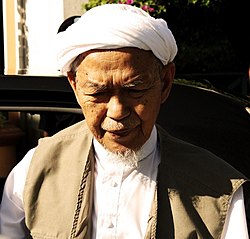
When PAS saw its share of seats shrink in the 2013 election, it started to reassert its Islamic agenda.[54] The passing of spiritual leader Nik Abdul Aziz Nik Mat in 2015 –who was known to be sympathetic and friendly to non-Malays and non-Muslims– shifted PAS more to the right-wing.[2] In the meantime, DAP criticised its president Abdul Hadi Awang for pushing a bill on hudud without consulting his opposition partners. This incident led to the DAP announcing in March 2015 that it would no longer work with the PAS leader. The rift worsened after conservatives captured PAS leadership, as progressive leaders endorsed by the late Nik Aziz were voted out of office in party elections, characterised by the media as an intentional wipe out and purge,[55][56] members of this progressive faction left and splintered as the National Trust Party (Parti Amanah Negara, PAN) helmed by Mohamad Sabu. The now purged PAS accepted a motion by its conservative ulama wing to sever ties with DAP.[57][2] In response, DAP's Secretary-General Lim Guan Eng said that the Pakatan Rakyat coalition had ceased to exist.[58] The coalition was replaced by Pakatan Harapan, which the newly formed PAN joined as a founding member.
The party formed Gagasan Sejahtera with Malaysia National Alliance Party (IKATAN) in 2016,[59] with BERJASA joining the coalition the same year. The coalition entered the 2018 Malaysian general election using the PAS logo and contested 158 seats, with PAS contesting 155 of them.[60] The coalition was able to win 18 parliamentary seats as well as wrangle control of the state of Terrenganu from BN, which PAS had last ruled in 2004, in addition to retaining control of Kelantan and denying the BN state government a supermajority in Pahang. They also managed to flip a large number of state seats held by BN in Kedah.[61] However, PAS was the only party from the coalition to win any seats as both BERJASA and IKATAN remained without representation.
During the 2020–2022 Malaysian political crisis, sparked by Mahathir's abrupt resignation and his party's exit from the Pakatan Harapan coalition, PAS initially pledged its support for Mahathir to remain as prime minister as part of an alternative coalition to Pakatan Harapan, specifically excluding DAP. When Mahathir revealed his intentions to form a broad unity government, the party, alongside UMNO, with which it had formed an alliance known as National Concord in 2019,[64] retracted their support and called for the dissolution of parliament.[65][66] Ultimately, PAS entered the federal government as part of Perikatan Nasional[67]under prime minister Muhyiddin Yassin and later Ismail Sabri Yaakob.
In the Muhyiddin cabinet, three ministerial and five deputy ministerial positions were allocated to PAS members of parliament.
In the 2022 general election, PAS emerged as the largest party in parliament with 43 seats. However, the Perikatan Nasional alliance as a whole only managed to secure 74 seats, coming in second. Unlike its erstwhile ally UMNO, the party refused to join the "unity government" formed by Anwar Ibrahim. PAS gained its first elected representative in East Malaysia in the 2025 Sabah state election.
The Terengganu police have announced an investigation into a controversial parade organised by the local PAS Youth group, which took place on 19 February 2023. The police were initially informed about the march but were not aware that some supporters would be carrying replica weapons, raising concerns among certain groups. DCP Datuk Rohaimi Md Isa, the police chief, stated that preliminary investigations will be conducted to determine whether any offences were committed during the event, and appropriate action will be taken accordingly.
Images circulating on social media showed members of Terengganu PAS Youth dressed in medieval Islamic war attire and wielding fake swords, spears, and shields. The parade was reportedly part of a two-day gathering called "Himpunan Pemuda Islam Terengganu" (Himpit), held at a resort in Setiu, Terengganu. Religious Affairs Minister Datuk Dr Mohd Na’im Mokhtar criticised the parade, stating that it presented an inappropriate image of Islam and emphasising the importance of promoting peace and unity in society. He also called for authorities to investigate any potential legal violations.
Furthermore, social media photos depicted a pickup truck carrying a large fake sword, with youths dressed in militant costumes standing on its cargo bed while it was in motion.[68][69]
Unconstitutional Kelantan Syariah Law amendment
Sisters in Islam had criticized PAS for unconstitutional Shariah enactment on the recent update of the Shariah law of the Kelantan penal code including:
attempting to convert out of Islam
distortion of Islamic teachings
disrespecting the month of Ramadan
destroying houses of worship
disobeying parents
tattooing
undergoing plastic surgery.
This has sparked another controversy where the punishments include a jail term of not more than three years and a fine of up to RM5,000 or six strokes of the cane, and that the punishment is categorized under ta'zir (crimes with discretionary punishments) and not under hudud (Islamic Penal Code).[70][71]
Flight attendant uniform criticism
PAS had sparked another controversy where several of its lawmakers criticised flight stewardess uniform attire they claimed that it is "too revealing" and added that flight stewardesses must be allowed to wear a hijab. Following those two statements, Sisters in Islam (SIS) said the issue had taken priority over other concerns somehow and they claim that ministerial directives should not interfere with a company's policy which may subject to extra rebranding and production costs unless there were issues of safety, health and security. National Union of Flight Attendants Malaysia vice secretary-general S Shashi Kumar also publicly stated that this complaint is "nonsensical" when he said the baju kebaya has become a fashion statement in southeast Asia. He said, "Royal Brunei Airlines, Singapore Airlines and Garuda Indonesia have adopted the baju kebaya as the uniform for their female flight attendants." Transport minister Anthony Loke had said “We are aware that this is not a new policy and there is nothing new, but there are no plans to change the existing policies on the dressing of stewards and stewardesses. The image and outfit depend on the airline company.".He added that “The Ministry has no restriction if Muslim air stewardesses choose to wear attire that is Syariah compliant as long as it fulfils the criteria set by CAAM," It looks like PAS leaders lack knowledge of the Malay heritage and criticising their traditional attire, responded the Global Human Rights Federation.[72][73][74][75]
Timah whiskey
Following the fame of Malaysia's local liquor company, Timah Whiskey after winning two silver medals in the Tasting Awards for the International Spirits Challenge 2020 (ISC) as well as the Annual San Francisco World Spirits Competition 2020 (SFWSC), PAS urged Ismail Sabri Yaakob's Cabinet for the company to be shut down stating that it "to prevent triggering the sensitivity of Muslims in the country" and "to avoid a precedent of new liquor companies emerging". PAS also states that they had to face numerous severe backlash. PAS Deputy President, Tuan Ibrahim Tuan Man, said that "We have always been consistent in our stance against alcohol because it is clear that it is haram according to the Quran,".[76][77][78]
The request was denied by Ismail Sabri Yaakob's Cabinet where they had decided to rule against the decision. Prime Minister Ismail Sabri Yaakob state that the "cannot cause concern to the people in the context of race and religion". PAS Deputy President, Tuan Ibrahim Tuan Man, states "For me, the ' people's anxiety ' can be considered as ' the confusion of the people, especially the Malay-Muslims ' ". Tuan Ibrahim was also reported by the media on October 19 as saying that the brand and logo of Timah whiskey "can be confusing" and asked for it to be reviewed.[79][80]
English language criticism
PAS president Abdul Hadi Awang has claimed that people who advocate for the English language to be taught in Malaysia are "stuck in a colonial mindset". Expanding on this point, he said such Malaysians seemed to be embarrassed to use their national language (Malay) and had placed greater importance on English. In the PAS party newspaper, Harakah Hadi wrote an article titled "Ignore the delirious voices which are trying to reduce the importance of the Malay language" where in it he stated that such advocates "are behaving like slaves to the former colonial masters despite having been freed from their clutches". Additionally in the same article he further went on to say that "advertisements in shops and the market, as well as the names of cities and roads, are named in English even though a majority of its target audience does not know English, at the same time, they do not care about whether their audiences consist of Malaysians who do not know English".[81][82][83]
Ideology
flag of PAS, occasionally flown along the official full-moon-on-a-green-field flag
According to Farish A. Noor, a Malaysian academic who has written a complete history of PAS:
From the day PAS was formed, in November 1951, the long-term goal of creating an Islamic state in Malaysia has been the beacon that has driven successive generations of PAS leaders and members ever forward. What has changed is the meaning and content of the signifier 'Islamic state'[84]
From time to time, PAS's pursuit of an "Islamic state" has involved attempts to legislate for hudud—an Islamic criminal justice system—in the states that it governs.[85] Such laws would apply to all Muslims and would not apply to non-Muslims. PAS-dominated state assemblies in Kelantan and Terengganu passed hudud laws in the early 1990s and early 2000s respectively, although neither has ever been enforced due to opposition from the federal government.[86] PAS returned to its pursuit of hudud laws after the 2013 election, signalling that it would table bills in the federal Parliament to allow the laws, still on the statute books in Kelantan, to be enforced. The bills would require a two-thirds majority in the Parliament as they involve constitutional amendments.[87]
After PAS's electoral rout in 2004, the party sought to broaden its policies beyond Islamism. Among other things, the party focused on calling for improved civil liberties and race relations. However, these policy shifts have proven controversial within the party; conservatives have considered them part of a dilution of PAS's commitment to an Islamic state.[88][89]
When PAS was defeated in Terengganu, enforcement of female dress codes was reduced. The state PAS government in Kelantan banned traditional Malay dance theatres, banned advertisements depicting women who are not fully clothed, and enforced the wearing of headscarves. However, they allowed gender-segregated cinemas and concerts. Some government-controlled bodies pressure non-Muslims also to wear headscarves, and all students of the International Islamic University of Malaysia and female officers in the Royal Malaysian Police are required to wear headscarves in public ceremonies.[90]
The PAS party wishes that the death penalty be enacted for Muslims who attempt to convert, as part of their ultimate desire to turn Malaysia into an Islamic state.[91] The party is also against the government-backed wave of Anti-Shi'a persecution.[92]
Connections with the Muslim Brotherhood
PAS has also maintained close personal and ideological ties with the Egyptian Muslim Brotherhood.[4] The party's relationship with the Muslim Brotherhood dates back to the 1940s when PAS's founders were exposed to the ideas and teachings of the Muslim Brotherhood while they were studying in Cairo during the 1940s. According to Wan Saiful Wan Jan of the think tank Institute for Democracy and Economic Affairs, the Muslim Brotherhood regards PAS as a model for a successful Muslim political party; since PAS has governed the state of Kelantan continually since 1990. PAS representatives are often invited to Muslim Brotherhood speaking engagements overseas. In 2012, PAS President Abdul Hadi Awang spoke alongside Muslim Brotherhood scholar Sheikh Yusuf al-Qaradawi at a speaking event in London.[93] That same year, PAS representatives met with Muslim Brotherhood leaders Sheikh Mahdi Akif and Dr Muhammad Badie in Cairo.[5]
According to Müller, PAS's current generation of leaders, the Ulama Leadership (Kepimpinan Ulama) was also influenced by Muslim Brotherhood ideology while studying in Egypt, Saudi Arabia and India during the 1980s. Muslim Brotherhood–inspired Islamic education methods (tarbiyah) and regular study circles (usrah/halaqah) were systematically introduced while networks were established with Muslim political parties and movements abroad.[94] In April 2014, Awang criticised the governments of Saudi Arabia, Bahrain, and the United Arab Emirates for designating the Muslim Brotherhood as a terrorist organisation.[5] In January 2016, former PAS leader Mujahid Yusof Rawa claimed that the Muslim Brotherhood's influence on PAS was limited to sharing the organisation's views on the role of Islam in society. Rawa also claimed that other local Muslim groups such as Angkatan Belia Islam Malaysia (ABIM; Muslim Youth Movement of Malaysia) and IKRAM were also sympathetic to the Muslim Brotherhood.[95]
Support for the Taliban
After the Talibantook over Kabul in 2021 and re-established an Islamic theocracy in Afghanistan, PAS international affairs and external relations committee chairman, Muhammad Khalil Abdul Hadi (also the son of the incumbent PAS president), congratulated the Islamist militant group for "successfully achieving victory for their country" on Twitter and Facebook, stating its liberation from Western powers.[96]
The victory and ‘independence’ achieved this time is the result of the efforts of all Afghans to liberate their homeland which for 20 years has been colonised and invaded without mercy and humanity that almost destroyed Afghanistan.
—Muhammad Khalil Abdul Hadi, PAS international affairs and external relations committee chairman, Harakah
In August 2021, Khalil also added that the Taliban had also become more moderate, spuriously claiming that women's rights (including women's freedom of movement) and the opportunities for women in the workforce were preserved.[97] The unsubstantiated comments were widely condemned by numerous Malaysian social media users, and Muhammad Khalil Abdul Hadi's pro-Taliban posts on Facebook and Twitter were taken down in response.[98][99] In March 2022, numerous independent news reports indicated that women and girls in Afghanistan were deprived (by decrees from the Taliban) from their ability to work, study or move freely within the country.[100][101][102][103]
In October 2021, the leader of PAS's youth wing, Khairil Nizam Khirudin, proposed closer ties between PAS and the Taliban. He claimed that if China was able build ties with the Taliban, Malaysia should also do so.[104]
In February 2022, PAS president Abdul Hadi Awang described media outlets such as Malaysiakini as anti-Islam and alleged that they had slandered the Taliban by reporting that it was denying girls and women the right to education.[114] The Taliban had banned girls from obtaining a formal education in the 1990s. In March 2022, the Taliban reneged on its promise to open secondary schools for girls, eliciting condemnation.[115][116]
PAS's general assembly ("Muktamar") elects the party's president, deputy president, three vice presidents and a multi-member Central Working Committee. The assembly is held annually, but elections occur only once every two years. The assembly is composed mainly of delegates elected by individual local divisions of the party.[117] The day-to-day administration of the party is carried out by its Secretary-General, a position appointed by the party's leadership.[118] The Central Working Committee is ostensibly the party's principal decision-making body, although its decisions are susceptible to being overturned by the Syura Council, an unelected body composed only of Muslim clerics and led by the party's Spiritual Leader ("Musyidul 'Am").[119] The relationship between the different administrative bodies within the party occasionally causes conflict. In 2014, the Central Working Committee voted to support the nomination of Wan Azizah Wan Ismail, the President of the People's Justice Party, to be the Chief Minister of the Pakatan Rakyat government in Selangor. Abdul Hadi Awang, as PAS's president and with the backing of the Syura Council, overturned the decision and nominated different candidates.[120]
The party has three recognised sub-organisations for different categories of party members: an ulama wing (the "Dewan Ulama") for Muslim clerics, a women's wing (the "Dewan Muslimat") and a youth wing (the "Dewan Pemuda"). Each wing elects its leadership at its general assembly.[120] There is a fourth wing for non-Muslim supporters of the party, although it does not have the same recognised position in the party's structure as the other three wings.[117]
PAS has approximately one million members,[121] more than any other opposition party in Malaysia.[122] PAS members often distinguish themselves from UMNO members through cultural and religious practices. For Islamic headwear, males who support PAS tend to prefer the white, soft kopiah, while UMNO supporters tend to wear the traditional Malay songkok, a rigid black cap.[123] Some areas of Malaysia host rival mosques catering for the members and supporters of each party.[124]
PAS has 146 members of state legislative assemblies, more than any other parties. It has representatives in every assembly outside of Sarawak. The party holds a majority in the Kelantan, Terengganu, Kedah and Perlis State Legislative Assemblies.
↑Liow, Joseph Chinyong; Pasuni, Afif (2014). "Islam, the state and politics in Malaysia". In Weiss, Meredith (ed.). Routledge Handbook of Contemporary Malaysia. Routledge. p.54. ISBN978-1317629597.
↑Osman, Salim (23 August 2013). "Clampdown on Shi'ism in Malaysia a cause for concern". The Jakarta Post. Politics is yet another reason for Malaysia's hardening stance towards the Shi'ites. A small Shi'ite community has emerged in several Kedah districts, upsetting Umno as the Shi'ites support the Islamic Parti Islam SeMalaysia (or Pas-Malaysian Islamic Party, PAS). Word has spread that Shi'ites have infiltrated PAS, and that even some top leaders have become believers. Hence, the current witch hunt in PAS. But PAS and its Kelantan state government are opposed to the anti-Shi'ite campaign.
↑Abdul Hadi, Muhammad Khalil (18 August 2021). "Tahniah kepada rakyat Afghanistan"[Congratulations to the people of Afghanistan]. HarakahDaily (in Malay). Retrieved 29 April 2022.
↑Abdul Hadi, Muhammad Khalil (20 August 2021). "Imej sederhana Taliban mulai diterima rakyat"[The moderate image of the Taliban is starting to be accepted by the people]. HarakahDaily (in Malay). Retrieved 29 April 2022.
↑Awang, Abdul Hadi (25 August 2021). "Taliban yang beristiqamah dan berubah"[The Taliban are steadfast and have changed]. HarakahDaily (in Malay). Retrieved 29 April 2022.
↑PAS successfully proposed PKR MLA Azmin Ali as Menteri Besar during 2014 Kajang Move, after which his party joined Pakatan Harapan in 2015 while PAS never did.
Cited texts
Daniels, Timothy P. (2005). Building Cultural Nationalism in Malaysia: Identity, Representation, and Citizenship. Psychology Press. ISBN0415949718.
Farish A. Noor (2012). "Pan-Malaysian Islamic Party (PAS)". The Princeton Encyclopedia of Islamic Political Thought. Princeton University Press. pp.408–409. ISBN978-1400838554.
Farish A. Noor (2014). The Malaysian Islamic Party 1951-2013: Islamism in a Mottled Nation. Amsterdam University Press. ISBN9789089645760.
Function, John (2006). "The Malay Electorate in 2004: Reversing the Result". In Swee-Hock, Saw; Kesavapany, K. (eds.). Malaysia: Recent Trends and Challenges. Institute of Southeast Asian Studies. pp.132–156. ISBN9812303391.
Hooker, Virginia; Norani Othman (2003). Malaysia: Islam, Society and Politics. ISEAS series on Islam. Institute of Southeast Asian Studies. ISBN9812301615.
Liow, Joseph Chinyong (2009). Piety and Politics: Islamism in Contemporary Malaysia. Oxford University Press. ISBN9780195377088.
Müller, Dominik M. (2014). Islam, Politics and Youth in Malaysia: The Pop-Islamist Reinvention of PAS. Routledge Contemporary Southeast Asia Series. Routledge. ISBN978-1317912989.
Riddell, Peter G. (2005). "Islamization and Partial Shari'a in Malaysia". In Marshall, Paul (ed.). Radical Islam's Rules: The Worldwide Spread of Extreme Shari'a Law. Rowman & Littlefield Publishers. pp.135–160. ISBN1461686903.
Stark, Jan (2004). "Constructing an Islamic Model in Two Malaysian States: PAS Rule in Kelantan and Terengganu". Sojourn: Journal of Social Issues in Southeast Asia. 19 (1) SJ19-1c. Institute of Southeast Asian Studies: 51–75. doi:10.1355/sj19-1c (inactive 1 July 2025). ISSN0217-9520. S2CID145124619.{{cite journal}}: CS1 maint: DOI inactive as of July 2025 (link)
This page is based on this Wikipedia article Text is available under the CC BY-SA 4.0 license; additional terms may apply. Images, videos and audio are available under their respective licenses.