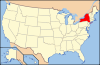
Warren County is a county in the U.S. state of New York. As of the 2020 census, the population was 65,737. The county seat is Queensbury. The county was established in 1813 and is named in honor of General Joseph Warren, an American Revolutionary War hero of the Battle of Bunker Hill. The county is part of the Capital District region of the state.

Glens Falls is a city in Warren County, New York, United States and is the central city of the Glens Falls Metropolitan Statistical Area. The population was 14,830 at the 2020 census. The name was given by Colonel Johannes Glen, the falls referring to a large waterfall in the Hudson River at the southern end of the city.

McLaughlin Motor Car Company Limited was a Canadian manufacturer of automobiles headquartered in Oshawa, Ontario. Founded by Robert McLaughlin, it once was the largest carriage manufacturing factory in the British Empire.

William Crapo Durant was a leading pioneer of the United States automobile industry, founder of General Motors and co-founder of Chevrolet. He created a system in which a company held multiple marques – each seemingly independent, with different automobile lines – bound under a unified corporate holding company. He also founded Frigidaire.

The Brass Era is an American term for the early period of automotive manufacturing, named for the prominent brass fittings used during this time for such features as lights and radiators. It is generally considered to encompass 1896 through 1915, a time when cars were often referred to as horseless carriages.

The Stutz Motor Car Company was an American automobile manufacturer based in Indianapolis, Indiana that produced high-end sports and luxury cars. The company was founded in 1911 as the Ideal Motor Car Company before merging with the Stutz Auto Parts Company in 1913. Due to the pressures of the Great Depression, the Stutz company went defunct in 1938. The Stutz Motor Car Company produced roughly 39,000 automobiles in their Indianapolis factory during their existence.

Fisher Body was an automobile coachbuilder founded by the Fisher brothers in 1908 in Detroit, Michigan.

Adirondack Trust Company is the largest independent community bank in Saratoga County, New York, USA. Adirondack Trust's 167 full-time employees own the company, which offers banking, loans, and investment services, along with insurance through its Amsure subsidiary. As of December 2020, the bank reported almost $1.5 billion in assets and over $1.3 billion in deposits across 13 branches.
New York State Route 254 (NY 254) is a state highway that extends for 6.01 miles (9.67 km) through Warren and Washington counties in the Capital District of New York in the United States. The route runs from exit 19 along the Adirondack Northway in Queensbury and follows Aviation Road, Quaker Road, and Lower Warren Street through Queensbury to Hudson Falls, where it terminates at an intersection with U.S. Route 4 (US 4) in the center of the village.
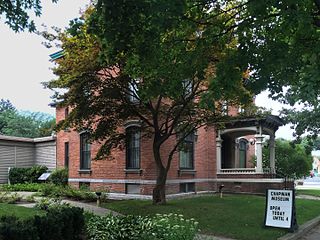
The Chapman Museum presents the history of the Glens Falls – Queensbury community and its connection to the Adirondack region. By encouraging discovery, understanding, and appreciation of the region's heritage, the museum provides perspective for the present and the future. The museum is owned and operated by the Glens Falls-Queensbury Historical Association. The historic home attached to the museum was originally built by Zopher DeLong who made his living as a hardware merchant in Glens Falls.
Robert H. Rheinlander (1880–1961) was an American architect, contractor and structural engineer from Glens Falls, New York.

The Rauch & Lang Carriage Company was an American electric automobile manufactured in Cleveland, Ohio, from 1905 to 1920 and Chicopee Falls, Massachusetts, from 1920 to 1932.
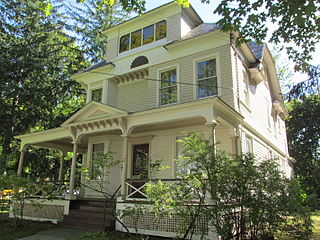
The W. T. Cowles House is a historic house located at 43-47 William Street in Glens Falls, Warren County, New York.

Three Squares Historic District is a national historic district located at Glens Falls, Warren County, New York. It includes 75 contributing buildings, one contributing site, and one contributing object. It encompasses Glens Falls historic and contemporary commercial center. The buildings generally consist of brick commercial, office, and institutional structures between two and five stories in height. Because of devastating fires in 1862 and 1902, the majority of the buildings were built between 1902 and 1930. Notable buildings include the Italianate style Cowles block (1865), Neoclassical style Rogers Building (1926-1927), Beaux-Arts style Empire Theater (1899), and Neoclassical style Glens Falls City Hall (1900).
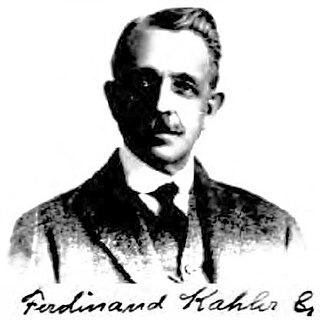
Ferdinand Nickolas Kahler Sr. was an American inventor, entrepreneur and automobile pioneer who founded The Kahler Co. in New Albany, Indiana.

Ephraim Potter (1855–1925) was an American architect from Glens Falls, New York.
Flint Wagon Works of Flint, Michigan, manufactured wagons from the early 1880s. One of the world's most successful horse-drawn vehicle makers they formed with their Flint neighbours a core of the American automobile industry. In 1905 Flint was promoting itself as Flint the Vehicle City. The former site is now located in the neighborhood of Flint known as "Carriagetown".

Durant-Dort Factory One is a former cotton textile, carriage, and automobile factory in Flint, Michigan, that is now an archive and a center for research, meetings, and the community. The building was constructed in 1880 as a cotton textile factory. It produced carriages for the Durant-Dort Carriage Company from 1886 to 1917 and then produced cars for the Dort Motor Car Company from 1917 to 1924. It is often considered the birthplace of General Motors (GM).
Powel J. Smith was an American businessman and politician from Glens Falls, New York.