The avifauna of Gibraltar include a total of 325 species, of which 3 have been introduced by humans. The majority of the introduced species are wanderers from introduced populations in Spain.
The following tags have been used to highlight categories. Vagrant and established introduced species are included in the total counts for Gibraltar.[1]
(A) recorded in a natural wild state in Gibraltar since 1 January 1950
(B) recorded in a natural wild state in Gibraltar but only before 1 January 1950
(C) introduced – a species which occurs in Gibraltar as a consequence, direct or indirect, of human actions
The family Anatidae includes the ducks and most duck-like waterfowl, such as geese and swans. These are birds adapted to an aquatic existence with webbed feet, flattened bills, and feathers that are excellent at shedding water due to an oily coating.
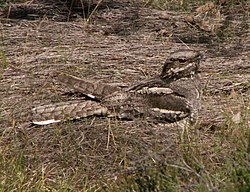
Nightjars are medium-sized nocturnal birds that usually nest on the ground. They have long wings, short legs and very short bills. Most have small feet, of little use for walking, and long pointed wings. Their soft plumage is camouflaged to resemble bark or leaves.
Swifts are small birds which spend the majority of their lives flying. These birds have very short legs and never settle voluntarily on the ground, perching instead only on vertical surfaces. Many swifts have long swept-back wings which resemble a crescent or boomerang.
Bustards are large terrestrial birds mainly associated with dry open country and steppes in the Old World. They are omnivorous and nest on the ground. They walk steadily on strong legs and big toes, pecking for food as they go. They have long broad wings with "fingered" wingtips and striking patterns in flight. Many have interesting mating displays.
Sandgrouse have small, pigeon like heads and necks, but sturdy compact bodies. They have long pointed wings and sometimes tails and a fast direct flight. Flocks fly to watering holes at dawn and dusk. Their legs are feathered down to the toes.
Rallidae is a large family of small to medium-sized birds which include the rails, crakes, coots and gallinules. Typically they inhabit dense vegetation in damp environments near lakes, swamps or rivers. In general they are shy and secretive birds, making them difficult to observe. Most species have strong legs and long toes which are well adapted to soft uneven surfaces. They tend to have short, rounded wings and to be weak fliers.
Cranes are large, long-legged and long-necked birds. Unlike the similar-looking but unrelated herons, cranes fly with necks outstretched, not pulled back. Most have elaborate and noisy courting displays or "dances".
Grebes are small to medium-large freshwater diving birds. They have lobed toes and are excellent swimmers and divers. However, they have their feet placed far back on the body, making them quite ungainly on land.
Flamingos are gregarious wading birds, found in both the Western and Eastern Hemispheres. Flamingos filter-feed on shellfish and algae. Their oddly shaped beaks are specially adapted to separate mud and silt from the food they consume and, uniquely, are used upside-down.
The stone-curlews and thick-knees are a group of largely tropical waders in the family Burhinidae. They are found worldwide within the tropical zone, with some species also breeding in temperate Europe and Australia. They are medium to large waders with strong black or yellow-black bills, large yellow eyes and cryptic plumage. Despite being classed as waders, most species have a preference for arid or semi-arid habitats.
Recurvirostridae is a family of large wading birds, which includes the avocets and stilts. The avocets have long legs and long up-curved bills. The stilts have extremely long legs and long, thin, straight bills.
The family Charadriidae includes the plovers, dotterels and lapwings. They are small to medium-sized birds with compact bodies, short, thick necks and long, usually pointed, wings. They are found in open country worldwide, mostly in habitats near water.
Scolopacidae is a large diverse family of small to medium-sized shorebirds including the sandpipers, curlews, godwits, shanks, tattlers, woodcocks, snipes, dowitchers and phalaropes. The majority of these species eat small invertebrates picked out of the mud or soil. Variation in length of legs and bills enables multiple species to feed in the same habitat, particularly on the coast, without direct competition for food.
Glareolidae is a family of wading birds comprising the pratincoles, which have short legs, long pointed wings and long forked tails, and the coursers, which have longer legs, shorter wings and longer pointed bills which curve downwards.
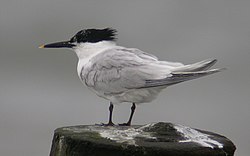
Laridae is a family of medium to large seabirds that includes gulls and terns. Gulls are typically grey or white, often with black markings on the head or wings. They have stout, longish bills and webbed feet. Terns are a group of generally small to medium-size seabirds typically with grey or white plumage, often with black markings on the head. Most terns hunt fish by diving but some pick insects off the surface of fresh water. Both are generally long-lived birds, with several species known to live in excess of 30 years.
Skuas are, in general, medium to large birds, typically with grey or brown plumage, often with white markings on the wings. They nest on the ground in temperate and arctic regions and are long-distance migrants. Much of their food is obtained by piracy, robbing other seabirds of their catches. Some species are also called 'jaegers' in North America.
Alcids are superficially similar to penguins due to their black-and-white plumage, their upright posture and some of their habits, however they are not related to the penguins and differ in being able to fly. Auks live on the open sea, only deliberately coming ashore to nest.
Divers, known as loons in North America, are a group of aquatic birds found in many parts of northern Eurasia and North America. They are the size of a large duck or small goose, but to which they are completely unrelated.
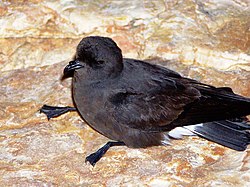
The northern storm petrels are a family of petrels, and are the smallest seabirds. They feed on planktonic crustaceans and small fish picked from the surface, typically while hovering. The flight is fluttering and sometimes bat-like.
Storks are large, long-legged, long-necked, wading birds with long stout bills. Storks are mute, but bill-clattering is an important mode of communication at the nest. Their nests can be large and may be reused for many years. Many species are migratory.
Phalacrocoracidae is a family of medium to large coastal, fish-eating seabirds that includes cormorants and shags. The majority have mainly dark plumage, some species being black-and-white; many show some plumage iridescence, and many have brightly coloured eyes.
Threskiornithidae is a family of large terrestrial and wading birds which includes the ibises and spoonbills. They have long, broad wings with 11 primary and about 20 secondary feathers. They are strong fliers and despite their size and weight, very capable soarers.
The family Ardeidae contains the bitterns, herons, and egrets. Herons and egrets are medium to large wading birds with long necks and legs. Bitterns tend to have shorter necks and be more wary. Members of Ardeidae fly with their necks retracted, unlike other long-necked birds such as storks, ibises and spoonbills.
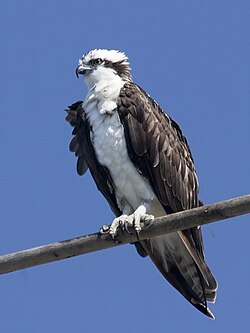
The family Pandionidae contains only one species, the osprey. The osprey is a medium-large raptor which is a specialist fish-eater with a worldwide distribution.
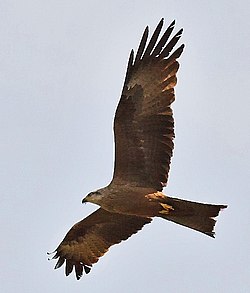
Accipitridae is a family of birds of prey, which includes hawks, eagles, kites, harriers and Old World vultures. These birds have powerful hooked beaks for tearing flesh from their prey, strong legs, powerful talons and keen eyesight.
The typical owls are small to large solitary nocturnal birds of prey. They have large forward-facing eyes and ears, a hawk-like beak and a conspicuous circle of feathers around each eye called a facial disk.
Rollers resemble crows in size and build, but are more closely related to the kingfishers and bee-eaters. They share the colourful appearance of those groups with blues and browns predominating. The two inner front toes are connected, but the outer toe is not.
The bee-eaters are a group of near passerine birds in the family Meropidae. Most species are found in Africa but others occur in southern Europe, Madagascar, Australia and New Guinea. They are characterised by richly coloured plumage, slender bodies and usually elongated central tail feathers. All are colourful and have long downturned bills and pointed wings, which give them a swallow-like appearance when seen from afar.
Woodpeckers are small to medium-sized birds with chisel-like beaks, short legs, stiff tails and long tongues used for capturing insects. Some species have feet with two toes pointing forward and two backward, while several species have only three toes. Many woodpeckers have the habit of tapping noisily on tree trunks with their beaks.
Falconidae is a family of diurnal birds of prey. They differ from hawks, eagles and kites in that they have a tomial 'tooth' on their bill, and are genetically unrelated.
Shrikes are passerine birds known for their habit of catching other birds and small animals and impaling the uneaten portions of their bodies on thorns. A typical shrike's beak is hooked, like a bird of prey.
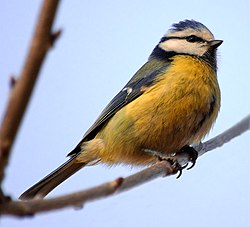
The Paridae are mainly small stocky woodland species with short stout bills. Some have crests. They are adaptable birds, eating a mixed diet including seeds and insects.
Larks are small terrestrial birds with often extravagant songs and display flights. Most larks are fairly dull in appearance. Their food is insects and seeds.
The family Hirundinidae is adapted to aerial feeding. They have a slender streamlined body, long pointed wings and a short bill with a wide gape. Their feet are designed for perching rather than walking, and the front toes are partially joined at the base.
The long-tailed tits are a group of small passerine birds with medium to long tails. They make woven bag nests in trees. Most eat a mixed diet which includes insects.
Leaf warblers are a family of small insectivorous birds found mostly in Eurasia and ranging into Wallacea and Africa. The species are of various sizes, often green-plumaged above and yellow below, or more subdued with greyish-green to greyish-brown colours.
The members of this family are usually rather large for "warblers". Most are rather plain olivaceous brown above with much yellow to beige below. They are usually found in open woodland, reedbeds, or tall grass. The family occurs mostly in southern to western Eurasia and surroundings, but it also ranges far into the Pacific, with some species in Africa.
Locustellidae are a family of small insectivorous songbirds found mainly in Eurasia, Africa, and the Australian region. They are smallish birds with tails that are usually long and pointed, and tend to be drab brownish or buffy all over.
The Cisticolidae are warblers found mainly in warmer southern regions of the Old World. They are generally very small birds of drab brown or grey appearance found in open country such as grassland or scrub.
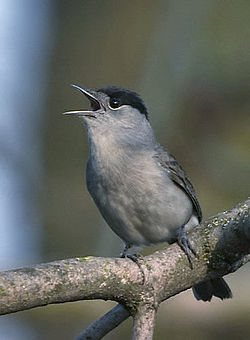
The family Sylviidae is a group of small insectivorous passerine birds. They mainly occur as breeding species in Europe, Asia and, to a lesser extent, Africa. Some are of generally undistinguished appearance, but many have distinctive head patterns, and musical songs.
The crests, also called kinglets in North America, are a small group of birds formerly often included in the Old World warblers, but now given family status because they are genetically distant from them.
The wrens are mainly small and inconspicuous except for their loud songs. These birds have short wings and thin down-turned bills. Several species often hold their tails upright. All are insectivorous.
Nuthatches are small woodland birds. They have the unusual ability to climb down trees head first, unlike other birds which can only go upwards. Nuthatches have big heads, short tails and powerful bills and feet.
Treecreepers are small woodland birds, brown above and white below. They have thin pointed down-curved bills, which they use to extricate insects from bark. They have stiff tail feathers, like woodpeckers, which they use to support themselves on vertical trees.
Starlings are small to medium-sized passerine birds. Their flight is strong and direct and they are very gregarious. Their preferred habitat is fairly open country. They eat insects and fruit. Plumage is typically dark with a metallic sheen.
The thrushes are a group of passerine birds that occur mainly in the Old World. They are plump, soft plumaged, small to medium-sized insectivores or sometimes omnivores, often feeding on the ground. Many have attractive songs.
Old World flycatchers and chats are a large group of small passerine birds native to the Old World. They are mainly small arboreal insectivores. The appearance of these birds is highly varied, and they mostly have weak songs and harsh calls.
Old World sparrows are small passerine birds. In general, sparrows tend to be small, plump, brown or grey birds with short tails and short powerful beaks. Sparrows are seed-eaters, but they also consume small insects.
The weavers are small passerine birds related to the sparrows, native to Africa and southern Asia. They are seed-eating birds with rounded conical bills. The males of many species are brightly coloured, usually in red or yellow and black, some species show variation in colour only in the breeding season. They are popular as cagebirds and some have established feral populations away from their native ranges.
The estrildid finches are small passerine birds of the Old World tropics and Australasia. They are gregarious and often colonial seed eaters with short thick but pointed bills. They are all similar in structure and habits, but have a wide variation in plumage colour and pattern. They are popular as cagebirds and several have established feral populations away from their native ranges.
The accentors are in the only bird family, Prunellidae, which is completely endemic to the Palearctic. They are small, fairly drab species superficially similar to sparrows.
Motacillidae is a family of small passerine birds with medium to long tails. They include the wagtails, longclaws and pipits. They are slender, ground feeding insectivores of open country.
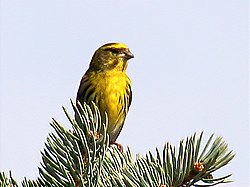
Finches are seed-eating passerine birds, that are small to moderately large and have a strong beak, usually conical and in some species very large. All have twelve tail feathers and nine primaries. These birds have a bouncing flight with alternating bouts of flapping and gliding on closed wings, and most sing well.
The Calcariidae are a family of birds that had been traditionally grouped with the buntings, but differ in a number of respects and are usually found in open grassy areas.
The New World sparrows (or American sparrows) are a large family of seed-eating passerine birds with distinctively finch-like bills. Several species have been recorded as transatlantic vagrants in Europe.
The icterids are a group of small to medium-sized, often colourful, passerine birds restricted to the New World and include the grackles, New World blackbirds and New World orioles. Most species have black as the predominant plumage colour, often enlivened by yellow, orange or red. A few species have been recorded as transatlantic vagrants in Europe.
The New World warblers are a group of small often colourful passerine birds restricted to the New World. Most are arboreal, but some are more terrestrial; most are insectivores. Several species have been recorded as transatlantic vagrants in Europe.
The cardinals are a family of robust, seed-eating birds with strong bills. They are typically associated with open woodland. The sexes usually have distinct plumage. A few species have been recorded as transatlantic vagrants in Europe.
12"Gibraltar Bird List". Gibraltar Ornithological & Natural History Society. 15 February 2024. Archived from the original on 24 June 2025. Retrieved 27 November 2025.
Clements, James F. (2000). Birds of the World: A Checklist. Cornell University Press. p.880. ISBN0-934797-16-1.
Garcia, Ernest; Paterson, Andrew (2001). Where to Watch Birds in Southern & Western Spain (2nded.). London: Christopher Helm. ISBN0-7136-5301-9.
Garcia, Ernest (2006). "The Gibraltar Bird List". Gibraltar Ornithological and Natural History Society. Retrieved 15 January 2008.
This page is based on this Wikipedia article Text is available under the CC BY-SA 4.0 license; additional terms may apply. Images, videos and audio are available under their respective licenses.