| |||||||||||||||||||||||||||||||||||||||||||||||||||||
12 (of the 24) seats to the Senate of the Philippines 13 seats needed for a majority | |||||||||||||||||||||||||||||||||||||||||||||||||||||
|---|---|---|---|---|---|---|---|---|---|---|---|---|---|---|---|---|---|---|---|---|---|---|---|---|---|---|---|---|---|---|---|---|---|---|---|---|---|---|---|---|---|---|---|---|---|---|---|---|---|---|---|---|---|
| Opinion polls | |||||||||||||||||||||||||||||||||||||||||||||||||||||
| |||||||||||||||||||||||||||||||||||||||||||||||||||||
| |||||||||||||||||||||||||||||||||||||||||||||||||||||
The 2019 election of members to the Senate of the Philippines will be the 33rd election of members to the Senate of the Philippines for a six-year term.
Elections to the Senate of the Philippines is done via plurality-at-large voting; a voter can vote for up to twelve candidates, with the twelve candidates with the highest number of votes being elected. The 24-member Senate uses staggered elections, with only one-half of its members up for election at any given time, except for special elections, which are always held concurrently with regularly scheduled elections.
The Senate of the Philippines is the upper house of the bicameral legislature of the Philippines, the Congress; the House of Representatives is the lower house. The Senate is composed of 24 senators who are elected at-large with the country as one district under plurality-at-large voting.
The seats of 12 senators elected in 2013 will be contested during this election, and the senators elected in this election will serve up to June 30, 2025. The winners in this election will join the winners of the 2016 election to form the 18th Congress of the Philippines. The senators elected in 2016 will serve until June 30, 2022.
The Eighteenth Congress of the Philippines is the future meeting of the national legislature of the Republic of the Philippines, composed of the Senate and House of Representatives. The convention of the 18th Congress was followed by the 2019 Senate election, which will replace half of the Senate membership, and the 2019 House of Representatives elections which will elect the entire membership of the House of Representatives.
The Partido Demokratiko Pilipino-Lakas ng Bayan (PDP-Laban), the ruling party headed by President Rodrigo Duterte is expected lead its own administration coalition. The opposition is expected to be led by the Liberal Party, headed by Vice President Leni Robredo, its de facto leader. Other opposition coalitions may be set up.
The Partido Demokratiko Pilipino–Lakas ng Bayan, more commonly known as PDP–Laban, is the ruling political party in the Philippines.
Rodrigo Roa Duterte,, also known as Digong and Rody, is a Filipino politician who is the 16th and current President of the Philippines and the first from Mindanao, to hold the office. He is the chair of the ruling PDP–Laban party. Taking office at 71 years old in June 2016, Duterte is the oldest person to assume the Philippine presidency; the record was previously held by Sergio Osmeña at the age of 65.
The Liberal Party of the Philippines or LP is a liberal political party in the Philippines, founded by then senators Senate President Manuel Roxas, Senate President Pro-Tempore Elpidio Quirino, and former 9th Senatorial District Senator José Avelino, on January 19, 1946 by a breakaway Liberal wing from the old Nacionalista Party. It was the ruling party from 2010 to 2016 after the election victory of Benigno Aquino III as the President of the Philippines. Today, the Liberals are the opposition and maintain at least five seats in the Senate, and at least 41 of seats in the House of Representatives. Around 50% of governors, 50% of vice governors, and 33% of board members are also Liberals.
The Senate election is held concurrently with elections to the House of Representatives and local officials above the barangay level.
The House of Representatives of the Philippines, is the lower house of the Congress of the Philippines. It is often commonly referred to as Congress and informally referred to as Camara or Kamara. Members of the House are officially styled as representative (Kinatawan) and sometimes informally called Congressmen/Congresswomen and are elected to a three-year term. They can be re-elected, but cannot serve more than three consecutive terms. Around eighty percent of congressmen are district representatives, representing a particular geographical area. There are 234 legislative districts in the country, each composed of about 250,000 people. There are also party-list representatives elected through the party-list system who constitute not more than twenty percent of the total number of representatives.
A barangay or baranggay, formerly referred to as barrio, is the smallest administrative division in the Philippines and is the native Filipino term for a village, district or ward. In metropolitan areas, the term often refers to an inner city neighbourhood, a suburb or a suburban neighborhood. The word barangay originated from balangay, a kind of boat used by a group of Austronesian peoples when they migrated to the Philippines.
Senate elections in the Philippines are conducted via the plurality-at-large voting system, where the entire country is one at-large "district". Each voter can select up to twelve candidates (one vote per candidate), and the twelve candidates with the highest total number of votes are elected.
Plurality-at-large voting, also known as block vote or multiple non-transferable vote (MNTV), is a non-proportional voting system for electing several representatives from a single multimember electoral district using a series of check boxes and tallying votes similar to a plurality election. Multiple winners are elected simultaneously to serve the district. Block voting is not a system for obtaining proportional representation; instead the usual result is that where the candidates divide into definitive parties the most popular party in the district sees its full slate of candidates elected, resulting in a landslide.
At-large is a designation for members of a governing body who are elected or appointed to represent the whole membership of the body, rather than a subset of that membership. At-large voting is in contrast to voting by electoral districts.
Senators are term limited to two consecutive terms, although they are eligible for a third non-consecutive term. Only half of the seats are up in every senatorial election. The winning senators will succeed those elected in 2013, and will join those elected in 2016 in the 18th Congress.
A term limit is a legal restriction that limits the number of terms an officeholder may serve in a particular elected office. When term limits are found in presidential and semi-presidential systems they act as a method of curbing the potential for monopoly, where a leader effectively becomes "president for life". This is intended to protect a democracy from becoming a de facto dictatorship. Sometimes, there is an absolute or lifetime limit on the number of terms an officeholder may serve; sometimes, the restrictions are merely on the number of consecutive terms he or she may serve.
Each party endorses a slate of candidates, typically not exceeding a 12-person ticket. A party may also choose to invite "guest candidates" to complete its slate. The party may even include, with the candidates' consent, independent candidates and candidates from other parties as the party's guest candidates. Parties also may form coalitions to endorse a multi-party slate of candidates.
While the Philippines is a multi-party system, parties tend to group themselves into two major coalitions in midterm elections (e.g. Lakas-Laban vs NPC in 1995; PPC vs Puwersa ng Masa in 2001). This is opposed to senatorial elections in presidential election years where most presidential candidates also have senatorial slates. This results in an election where voters can choose between two major political forces. Sometimes a weaker third coalition is also formed.
Winning candidates are proclaimed by the Commission on Elections (COMELEC), sitting as the National Board of Canvassers. Candidates are proclaimed senators-elect if the thirteenth-place candidate no longer has a mathematical chance of surpassing the twelfth-place candidate. Post-proclamation disputes are handled by the Senate Electoral Tribunal, a body composed of six senators and three justices from the Supreme Court.
As the 2016 Senate election was held concurrently with the presidential election, most of the presidential candidates also put up their respective senatorial slates. These slates shared several candidates, although most of the shared candidates only campaigned with one slate. The presidential election was won by Davao City Mayor Rodrigo Duterte of the Partido Demokratiko Pilipino-Lakas ng Bayan (PDP-Laban), while the vice presidency was won by the Liberal Party's Leni Robredo, the representative from Camarines Sur. [1] Senator Bongbong Marcos disputed Robredo's victory, and his electoral protest is still pending at the Presidential Electoral Tribunal. [2] The ruling Liberal Party won a plurality of seats in the Senate election, but politicians friendly to Duterte had the clear majority.
Koko Pimentel, Duterte's party-mate, was elected as President of the Senate in July 2016 by a large majority, while a handful of Liberal Party senators comprised the minority; they were later joined by other Liberal Party members who had earlier voted for Pimentel, forming a six-person minority bloc in the Senate. [3]
Pimentel resigned from the Senate presidency in May 21, 2018. He was replaced by Tito Sotto of the Nationalist People's Coalition (NPC), who was elected by majority of the senators. [4]
In October 2017, Partido Demokratiko Pilipino-Lakas ng Bayan (PDP-Laban) is only considering to form a coalition with the Nacionalista Party for the 2019 senatorial elections. [5]
On November 2017, PDP-Laban reportedly released a "partial list" of their senatorial slate for the 2019 edition consisting of six people. The party's president Aquilino Pimentel III clarified that the list is not finalized and remarked that there was "no party decision yet". In January 2018, the House Speaker announced that the 6 candidates were now official. [6] In February 2018, two more names were added to PDP-Laban's potential slate. [7]
Pimentel announced a shortlist of 20 names in April 2018. It includes himself and the five other senators that are members of the majority bloc, several administration officials, representatives, and private citizens. Pimentel said that his list was not approved by Alvarez when he released it. [8]
By August 2018, Pimentel wrote to Duterte of their party's prospective candidates for the Senate. Pimentel divided the names into three groups: members of PDP-Laban, outsiders, and the incumbent senators of the majority bloc. Pimentel said that Duterte's decision would be final in the composition of their slate. [9]
PDP-Laban is embroiled in a leadership dispute with one faction headed by Pimentel and the other by Willy Talag, president of the party's Makati City council and chair of the membership committee of the NCR Chapter. Talag said during an assembly of the party on July 27 that PDP-Laban's current leaders have committed violations, including holding mass oath taking of members "without proper basic seminar" and swearing in officials that are "involved in illegal drugs." The faction elected Rogelio Garcia and Talag as party president and chairman, respectively, removing Senator Aquilino "Koko" Pimentel III and Rep. Pantaleon Alvarez from their respective positions. Koko Pimentel dismissed the election of new leaders, disowning the group and assembly, and called the event an "unofficial, unauthorized, rogue assembly using the name of PDP-Laban". Sen. Pimentel, who personally dismissed the election, together with PDP-Laban vice chairman and Department of Energy Sec. Alfonso Cusi and Rep. Alvarez, have notified members that the supposed national assembly was not officially sanctioned by the party. Special Assistant to the President Bong Go said in an interview with CNN Philippines that Duterte is set to meet the two factions, in an effort to unite the party. Talag issued a Certificate of Nomination for singer Freddie Aguilar, who was later endorsed by President Duterte. The COMELEC is yet to resolve the leadership dispute.
In March 2018, a supposed Liberal Party slate was circulated on social media. The list of candidates included Interior Secretary Mar Roxas, Sen. Bam Aquino, former Senators Teofisto Guingona III and Ramon Magsaysay Jr., former Pampanga Governor Eddie Panlilio, former Representative from Quezon Lorenzo Tañada III, Representative from Albay Edcel Lagman, Representative from Northern Samar Raul Daza, Magdalo Representative Gary Alejano, Representatives Jose Christopher Belmonte from Quezon City and Kaka Bag-ao from Dinagat Islands, and Cebu City Mayor Tomas Osmeña. [10] However, on April 2, Magsaysay said that he had no plans of returning to the Senate. [11] Lagman, Daza, and Belmonte all denied that they are running for senator. Alejano, meanwhile, neither confirmed nor denied his plans. [12] After multiple candidates denied interest in running, Senator Francis Pangilinan denied that this slate was an accurate list of Liberal Party candidates, as the official list had yet to be finalized. [10]
In April, Antonio Trillanes said that his Samahang Magdalo was cooperating with the Liberal Party, Akbayan and Tindig Pilipinas to put up an opposition coalition against the pro-Duterte parties. [13] On April 24, Liberal Party and other groups urged Mar Roxas to run. [14] By mid-May, the Liberal Party had settled on several names; however, Roxas himself declined to run. The Liberals intend to form a coalition with anti-Duterte groups, with the slate being named as "the Resistance". [15] In June, Alejano announced his intention to run. [16]
Leni Robredo announced that she is accepting the role of opposition leader in the election, and they will release the line-up by mid-September. The line up may include former Chief Justice Maria Lourdes Sereno, who was removed from office by a quo warranto petition. [17] By August, Roxas, in an interview at Robredo's radio show said that he was unsure of his plans in 2019. [18] In early September, a list of 18 possible candidates was publicized by the coalition. The list included incumbent senator Paolo Benigno "Bam" Aquino IV, Magdalo representative Gary Alejano, former Department of Interior and Local Government secretary Manuel "Mar" Roxas II, former chief justice Maria Lourdes Sereno, former Quezon representative Lorenzo "Erin" Tañada III, lawyer Jose Manuel "Chel" Diokno, former Bangsamoro Transition Committee member Samira Gutoc, former Solicitor General Florin Hilbay, former Akbayan representative Ibarra "Barry" Gutierrez III, actor Dingdong Dantes, former presidential spokesman Edwin Lacierda, writer Manuel Luis "Manolo" Quezon III, activist Leah Navarro, actress Agot Isidro, musician Jim Paredes, election lawyer Romulo Macalintal, former Social Welfare secretary Corazon "Dinky" Soliman, and ex-chief justice Hilario Davide Jr. [19]
By June 2017, Nationalist People's Coalition (NPC), erstwhile chairman emeritus Danding Cojuangco returned as chairman, in an active leadership role. Senate Majority Leader Tito Sotto said Cojuangco was reportedly unsatisfied with how the party was being run, as leadership cannot agree on what direction to take. [20]
The party is considering all of the eligible incumbents from the majority bloc to run in its slate as "Friends of the party". Sotto also said that Bam Aquino, the only non-term limited incumbent from the minority bloc, was also invited to run in their slate. Aquino is the nephew of NPC founder Cojuangco who Sotto said will personally help Aquino in the latter's campaign. [21] Sotto announced in July 2018 that Senator JV Ejercito and former senator Lito Lapid would run under the NPC banner. Ejercito said this is to avoid with him running together with his half-brother Jinggoy Estrada, under the Pwersa ng Masang Pilipino. Lapid was formerly from the now moribund Lakas-CMD. [22]
Hugpong ng Pagbabago, Davao City mayor Sara Duterte's regional political party centered in the Davao Region formed in mid-2018, reportedly had national parties wanting to force alliances with. [23] By August, Hugpong signed alliances with the Nacionalista Party, Nationalist People's Coalition, the National Unity Party and six other local parties. [24] In August, incumbent senator Cynthia Villar announced that she will seek reelection, while the coalition will also support the candidacies of governor Imee Marcos and representative Pia Cayetano. [25]
A new political party called Partido Federal ng Pilipinas (Federal Party of the Philippines) was launched [26] and accredited by the Commission on Election on October 8, 2018 [27] . It elected Land Bank of the Philippines director Jesus Hinlo as president. [28] On October 17, 2018, the party fielded three senatorial candidates in the 2019 midterm election namely Maria Socorro Manahan, Elmer Francisco, and Diosdado Padilla. [29] The group is sympathetic with the president and advocated for the Philippines' shift to federalism.
The following are barred from running since they are on their second consecutive six-year term:
Alan Peter Cayetano, who was on his second consecutive term, resigned from the Senate in order to become Secretary of Foreign Affairs on May 18, 2017. It left one vacant seat and since it was vacated less than three years before Cayetano's term expires, no special election will be held to fill the seat. Cayetano resigned as foreign affairs secretary on October 17, 2018 and filed candidacy as House representative from Taguig's 1st district. [38]
It's disputed if Koko Pimentel (PDP–Laban) is on his second term already, considering he only took over from Juan Miguel Zubiri's seat after the latter resigned and Pimentel won his electoral protest against him. See banned candidacies, below.
Half of the seats in the Senate, or the 12 seats disputed in odd-numbered years since 1995, are up in the 2019 senatorial election.
All six incumbents filed candidacies for senator.
The filing of Certificate of Candidacies (COCs) was scheduled on October 1-5, 2018, although resolutions in the Senate and the House of Representatives are pushing for the re-scheduling of filing to October 11-17, 2018, as most parties have not yet finalized their senatorial slates. The commission acceded to Congress' requests, and filing ended on October 17.
The commission is expected to release a final list of candidates by December 15. [49] The commission accepted all of the certificate as it saw it as a clerical task not to discriminate when filing. This is the list of those who filed, as long as they have Wikipedia articles, or were elected into office above the barangay level, or served in the government in the assistant secretary level or above:
| Party | Name | Last government position | |
|---|---|---|---|
| PDP-Laban | Freddie Aguilar | ||
| Liberal | Gary Alejano | Representative for Magdalo Party-List (since 2016) | |
| Bagumbayan-VNP | Raffy Alunan | Secretary of the Interior and Local Government (1992–96) | |
| LDP | Sonny Angara | Senator (since 2013) | |
| Liberal | Bam Aquino | Senator (since 2013) | |
| UNA | Nancy Binay | Senator (since 2013) | |
| Lakas | Bong Revilla | Senator (2004–16) | |
| Nacionalista | Pia Cayetano | Representative from Taguig's 2nd district (since 2016) | |
| PMM | Melchor Chavez | ||
| KDP | Glenn Chong | former Representative from Biliran | |
| Makabayan | Neri Colmenares | Representative for Bayan Muna (2007–16) | |
| PDP-Laban | Ronald dela Rosa | Director-General of the Bureau of Corrections (2018) | |
| Liberal | Chel Diokno | ||
| NPC | JV Ejercito | Senator (since 2013) | |
| PMP | Jinggoy Estrada | Senator (2004–16) | |
| PDP-Laban | Bong Go | Special Assistant to the President (2016–18) | |
| Aksyon | Florin Hilbay | Solicitor-General (2015–16) | |
| NPC | Lito Lapid | Senator (2004–16) | |
| PDP-Laban | Zajid Mangundadatu | Representative from Maguindanao's 2nd district (since 2013) | |
| Independent | Jiggy Manicad | ||
| Nacionalista | Imee Marcos | Governor of Ilocos Norte (since 2010) | |
| Independent | Sergio Osmeña III | Senator (2010–16) | |
| PDP-Laban | Koko Pimentel | Senator (since 2007) | |
| Independent | Grace Poe | Senator (since 2013) | |
| PMP | Juan Ponce Enrile | Senator (2004–16) | |
| Aksyon | Ernesto Ramel | Assistant Secretary to the Office of the Political Adviser to the President (2011–16) | |
| UNA | Dan Roleda | Councilor from Manila's 4th district (1992–98) | |
| PRP | Harry Roque | Presidential Spokesperson (2017–18) | |
| Liberal | Mar Roxas | Secretary of the Interior and Local Government (2012–15) | |
| Liberal | Erin Tañada | Representative from Quezon's 4th district (2004–13) | |
| PDP-Laban | Francis Tolentino | Presidential Adviser on Political Affairs (2017–18) | |
| Liberal | Samira Gutoc-Tomawis | Regional assemblyperson from Lanao del Sur's 1st district | |
| Nacionalista | Cynthia Villar | Senator (since 2013) | |
These are the people who have personally publicly announced their intention to run for a Senate seat.
These are the people who have personally publicly considered their intention to run for a Senate seat.
These persons are considered as potential candidates or have been named by someone else as a potential candidate.
These are the people who have personally publicly denied their intention to run for a Senate seat.
These are the people who are not allowed to run for a Senate seat.
Opinion polling, locally known as "surveys" in the Philippines, is conducted by Social Weather Stations (SWS), Pulse Asia and other pollsters. The first poll released through by the DZRH website reportedly done by SWS in December 2017 was not posted in SWS's official website, and SWS neither confirmed nor denied the existence of the survey when asked by the Philippine Star, leading to speculation that it was commissioned by a third party. [91]
For candidates named by less than 10% of respondents, see the main article.
| Date/s administered | Pollster | Sample size | Margin of error | Major issues when poll was administered |
|---|---|---|---|---|
| March 23–28, 2018 [92] | Pulse Asia | 1,200 | ±3% | Movements to remove Chief Justice Maria Lourdes Sereno from office, withdrawal from the International Criminal Court, proposal to close Boracay Island, provisional acceptance of Janet Lim-Napoles to the Witness Protection Program. Only 57% of the respondents on the survey had surety in their 12 senatorial picks. |
| June 15–21, 2018 [93] | Pulse Asia | 1,800 | ±2% | Ouster of Chief Justice Maria Lourdes Sereno, the anti-loiterer campaign of the government, killing of Catholic priests |
| September 1–7, 2018 [94] | Pulse Asia | 1,800 | ±2% | Invalidation of the amnesty given to Antonio Trillanes, record-high inflation, Xiamen Airlines Flight 8667 accident at the Ninoy Aquino International Airport |
| September 15–23, 2018 [95] | Social Weather Stations | 1,500 | ±3% | This survey was commissioned by Alde Joselito Pagulayan. |
| September 15–23, 2018 [96] | Social Weather Stations | 1,500 | ±3% | This survey was commissioned by Francis Tolentino. |
| Name | Party | 2018 | |||||
|---|---|---|---|---|---|---|---|
| Mar 23–28 | Jun 15–21 | Sep 1–7 | Sep 15–23 | Sep 15–23 | |||
| Pulse [92] | Pulse [93] | Pulse [94] | SWS [95] | SWS [96] | |||
| Grace Poe | Independent | 70.8%, 1 | 67.4%, 1 | 70.1%, 1 | 52%, 1 | 43%, 2–3 | |
| Cynthia Villar | Nacionalista | 55.6%, 2–3 | 50.1%, 3–4 | 57.7%, 2–3 | 46%, 2 | 53%, 1 | |
| Pia Cayetano | Nacionalista | 53.8%, 2–3 | 55.7%, 2 | 54.4%, 2–4 | 37%, 3 | 43%, 2–3 | |
| Nancy Binay | UNA | 45.8%, 4–6 | 37.1%, 6–12 | 50.6%, 3–4 | 31%, 4 | 26%, 8–9 | |
| Sonny Angara | LDP | 44.9%, 4–7 | 41.9%, 4–8 | 37.1%, 5–7 | 26%, 8 | 26%, 8–9 | |
| Sara Duterte | PDP–Laban | 43.8%, 4–7 | 46.2%, 3–5 | 39.5%, 5–6 | 24%, 9 | — | |
| Koko Pimentel | PDP–Laban | 39.8%, 5–9 | 37.7%. 5–12 | 32.4%. 7–11 | 30%, 5–6 | 33%, 4–5 | |
| Sergio Osmeña III | Independent | 38.0%, 7–12 | 36.6%, 6–13 | 29.8%, 8–17 | 19%, 13–16 | 24%, 11–12 | |
| Erwin Tulfo | Independent | 36.7%, 7–13 | — | — | — | — | |
| Lito Lapid | Independent | 33.8%, 8–15 | 36.2%, 6–13 | 32.2%, 7–11 | 30%, 5–6 | 33%, 4–5 | |
| Ronald dela Rosa | PDP–Laban | 33.1%, 8–15 | 37.7%, 5–12 | 27.0%, 11–17 | 19%, 13–16 | 25%, 10 | |
| Jinggoy Estrada | UNA | 32.8%, 8–15 | 37.9%, 5–12 | 34.6%, 6–10 | 29%, 7 | 31%, 6 | |
| Imee Marcos | Nacionalista | 32.2%, 9–15 | 29.9%, 13–20 | 32.6%, 7–11 | 22%, 10–12 | 24%, 11–12 | |
| Bam Aquino | Liberal | 30.5%, 10–19 | 32.1%, 10–16 | 20.1%, 18–23 | 22%, 10–12 | 22%, 13 | |
| JV Ejercito | NPC | 29.0%, 10–19 | 35.6%, 6–13 | 26.7%, 11–17 | 19%, 13–16 | 19%, 14 | |
| Robin Padilla | Independent | 26.2%, 14–19 | 28.2%. 13–20 | 27.4%, 11–17 | 19%, 13–16 | — | |
| Herbert Bautista | NPC | 26.2%, 14–19 | 28.5%, 13–20 | 20.9%, 18–21 | 17%, 17 | — | |
| Ted Failon | Independent | 25.6%, 14–19 | 25.8%, 14–21 | 21.9%, 18–20 | — | — | |
| Mar Roxas | Liberal | 25.4%, 14–19 | 27.1%, 14–21 | 27.7%, 11–17 | 22%, 10–12 | 30%, 7 | |
| TG Guingona | Liberal | 17.5%, 20–25 | 23.3%, 17–21 | 17.3%, 20–24 | 12%, 19 | — | |
| Dingdong Dantes | Independent | 16.8%, 20–25 | — | — | — | — | |
| Rex Gatchalian | NPC | 16.7%, 14–19 | 11.2%, 23–28 | 13.3%, 24–28 | 6%, 25 | — | |
| Francis Tolentino | Independent | 14.6%, 20–26 | 9.9%, 23–31 | 11.4%, 25–31 | 11%, 20 | 16%, 15 | |
| Gina Lopez | Independent | 14.0%, 20–27 | — | 17.1%, 20–24 | — | — | |
| Isko Moreno | PMP | 13.9%, 20–27 | 15.5%, 22 | 10.4%, 25–31 | — | — | |
| Karlo Nograles | PDP–Laban | 10.6%, 24–32 | 8.4%, 24–33 | 9.0%, 27–33 | 4%, 27–30 | — | |
| Harry Roque | PRP | 8.7%, 27–36 | 7.9%, 25–33 | 7.7%, 29–36 | 5%, 26 | 8%, 18 | |
| Neri Colmenares | Makabayan | 7.0%, 28–37 | 7.1%, 27–34 | 7.8%, 28–35 | 3%, 31–35 | — | |
| Bong Go | PDP–Laban | 5.9%, 28–38 | 9.9%, 23–31 | 14.1%, 22–27 | 10%, 21–22 | 12%, 16 | |
| Gary Alejano | Liberal | 2.1%, 38–54 | 1.6%, 43–56 | 1.6%, 44–62 | 3%, 31–35 | 4%, 22 | |
| Erin Tañada | Liberal | 1.7%, 39–55 | 5.2%, 32–38 | 3.4%, 36–46 | 3%, 31–35 | 5%, 21 | |
| Bong Revilla | Lakas–CMD | — | 26.7%, 14–21 | 27.4%, 11–17 | 15%, 18 | — | |
| Ramon Tulfo | Independent | — | 27.1%, 14–21 | 27.0%. 11–17 | — | — | |
| Gloria Macapagal-Arroyo | PDP–Laban | — | 10.8%, 23–29 | 11.9%, 24–28 | 10%, 21–22 | — | |
| Freddie Aguilar | PDP–Laban | — | 9.3%, 23–32 | 8.9%, 27–33 | — | — | |
| Willie Ong | Lakas–CMD | — | 6.6%, 29–35 | 4.6%, 33–44 | — | — | |
| Chel Diokno | Liberal | — | 3.2%, 35–48 | 1.6%, 44–62 | — | 3%, 23–24 | |
| Zajid Mangundadatu | PDP–Laban | — | 3.2%, 35–48 | 2.2%, 39–56 | 3%, 31–35 | — | |
| Raffy Alunan | Bagumbayan–VNP | — | 2.0%, 39–56 | 1.8%, 43–61 | 3%, 31–35 | — | |
| Florin Hilbay | Aksyon | — | 0.1%, 57–58 | 0.2%, 57–66 | — | 3%, 23–24 | |
| Kris Aquino | Independent | — | — | 17.7%, 19–23 | — | — | |
| Don't know | 0.5% | 1.6% | 1.3% | 6% | 6% | ||
| None | 0.8% | 0.1% | 2.5% | — | — | ||
| Refused | 4.5% | 1.9% | 1.0% | — | — | ||
| Date | Pollster | LDP | Lakas | LP | NP | PDP-Laban | PMP | UNA | Ind |
|---|---|---|---|---|---|---|---|---|---|
| Mar 23–28, 2018 | Pulse Asia [92] | 1 | 0 | 1 | 3 | 2 | 1 | 2 | 4 |
| Jun 15–21, 2018 | Pulse Asia [93] | 1 | 0 | 1 | 2 | 2 | 1 | 2 | 4 |
| Sep 1–7, 2018 | Pulse Asia [94] | 1 | 1 | 1 | 3 | 3 | 1 | 2 | 5 |
| Sep 15–23, 2018 | SWS [95] | 1 | 0 | 2 | 3 | 2 | 0 | 2 | 2 |
| Sep 15–23, 2018 | SWS [96] | 1 | 0 | 1 | 3 | 2 | 0 | 2 | 3 |
Totals may not add up to 24 due to margin of error.
| Date | Pollster | Akbayan | LDP | Lakas | LP | NP | NPC | PDP-Laban | PMP | UNA | Ind |
|---|---|---|---|---|---|---|---|---|---|---|---|
| Jun 30, 2016 | Start of 17th Congress | 1 | 1 | 0 | 6 | 3 | 3 | 2 | 0 | 3 | 5 |
| Mar 23–28, 2018 | Pulse Asia [92] | 1 | 1 | 0 | 6 | 3 | 2 | 4 | 1 | 2 | 7 |
| Jun 15–21, 2018 | Pulse Asia [93] | 1 | 1 | 0 | 6 | 2 | 2 | 4 | 1 | 2 | 7 |
| Sep 1–7, 2018 | Pulse Asia [93] | 1 | 1 | 1 | 6 | 3 | 2 | 5 | 1 | 2 | 8 |
| Sep 15–23, 2018 | SWS [95] | 1 | 1 | 0 | 6 | 4 | 2 | 4 | 0 | 2 | 4 |
| Sep 15–23, 2018 | SWS [96] | 1 | 1 | 0 | 5 | 4 | 2 | 4 | 0 | 2 | 5 |
| Current party standings | 1 | 1 | 0 | 5 | 3 | 3 | 3 | 1 | 2 | 5 | |
Notes:
A table will be added once the coalitions and alliances have been announced.
The announcement of detained politicians Bong Revilla and Jinggoy Estrada to run for the Senate again in January 2018 after being jailed due to the Priority Development Assistance Fund scam has led to the issue of whether detained personalities should or should not be allowed to run for public office again. In February, representative Gwendolyn Garcia was dismissed by the Ombudsman for a corruption case and barred her from seeking public positions from 2019 onward, but Garcia said that she will appeal the dismissal at the courts.
Candidates campaigning from detention were previously allowed; Senator Antonio Trillanes ran and won in 2007 despite being jailed for taking part in the Oakwood mutiny. Trillanes was ultimately convicted of participating in a coup d'etat after winning, but accepted the amnesty passed by Congress that was proposed by President Benigno Aquino III. [98] While convicts are not allowed to run anymore unless pardoned or accepting an amnesty, these people have pending cases as of yet and are innocent until proven guilty.
As this is a midterm election, it serves as a de facto referendum on the policies of the presidency of Rodrigo Duterte, such as pursuing the Philippine Drug War, federalism in the Philippines, and the Bangsamoro peace process, among other things.
One of President Rodrigo Duterte's promises during the 2016 election campaign was to revise the current constitution and to shift the country from a unitary form to a federal form. On September 29, 2017, PDP-Laban presented a draft constitution to Congress. [99]
The House of Representatives, through Speaker Pantaleon Alvarez began its own hearings on constitutional change without the participation of the Senate. Alvarez took a hard line on the interpretation that voting via the Constituent Assembly would be joint, instead of the two chambers voting separately, as is the usual. A joint vote would've rendered the Senate's votes as virtually meaningless, as the representatives outnumber them by almost 300–23. Senators maintained that voting must be done separately. Senator Grace Poe moved that all moves to make the Senate irrelevant in the proposed constitution be rejected by the Senate, and supported Panfilo Lacson's suggestion that any vote be separate. [100]
This is how the Senate is currently constituted. On July 25, 2016, voting 20-3, senators elected Koko Pimentel as the new Senate President. The senators who voted for Pimentel became the majority bloc. Senator Francis Escudero then nominated Senator Ralph Recto, a member of the Liberal Party, for the presidency. Senator Antonio Trillanes seconded Escudero’s nomination. During nominal voting, Pimentel voted for Recto. Recto voted for Pimentel. After losing the vote, Recto automatically became the Minority Leader. He was joined by Escudero and Trillanes. Drilon was later elected Senate President Pro-Tempore while Sotto was elected Majority Leader. [101]
On February 27, 2018, Senator Manny Pacquiao, a key administration ally, motioned to remove from key positions LP senators Franklin Drilon, Francis Pangilinan and Bam Aquino and opposition-allied Risa Hontiveros (Akbayan). Drilon was removed as Senate President Pro-Tempore, Pangilinan was relieved as agriculture committee chairman, and Aquino was sacked as education committee chairman. Hontiveros was also removed as health committee head. The revamp prompted the LP senators to shift to the minority bloc. De Lima later joined them. Senator Ralph Recto, who used to be the Senate Minority Leader, was elected to replace Drilon as Senate President Pro-Tempore. [102]
| 1 | 2 | 3 | 4 | 5 | 6 | 7 | 8 | 9 | 10 | 11 | 12 | 13 | 14 | 15 | 16 | 17 | 18 | 19 | 20 | 21 | 22 | 23 | 24 | ||
|---|---|---|---|---|---|---|---|---|---|---|---|---|---|---|---|---|---|---|---|---|---|---|---|---|---|
| Before election | Senate bloc | Majority bloc | Minority bloc | ||||||||||||||||||||||
| Party | ‡ | ‡ | ‡ | ‡ | ‡ | ‡ | ‡ | ‡ | ‡ | ‡ | ‡ | ‡ | |||||||||||||
| After election | Party | Seats up for election | |||||||||||||||||||||||
| Senate bloc | 18th Congress of the Philippines | ||||||||||||||||||||||||
Key:
| Party | Seats up | Seats not up | Current seats | |
|---|---|---|---|---|
| Liberal (Liberal Party) | 1 | 4 | 5 | |
| NPC (Nationalist People's Coalition) | 2 | 2 | 4 | |
| Nacionalista (Nationalist Party) | 2 | 1 | 3 | |
| PDP-Laban (Philippine Democratic Party–People's Power) | 1 | 2 | 3 | |
| UNA (United Nationalist Alliance) | 2 | 0 | 2 | |
| Akbayan (Akbayan Citizens Action Party) | 0 | 1 | 1 | |
| LDP (Struggle of Democratic Filipinos) | 1 | 0 | 1 | |
| Independent | 2 | 2 | 4 | |
| Vacant | 1 | 0 | 1 | |
| Total | 12 | 12 | 24 | |
The Pwersa ng Masang Pilipino, formerly Partido ng Masang Pilipino is a populist political party in the Philippines. It is the political party of former Philippine President Joseph Estrada. In the 1998 presidential election, it aligned itself with other political parties to create Laban ng Makabayang Masang Pilipino or LAMMP.
The United Nationalist Democratic Organization (UNIDO) was the main political multi-party electoral alliance of the traditional political opposition during the turbulent last years of Philippine President Ferdinand Marcos in the mid-1980s. It was formed in January 1980, and was originally known as the United Democratic Opposition from 1980 to 1982. It was initially a union of eight major and minor political parties and organizations with the main aim to oust President Marcos through a legal political process. In April 1982, the coalition changed its name to United Nationalist Democratic Organization, and increased its members to twelve parties. Shortly after the assassination of popular oppositionist Senator Benigno Aquino, Jr., the party was led by Senator Salvador Laurel of Batangas.
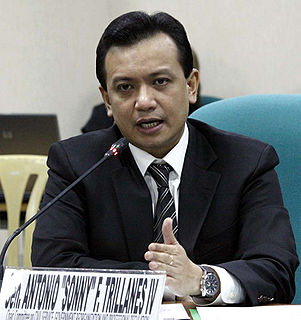
Antonio Fuentes Trillanes IV, is a retired Navy officer currently serving as a Senator of the Philippines and ex-mutineer against Philippine government. He was a vice presidential candidate in the 2016 Philippine presidential elections.

Genuine Opposition (GO) is the political multi-party electoral alliance of the parties senatorial line-up for the 2007 Philippine midterm elections, which is in opposition to President Gloria Macapagal-Arroyo. It was originally called the "United Opposition (UNO)", created by opposition stalwart and Makati City Mayor Jejomar Binay on June 2005 to unite all politicians who wanted to impeach President Gloria Macapagal-Arroyo. UNO then reorganized itself and changed its name to Grand and Broad Coalition (GBC), with the UNO party under that coalition. On February 15, 2007 the group changed its name again to Genuine Opposition after a meeting with Senate President Manny Villar in his office in Las Piñas City and due to defection of 3 formerly opposition senators named Edgardo Angara, Teresa Aquino-Oreta and Tito Sotto to GMA's senatorial slate.
The Nacionalista Party is the oldest political party in the Philippines and in Southeast Asia responsible for leading the country throughout the majority of the 20th century since its founding in 1907, being the ruling party from 1935 to 1944, 1944–1946, 1953–1957, 1957–1961 and 1965–1972.
The 2013 election to the Senate of the Philippines was the 31st election to the Senate of the Philippines. It was held on Monday, May 13, 2013 to elect 12 of the 24 seats in the Senate. Together with those elected in 2010, the candidates elected in this election shall comprise the 16th Congress. The senators elected in 2010 will serve until June 30, 2016, while the senators elected in this election will serve up to June 30, 2019. The elections to the House of Representatives as well as local elections occurred on the same date. The Philippines use plurality-at-large voting for seats in the Senate: the twelve candidates with the highest number of votes win the twelve seats up for election. The Senate seat vacated by President Benigno Aquino III in 2010 was among the twelve seats to be put for election.
The Laban ng Demokratikong Pilipino is a political party in the Philippines founded on September 16, 1988.
The Philippine presidential and vice presidential elections of 2016 was held on Monday, May 9, 2016, as part of the 2016 general election. This was the 16th presidential election in the Philippines since 1935 and the sixth sextennial presidential election since 1986.
These are the people who, at one time or another, had been considered, announced, declined or withdrew his or her candidacy in the Philippine Senate election, 2013.
The United Nationalist Alliance (UNA) is a political party in the Philippines. It was created as a multi-party electoral alliance replacing the former United Opposition (UNO) coalition for the 2013 midterm elections, before it was launched as a single political party on July 1, 2015 by Jejomar Binay for his candidacy in the 2016 presidential election.

Team PNoy, formerly known as the LP–Akbayan–NPC–NP–LDP Coalition, was a political umbrella coalition in the Philippines, originally formed to support the administration-backed senatorial line-up for the 2013 Philippine Senate election. Team PNoy is composed mostly of supporters of former President Benigno Aquino III. The coalition is composed of the Liberal Party, the Nacionalista Party, the Nationalist People's Coalition, the Laban ng Demokratikong Pilipino, the Akbayan Citizens' Action Party, the PDP–Laban and the National Unity Party.
The 2016 election of members to the Senate of the Philippines was the 32nd election of members to the Senate of the Philippines. The seats of 12 senators elected in 2010 were filled during this election. The winners in this election joined the winners of the 2013 election to form the 17th Congress of the Philippines. The senators elected in 2013 will serve until June 30, 2019, while the senators elected in this election will serve up to June 30, 2022.
The 2016 Philippine House of Representatives elections were the 34th lower house elections in the Philippines. They were held on May 9, 2016 to elect members to the House of Representatives of the Philippines. The winning candidates were to comprise the House's contingent in the 17th Congress of the Philippines that would serve from June 30, 2016 to June 30, 2019.
The Koalisyon ng Daang Matuwid was the umbrella of the administration-backed presidential and senatorial line-up for the 2016 Philippine Senate election. It is composed of mostly supporter of Mar Roxas who announced his presidential bid after the endorsement of Philippine President Benigno Aquino III during the event at the Club Filipino on July 31, 2015. It is the remnant of Team PNoy which was formed by the Liberal Party along with Akbayan Citizens Action Party, Laban ng Demokratikong Pilipino, the Nacionalista Party, the Nationalist People's Coalition and the National Unity Party as its coalition members.
Coalition for Change, also known as Kilusang Pagbabago, is the informal name of a multi-party umbrella coalition formed by the supporters of the administration of Rodrigo Duterte and the 17th Congress of the Philippines. Headed by PDP-Laban, it has formed coalition agreements with the Nacionalista Party, Lakas–CMD, Nationalist People's Coalition and National Unity Party, as well as the Centrist Democratic Party and an independent congressional block of 24 party-list groups.
The 2019 Philippine House of Representatives elections will be the 35th triennial election held in the Philippines to decide the 18th Congress of the Philippines. All seats in the House of Representatives will be contested. It is scheduled to be held on May 13, 2019.
Hugpong ng Pagbabago is a political alliance in the Philippines that began as a regional political party. It was formed by Davao City Mayor Sara Duterte in 2018. The party was established in support of her father President Rodrigo Duterte's government. In July 2018, the Philippine Commission on Elections granted the accreditation of Hugpong ng Pagbabago. In addition to the party's alignment with the Duterte administration, Sara Duterte said that she formed Hugpong ng Pagbabago "to pursue the ideals of what we all want, a strong region, a secure life for our constituents, good governance and effective leadership of the members of the party."