| Procolophonomorphs Temporal range: Gzhelian - Late Triassic, | |
|---|---|
 | |
| Kapes bentoni (Procolophonidae) | |
 | |
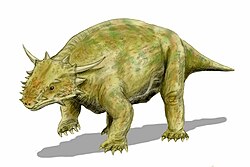
| Scutosaurus (Pareiasauria) | |
Scientific classification  | |
| Kingdom: | Animalia |
| Phylum: | Chordata |
| Class: | Reptilia |
| Subclass: | † Parareptilia |
| Order: | † Procolophonomorpha Romer, 1964 |
| Subgroups | |
| |
Procolophonomorpha is a proposed order containing most groups included within the traditional "Parareptilia." Many papers have applied various definitions to the name, though most of these definitions have since been considered synonymous with modern parareptile clades such as Ankyramorpha and Procolophonia. The current definition of Procolophonomorpha, as defined by Modesto, Scott, & Reisz (2009), is that of a stem-based group containing Procolophon and all taxa more closely related to it than Milleretta . It constitutes a diverse assemblage that includes several lizard-like forms, and more diverse types such as the pareiasaurs. Lee 1995, 1996, 1997 argues that turtles evolved from pareiasaurs. Still, this view is no longer considered likely. Rieppel and deBraga 1996 and deBraga and Rieppel, 1997 argue that turtles evolved from sauropterygians, and there is both molecular and fossil ( Pappochelys ) evidence for the origin of turtles among diapsid reptiles.