Resorts often are often located in beautiful locations and offer a variety of amentities, such as swimming pools and lounging areas, as seen here in a luxury establishment in Playa Del Carmen, MexicoKayaking provided by a lakeside resort in Jasper, Alberta
A resort (North American English) is a self-contained commercial establishment that aims to provide most of a vacationer's needs. This includes food, drink, accommodation, sports, entertainment and shopping, on the premises. A hotel is frequently a central feature of a resort and the term resort may be used for a hotel that provides an array of entertainment and recreational activities.
Some resorts are also condominium complexes that offer timeshares or fractional ownership, in addition to wholly owned condominiums. A resort is not always a commercial establishment operated by a single company, but in the late 20th century, this type became more common.
In British English, "resort" means a town which people visit for holidays and day trips, typically containing hotels where holidaymakers stay. Blackpool and Brighton in UK and Ayia Napa in Cyprus are examples of such places.
A destination resort has the necessary guest attraction capabilities itself, so it does not need to be near a destination such as a town, historic site, or theme park, to attract its patrons. A commercial establishment at a destination resort, such as a recreational area, a scenic or historic site, amusement park, a gaming facility, or other tourist attraction may compete for customers.
A destination resort offers food, drink, lodging, sports, entertainment, and shopping within the facility, so that guests have no need to leave the facility throughout their stay. Commonly, the facilities are of higher quality than would be expected, if one were to stay at a hotel or eat in a town's restaurants.
Closely related are convention hotels and large meeting sites. Generally, these resorts are located in cities where they offer special meeting halls, ample accommodations, and a variety of dining and entertainment options.
An all-inclusive resort charges a fixed price that includes most or all items. At a minimum, most inclusive resorts include lodging, unlimited food, drink, sports activities, and entertainment. In recent years, the number of resorts in the United States offering "all-inclusive" amenities has decreased dramatically. In 1961, over half offered such plans, but in 2007, less than a tenth do so.[1]
All-inclusive resorts are found around the world, but tend to be located in warmer regions. Notable examples are Club Med, Sandals Resorts, and Beaches Resorts.
An all-inclusive resort includes three meals daily, soft drinks, most alcoholic drinks, gratuities, and usually other services in the price. Many also include offered sports and other activities in the price. The all-inclusive model originated in the Club Med resorts, which were founded by the Belgian Gérard Blitz.[2]
Some all-inclusive resorts are designed for specific groups. For example, some cater for adults only, and even more-specialized properties are restricted to couples. Others are geared toward families, with facilities like craft centers, game rooms, and water parks to keep children of all ages entertained. All-inclusive resorts are also very popular locations for destination weddings.
A spa resort is a short-term residential facility primarily providing individual services for spa goers. Historically, many such spas were developed at natural hot springs or sources of mineral waters. Such facilities provide a comprehensive program that includes spa services, physical fitness activities, healthy diet programs, and special interest programming.
Golf resorts cater specifically to the sport of golf, and include access to one or more golf courses or clubhouses, typically providing golf packages that give visitors access to all greens and include cart fees, range balls, accommodation, and meals.
Surf resorts are a new trend,[3] based around artificial surfing facilities with purpose-built amenities and accommodation catering to the surfing community.
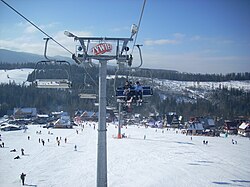
A view of a typical ski resort and ski lifts
In North America, a ski resort is generally a destination resort in a ski area. The term is less likely to refer to a town or village.
A resort hotel contains full-sized luxury facilities with full-service accommodations and amenities. These hotels may attract vacationing tourists and offer more than a convenient place to stay.
Timeshare resort
There are more than 1500 timeshare resorts in the United States. They represent 198,000 residences and nearly 9 million owners, who pay an average $880 per year in maintenance fees. A reported 16% of the residences became vacation rentals.[4]
Notable historic resorts
Baiae, Italy, a famous historic resort of the ancient world that was popular over 2000 years ago.
Capri, an island near Naples, Italy, has attracted visitors since Roman times.
Monte Ne, near Rogers, Arkansas, a famous historic resort active in the early 20th century. At its peak, more than 10,000 people a year visited. Two of its hotels, Missouri Row and Oklahoma Row, were the largest log buildings in the world. Monte Ne closed in the 1930s and was ultimately submerged in Beaver Lake in the 1960s.
Tawawa House, also known as Tawawa Springs or Xenia Springs, inspired Dolen Perkins-Valdez to write her debut novel, Wench (2010),[5] when she read about it in an autobiography of W.E.B. Du Bois. The book mentioned in passing that the land for Wilberforce University had once been used for a privately owned resort called Tawawa House, where white slave owners would bring the black slaves that they kept as mistresses.[6][7]
Seaside resorts are located on a coast. In the United Kingdom, many seaside towns have turned to other entertainment industries. The cinemas and theatres often remain to become host to a number of pubs, bars, restaurants, and nightclubs. Most of their entertainment facilities cater for both locals and visitors and the beaches still remain popular during the summer months.
In Europe and North America, ski resorts are towns and villages in ski areas, with support services for skiing such as hotels and chalets, equipment rental, ski schools and ski lifts to access the slopes.
This page is based on this Wikipedia article Text is available under the CC BY-SA 4.0 license; additional terms may apply. Images, videos and audio are available under their respective licenses.