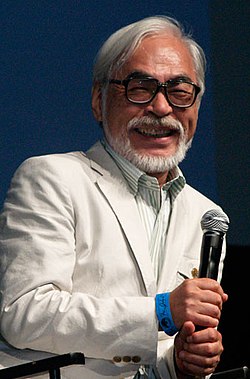
Castle in the Sky,[a] also known as Laputa: Castle in the Sky, is a 1986 Japanese animatedfantasyadventure film written and directed by Hayao Miyazaki. It was produced by Isao Takahata, animated by Studio Ghibli, and distributed by Toei. The film stars the voices of Mayumi Tanaka, Keiko Yokozawa, Kotoe Hatsui[ja], and Minori Terada. In the film, orphans Sheeta and Pazu are pursued by government agent Muska, the army, and a group of pirates. They seek Sheeta's crystal necklace, the key to accessing Laputa, a legendary flying castle hosting advanced technology.
Castle in the Sky was the first film to be animated by Studio Ghibli. Its production team included many of Miyazaki's longtime collaborators, who would continue to work with the studio for the following three decades. The film was partly inspired by Miyazaki's trips to Wales, where he witnessed the aftermath of the 1984–1985 coal miners' strike. The island of Laputa is used to highlight the theme of environmentalism, exploring the relationships between humanity, nature, and technology, a reflection of Miyazaki's ecological philosophy. The young protagonists also provide a unique perspective on the narrative, as a result of Miyazaki's desire to portray "the honesty and goodness of children in [his] work".[1] Many aspects of the film's retrofuturistic style – the flying machines in particular – are influenced by nineteenth-century approaches, which has earned the film a reputation in the modern steampunk genre.
The film was released in Japanese theaters on August 2, 1986. It underperformed expectations at the box office, but later achieved commercial success through rereleases, earning over US$157 million as of 2021. An English dub commissioned by Tokuma Shoten was distributed in North America by Streamline Pictures, and another dub was produced by Disney in 1998, released internationally by Buena Vista in 2003. The film's score was composed by Joe Hisaishi, who would become a close collaborator of Miyazaki's; Hisaishi also composed a reworked soundtrack for the 2003 English dub. The film was generally acclaimed by critics, though the English dubs received mixed reviews. It was well received by audiences, being voted as one of the greatest animated films in polls conducted by the Agency for Cultural Affairs and Oricon. The film also received several notable accolades, including the Ōfuji Noburō Award at the Mainichi Film Awards and the Anime Grand Prix from Animage. Castle in the Sky has since earned "cult status",[2] and has influenced several notable artists working in multiple media.
Plot summary
An airship carrying Sheeta – an orphan girl abducted by government agent Muska – is attacked by air pirate Dola and her gang, who seek Sheeta's crystal necklace. Attempting to escape, Sheeta falls from the airship but is saved by the magic of the now-glowing crystal, which lowers her gently. Pazu, an orphan working as a mechanic in a 19th-century mining town, catches Sheeta and takes her to his home to recover. The next morning, Pazu shows Sheeta a picture his father took of Laputa, a mythical castle on a flying island, which Pazu now seeks. Dola's gang and Muska's soldiers shortly arrive looking for Sheeta. Pazu and Sheeta are chased through the town and fall into a mine shaft, but are saved again by the crystal. In the tunnels, they meet Uncle Pom, who shows them deposits of the glowing mineral Aetherium, the same material as Sheeta's crystal.
Sheeta reveals to Pazu that she has a secret name tying her to Laputa, proving the myth is real. The army captures and detains the two in a fortress. Muska shows Sheeta a dead robot that fell from the sky, bearing the same insignia as on Sheeta's crystal, and reveals she is the heiress to the Laputan throne. Muska releases Pazu in exchange for Sheeta guiding the army to Laputa. Returning home, Pazu is captured by Dola's gang, who prepare to take the crystal from the fortress. Pazu joins the gang in an attempt to save Sheeta. In the fortress, Sheeta recites an ancient phrase her grandmother taught her and inadvertently activates the crystal's magic, reanimating the robot. The robot protects Sheeta from the army and destroys the fortress with its weapons, but is destroyed in turn by the military airship Goliath. In the chaos, Pazu and Dola rescue Sheeta. However, Sheeta's crystal is left behind, its magic still active, which allows Muska to use it to navigate to Laputa.
Sheeta, having seen the crystal's directions and being able to navigate to Laputa, helps Pazu convince Dola to take them there in exchange for temporarily joining her crew. That night, Sheeta and Pazu keep watch from the crow's nest as Goliath suddenly attacks Dola's airship. Dola detaches the crow's nest, which also functions as a glider attached to the ship with a line. Pazu spots a massive storm, wherein he believes his father saw Laputa. Dola attempts to steer into the clouds, but is halted by violent winds. Goliath destroys the airship, severing the line connecting it to the glider. Sheeta and Pazu pass through the turbulent lightning storm.
They land safely on Laputa, which they find deserted but for some fauna and one peaceful robot. The castle is in ruins, and a giant tree now grows out of the top of the island. The army arrives and begins looting the castle, having taken Dola's gang captive. Muska and his accomplices betray the army, destroying their communication systems, and take Sheeta into the castle's core. Pazu frees Dola's gang from their bindings and pursues Muska. The castle's core is the center of Laputa's ancient knowledge and weapons, which Muska activates using Sheeta's crystal, revealing to her that he is also a descendant of the Laputan royal line. Demonstrating Laputa's power by causing a massive explosion over the ocean and by destroying Goliath, Muska plans to use Laputa to destroy humanity, believing them inferior to himself and Sheeta. A horrified Sheeta takes back the crystal and flees, but Muska intercepts her in Laputa's throne room.
Pazu reaches the throne room and bargains for a brief truce. Sheeta teaches Pazu another ancient phrase, the spell of destruction. The spell sends Muska falling to his death, with the giant tree shielding Sheeta and Pazu from Laputa's destruction. The rest of the castle – along with Dola's glider – is preserved by the giant tree, and the island rises into space. Sheeta, Pazu, and Dola's gang escape, and briefly reunite before flying away.
Voice cast
Mayumi Tanaka(pictured in 2023), who voiced Pazu in the original Japanese version[3]
Mark Hamill(pictured in 2017) received critical praise for his performance of Muska in the 2003 English dub.[4]
Following the success of his previous film, Nausicaä of the Valley of the Wind(1984), Hayao Miyazaki began looking for different projects to direct.[7]Tokuma Shoten, the company backing Miyazaki financially, made propositions to produce a follow-up to Nausicaä, which he refused.[8] He envisioned creating an old-fashioned adventure film that would be a "pleasure" to watch,[9] for which he took a research trip to the city of Yanagawa. He developed an initial film concept set in the city, tentatively titled Blue Mountains,[10][c] which he pitched to Tokuma Shoten in June1984.[11] However, he stated in a later interview that he "wasn't in shape to direct" at the time, and was unable to make progress on the concept.[12]
Research for an abandoned concept set in Yanagawa inspired Isao Takahata to create a documentary focusing on the city's canals instead.
The film was never produced, but the city's canals inspired Miyazaki's longtime collaborator, Isao Takahata, to propose they create a documentary about them rather than an animation. This eventually became The Story of Yanagawa's Canals(1987), which focused on the environmental effects of industry on the local waterways.[13] A documentary, however, was unlikely to be commercially viable and had no prospect of support from Tokuma Shoten.[14] Miyazaki therefore financed its production through his personal office, Nibariki, using the profits he had made from Nausicaä.[15]
Takahata rapidly expended the funds on research;[16] to recover the expense and help complete the filming, Toshio Suzuki, an editor of Animage at the time, recommended that Miyazaki direct another film.[16] According to Suzuki, Miyazaki immediately agreed, and quickly developed a concept for the film based on an idea he had had in elementary school. Suzuki later commented that "if Takahata had made his movie on schedule, [Castle in the Sky] wouldn't have been born."[17]
Pre-production
Miyazaki completed a project proposal in December1984, tentatively titled Young Boy Pazu.[18][d] According to the animation scholar Seiji Kanō, its concepts constituted a "direct rebellion" against popular animation trends at the time; instead of a protagonist with superhuman powers and a futuristic setting, the proposal featured an ordinary child within a fantastical nineteenth-century period.[20] Although Miyazaki had expected Nausicaä to appeal to teenagers, he realized that his audience included many younger children as well, leading him also to conceptualize a film catered to this demographic that opposed the trend of increasingly adult-oriented animations.[21]
The proposal was also unusual in that it did not adapt an already-successful manga, which weakened its commercial potential.[22] Feeling that it was unlikely to be greenlit, Miyazaki preemptively began work on a back-up proposal. However, Tokuma Shoten was eager to back Young Boy Pazu,[23] and immediately approved it to begin production, with Takahata acting as producer as he had done on Nausicaä.[24] Miyazaki continued working on the proposal, producing a second draft in February1985; Kanō wrote that this draft contained a shift towards a more realistic perspective. Refinements were made to the plot, multiple settings were described in detail, and additional characters were included.[24]
On Takahata's suggestion, Miyazaki traveled to the country of Wales in May1985 to conduct location scouting for the film. With Takahata and Suzuki occupied on the documentary and with building the film's production crew, Miyazaki went alone.[25] Although using real locations as inspirations for fictional settings was a common practice among Japanese animators,[26] Miyazaki's intention for the film was only a generally Western appearance.[27]
He was significantly influenced by the region's architecture and landscapes;[28] the Big Pit Mine– by then converted into a museum– influenced the opening scenes set in the mining village. Cardiff Castle, and other edifices like it around Wales, provided references for the film's Titus Fort.[24] He also witnessed the aftermath of the 1984–1985 coal miners' strike in protest of the push from Margaret Thatcher's government to close many of the mines.[29] He was significantly moved by the empty facilities and defeated atmosphere he saw, which resonated with him politically and influenced the themes that he eventually explored.[30][e]
Writing and production
While Miyazaki was away, Takahata, Suzuki, and Tokuma Shoten's Yasuyoshi Tokuma[ja] searched for an animation studio willing to take on the new production, but were unsuccessful. The company responsible for Nausicaä's production, Topcraft, had also gone bankrupt around the time. They therefore decided to set up a new studio, hiring some of their previous collaborators, including Tōru Hara[ja]– Topcraft's founder– and the colorist Michiyo Yasuda.[31] After scouting several properties on which to set up an office, they selected a location in Tokyo's Kichijōji neighborhood, and were set to begin production upon Miyazaki's return. Studio Ghibli opened on June15, 1985, as a subsidiary of Tokuma Shoten.[32][f]
Along with some initial sketches of the visuals, Miyazaki began working on the script on June17, the first draft of which was completed by the end of the month.[33] The film's title, Laputa: Castle in the Sky, was finalized.[34] This draft's plot was similar to that of the finished film until the substantially different final act: Sheeta and Pazu remained separated throughout their time on Laputa, more scenes of violence and strife that occurs there were included, and additional runtime was spent on an exploration of Muska's character. Takahata and Suzuki, who felt that this deviated from the intended adventurous mood, advised Miyazaki to make revisions.[35]
A second script draft was finished on July22. In addition to changes to the second half of the plot, new elements began to appear: the power of Sheeta's necklace became tied to her thoughts, and Laputa's natural elements were emphasized.[33] However, other concepts that had featured in Miyazaki's concept art for several years, such as a scene in which Sheeta and Pazu pilot an ornithopter, were cut. Miyazaki also began the storyboarding around this time.[35]
Studio Ghibli gradually built its production staff over the following months and began work on the main animation,[36] recruiting animators from companies they had previously worked with, such as Telecom Animation Film, Toei Animation, and Nippon Animation.[37] Other animation studios, such as Doga Kobo and Oh! Production, provided support for the in-between animation.[3] By January1986, 33people were working on the project. Sequences began being committed to film the following month, and a teaser trailer was sent out to theaters. Miyazaki finalized the storyboards; according to Kanō, they required significant condensing, as the original plan would have run over three hours. The final runtime was just over two hours, making it Miyazaki's longest film at the time.[38]
Animation and special effects
Castle in the Sky was animated by hand using at least 69,262cel drawings.[39][g] Hara said that the studio was "aiming for a manga-like feel", which they planned to accomplish with a limited color palette. However, they ended up using over 300shades, which Yasuda attributed to the varied lighting conditions across the film;[41] by comparison, Nausicaä had used only around250.[42] The lead animator Yoshinori Kanada was hired in August1985,[33] and the first task he was delegated was to experiment on the flaptors– the flying machines used by Dola's gang in the film. He attempted multiple approaches to portray their insect-like wings, eventually deciding upon drybrushed strokes to imply rapid motion.[43]
Certain special effects from the film use a combination of cel and film techniques.[44] For example, double exposures in which parts of the image are exposed only once, creating the effect of semi-transparency; this technique was used in the film to depict Laputa's holograms.[45] The opening sequence uses multiple "transmitted light" techniques– in which the film is deliberately overexposed, allowing light to bleed into adjacent sections of the image– to convey the luminance of the crystal necklace.[44] According to Hara, the majority of the cels had been completed by May, but around 30% required retouching during the filming process.[42]
Some of the film's shots make use of the Harmony Process, a technique pioneered by Noriko Takaya[ja].[46] This involved cutting cels into custom shapes and painting them in the style of a background layer, which could then be articulated between frames in a manner comparable to stop-motion animation. This allowed certain foreground elements to be highly detailed as, unlike the other cels, they did not have to be redrawn on every frame.[47] An early shot of the Goliath airship that Takaya worked on features Harmony elements,[48] and a similar technique was used to animate the storm initially obscuring Laputa.[49]
Casting and voice acting
Auditions for the voice cast began in May1986,[50] led by Miyazaki, Takahata, and Shigeharu Shiba, the film's sound director. Pazu was initially intended to be voiced by a young boy, but they found the audition performances unsatisfactory. Shiba eventually recommended Mayumi Tanaka, who was known for other voice roles playing children. For Sheeta, Miyazaki requested they cast someone other than Sumi Shimamoto, who had voiced the female leads of his two previous films; they finally decided on Keiko Yokozawa, a veteran voice actor who had also tried out for the lead role in Nausicaä.[51]
Minori Terada (Muska) and Kotoe Hatsui[ja] (Dola) were considered unusual choices, as they were both known more for their careers in live-action films. Shiba stated that Terada was selected in part due to his voice's similarity to the actor Jinpachi Nezu's, but that he and Miyazaki had also been impressed by Terada's work on the Japanese dub of Blade Runner(1982).[52] Shiba considered casting a comedian from the Kansai region as Dola, but Miyazaki found their dialect of Japanese to be undesirable. However, after he happened to view a television program in which Hatsui talked about her past, Shiba was impressed by her voice and personality, and handed her the role.[51]
The voice recordings took place over three days in late June and early July.[53] As further changes had been made to the story since the last script draft, the scripts given to the voice actors consisted of dialog extracted from the storyboards.[35] Terada, who was voicing an animated character for the first time, initially had difficulty delivering his lines in sync with Muska's lip movements; however, he grasped the technique during rehearsals and, according to Shiba, made a confident performance.[52]
Themes
Roles of nature and technology
Castle in the Sky contains a strong theme of environmentalism, questioning humanity's relationship with nature and the role of technology.[54] McCarthy interprets the giant tree of Laputa as a "metaphor for the reviving and life-giving power of nature."[55] However, in contrast with the more optimistic conclusions of Miyazaki's previous works, Napier notes that the film ends with an "unsettling view" of the castle flying away, suggesting that humanity may not deserve to exist in the natural world.[56] Literary scholar Anthony Lioi interprets Laputa as an ecological utopia that demonstrates the peace that can be established between nature and advanced technology, but also serves as a criticism of modernity when "[the] peace is shattered by human violence."[57] Lioi notes that this outlook differs from dominant Western ideas, eschewing the extremes of capitalism and industrialism, as well as radical environmentalism and conservationism.[57]
While Laputa's giant tree is seen as a metaphor for the restorative capability of the natural world, its underside is a symbol of the immorality of modernity.
Critics note the philosophical ambiguity of the castle; while Laputa initially appears to be an ideal union of nature and technology, it is later revealed to have a much harsher and more oppressive underside;[55] Napier writes that Laputa is "deeply paradoxical".[58] Laputa itself takes direct inspiration from the island of the same name from Gulliver's Travels (1726),[59] and film scholar Cristina Cardia claims that, like its namesake, the island is introduced with benign intentions but is ultimately "exploited for perverse ends, in this case war."[60] Lioi argues that Laputa is used as a means to comment on the ethics of contemporary culture,[57] based on Ildney Cavalcanti's observation that such a utopia also "must contain an overtly dystopian element, such that the implicit critique in utopian discourse becomes explicit."[61] However, he interprets the ultimate destruction of the castle's weapons as a demonstration that "violence is not the heart of the city", and that the dystopic elements of modernity can be healed.[57]
The film also presents an ambiguous view on the usage of technology.[62] The robots from Laputa provide an example of this view, as they are introduced in the film as a violent force capable of extreme destruction. However, when the protagonists next meet a robot, it is entirely peaceful, tending to the gardens and fauna on Laputa.[63] Lioi argues that the robots, as a representation of Laputan technology, are caretakers by default and only become destructive in response to human brutality.[57] McCarthy argues that "this is not a comment on technology but on man's inability to use it wisely."[64] Odell and Le Blanc conclude that "technology... is not necessarily a bad thing, but we must consider how it's used and to what extent."[65] The duality of nature and technology is further explored in Miyazaki's later film Princess Mononoke (1997).[66]
Innocence of children
Like many other films by Miyazaki, Castle in the Sky features young children as protagonists.[62] Miyazaki values the portrayal of children as good-hearted, confident in their own agency, and resilient and upbeat in response to adversity.[67] He criticized reviewers of his television series Future Boy Conan (1978) who described the titular character as "too much of a goody-two-shoes", admitting he was tempted to retort "So you want to see 'bad characters', you fool?"[68] Film critics Colin Odell and Michelle Le Blanc argue that creating a film with younger protagonists generates perspectives that an adult would not perceive, saying "the children in Ghibli's films are a liberating force that allows anything to be possible."[62]
The lack of parental oversight of the protagonists is an element Miyazaki feels to be important in promoting children's independence. The protagonists of his films are, like Sheeta and Pazu, often orphaned, or in some way parted from their parents.[69] Miyazaki believes that "one of the essential elements of most classical children's literature is that the children in the stories actually fend for themselves."[70] The presence of parents, in his opinion, would stifle the children's autonomy.[71] The limitations that children have in their abilities are also explored in the film; for example, Pazu comes close to forsaking Sheeta and his quest for Laputa.[72] Additionally, unlike Miyazaki's previous works, the protagonists do not succeed at convincing the antagonists of their wrongdoing, which offers a more pessimistic view on children's ability to educate others.[72]
Napier proposes that Miyazaki's insistence on showing the freedom of children in Castle in the Sky can be credited to the influence of Panda and the Magic Serpent (1958).[71] Miyazaki first watched the film at age 17, and it moved him to pursue a career in animation.[73] At a lecture given in 1982 at Waseda University, he said "When I saw Panda and the Magic Serpent, it was as if the scales fell from my eyes; I realized that I should depict the honesty and goodness of children in my work." He considers this a focal point in his endeavors.[1] The theme of innocence is explored further in Miyazaki's succeeding film My Neighbor Totoro (1988).[74]
Working-class moralities
While in Wales for his location scouting, Miyazaki witnessed the aftermath of the 1984–1985 coal miners' strike. Their ultimate failure to preserve the industry left a lasting impact on him; he viewed the event as an attack by the powerful on the miners' way of life and hard-working spirit.[75] His experiences are reflected in several supporting characters in the film, who, despite living impoverished lives of hard labor in the mines, enthusiastically protect the protagonists from multiple aggressors. Napier argued that this depiction reveals Miyazaki's yearning for a simpler way of life and a desire to create a story based in optimism.[76] Miyazaki later stated that he had "felt a real sense of solidarity with the mine workers" while in Wales;[77] Kanō speculated that they reminded him of his time in a labor union while working at Toei Animation.[78] The animation scholar Helen McCarthy wrote that the film "also contains echoes of the struggle of the Welsh people for nationhood and freedom."[79] Miyazaki visited Wales once more in 1986, ahead of the release of the film. In 2005, he told The Guardian "I admired those men, I admired the way they battled to save their way of life, just as the coal miners in Japan did. Many people of my generation see the miners as a symbol, a dying breed of fighting men. Now they are gone."[80]
Style
Miyazaki's affinity for flight is repeatedly displayed in Castle in the Sky, a motif that continues throughout the feature films of his career.[66] A variety of fictional flying machines appear across the film, including the island of Laputa, the airships, and the pirates' ornithopters; Sheeta's crystal also allows her to float through the air.[81] However, many of the other flying machines in the film are retrofuturistic, influenced by nineteenth-century stylistic approaches.[82] Additionally, Miyazaki was inspired by the literature of Jules Verne and Robert Louis Stevenson when considering the style of the film.[83]
Another stylistic trait that Miyazaki drew from nineteenth-century influences is the depiction of machines that "still possess the inherent warmth of handcrafted things."[84] Literary scholars Jeff VanderMeer and S. J. Chambers argue that Pazu's enthusiasm to build and work with flying machines gives the film's airships "a realistic physicality."[85] Commenting on the mecha anime popular at the time, Miyazaki expressed his hatred for shows that glorified machines without portraying the characters struggling to build or maintain them.[86] Animation scholar Thomas Lamarre argues that the film provides an "alternative to our received technologies" and thus a critique of more contemporary technologies and society's perception of them.[87]
Boyes felt that many of these elements subsequently influenced the steampunk genre.[88] Napier writes that Verne's impact on the film's style was instrumental in evoking imagined nostalgia for a time when "machines were still fun", in Miyazaki's words.[89] While the other machines are presented as joyful, Laputa's underside is used exclusively as an instrument of destruction.[28] Miyazaki stated that, as a child, he was attracted to the design and power of military planes, a view that has since been replaced with revulsion for the indiscriminate acts of violence that the machines have been used for.[90] Miyazaki further explores the beauty of flying machines as well as their innate destructive potential in his later film The Wind Rises (2013).[91]
The film was released in Japan on August 2, 1986, by Toei.[92] At the Japanese box office, the film sold about 775,000 tickets,[93] and made relatively unremarkable earnings at the box office.[94] Miyazaki and Suzuki expressed their disappointment with the film's box office figures.[95] The film was promoted with a tie-in fruit soda brand which animation scholar Rayna Denison described as an "economic failure".[96]
The film later earned a significant additional amount through rereleases;[76]as of 2021[update], it has grossed approximately US$157 million in box office, home video, and soundtrack sales.[97] In the United Kingdom, it was 2019's eighth-best-selling foreign language film on home video, below five other Studio Ghibli films.[98] The film has sold approximately 1.1million tickets in Europe as of 2023.[99] Multiple international theatrical rescreenings between 2003 and 2023 have earned the film approximately US$6.2 million.[100]
English dubs
The first English dub of Castle in the Sky was produced by an unknown party.[b] It was first screened in Hong Kong on June 26, 1987,[3] and debuted in the United States on July 14, 1987, at the Los Angeles Animation Celebration.[106] It was licensed for theatrical distribution in North American markets from March 24, 1989, to February 1991 by the then-new Streamline Pictures.[107] An edited version of this dub briefly aired on UK television.[h] In addition to distribution rights, Streamline would go on to dub two other Studio Ghibli films in-house: My Neighbor Totoro and Kiki's Delivery Service (1989).[109]
The English dub produced by Disney was recorded in 1998 and planned for release on video in 1999, but the release was postponed after Princess Mononoke did not perform well in North American theaters.[102] The film premiered at the New York International Children's Film Festival on February 2, 2000.[3] It was released on home video in North America on April 15, 2003, alongside a rerelease of Kiki's Delivery Service and Spirited Away (2001).[110] Due to the possible confusion of the title with the Spanish phrase la puta – literally 'the whore' – the film was released as simply Castle in the Sky in North America.[111] The film was released by Buena Vista on Blu-ray in North America on May 22, 2012.[112]Shout! Factory and GKIDS re-issued the film on Blu-ray and DVD on October 31, 2017.[113] Both the original Japanese version and the 2003 English dub were made available for streaming when the rights to Studio Ghibli's filmography were acquired by Netflix in 2020.[114]
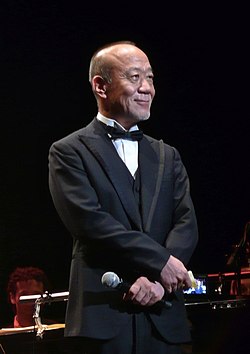
Joe Hisaishi, a returning collaborator from Nausicaä, composed Castle in the Sky's score. He was not initially planning to fill this role, as he was occupied with composing for Arion(1986) at the time, but accepted the project at Miyazaki's request.[115] The two went on to become close collaborators, and Hisaishi has since written the music for all of Miyazaki's feature films.[116]
After he was brought on in February1986, Hisaishi began work on the image album, a collection of demos based on the concept materials that serve as a precursor to the finished score.[117] Takahata acted as music supervisor,[118] and worked with Hisaishi on a plan for the music required in each scene.[119] Each song from the image album was then extended and arranged for full symphony orchestra; this version was recorded by the Tokyo City Philharmonic[ja].[120]
In March, the song "If I Could Fly"[i] was commissioned from Takashi Matsumoto, who had written a similar song for Nausicaä.[121] Unlike the other music, this was not planned to be featured in the film, and only appears in an Ajinomoto television advertisement for the film. Kanō described the track, performed by Yōko Obata[ja], as similar to other pop music from the time.[120]
For the final score, Hisaishi aimed to precisely synchronize the music with the on-screen action.[120] Advancements in digital playback allowed him to compose while watching the animation to compare their timing; he then sent the pieces to Miyazaki and Takahata for review.[119] This resulted in lengthy sequences with uninterrupted background score, and pieces that dynamically switch between different motifs to match the scene's point of view.[120] While the image album contains prominent electronic elements,[122] Hisaishi intended for a more "acoustic" sound in the film; the soundtrack version therefore uses Fairlight synthesizers alongside a 50-piece orchestra.[119]
Disagreements between Miyazaki, Takahata, and Hisaishi about which scenes needed background accompaniment led to delays; the music for the opening scene, for example, was written less than a month from the release date.[120]"Carrying You",[j] the vocal song that plays over the credits sequence, was requested by Takahata late in the production. He asked Miyazaki to write the lyrics– Kanō wrote that they were likely inspired by Wind, Sand and Stars(1939), a memoir by Antoine de Saint-Exupéry[123]– and Hisaishi set them to an arrangement of the film's main theme.[124] It was performed by Azumi Inoue.[125]
According to Shigeharu Shiba, Castle in the Sky was among the first films in Japan to use quadraphonic (4-channel) sound for its theatrical release. He avoided using the additional speakers to move sounds around the room– as Miyazaki felt the effect became too artificial– and instead strove to preserve a "natural sense of space". The final mixing was done at the Tokyo Television Center[ja]. Shiba said that Hisaishi's score required very few changes during the process with the exception of the scene of Laputa's collapse, where Takahata insisted the song be cut off in the middle of the scene.[126]
Rewriting for the English dub
The soundtrack for the 2003 English dub was performed by the Seattle Symphony(pictured in 2009).
Hisaishi began rewriting the soundtrack for the English dub in March1999, rearranging the original themes in an American cinematic style.[128] He was advised by Disney staff that non-Japanese audiences preferred comparatively more music in films. As a result, this soundtrack is much longer, around 90minutes in length, while the Japanese version featured just an hour of music.[127]
The new material was used to fill scenes that had previously been silent or partially scored.[129] Various other changes were made, and scenes from the original that Miyazaki or Hisaishi had been dissatisfied with were rewritten entirely.[130] Although Hisaishi felt that writing in a Hollywood style involved an overly simplistic compositional approach, he stated that he "learned a lot" from the experience.[131]
As many of the original scores and synthesizer data had been lost by this point, Hisaishi reconstructed them before starting on the adaptation.[127] Every piece in this version was written for symphony orchestra, and many electronic-heavy tracks for the original were rearranged for the ensemble.[132] The soundtrack was performed by the Seattle Symphony, which Hisaishi had chosen for their "well-balanced" sound.[127] The recordings took place in Seattle in late April and early May, inside a local church.[133]
Analysis
The cinema and music scholar Marco Bellano identified the image album as the beginning of a change in Hisaishi's compositional style for Miyazaki's films; it contains more experimental pieces, and the melodies are written with much longer phrases.[122] Hisaishi said that these were drawn from Scottish and Irish folk influences, which often use pentatonic scales.[134] Bellano found that, to match the pacing of the film, these melodies are introduced in their complete forms before being "fragmented" when reappearing in later scenes.[135]
Although Hisaishi uses leitmotifs– short, recurring musical elements tied to aspects of the narrative, such as characters or moods– Bellano argued that he developed a novel approach to using leitmotifs due to the particular constraints of composing for a Miyazaki film.[135] Bellano analyzed the film's main theme as built on a descending four-note line (highlighted below in red), a technique that would characterize Hisaishi's future melodies in Miyazaki's work:[136]
In this film's context, he found the descending pattern reflective of the film's theme of flight; rather escaping into the sky, the film's characters must return to the earth. The pieces underscoring Sheeta's speech to Muska, as well as the introductory scene on Laputa, contain similar descending lines, emphasizing the thematic connection.[137]
Castle in the Sky has been generally acclaimed by film critics in the years since its release. In 2001, Animage ranked Castle in the Sky 44th in their list of top 100 anime.[139] Animation critic and writer Raz Greenberg calls Castle in the Sky "one of the greatest adventure films ever made",[140] and critic Manabu Murase names it "quite possibly the most entertaining anime that Miyazaki ever made".[141] On the review aggregator website Rotten Tomatoes, the film holds an approval rate of 96% from 28 critics, with an average rating of 7.6 out of 10. The site's critic consensus reads, "With a storytelling palette as rich and brilliant as its animation, Castle in the Sky thrillingly encapsulates Studio Ghibli's unique strengths."[142] At Metacritic, the film has a weighted average score of 78 out of 100 based on seven critics, indicating "generally favorable reviews".[143]
While multiple reviewers felt that the film's two-hour runtime would turn audiences away,[144]The New York Times'sCaryn James commenting that it is "liable to strain patiences of adults and the attention spans of children",[145] others argued that the film had the appeal to keep audiences entertained.[146]IGN's Jeremy Conrad felt the characters are "so likable that you never get bored, you always want to see what adventure is next for them".[4] Reviewers were split over the 1987 English dub,[147] with the Dayton Daily News's Terry Lawson calling it "the film's weakest element",[148] while The Cincinnati Post's David Lyman felt the dubbing into English had been done "superbly".[149] The 2003 dub similarly received mixed reviews, with The A.V. Club's Tasha Robinson calling Disney's recordings "almost comically bland",[150] and Conrad expressing his appreciation for Anna Paquin as Sheeta and Mark Hamill's performance as Muska.[4] Many critics also praised the animation,[151] the Asheville Times's Tom Sabulis considering it "state-of-the-art"[152] and The Philadelphia Inquirer's Steven Rea naming it "masterful".[153] However, some felt the motions lacked fluidity,[154] with Lyman describing it as "stiff-limbed".[149]
Most reviewers highlighted the imaginative capacity that Miyazaki displays in the film.[155]Slant's Chuck Bowen noted the subtle details included in the film, which he felt lends it "texture and originality".[156] A review in the Weekly Asahi highlighted the film's dynamism, favorably comparing its flying sequences with Peter Pan (1953).[157] Several reviewers praised the use of color, which made the film "a joy to watch" according to James.[158] A reviewer for City Road noted that the film could present themes that were critical of modern society while still maintaining a "warm and caring" view of humanity.[159] Several reviewers noted the film's strong ecological theme, with The Washington Post's Richard Harrington appreciating the "moral duality" of Laputa's technology,[160] and the Asahi Journal's Yomota Inuhiko praising the depiction of Laputa as a utopia which gradually developed dystopic elements.[161] Critics and scholars also noted the film's connections to Miyazaki's previous works; Greenberg felt that the film is "deeply rooted within Miyazaki's filmography of the two decades that preceded it",[72] and Denison called it a "compendium of Miyazaki's previous interests as an animator".[162]
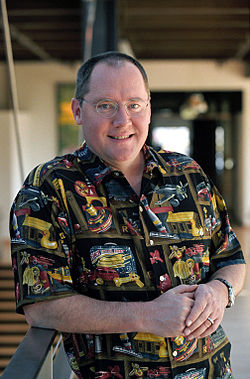
John Lasseter(pictured in 2002) has called Castle in the Sky one of his favorite films.
Castle in the Sky is considered by some scholars and writers to be an important work in the modern steampunk and dieselpunk styles.[169] Along with Nausicaä of the Valley of the Wind, Philip Boyes of Eurogamer considers Castle in the Sky a major contributor to the genres' popularity in Japan, introducing audiences to stylistic features such as airships which were otherwise mostly prevalent in Europe.[88] According to McCarthy, "its mix of epic action-adventure and techno-ecological theme has since earned [Castle in the Sky] cult status."[2]
Several notable artists in the anime and manga industries have cited Castle in the Sky as a major influence on their works. Nadia: The Secret of Blue Water (1990), by Neon Genesis Evangelion director Hideaki Anno, is noted for its similarities in premise with Castle in the Sky. Anno had previously worked with Miyazaki on the production of Nausicaä of the Valley of the Wind, and has stated that Nadia was based in part on one of Miyazaki's concepts.[170]D.Gray-man (2004) author Katsura Hoshino was moved to pursue a career in animation after watching the film, ultimately becoming a manga artist.[171]Ghost in the Shell (1995) director Mamoru Oshii[172] and Your Name (2016) director Makoto Shinkai named Castle in the Sky among their favorite animations.[173] Additionally, VanderMeer and Chambers argue that Castle in the Sky forms the stylistic foundation for several of Miyazaki's later films, including Porco Rosso (1992) and Howl's Moving Castle (2004).[85]
John Lasseter, former chief creative officer at Pixar and Disney Animation, often cited Miyazaki and his works to be his "greatest inspiration".[174] When asked about some of his favorite films, Lasseter expressed his admiration for Castle in the Sky.[168] Lasseter has worked with Miyazaki on the English dubs of several of his films, and notes this as an influence on his work with his colleagues. At a speech delivered at the 2014 Tokyo International Film Festival, Lasseter said "Whenever we get stuck at Pixar or Disney, I put on a Miyazaki film sequence or two, just to get us inspired again."[175] Napier argues that the protagonist of Pixar's WALL-E (2008), a robot left to care for a world abandoned by humans, "may have its roots in Laputa's nurturing robot."[176] The creators of The Wild Robot(2024) also cited the film as an influence on their work.[177]
Castle in the Sky has influenced numerous video games, particularly in Japan, with its success leading to a wave of steampunk video games.[88] According to Boyes, Castle in the Sky also influenced the airships in the Mario and Civilization franchises.[88] The Iron Golem from Minecraft(2011) is designed after the robots in the film,[178] and Anton Bitel of the British Film Institute also found influences in A Minecraft Movie(2025).[179] Several games from The Legend of Zelda series are noted to have been influenced by Castle in the Sky, particularly Tears of the Kingdom (2023), which features a flying castle and several thematic parallels with the film.[180]
On December 9, 2011, during an airing of Castle in the Sky on Japanese television, fans posting to Twitter set a new record for the platform by causing a peak of 25,088 tweets per second.[181] The record was later surpassed during another airing on August 2, 2013, with a figure of 143,199 per second.[182]
12The company responsible for producing the 1987 dub of Castle in the Sky is unknown. This dub is sometimes referred to as the "Streamline dub", which led to a misconception that it was produced by Streamline Pictures themselves.[101] Others attribute the dub to a company called "Magnum".[102] However, the dub was commissioned by Tokuma Shoten and licensed to Streamline for distribution in North America.[103]Fred Patten, a representative for Streamline, reported that it was originally produced for Japan Airlines as on-board entertainment on international flights.[104] According to Streamline's co-founder Carl Macek, Tokuma Shoten had outsourced its production to an unnamed company in Hollywood.[105]
↑Seiji Kanō reported the title of this concept was The City Where the Water Flows (Japanese: 水の流れる街, Hepburn: Mizu no nagareru machi).[11]
↑Japanese: 少年パズー, Hepburn: Shōnen Pazū. A few other titles were suggested in the proposal, including Mystery of the Levitation Crystal and Flying Treasure Island.[19]
↑The circumstances surrounding the formation of Studio Ghibli are the subject of debate among animation scholars. See Denison 2018 and Denison 2023 for further information.
↑Some sources claimed that the film uses as many as 75,000cels.[40]
↑The 1987 dub was aired by ITV in some regions of the eastern UK. This airing was altered from the original, with some scenes being cut,[104] and the film being listed on programs as Laputa: The Flying Island.[108]
↑Macek 2014, 48:49–49:17: "We didn't dub it. Streamline didn't dub it.... It was paid for by Tokuma Shoten, but they just picked some company out in the middle of Hollywood to do it. They just phone-booked the guy."
Bellano, Marco (2010). "The parts and the whole: audiovisual strategies in the cinema of Hayao Miyazaki and Joe Hisaishi". Animation Journal. 18. ISSN1061-0308.
Cavalcanti, Ildney (2004). "The writing of utopia and the feminist critical dystopia: Suzy McKee Charnas's holdfast series". In Baccolini, Raffaella; Moylan, Tom (eds.). Dark Horizons: Science Fiction and the Dystopian Imagination. Routledge. pp.47–69. ISBN978-0-4159-6614-6.
面白かったアニメ映画、宮崎作品が人気[Interesting anime movies, Miyazaki's works are popular]. Oricon (in Japanese). May 1, 2008. Archived from the original on May 6, 2008.
宮崎駿『風の谷のナウシカ』から二年ぶりの新作[Hayao Miyazaki: his first new work in two years since Nausicaä of the Valley of the Wind]. Shūkan Bunshun (in Japanese). July 17, 1986.
Mr. Tim (June 9, 2021). Mr. Tim's Interviews – Barbara Goodson. Event occurs at 22:19. Archived from the original on December 2, 2023 – via YouTube. Yeah, Pazu. Friends were watching it – Castle in the Sky... and I said 'Yeah, I'm in this.'{{cite AV media}}: CS1 maint: ref duplicates default (link)
Milthorpe, Brian (2025). "Rediscovering Laputa: literary form and technoscience in Castle in the Sky and Gulliver's Travels". In Nardi, Dominic J.; Fancher, Keli (eds.). Studio Ghibli Animation as Adaptations: Investigating How the Japanese Animation Powerhouse Reimagines Stories. Bloomsbury Academic. pp.205–230. ISBN979-8-7651-2708-7.
Murase, Manabu (2015). 宮崎駿再考:「未来少年コナン」から「風立ちぬ」へ[Reconsidering Hayao Miyazaki: From Future Boy Conan to The Wind Rises] (in Japanese). Heibonsha. ISBN978-4-5828-5781-8.
Nomura, Kōichirō (2010). 宮崎駿の地平: 広場の孤独・照葉樹林・アニミズム[Hayao Miyazaki's Horizon: The Solitude of the Square, the Evergreen Forest, Animism] (in Japanese). Hakujisha. ISBN978-4-8935-9103-6.
This page is based on this Wikipedia article Text is available under the CC BY-SA 4.0 license; additional terms may apply. Images, videos and audio are available under their respective licenses.