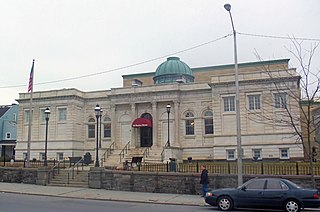
The Adriance Memorial Library is located on Market Street in Poughkeepsie, New York, United States. It is a stone building in the Classical Revival architectural style erected shortly at the end of the 19th century. In 1982 it was listed on the National Register of Historic Places.

The U.S. Post Office in Beacon, New York, is located on Main Street. It serves the ZIP Code 12508, covering the entire city of Beacon and some of the neighboring areas of the Town of Fishkill. It is a stone structure in the Dutch Colonial Revival architectural style built in the mid-1930s. In 1988 it was listed on the National Register of Historic Places along with many other older post offices in the state.

The U.S. Post Office in Rhinebeck, New York serves the 12572 ZIP Code. It is located on Mill Street just south of the intersection with NY 308 at the center of the village.
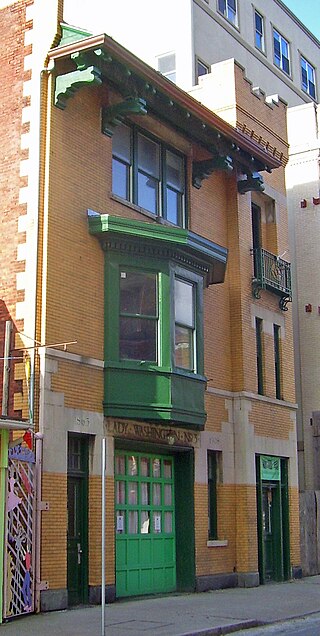
The Lady Washington Hose Company building is located on Academy Street in downtown Poughkeepsie, New York, United States. It was once home to one of the city's volunteer companies of the same name and subsequently housed the Children's Media Project. It is currently owned by two Poughkeepsie artists.. It is an unusual combination of different architectural styles.

The Poughkeepsie Trust Company building is located on Main Street in that city in the U.S. state of New York. It is immediately to the east of, and joined to, the Dutchess County Court House.

Benjamin Church House is a Colonial Revival house at 1014 Hope Street in Bristol, Rhode Island, U.S.A. It opened in 1909 as the "Benjamin Church Home for Aged Men" as stipulated by Benjamin Church's will. Beginning in 1934, during the Great Depression, it admitted women. The house was closed in 1968 and became a National Register of Historic Places listing in 1971. The non-profit Benjamin Church Senior Center was incorporated in June 1972 and opened on September 1, 1972. It continues to operate as a senior center.

The Mill Street–North Clover Street Historic District is located along those streets and Main Street in western Poughkeepsie, New York, United States. It is an irregularly-shaped area of 27 acres (11 ha) between US 9 and downtown Poughkeepsie, located on the slope up from the Hudson River. There are roughly 139 historic buildings, and very few new ones.

Wildcliff, also referred to as the Cyrus Lawton House, was a historic residence overlooking Long Island Sound in New Rochelle in Westchester County, New York. This 20-room cottage-villa, built in about 1852, was designed by prominent architect Alexander Jackson Davis in the Gothic Revival style. The home was added to the National Register of Historic Places on December 31, 2002.

The building at 73 Mansion Street in Poughkeepsie, New York, United States, was first built around 1890 as a single-family residence. It is next to the city's post office and across from the offices of the Poughkeepsie Journal, at the corner with Balding Avenue.

The Niagara Engine House is located on North Hamilton Street in downtown Poughkeepsie, New York, United States. It is a brick building constructed in the early 20th century, the only extant fire house of the six engine companies that once protected the city.

The former U.S. Post Office in Canandaigua, New York, is located on North Main Street. It is a Classical Revival granite structure built in 1910 and expanded in 1938. It was listed on the National Register of Historic Places both as a contributing property to the Canandaigua Historic District in 1984 and individually in 1988, as part of a Multiple Property Submission of over 200 post offices all over the state.

The Cornelius H. Evans House is located on Warren Street in downtown Hudson, New York, United States. It is a brick house dating to the mid-19th century.

Poughkeepsie Meeting House (Hooker Avenue) is a historic Quaker (Society of Friends) meeting house at 249 Hooker Avenue in Poughkeepsie, New York. It was built in 1927, and is a two-story, rectangular, Colonial Revival style brick building, with a basement. It has a gable roof and projecting entrance pavilion.

Eastman Terrace is a historic rowhouse block located at Poughkeepsie, Dutchess County, New York. It was built in 1872 and consists of ten sections. The block is three stories high on a raised basement. It features a mansard roof with polychrome slate and an elaborate roofline with decorative stone parapets and iron cresting. The block was part of a larger plan to develop the Eastman Park section of the city.
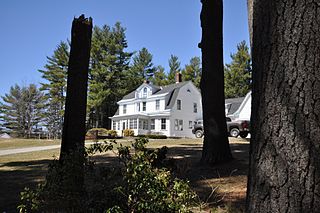
Foothill Farm is a historic farmhouse on Old Troy Road in Dublin, New Hampshire, United States. Built about 1914 as part of the large Amory summer estate, it is a distinctive local example of Dutch Colonial Revival architecture. The house was listed on the National Register of Historic Places in 1983.

The Hills House is a historic house museum at 211 Derry Road in Hudson, New Hampshire. Built in 1890 as a summer country house by a local philanthropist, it is an excellent local example of Shingle style architecture. The house is now used by the local historical society as a museum and meeting space. It was listed on the National Register of Historic Places in 1983.

Corlies–Hart–Ritter House is a historic home located at Poughkeepsie, Dutchess County, New York. It was built about 1872, and is a 2+1⁄2-story, Second Empire style frame dwelling with a 1+1⁄2-story rear section. A garage was added about 1920. It has a fishscale slate-covered, concave-shaped mansard roof. The front façade features a full-width, one-story, flat-roofed, porch. It was home to three successive families important in local musical history.

William J. Beardsley was a Poughkeepsie, New York-based architect.

Denton Homestead is a historic home located at East Rockaway in Nassau County, New York. It was built as a tavern about 1795, and is a 1+1⁄2-story, five-bay, center-hall-plan, vernacular Colonial style frame dwelling. The Denton family bought it in 1808 and converted to a residential farmhouse. It has a side-gable roof and a hipped roof addition added after the house was moved to its present location in 1924. The front facade features a full-width, shed-roofed front porch. The interior features some Colonial Revival style design elements. Also on the property is a contributing carriage house. The house is a rare surviving former tavern and farmhouse from the village's early period.

The Charles W. and Nellie Perkins House is a historic building located in Cedar Rapids, Iowa, United States. This 2½-story, wood-frame, Queen Anne was designed by local architect Charles A. Dieman. Dieman himself lived in the same middle and upper-class neighborhood. The house was completed in 1897 for Charles Perkins, who had worked as a cashier in a couple of life insurance companies. By 1928 the house had been converted into an eight-plex. Prominent features include the 2½-story corner tower with a conical roof, the large brick chimney on the main facade, the front porch with round-arched brick columns, the hip roof with dormers of various sizes, the bracketed eaves, the Palladian window and bay window on the east elevation, as well as the oval and rectangular window openings. The house was listed on the National Register of Historic Places in 2002.