| NGC 4692 | |
|---|---|
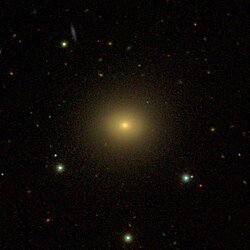 SDSS image of NGC 4692. | |
| Observation data (J2000 epoch) | |
| Constellation | Coma Berenices |
| Right ascension | 12h 47m 55.3s [1] |
| Declination | 27° 13′ 21″ [1] |
| Redshift | 0.026605 [1] |
| Heliocentric radial velocity | 7976 km/s [1] |
| Distance | 370 Mly (112 Mpc) |
| Apparent magnitude (V) | 13.64 [1] |
| Absolute magnitude (B) | -23.22 [1] |
| Characteristics | |
| Type | E+ [1] |
| Size | ~154,200 ly (47.29 kpc) (estimated) [1] |
| Apparent size (V) | 1.3′ × 1.3′ [1] |
| Other designations | |
| UGC 07967, CGCG 159-078, MCG +05-30-086, PGC 043200 [1] | |
NGC 4692 is an elliptical galaxy located 370 million light-years away [2] in the constellation Coma Berenices. It was discovered on April 11, 1785, by astronomer William Herschel. [3] NGC 4692 is the brightest member of a group of 11 galaxies, known as [T2015] nest 100111, which is also known as the NGC 4692 Group [4] and is part of the Coma Supercluster. [5]
Contents
According to Harold Corwin, NGC 4702 is equal to NGC 4692, with the former designation simply being a reobservation of NGC 4692. [6]
NGC 4692 is host to a supermassive black hole with an estimated mass of 9 × 10⁸ M☉. [7]
