
The Dayak or Dyak or Dayuh are one of the native groups of Borneo. It is a loose term for over 200 riverine and hill-dwelling ethnic groups, located principally in the central and southern interior of Borneo, each with its own dialect, customs, laws, territory, and culture, although common distinguishing traits are readily identifiable. The Dayak were animist in belief; however, since the 19th century there has been mass conversion to Christianity as well as Islam due to the spreading of Abrahamic religions.

West Kalimantan is a province of Indonesia. It is one of five Indonesian provinces comprising Kalimantan, the Indonesian part of the island of Borneo. Its capital and largest city is Pontianak. It is bordered by East Kalimantan and Central Kalimantan to the east, the Malaysian state of Sarawak to the north, and the Bangka Belitung Islands to the west and the Java Sea to the south. The province has an area of 147,037 km2, and had a population of 4,395,983 at the 2010 Census and 5,414,390 at the 2020 Census; the official estimate as at mid 2023 was 5,623,328, and was projected to rise to 5,695,500 at mid 2024. Ethnic groups include the Dayak, Malay, Chinese, Javanese, Bugis, and Madurese. The borders of West Kalimantan roughly trace the mountain ranges surrounding the vast watershed of the Kapuas River, which drains most of the province. The province shares land borders with Central Kalimantan to the southeast, East Kalimantan to the east, and the Malaysian territory of Sarawak to the north.
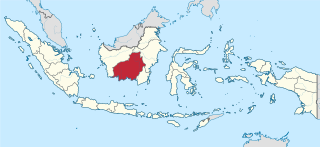
Central Kalimantan is a province of Indonesia. It is one of five provinces in Kalimantan, the Indonesian part of Borneo. It is bordered by West Kalimantan to the west, South Kalimantan and East Kalimantan to the east, Java Sea to the south and is separated narrowly from North Kalimantan and Malaysia by East Kalimantan's Mahakam Ulu Regency. Its provincial capital is Palangka Raya and in 2010 its population was over 2.2 million, while the 2020 Census showed a total of almost 2.67 million; the official estimate as at mid 2023 was 2,774,747, and was projected to rise to 2,809,700 at mid 2024.

Singkawang, or San-Khew-Jong, is a coastal city and port located in the province of West Kalimantan, on the island of Borneo in Indonesia. It is located at about 145 km north of Pontianak, the provincial capital, and is surrounded by the Pasi, Poteng, and Sakkok mountains. Singkawang is derived from the Salako language, which refers to a very wide area of swamps. In addition, the ancestors of the Hakka Chinese community in Sakawokng also named this area in Hakka as "San-Khew-Jong" (Mount-Mouth-Sea), which means "A city located at the foot of a mountain near the sea and has a river that flows up to the mouth of the river (estuary)."

Bidayuh is the collective name for several indigenous groups found in southern Sarawak, Malaysia and northern West Kalimantan, Indonesia, on the island of Borneo, which are broadly similar in language and culture. The name Bidayuh means 'inhabitants of land'. Originally from the western part of Borneo, the collective name Land Dayak was first used during the period of Rajah James Brooke, the White Rajah of Sarawak. At times, they were also lesser referred to as Klemantan people. They constitute one of the main indigenous groups in Sarawak and West Kalimantan and live in towns and villages around Kuching and Serian in the Malaysian state of Sarawak, while in the Indonesian province of West Kalimantan they are mainly concentrated in the northern Sanggau Regency. In Sarawak, most of Bidayuh population can be found within 40 km of the geographical area known as Greater Kuching, within the Kuching and Serian Division. They are the second-largest Dayak ethnic group in Sarawak after the Iban and one of the major Dayak tribes in West Kalimantan.

Being an indigenous tribe in Borneo, the Kayan people are similar to their neighbours, the Kenyah tribe, with which they are grouped together with the Bahau people under the Apo Kayan people group. The Kayan people are categorised as a part of the Dayak people. They are distinct from, and not to be confused with, the Kayan people of Myanmar.
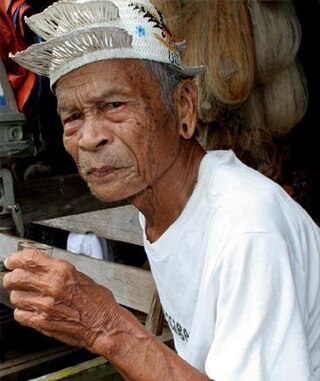
Punan Bah or Punan is an ethnic group found in Sarawak, Malaysia and Kalimantan, Indonesia. The Punan Bah people are distinct and unrelated to the semi-nomadic Penan people. Their name stems from two rivers along the banks of which they have been living since time immemorial. They have other names including Mikuang Bungulan or Mikuang and Aveang Buan but those are used only ritually nowadays.

The Murut, alternatively referred to as Tagol/Tahol, constitute an indigenous ethnic community comprising 29 distinct sub-ethnic groups dwelling within the northern inland territories of Borneo. Characterized by their rich cultural diversity, the Murutic languages form a linguistic family encompassing approximately half a dozen closely intertwined Austronesian languages. Murut populations exhibit dispersion in Malaysia's Sabah and the northern part of Sarawak, as well as in the country of Brunei and the Indonesian North Kalimantan Province. Furthermore, the Murut people have close connections with the Tidung, who historically inhabited Borneo's east coast region that underwent processes of Islamization and Malayalization,

Lundu is a town and the capital of Lundu District located in the northwest of Kuching Division of Sarawak, Malaysia, and borders the Indonesian Province of West Kalimantan.

The Banjar or Banjarese are an Austronesian ethnic group native to the Banjar regions in the southeastern Kalimantan regions of Indonesia. Nowadays, Banjarese diaspora can be found in neighbouring Banjar regions as well; including Kotabaru Regency, the southeastern regions of Central Kalimantan, southernmost regions of East Kalimantan, and some provinces of Indonesia in general. The Banjarese diaspora community also can be found in neighbouring countries of Indonesia, such as Brunei, Malaysia, and Singapore.
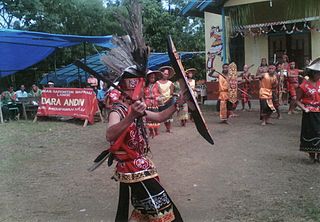
The Kendayan are an Indonesian ethnic group native to Kalimantan, Indonesia in Borneo. The population of the group is around 366,000.

Ma'anyan, Dayak Maanyan or Eastern Barito Dayak people are an ethnic group of the Dayak people indigenous to Borneo. They are also considered as part of the east Barito Dusun group with the name Dusun Ma'anyan. According to J. Mallinckrodt (1927), the Dusun people group is part of the Ot Danum people cluster, although later that theory was disproved by A. B. Hudson (1967), who argues that the Ma'anyan people are a branch of the Barito family. The Ma'anyan people who are often referred to as Dayak people are also referred to as Dayak Ma'anyan. The Dayak Ma'anyan people inhabit the east side of Central Kalimantan, especially in the East Barito Regency and parts of South Barito Regency which are grouped as Ma'anyan I. The Dayak Ma'anyan people also inhabit the northern parts of South Kalimantan, especially in Tabalong Regency which refers to the Dayak Warukin people. The Dayak Balangan people or Dusun Balangan people which are found in the Balangan Regency and the Dayak Samihim people that are found in the Kotabaru Regency are grouped together with the Dayak Ma'anyan people group. The Dayak Ma'anyan people in South Kalimantan are grouped as Ma'anyan II.

Sambas Regency is the most northerly regency in West Kalimantan Province of Indonesia. The regency is one of the original regencies in West Kalimantan, but on 20 April 1999 the southern districts were removed from Sambas Regency to form a new Bengkayang Regency. The residual regency now covers 6,394.70 km2, and had a population of 496,120 at the 2010 census and 629,905 at the 2020 census; the official estimate as at mid 2023 was 648,181. The administrative centre is at the town of Sambas.
Sarawak's population is very diverse, comprising many races and ethnic groups. Sarawak has more than 40 sub-ethnic groups, each with its own distinct language, culture and lifestyle. This makes Sarawak demography very distinct and unique compared to its Peninsular counterpart. However, it largely mirrors to other territories in Borneo – Sabah, Brunei and Kalimantan.
Kendayan, or Salako (Selako), is a Malayic Dayak language of Borneo. The exact number of speakers remains unknown, but is estimated to be around 350,000.

Bahau people is a sub-ethnic group of the Dayak people who inhabit West Kutai Regency (9.3%), East Kalimantan, Indonesia.

Pontianak Malay is a Malayic language primarily spoken by the Malay people in Pontianak and the surrounding areas in West Kalimantan, Indonesia. It is also widely spoken in neighboring regencies, including Kubu Raya and Mempawah, both of which were historically part of the now-dissolved Pontianak Regency. Pontianak Malay was also the primary language of the Pontianak Sultanate, a Malay state that once governed the area now known as Pontianak. In these regions, Pontianak Malay is not limited to being spoken exclusively by the Malay community. It functions as a lingua franca alongside standard Indonesian, enabling communication among the diverse ethnic groups in the area. However, the use of Pontianak Malay faces a slight threat as many speakers are gradually shifting to Indonesian, the national language.
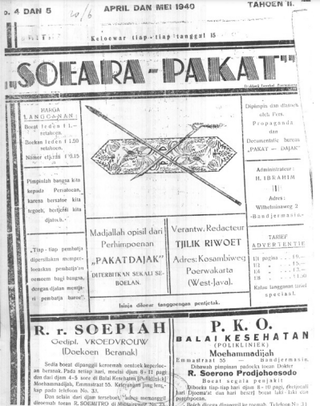
Dayak in politics refers to the participation of Dayaks to represent their political ideas and interests outside of their community. The movement has continued to have a profound impact on the development of Indonesia and Malaysia, especially in Kalimantan and Sarawak.

Sambas Malay is a Malayic language primarily spoken by the Malay people living in Sambas Regency in the northwestern part of West Kalimantan, Indonesia. It is also widely used in Bengkayang and Singkawang, both of which were formerly part of Sambas Regency before being split in 1999 and 2001 respectively. Sambas Malay contains unique vocabulary not found in Indonesian or standard Malay, although it shares many similarities with the vocabularies of both languages. It is closely related to Sarawak Malay, spoken in the neighboring Malaysian state of Sarawak, particularly in terms of vocabulary. The border between Sambas and Sarawak has fostered a long-standing connection between the Sambas Malay community and the Sarawak Malay community, existing even before the formation of Malaysia and Indonesia. It is also more distantly related to other Malay dialects spoken in West Kalimantan, such as Pontianak Malay, which exhibits significant phonological differences.
 Indonesia (West Kalimantan)
 Malaysia (Sarawak)


