| Weapons of mass destruction |
|---|
| |
| By type |
| By country |
|
| Non-state |
| Biological weapons by country |
| Chemical weapons by country |
| Nuclear weapons by country |
| Proliferation |
| Treaties |
The Soviet Union had, by 1991, the world's largest stockpiles of nuclear, biological, and chemical weapons. It carried out its first nuclear test in 1949 and its first multi-stage thermonuclear test in 1955. It was one of the five nuclear-weapon states of the Non-Proliferation Treaty, and its biological warfare program was in violation of its ratification of the Biological Weapons Convention. These programs were inherited primarily by Russia.
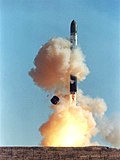
In 1991, the Soviet Union possessed approximately 29,000 nuclear warheads. The Soviet Armed Forces operated a nuclear triad that deployed over 10,000 strategic nuclear weapons: 6,280 warheads assigned to the Strategic Rocket Forces' 1,334 intercontinental ballistic missiles, 3,626 warheads to the Soviet Navy's 914 submarine-launched ballistic missiles, and 974 cruise missiles and bombs to Long Range Aviation's 106 Tu-95MS and Tu-160 bombers.
Another 11,000 tactical nuclear weapons were assigned to aircraft, missiles, artillery, and anti-submarine weapons. An estimated 3,000 nuclear weapons tipped surface-to-air missiles, and 100 tipped the ABM-1 and ABM-3 anti-ballistic missile systems around the capital city Moscow. [1]
The Soviet Union conducted 715 nuclear tests, second only to the United States. These were primarily at Semipalatinsk Test Site, and Novaya Zemlya, where the most powerful nuclear test ever, the Tsar Bomba at 50 megatons, was conducted in 1961. The Soviet Union, with the US and UK, joined the 1963 Partial Nuclear Test Ban Treaty banning non-underground tests. Its nuclear weapons infrastructure saw many radioactive contamination events; the 1957 Kyshtym disaster remains the worst military accident on the International Nuclear and Radiological Event Scale.
Following the December 1991 dissolution of the Soviet Union, the hundreds of tactical warheads stationed in each of the fourteen other former Soviet republics were withdrawn to Russia by May 1992. [2] The over two thousand strategic warheads, stationed between Belarus, Ukraine, and Kazakhstan, were withdrawn to Russia by November 1996, under the Lisbon Protocol and Budapest Memorandum. [3]
The Soviet chemical weapons program became the largest in world history. [4] Russia in 1993 declared almost 40,000 tons of chemical weapons. [5] The program produced Novichok, VX, sarin, and soman nerve agents, lewisite, mustard, and phosgene blister agents, and others, employing 6,000 people. In 1978, Bulgarian dissident Georgi Markov was assassinated in London with the toxin ricin, by Bulgaria's State Security with the aid of the KGB.
The Soviet biological weapons program was the world's largest, longest, and most sophisticated biological warfare project. It weaponized and stockpiled the biological agents that cause anthrax, plague, tularemia, smallpox, and others. Genetic engineering improved agent stability and antibiotic resistance. The program employed a peak of 65,000 people and annually produced, for example, 100 tons of smallpox. The Sverdlovsk anthrax leak, which led to at least 68 deaths, began to reveal the extent of the program, continued by defectors including Ken Alibek and Vladimir Pasechnik.
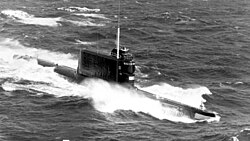
In 1991, the USSR possessed approximately 29,000 nuclear warheads. The Soviet Armed Forces operated a nuclear triad that deployed over 10,000 strategic nuclear weapons: 6,280 warheads assigned to the Strategic Rocket Forces' 1,334 intercontinental ballistic missiles, 3,626 warheads to the Soviet Navy's 914 submarine-launched ballistic missiles, and 974 cruise missiles and bombs to Long Range Aviation's 106 Tu-95MS and Tu-160 bombers.
Another 11,000 tactical nuclear weapons were assigned to aircraft, missiles, artillery, and anti-submarine weapons. An estimated 3,000 nuclear weapons tipped surface-to-air missiles, and 100 tipped the ABM-1 and ABM-3 anti-ballistic missile systems around the capital city Moscow. [1]
The Soviet atomic bomb project was authorized by Joseph Stalin in the Soviet Union to develop nuclear weapons during and after World War II. [6] [7]
Physicist Georgy Flyorov, suspecting a Western Allied nuclear program, urged Stalin to start research in 1942. [7] [8] : 78–79 Early efforts were made at Laboratory No. 2 in Moscow, led by Igor Kurchatov, and by Soviet-sympathizing atomic spies in the US Manhattan Project. [6] Subsequent efforts involved plutonium production at Mayak in Chelyabinsk and weapon research and assembly at KB-11 in Sarov.
After Stalin learned of the atomic bombings of Hiroshima and Nagasaki, the nuclear program was accelerated through intelligence gathering on the US and German nuclear weapon programs. [9] Espionage coups, especially via Klaus Fuchs and David Greenglass, included detailed descriptions of the implosion-type Fat Man bomb and plutonium production. In the final months of the war, the Soviet "Russian Alsos" task force competed against the Western Allies' Alsos Mission to capture German and Austrian nuclear scientists and material, including refined uranium and cyclotrons. [10] : 242–243 The Soviet project utilized East German industry for further uranium mining, refinement, and instrument manufacture. Lavrentiy Beria was placed in charge of the atomic project, and the replication of the Fat Man bomb was prioritized. [11]
The Manhattan Project had established a monopoly on the global uranium market. The Soviet project relied on SAG Wismut in East Germany and the development of the Taboshar mine in Tajikistan. Domestic large-scale production of high purity graphite and high purity uranium metal, to construct plutonium production reactors, was a significant challenge.
In late 1946, F-1, the first nuclear reactor outside North America, achieved criticality at Laboratory No. 2. In mid-1948, the A-1 plutonium production reactor became operational at the Mayak site, and in mid-1949, the first plutonium metal was separated. [12] The first nuclear weapon was assembled at the KB-11 design bureau, led by Yulii Khariton, in the closed city of Arzamas-16 (Sarov). [13]
On 29 August 1949, the Soviet Union secretly conducted its first weapon test, RDS-1, at the Semipalatinsk Test Site of the Kazakh SSR. [6] Simultaneously, project scientists had been developing conceptual thermonuclear weapons. The US detection of the test, via anticipatory atmospheric fallout monitoring, led to a US crash program to develop thermonuclear weapons, opening of the nuclear arms race of the Cold War.
Boosted fission and multi-stage thermonuclear weapons were developed during the 1950s, testing expanded to Novaya Zemlya and Kapustin Yar, and fissile material production sites grew, including the invention of the gas centrifuge. The program created demand for nuclear weapons delivery, command and control, and early warning, influencing the Soviet space program. Soviet nuclear weapons played a major role in the Cold War, including the Cuban Missile Crisis, and the Sino-Soviet border conflict.
Three sites in the Russian SFSR and subsequently Russia produced 145 tons of weapons-grade plutonium (uncertainty ±8 tons) from 1948 to 2010, with a consistent production peak between 1967 and 1989. Following the Moscow test reactor F-1 in 1946, the Mayak site in Chelyabinsk-40 began construction. The first plutonium production reactor A-1 began operation in 1948, fuelling the RDS-1 test. The Mayak site received nine further reactors were constructed. Of these, four were used for plutonium production, the other six reactors primarily produced tritium for thermonuclear weapons. Plutonium was also produced by five reactors at the Siberian Chemical Combine in Tomsk-7, and three reactors at the Mining and Chemical Combine in Krasnoyarsk-26. The last plutonium production reactor in Russia is believed to have shut down in 2010. Mayak continues to operate two reactors for tritium and industrial radioisotope production. [14]
Russian sites also produced 1,250 tons of highly enriched uranium (uncertainty ±120 tons) from 1949 to 2010, excluding HEU produced for naval nuclear reactors. Of this, 500 tons was downblended by the Megatons to Megawatts Program, and a further hundred tons were used in production research reactors, nuclear tests, and other downblending programs. Russia is now believed to possess 656 tons between HEU stockpiles and HEU inside weapons themselves. This began with the SU-20 electromagnetic separation plant, but the Soviet project quickly followed the Manhattan Project's gaseous diffusion scheme, constructing the D-1 plant in Sverdlovsk-44, eventually becoming the Ural Electrochemical Combine. The D-1 plant could produce 0.01 million SWU/year. The development of the gas centrifuge and waves of modernizations brought the Ural Electrochemical Combine to 11.9 million SWU/year by 1993. Further enrichment plants were built at the Siberian Chemical Combine, the Zelenogorsk Electrochemical Plant and the Angarsk Electrochemical Combine. [15]The Soviet Union used three major test sites: Semipalatinsk in Kazakhstan, Novaya Zemlya in the extreme north, and Kapustin Yar.
Notable tests at Semipalatinsk following RDS-1 include RDS-4, the first Soviet tactical nuclear weapon, RDS-6s, the first Soviet weapon to use thermonuclear reactions in a layer cake design, sometimes called a boosted fission weapon, and RDS-37, the first Soviet true two-stage thermonuclear weapon. [16]
Novaya Zemlya was the site of further megaton-range explosions, including the Tsar Bomba, the largest weapon ever detonated, and the Raduga live test of an R-13 submarine-launched ballistic missile. Kapustin Yar was used for high-altitude nuclear tests launched by missiles, including the 1961 tests and Project K tests.
The Soviet Army also conducted the Totskoye nuclear exercise in 1954. After the 1963 Partial Nuclear Test Ban Treaty, underground testing continued at Semipalatinsk and Novaya Zemlya until 1990. [17] The Soviet Union also developed "clean" thermonuclear weapons, including weapons with only deuterium as thermonuclear fuel, used in a brief program of peaceful nuclear explosions. [18] [19] [20]Russia declared an arsenal of 39,967 metric tons of chemical agents, including lewisite, mustard, phosgene, sarin, soman, and VX when it signed the CWC in 1993. [21] The USSR also investigated and produced Novichok agents, hydrogen cyanide, ricin. [22] [23] By comparison, 27,770 metric tons were declared for the United States chemical weapons program in 1997. [24]
By the time of the Soviet Union's dissolution in 1991, its chemical weapons research institute, GosNIIOKhT, employed approximately 6,000 people. The employees worked in Novocheboksarsk and Volgograd on nerve agent production, in Dzerzinsk on blister agent production, in Shikhany on testing, and in Nukus, Uzbekistan on testing. [25] [26]
Novichok agents were designed to be undetectable and unprotectable by NATO equipment, safer to handle, and circumvent the Chemical Weapons Convention list of controlled precursors, classes of chemical and physical form. [23] [27] [28]
David Wise, in his book Cassidy's Run, implies that the FBI program Operation Shocker may have led the Soviet Union to develop Novichok agents. The program aimed to feed false information about US chemical and biological programs to the Soviet Union, and the Novichok agents may have resulted from false US research on a "GJ" codenamed agent. [29]
The Soviet Union covertly operated the world's largest, longest, and most sophisticated biological weapons program, thereby violating its obligations as a party to the Biological Weapons Convention of 1972. [30] The Soviet program began in the 1920s and lasted until at least September 1992 but has possibly been continued by Russian Federation after that. [30] [31]
By 1960, numerous military-purposed biological research facilities existed throughout the Soviet Union. Although the former USSR also signed the 1972 Biological Weapons Convention (BWC), the Soviet authorities subsequently augmented their biowarfare programs. Over the course of its history, the Soviet program is known to have weaponized and stockpiled the following bio-agents [32] (and to have pursued basic research on many more):
These programs became immense and were conducted at dozens of secret sites employing up to 65,000 people. [30] Annualized production capacity for weaponized smallpox, for example, was 90 to 100 tons. In the 1980s and 1990s, many of these agents were genetically altered to resist heat, cold, and antibiotics. In the 1990s, Boris Yeltsin admitted to an offensive biological weapons program as well as to the true nature of the Sverdlovsk biological weapons accident of 1979, which had resulted in the deaths of at least 64 people. Defecting Soviet bioweaponeers such as Vladimir Pasechnik and Colonel Kanatjan Alibekov confirmed that the program had been massive and still existed. In 1992, a Trilateral Agreement was signed with the United States and the United Kingdom promising to end biological weapons programs and convert facilities to benevolent purposes, but compliance with the agreement—and the fate of the former Soviet bio-agents and facilities—is still mostly undocumented.The Novichok class of agents were reportedly developed in an attempt to circumvent the Chemical Weapons Treaty (chemical weapons are banned on the basis of chemical structure and therefore a new chemical agent is not subject to past treaties). They have reportedly been engineered to be undetectable by standard detection equipment and to defeat standard chemical protective gear...Novichok agents may consist of two separate 'non-toxic' components that, when mixed, become the active nerve agent...The binary concept—mixing or storing two less toxic chemicals and creating the nerve agent within the weapon—was safer during storage.