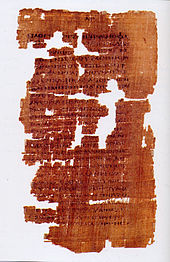
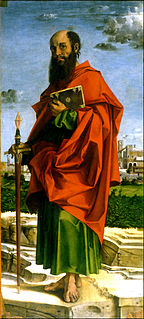
The Epistle to the Galatians, often shortened to Galatians, is the ninth book of the New Testament. It is a letter from Paul the Apostle to a number of Early Christian communities in Galatia. Scholars have suggested that this is either the Roman province of Galatia in southern Anatolia, or a large region defined by an ethnic group of Celtic people in central Anatolia.
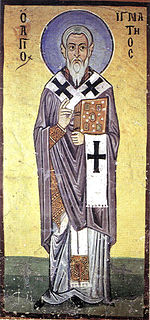
Ignatius of Antioch, also known as Ignatius Theophorus or Ignatius Nurono, was an early Christian writer and bishop of Antioch. En route to Rome, where he met his martyrdom, Ignatius wrote a series of letters. This correspondence now forms a central part of the later collection known as the Apostolic Fathers. His letters also serve as an example of early Christian theology. Important topics they address include ecclesiology, the sacraments, and the role of bishops.

The New Testament is the second part of the Christian biblical canon, the first part being the Old Testament, based on the Hebrew Bible. The New Testament discusses the teachings and person of Jesus, as well as events in first-century Christianity. Christians regard both the Old and New Testaments together as sacred scripture. The New Testament has frequently accompanied the spread of Christianity around the world. It reflects and serves as a source for Christian theology and morality. Extended readings and phrases directly from the New Testament are incorporated into the various Christian liturgies. The New Testament has influenced religious, philosophical, and political movements in Christendom and left an indelible mark on literature, art, and music.

Polycarp was a 2nd-century Christian bishop of Smyrna. According to the Martyrdom of Polycarp he died a martyr, bound and burned at the stake, then stabbed when the fire failed to touch him. Polycarp is regarded as a saint and Church Father in the Eastern Orthodox, Oriental Orthodox, Catholic, Anglican, and Lutheran churches. His name 'Polycarp' means 'much fruit' in Greek.
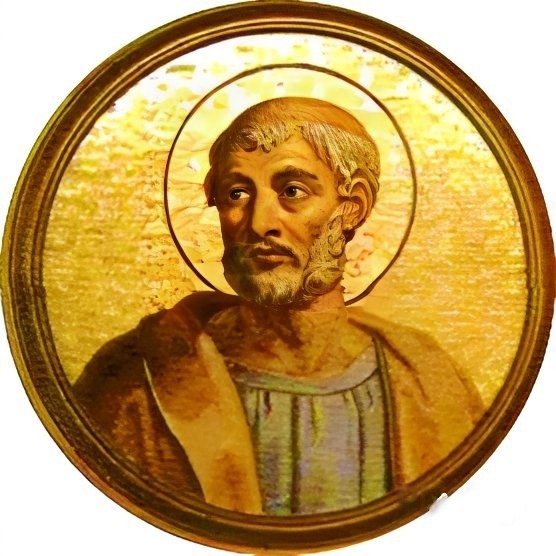
Pope Clement I, also known as Saint Clement of Rome, is listed by Irenaeus and Tertullian as Bishop of Rome, holding office from 88 to his death in 99. He is considered to be the first Apostolic Father of the Church.

James the Just, or a variation of James, brother of the Lord, was an early leader of the Jerusalem Church of the Apostolic Age, to which Paul was also affiliated. He died in martyrdom in 62 or 69 AD.
The Pauline epistles, Epistles of Paul, or Letters of Paul, are the thirteen books of the New Testament, composed of letters which are largely attributed to Paul the Apostle, although authorship of some is in dispute. Among these letters are some of the earliest extant Christian documents. They provide an insight into the beliefs and controversies of early Christianity. As part of the canon of the New Testament, they are foundational texts for both Christian theology and ethics. The Epistle to the Hebrews, although it does not bear his name, was traditionally considered Pauline for a thousand years, but from the 16th century onwards opinion steadily moved against Pauline authorship and few scholars now ascribe it to Paul, mostly because it does not read like any of his other epistles in style and content. Most scholars agree that Paul really wrote seven of the Pauline epistles, but that four of the epistles in Paul's name are pseudepigraphic ; scholars are divided on the authenticity of two of the epistles.
The Apostolic Fathers were Christian theologians who lived in the 1st and 2nd centuries AD, who are believed to have personally known some of the Twelve Apostles, or to have been significantly influenced by them. Their writings, though popular in Early Christianity, were not included in the canon of the New Testament. Many of the writings derive from the same time period and geographical location as other works of early Christian literature which came to be part of the New Testament. Some of the writings found among the Apostolic Fathers appear to have been highly regarded as some of the writings which became the New Testament.
Pauline Christianity or Pauline theology is the Christianity or theology associated with the beliefs and doctrines espoused by Paul the Apostle through his writings. Traditional Christianity relies heavily on these teachings and considers them to be amplifications and explanations of the teachings of Jesus. Others perceive in Paul's writings teachings that are different from the original teachings of Jesus documented in the canonical gospels, early Acts and the rest of the New Testament, such as the Epistle of James.
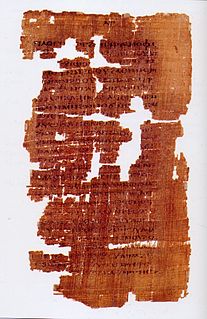
The Epistle of Mathetes to Diognetus is an example of Christian apologetics, writings defending Christianity from its accusers. The Greek writer and recipient are not otherwise known; estimates of dating based on the language and other textual evidence have ranged from AD 130, to the late 2nd century, with the latter often preferred in modern scholarship.

Early Christianity covers the period from its origins until the First Council of Nicaea (325). This period is typically divided into the Apostolic Age and the Ante-Nicene Period. After the death of John the Apostle, early Christianity was guided by the Ante-Nicene Fathers until the Council of Nicaea (c.325). Early Christianity is also known as the Early Church by the proponents of apostolic succession, notably the Catholic Church, the Eastern Orthodox Church, Oriental Orthodoxy, Assyrian Church of the East, and Ancient Church of the East, in addition to some Protestant denominations.
The pastoral epistles are three books of the canonical New Testament: the First Epistle to Timothy the Second Epistle to Timothy, and the Epistle to Titus. They are presented as letters from Paul the Apostle to Timothy and to Titus. They are generally discussed as a group and are given the title pastoral because they are addressed to individuals with pastoral oversight of churches and discuss issues of Christian living, doctrine and leadership. The term "pastorals" was popularized in 1703 by D. N. Berdot and in 1726 by Paul Anton.
The Third Epistle to the Corinthians is a pseudepigraphical text under the name of Paul the Apostle. It is also found in the Acts of Paul, and was framed as Paul's response to the Epistle of the Corinthians to Paul. The earliest extant copy is Papyrus Bodmer X, dating to the third century. Originally written in Greek, the letter survives in Greek, Coptic, Latin, and Armenian manuscripts.
The Pauline epistles are the fourteen books in the New Testament traditionally attributed to Paul the Apostle, although many dispute the anonymous Epistle to the Hebrews as being a Pauline epistle.
Nothing is known for certain of an alleged pseudepigraphical Epistle to the Alexandrians — purportedly by Paul the Apostle — that is mentioned in the Muratorian fragment, one of the earliest lists of the canonical texts of the New Testament. The anonymous author of the Muratorian canon considered spurious the letters claiming to have Paul as author, and that claim to be written to the Laodiceans and this one to the Alexandrians, which are specifically said to be "forged in Paul's name to [further] the heresy of Marcion."
The Ante-Nicene Period of the history of early Christianity was the period following the Apostolic Age of the 1st century down to the First Council of Nicaea in 325. During this period Proto-orthodoxy developed.

Christianity in the 2nd century was largely the time of the Apostolic Fathers who were the students of the apostles of Jesus, though there is some overlap as John the Apostle may have survived into the 2nd century and Clement of Rome is said to have died at the end of the 1st century. While the Christian church was centered in Jerusalem in the 1st century, it became decentralized in the 2nd century. The 2nd century was also the time of several people who were later declared to be major heretics, such as Marcion, Valentinius, and Montanus.
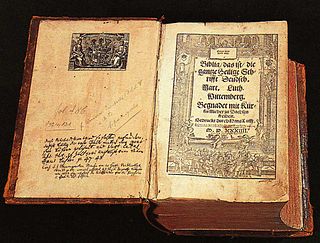
Luther's canon is the biblical canon attributed to Martin Luther, which has influenced Protestants since the 16th-century Protestant Reformation. While the Lutheran Confessions, specifically did not define a canon, it is widely regarded as the canon of the Lutheran Church. It differs from the 1546 Roman Catholic canon of the Council of Trent in that it rejects the Deuterocanonical books and questions the seven New Testament books, called "Luther's Antilegomena", four of which are still ordered last in German-language Luther Bibles to this day.
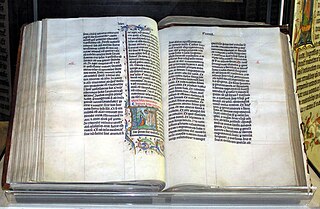
The canon of the New Testament is the set of books Christians regard as divinely inspired and constituting the New Testament of the Christian Bible. For most, it is an agreed-upon list of twenty-seven books that includes the Canonical Gospels, Acts, letters of the Apostles, and Revelation. The books of the canon of the New Testament were written before 120 AD.