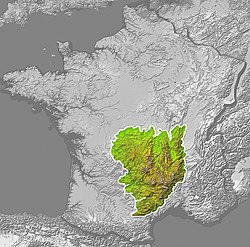
The Massif Central is located in the center-south of France, at the crossroads of several climatic zones: oceanic to the west, continental to the east, and Mediterranean to the south.Contrasting vegetation between an adret, occupied by a heath of purgative broom, and a ubac, covered by a beech forest, in a valley in the Massif Central (Biourière valley in Aubrac)
The flora[nb 1] of the Massif Central is rich and diverse. This diversity can be explained by the massif's large surface area, its position at the intersection of different climatic zones, and its geological variety. The plants that can be found in the very wet western part are not the same as those found in the drier eastern part, and the difference is even greater with the species that can be found in the southern part (Causses, Cévennes), which are subject to marked Mediterranean influences. This spatial component is not the only one involved, since exposure, altitude, and the nature of the substrate are also determining factors. For example, there is the classic contrast between south-facing and north-facing slopes (adret and ubac), and the differences in vegetation between acidic soils (granite) and basic soils (limestone or basalt). Although the altitude of the Massif Central is low compared to other mountain ranges such as the Alps or the Pyrenees, there is a clear range of vegetation, from Mediterranean vegetation to sub-alpine grassland (as in the Cévennes). Generally speaking, in most of the Massif Central, there are four distinct levels of vegetation:
In the Cévennes, the plain level can be described as the "Mediterranean level". These limits can obviously vary according to exposure (lower on the north-facing slopes).
Lowland
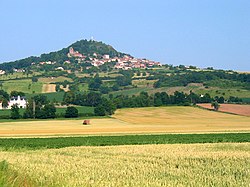
The Limagne plain with its small volcanic peaks
This level is relatively rare in the Massif Central, given its high plateaux. However, it is well present on the Limagne Plain and in the Roanne and Montbrison basins. These are intensively farmed areas that leave little room for nature. They also receive little water (the Limagne d'Issoire is one of the driest areas in France, with just over 500mm of rainfall a year)[1] and are subject to a fairly marked semi-continental climate (more accurately, a semi-oceanic "intramontane" or semi-oceanic shelter climate in France), with hot summers and cold winters (due to frequent temperature inversions). The characteristic plants of this environment include downy oak (Quercus pubescens), Etruscan honeysuckle (Lonicera etrusca), sainfoin (Onobrychis viciifolia), meadow sage (Salvia pratensis), red poppy, red clover, wild pansy, common milkwort (Polygala vulgaris), yarrow, Persian speedwell and many others that are not at all specific to the flora of Auvergne.
In fact, only a few small volcanic peaks that are scattered across Limagne are of any ecological interest, especially on their southern slopes, where flora with Mediterranean affinities thrives. A number of interesting plants[2] of clearly southern origin can be found here, such as Montpellier burclover (Medicago monspeliaca), morning glory (Convolvulus lineatus) and Montpellier astragalus (Astragalus monspessulanus).
The Lot valley towards Mende. The slopes have been heavily planted with black pine.
This level is more often forested than the lower level. The characteristic trees at this altitude are the Sessile Oak and the Pedunculate Oak, especially in the west of the massif. In the east, the Scots pine can be found.[3] The flora accompanying these woody species is not particularly remarkable: the classic woodland flowers such as Lily of the Valley, Wood Anemone, common cow-wheat and Solomon's Seal can be found here. Among the slightly less common plants, one might come across the Stinking hellebore or Bear's foot, a plant that is easy to recognize and characteristic of basic soils (especially limestone). Generally speaking, in the nineteenth and twentieth centuries, this level was the subject of massive reforestation, as in the Limousin region (planting of conifers), but also in the south on certain steep slopes which tended to erode (a good example is provided by the black pine forests all around the causses and in particular in the upper Lot valley around Mende).
There are, however, some areas of undoubted ecological interest, such as the Planèze of Saint-Flour, where relatively rare flowers of continental origin (Veronica spicata) and Atlantic origin (Ranunculus nodiflorus)[2] can be found in the same place. The same applies to the Puy-en-Velay basin, where it is possible to find segetal species (i.e. linked to cereal fields) of oriental origin, such as Conringia orientalis and Neslia apiculata.[2] The Grands Causses region also has a flora of great interest due to its particular geology and its location, which is characterized by a strong spread of Mediterranean flora as well as the presence of plants from steppe and limestone mountain environments (see below).
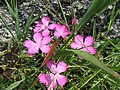
Also of note is the presence of a carnation endemic to the Massif Central: the granite carnation (Dianthus graniticus) which, as its name suggests, grows on siliceous soil in the Cévennes and Vivarais up to an altitude of around 1,000m (3,300ft).
Mountains
Forest
High altitude beech forest in autumn. Trees are limited to 5–6m (16–20ft) in height due to the strength of the winds.Martagon lily (Aubrac mountains)
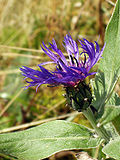
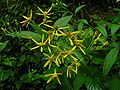
From an altitude of 900m (3,000ft), the beech forest begins, with its highly characteristic flora. Beech dominates at this altitude, at least over a large part of the western half of the massif. In the east, particularly in the Haute-Loire, beech is replaced by Scots pine (drier climate). In some cold, damp areas, fir is mixed in with beech and may even become dominant[4] (Monts du Cantal, Artense, northern Margeride, Forez mountains). At any rate, it is at the mountain level that the Massif Central begins to stand out from the lowlands that surround it for the great richness of its flora. The species found will vary depending on whether the woodlands have a basaltic subsoil (basic rock) or a granitic subsoil (acid rock). In the former case, we'll come across calcicole flowers such as the very precocious Snowdrop, Montane knapweed, February daphne, yellow thistle (rarer), Five- or Seven-leaved Cardamine or Cacaliaster Groundsel, and sometimes, paradoxically, calcifugous species (due to the relatively neutral nature of basalt, which contains little silica or calcium carbonate in a natural state, these elements being in the form of silicates).[5] On granite, on the other hand, there are no calcicolous species. Acidophilous species include wood ragwort (very common in Forez), Prenanthes purpurea, common cow-wheat, and small cow-wheat. However, the vast majority of flowers thrive in both types of soil: Sweet woodruff, Martagon lily, two-leaved cornflower, Snow-white wood-rush, common foxglove, Herb Paris, Austrian Doronicum (Doronicum austriacum), Alpine squill, Pyrenean squill (west of the massif), whorled Solomon's seal, and Large-flowered Calament ("Aubrac tea"). Climatic influences also play a part: for example, rare plants with an Atlantic affinity such as the Welsh poppy[6] (Meconopsis cambrica) can be found in the forests of the western part of the massif.
All these plants are found in the Beech zone (especially on the edges of woods or in clearings, as beech woods are very dark, which prevents the majority of plants from growing) or in hazel coppices, but some of them can also be found in the Scots Pine zone. On the other hand, since pine forests are lighter, they are home to more plant species, particularly shrubs such as Common Juniper and mosses.
Finally, foxglove and fireweed, pioneer species that sometimes colonize large areas, are very common in woodland cuttings, often accompanied[nb 2] by trees or shrubs such as Birch, Black Elder (altitude < 1,200 m), Red Elder[7] (rare below 1,000 m altitude) or, more commonly, Scotch Broom.
Open areas
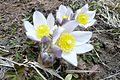
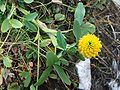
Heaths of Genêt purgative (Aubrac)Red Pulsatilla (endemic to the Massif Central)
In the Massif Central, the open spaces of the mountainous regions are all man-made. There are three main types: pastures on volcanic mountains,[nb 3] which are very rich both ecologically and agronomically; moors or grasslands on granitic or schistose soils, which are less interesting agronomically but very rich in species; and finally, hay meadows. Within heathland, several sub-categories can be distinguished:[8]heathland with fern, purgative broom,[nb 4]callune or common bilberry[nb 5] (the latter two are generally found on thin granite soil). In addition, as moorlands are transitional areas between pasture and forest, they are often home to native tree and shrub species as diverse as birch, wild rose, hazel, hawthorn, rowan and whitebeam.[8]
The boundary hedges[9] (where they exist, as bocage landscapes are fairly rare in the Massif Central) also include some interesting woody species such as Common Ash (which is often severely pruned as its leaves are used to feed livestock), Norway maple, Sycamore maple, blackthorn, raspberry and black birch, a shrub with white flowers that only grows at a certain altitude.
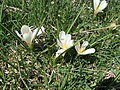
Heath in spring with Crocus and Dogtooth Erythrone
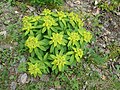
In terms of the herbaceous layer, grasses[nb 6] make up most of the plant cover, with a large number of species represented. The most common, particularly in acidic grassland and moorland, are orchard grass, tall wheatgrass, red fescue, common bentgrass, and stiff spurge (grassland dominated by stiff spurge is known as narda). There are also a number of species that are more typical of high-altitude pastures or heaths, such as sweet vernal grass, wavy hair-grass (Deschampsia flexuosa), broadleaf bluegrass and field fescue (Festuca arvernensis), the latter being endemic to the Massif Central[2] and found in broom heaths.
A plant that is extremely rare in France: the Siberian LigulariaAquatic plants on the banks of the Saint-Andéol lake (Aubrac). In particular, we can see Water Clover and Swimming Flute (small leaves that float).
Wetlands can include a number of biotopes: riverbanks or lakeshores, megaphorbs and peat bogs.[nb 7]
Cranberry (Vaccinium oxycoccos) fruit on a carpet of sphagnum moss
The Massif Central also boasts a number of peatland plants that are relicts of the last ice age and are extremely rare in France, such as the impressive Ligularia sibirica (Cézallier, Aubrac), Rannoch-rush, dwarf birch and downy willow (these two shrubs are found in the peatlands of the Margeride and, in the case of the latter, in the Monts Dore). There are also a number of stations of the very rare epiphytic orchid Hammarbya paludosa (the Swamp Malaxis) in certain peat bogs in the Lozère (Aubrac, Margeride) and Limousin regions.
Finally, we should mention a few interesting representatives of lake flora, including Isoetes (Isoetes lacustris and Isoetes echinospora), boreal aquatic plants that are very demanding in terms of water quality and very rare in France, found in a few lakes in the Cézallier and Aubrac regions (as well as in a few lakes in the Pyrenees), the floating water-plantain (Luronium natans), which can be found at the edge of certain stretches of water and is protected at European level, and the dwarf water-lily (Nuphar pumila), a rare boreal species in France, which can be found in a few cold-water lakes in the Auvergne.
Special conditions in the South of the massif
The limestone rock, which is omnipresent in the Causses region, gives rise to a very specific flora. Here, the Jonte gorges.Spring Adonis (Adonis vernalis) hatching on the Causse de Sauveterre
In the south of the massif (Causses and Cévennes), the specific nature of the soil and climate has resulted in a particular flora, with a higher rate of endemism than in the rest of the Massif Central.[nb 8][12] Beech forests are always present, particularly in the Cévennes, even on the southern slopes, which are exposed to rain from the Mediterranean (Mont Aigoual in particular). In the Causses, it is only found on the north-facing slopes, while the southern slopes and plateaux are mainly occupied by meagre pastures, favourable to small shrubs neglected by sheep, such as boxwood (Buxus sempervirens) or juniper (Juniperus oxycedrus), sometimes with occasional oak and pine woods. These pastures are not homogeneous and are sometimes dominated by Poaceae; (erect brome grass, blue fescue, blue moor-grass, rush-leaf fescue or the very emblematic Pinnate Stipe), or by other plants such as Breckland thyme, dwarf sedge or heath false brome.
Coste Anemone (Pulsatilla vulgaris var. costeana) on the Causse de Sauveterre
Because of the limestone substrate, the flora of the Causses differs markedly from that of the rest of the Massif Central. Plants native to steppe environments can be found here, such as Stipa pennata and Lathyrus pannonicus subsp. asphodeloides) and, more generally, dry grassland and/or limestone rockland plants such as the field eryngo (Eryngium campestre), the "Thistle-barometer" (Carlina acanthifolia), the flax campanula (Linum campanulatum), the chalk milkwort (Polygala calcarea), etc.
There are also more specifically Mediterranean plants (present in the hills but which may extend into the mountains) such as common kidneyvetch (Anthyllis vulneraria subsp. rubriflora), Pyrenean flax (Linum suffruticosum subsp. salsoloides), wallflower carnation (Dianthus caryophyllus), Orcanette (Onosma tricerosperma subsp. fastigiata), Montpellier astragalus (Astragalus monspessulanus), true lavender (Lavandula angustifolia), etc.
Plants strictly endemic to the Causses and Cévennes include Germandrée de Rouy (Teucrium rouyanum), Pulsatilla vulgaris var. costeana (on limestone grassland),[13]Short-stemmed cinquefoil (Potentilla caulescens subsp. cebennensis), Coste's gentian (Gentiana clusii subsp. costei), a subspecies of the Alpine Aster growing at altitude (Aster alpinus subsp. cebennensis), an Orchid, the Causses Fly Orchid (Ophrys insectifera subsp. aymoninii), Arabidopsis cebennensis (also found in Aubrac and Cantal but not further north), Saxifraga prostii (siliceous rocks), Saxifraga cebennensis (limestone rocks), the long-leaved butterwort (Pinguicula caussensis, limestone rocks), the Sabline de Lozère (Arenaria ligericina, limestone rocks), the slimy Columbine of Causses (Aquilegia viscosa), the glowing Thyme (Thymus nitens, siliceous soils at high altitude), and so on. Certain other species are almost endemic to the region (i.e. present in the Causses, the Cévennes and a limited number of neighboring regions), such as spiked sandwort (Arenaria hispida, also present in Catalonia), Pectinated Centaurea (Centaurea pectinata, also present in Provence and northern Spain) or the Asarina lying down (Asarina procumbens), a particular and easy-to-recognize plant, growing on siliceous soil, strictly localized in the mountains of the Cévennes and the eastern Pyrenees.
The Causses also boast a number of stations of the famous Lady's-slipper orchid (Cypripedium calceolus) and the only French locations of the Spring pheasant's eye (Adonis vernalis).
Subalpine zone
Subalpine level above the forest (the Cuzeau rock in the Monts Dore not far from the Puy de Sancy)Alpine sow-thistle (Cicerbita alpina) in the Monts Dore (also found in the Cantal and Forez regions). Lapland willows (Salix lapponum) can be seen in the background.Megaphorbia in the Monts du Cantal (altitude: around 1,500 m) with, among others, Alliaria-leaved Adenostyles
Although this level occupies very little space in the Massif Central, it is nevertheless of prime ecological interest for the species it contains. This is the domain of moorland or sub-alpine[nb 9] grassland with a few stunted trees (beech or coniferous) due to the climatic conditions, in particular the cold temperatures and violent, even very violent winds (the wind has already blown at more than 300km/h at the summit of Mont Aigoual). Unsurprisingly, the largest areas of grassland are found in the two highest massifs: Monts Dore and Monts du Cantal. However, sub-alpine grasslands can also be found on the Forez crests, Mont Mézenc,[nb 10]Mont Lozère, and Mont Aigoual.
More locally, plants such as Spring pasqueflower (Pulsatilla vernalis), which grows on the Plomb du Cantal, Mézenc and Mont Lozère, and Alpine Anemone (Pulsatilla alpina) can also be seen in the Monts Dore (predominantly the white variety, subsp. alpina, in this massif) and the Monts du Cantal (predominantly the yellow "sulphurous" variety, subsp. apiifolia, which is very abundant locally), Alpine avens (Geum montanum - Dore and Cantal), Spring gentian (Gentiana verna - Cantal, Monts Dore), Alpine Bartsia (Bartsia alpina - Cantal only), Norwegian arctic cudweed (Omalotheca norvegica - Cantal, Monts Dore), Androsace de Haller (Androsace halleri - Scree plant of the Monts Dore and Cantal), Alpine fleabane (Erigeron alpinus), etc.
There are also a number of species at this level whose presence in the Massif Central is anecdotal but worth mentioning. These include[2] the St Bruno's lily (Paradisea liliastrum), a large lily with beautiful white flowers, of which there is a known station on Mont Aigoual and Mont Mézenc, the leucophyllous ragwort (Senecio leucophyllus), whose only station in the Massif Central is also on Mont Mézenc (a plant of the eastern Pyrenees growing on scree), the Hawkweed Saxifrage (Saxifraga hieraciifolia) whose only known location in France is in the Monts du Cantal and which usually grows in arctic regions (Norway, Siberia, Canada) as well as in the eastern Alps and the Carpathians, the Alpine coltsfoot, only recorded in the Monts du Forez (Pierre-sur-Haute sector),[14] the Alpine snowbell (Soldanella alpina - only in the Monts Dore), the Eightpetal mountain-avens (Dryas octopetala) on the northern slopes of the Cantal and Monts Dore, etc. All these plants are fragile and strictly protected by law, some being highly endangered (such as Dryas octopetala).
There are areas that stand out in particular, such as Puy Mary and its surroundings, which contain a number of alpine species that are not found elsewhere in the Massif Central, such as Tozzia alpina, Saxifrage oppositifolia, Saxifraga androsacea and Pedicularis verticillata.
Finally, in terms of endemic species,[2] the Sancy massif (puy Ferrand, puy de la Perdrix) has a jasione that grows only on trachytic soil above 1,500m (4,900ft): the Jasione daine (Jasione crispa subsp. arvernensis). In the Monts Dore and Cantal, there is also a unique saxifrage: the Saxifrage de Lamotte (Saxifraga lamottei), which grows in rock crevices above 1,400m (4,600ft). In the same biotope (i.e. the rocks and scree at altitude in the Cantal and Monts Dore), you can also come across an endemic plant with yellow flowers, the Auvergne Biscutella (Biscutella arvernensis).
Threats and protection
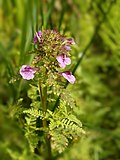
Pedicularis comosa is a mountain species that has migrated to higher altitudes and is becoming rarer.
Biodiversity in the Massif Central has declined slightly in recent years, but not to the same extent as in some neighboring regions. Only around thirty species that were once present have not returned since 1990, representing a very small proportion of the total flora.[15] This relative impoverishment is essentially linked to the destruction of certain environments with a high heritage value, particularly wetlands (drainage of peaty meadows, recalibration of watercourses, etc.), the intensification of agriculture (disappearance or rarefaction of certain segetal species that were once common due to the use of herbicides) and the ever-increasing presence of urbanized areas (although this progression is not as rapid in the Massif Central as in other French regions).
There are also invasive species, often exotic, which can cause local problems by expanding to the detriment of native species (primrose willow in certain rivers, ragweed, etc.). This phenomenon can also affect over-amended hay meadows, where we can sometimes observe the excessive development of eutrophilous species that compromise the quality of the fodder (e.g. the Queen Anne's lace, which is not an exotic species but is normally confined to areas rich in nitrates).[16]
Chaudefour Valley Nature Reserve (Monts Dore)
As for the consequences of global warming,[15] these have not yet been studied in depth. However, initial observations suggest that the impact of climate change is not yet being felt to any significant degree. In most cases, sub-alpine species, which are the most sensitive to rising temperatures, have not been observed to rise in altitude. There are, however, a few species that have migrated to higher altitudes, but whose movement is difficult to link to global warming: This is the case, for example, of Pedicularis comosa (the Tufted Lousewort), once found at altitudes of over 1,200m (3,900ft) and now only found at 1,500m (4,900ft), or Hieracium aurantiacum (the Orange Hawkweed), found in abundance in the eighteenth century in the entire massif and now confined to higher altitudes in the Cantal and Monts Dore.[17]
Finally, in terms of protecting this natural heritage, the Massif Central boasts a large number of regional nature parks (in particular the Parc des Volcans, one of France's largest in terms of surface area) and, above all, the Cévennes National Park, designated by UNESCO as a biosphere reserve. The Natura 2000 network also covers vast areas, particularly in the center of the massif (Couzes country, Allier valley, St Flour planèze). On the other hand, the number of nature reserves (both national and regional) is low compared to other French regions, despite the massif's great ecological interest (with the exception of the Monts Dore and Cézallier regions).
List of plants
The following is a list of some of the characteristic and easily observed plants of the mountain and sub-alpine levels of the Massif Central. Common species found at all altitudes have been deliberately omitted, along with plants that are too rare and therefore difficult to observe and unrepresentative. Even with these exceptions, the list is far from exhaustive.
List of plants characteristic of the montane and subalpine levels of the Massif Central
↑Only vascular plants are covered here, with the exception of ferns. Non-vascular plants (bryophytes), a difficult group reserved for specialists, will not be discussed, nor will lichens and fungi. A chorological and phytosociological point of view has been favored to make the article more pleasant to read.
↑Phytosociological class Epilobietea angustifolii.
↑In the literature, this heath is referred to as " Cytisus purgans mountain formation". It is very common in the south and center of the massif (Margeride, Aubrac, Cévennes). However, on deep soils, purgative broom competes strongly with Scotch broom (Cytisus scoparius), with which it forms mixed heaths. Sources: Landes à Genêt purgatif du Massif central[archive], Natura 2000.
↑Whortleberry participates in several plant associations, defining several heath subtypes: yellow gentian and whortleberry heath, rock bedstraw and whortleberry heath, whortleberry and hairy broom heath (Forez stubble). Sources: Landes acidiphiles montagnardes du Massif central[archive], Natura 2000.
↑Grasses do not have remarkable flowers and are often difficult to identify. For this reason, they are briefly mentioned here, and only the most characteristic species and/or those with a marked mountain affinity are cited.
↑Most of the peat bogs in the Massif Central, particularly in the northeastern part (Forez, Margeride), are classified as Medio-European active raised bogs, i.e. with a majority of continental or boreal species. In the western part of the massif, the peat bogs contain a greater number of species of Atlantic origin (e.g. Narthécie des marais). Source: Active raised bog vegetation[archive], Natura 2000
↑However, this endemism must be put into perspective, as it essentially concerns only subspecies.
↑Phytosociologists distinguish several types of heath or subalpine grassland in the Massif Central: heath with Spring Pulsatilla and Hairy Broom (Monts du Cantal, Monts Dore, Mézenc, from 1,650 m), heath with Yellow Gentian and Small-leaved Cranberry (Monts du Cantal, Monts Dore, between 1,600 and 1,800 m), heath with Rock Alchemilla and Marsh Cranberry (Forez, Margeride, between 1,480 and 1,650 m), Victory Garlic and Blueberry heath (Forez, Pilat, Margeride, granitic Aubrac and in an impoverished form in the volcanic massifs of Auvergne) and, in grazed areas (Cantal, Monts Dore), grassland with stiff nard, red fescue and pill sedge. Source: Subalpine acidiphilous moors of the Massif Central[archive] and Subalpine grasslands[archive], Natura 2000
↑The Mézenc has a very special type of subalpine moorland on southern exposure: the dwarf juniper and bearberry moorland, unique in the Massif Central. Source: Pelouses subalpines du Mézenc[archive], Natura 2000
↑This apiaceae from the cold regions of Europe and Asia is found in France only in the Massif Central.
↑Large-flowered Brunelle can coexist with Pyrenean Brunelle, which looks very similar to it and with which it can hybridize.
↑There are two arctic-alpine species of cranberry in the Massif Central: Vaccinium oxycoccos and Vaccinium microcarpum (the rarer small-fruited cranberry).
↑There are several subspecies of Chaerophyllum hirsutum, some of which are also found in the massif.
↑Petty whin is responsible for the often thorny character of many acidic heaths in the Massif Central.
↑Knautia is a complex genus, with a confused taxonomy, and several species that are often closely related and easily hybridized. This is particularly true of the Auvergne knautie, which differs from the carder-leaved knautie only in the monopodial character of its development. It is found almost exclusively in the Massif Central (elsewhere, it is only found in the Pyrenees, but much more rarely). There is also a more strictly endemic, closely related species in the Massif Central: Knautia basaltica and its subspecies Knautie du Forez (Knautia basaltica var. foreziensis).
↑This subspecies of the spiked raywort is blue in color. It is the most common in the Massif Central, and its color is more intense at higher altitudes. Another subspecies, very similar but more robust, grows at higher altitudes: the alpestre raiponce (Phyteuma spicatum subsp. alpestre). These two taxa should not be confused with Phyteuma gallicum, a rarer and smaller Massif Central endemic.
↑This subspecies may also be referred to as macrocephala (the large-headed serratula).
References
↑(fr) G. Joberton, Y. Perret, T. Dalbavie, Arbres et fleurs de nos montagnes, De Borée, 1991, p. 12
12345678Based on surveys carried out by the Conservatoire Botanique National du Massif Central (CBNMC).
↑G. Joberton, Y. Perret, T. Dalbavie, op. cit., p. 16
↑G. Joberton, Y. Perret, T. Dalbavie, op. cit., p. 15
↑(fr) F.Nouyrigat, Fleurs et paysages d'Aubrac, Du Rouergue Editions, 1998, p. 15
↑G. Joberton, Y. Perret, T. Dalbavie, op. cit., p. 183
↑(fr) F. Nouyrigat, Fleurs et paysages d'Aubrac, Du Rouergue Editions, 1998, p. 108
12G. Joberton, Y. Perret, T. Dalbavie, op. cit., p. 122
↑G. Joberton, Y. Perret, T. Dalbavie, op. cit., p. 105
↑Based on surveys carried out on the Lozère Aubrac by the Conservatoire Botanique National de Porquerolles (on various wetlands protected under the Natura 2000 scheme or classified as ZNIEFF and well representative of all those found throughout the massif).
↑(fr) JP. Favre, N. Graveline, F. Debaisieux, Fleurs familières et méconnues du Massif central, Debaisieux, 2000, p. 12
↑(fr) Philippe Jestin, Flore du parc national des Cévennes, Rodez, Du Rouergue Editions, 1998 ( ISBN2-84156-094-5), p. 83.
↑Altitude limits are taken from the bibliography or, in their absence, from CBNMC distribution maps.
12The Alchemilla genus is complex and includes many related species that hybridize easily. For the "alpina" species, botanists have identified several montane subspecies in the Massif Central, the main one being Alchemilla alpina subsp. saxatilis (on siliceous soil). On basaltic soils, we find another species, Alchemilla basaltica, adapted to basic substrates.
(fr) Gérard Joberton, Yves Perret, Thierry Dalbavie, Arbres et fleurs de nos montagnes, De Borée, 1991 ( ISBN2-908592-08-8)
(fr) Francis Nouyrigat, Fleurs et paysages d'Aubrac, Éditions du Rouergue, 1998 ( ISBN2-84156-084-8).
(fr) Noël Graveline, Jean-Paul Favre, Francis Debaisieux, Fleurs familières et méconnues du massif central, Debaisieux, 2000 ( ISBN2-913381-05-7)
(fr) Philippe Antonetti, Éric Brugel, Francis Kessler, Maryse Tort, Jean-Pierre Barbe, Atlas de la flore d'Auvergne, Chavaniac-Lafayette: Conservatoire national du Massif central, 2006 ( ISBN978-2-9524722-0-3)
(fr) Hervé Christophe, Fleurs des volcans, sommets du Cantal et d'Auvergne, Biome, 2007 and 2011 ( ISBN978-2-9529409-1-7)
This page is based on this Wikipedia article Text is available under the CC BY-SA 4.0 license; additional terms may apply. Images, videos and audio are available under their respective licenses.