| Lists of classical music composers by era and century | ||||||||||||||||||
|---|---|---|---|---|---|---|---|---|---|---|---|---|---|---|---|---|---|---|
|
This is a list of Romantic-era composers. Note that this list is purely chronological, and also includes a substantial number of composers, especially those born after 1860, whose works cannot be conveniently classified as "Romantic".
| Name | Date born | Date died | Nationality | Comments |
|---|---|---|---|---|
| Ludwig van Beethoven | 1770 | 1827 | German | |
| Ferdinando Carulli | 1770 | 1841 | Italian | |
| Édouard Du Puy | 1770 | 1822 | Swiss | |
| Peter Hänsel | 1770 | 1831 | German-Austrian | |
| James Hewitt | 1770 | 1827 | American | composer, conductor and music publisher |
| Anton Reicha | 1770 | 1836 | Czech-French | |
| Christian Heinrich Rinck | 1770 | 1846 | German | composer and organist |
| Jan August Vitásek | 1770 | 1839 | Bohemian | composer |
| Friedrich Witt | 1770 | 1836 | German | composer and cellist |
| Johann Baptist Cramer | 1771 | 1858 | English | musician of German origin |
| Ferdinando Paer | 1771 | 1839 | Italian | composer |
| Maria Frances Parke | 1772 | 1822 | English | composer, pianist and soprano |
| François-Louis Perne | 1772 | 1832 | French | composer and musicographer |
| Josef Triebensee | 1772 | 1846 | Bohemian | composer and oboist |
| Johann Wilhelm Wilms | 1772 | 1847 | Dutch-German | composer, best known for writing Wien Neêrlands Bloed , which served as the Dutch national anthem from 1815 to 1932 |
| Sophie Bawr | 1773 | 1860 | French | composer, writer and playwright |
| Pietro Generali | 1773 | 1832 | Italian | composer of operas and vocal music |
| Wenzel Thomas Matiegka | 1773 | 1830 | Czech | composer |
| Bartolomeo Bortolazzi | 1773 | 1820 | Italian | mandolin and guitar virtuoso and composer |
| Pierre Rode | 1774 | 1830 | French | |
| Gaspare Spontini | 1774 | 1851 | Italian | |
| Václav Tomášek | 1774 | 1850 | Czech | |
| Christoph Ernst Friedrich Weyse | 1774 | 1842 | Danish | composer in the Danish Golden Age |
| Johann Anton André | 1775 | 1842 | German | composer and music publisher |
| François-Adrien Boieldieu | 1775 | 1834 | French | |
| João Domingos Bomtempo | 1775 | 1842 | Portuguese | composer, pianist and pedagogue |
| Bernhard Crusell | 1775 | 1838 | Finnish | composer and clarinet player |
| Sophia Dussek | 1775 | 1831 | Scottish | composer of Italian descent, singer, pianist and harpist |
| François de Fossa | 1775 | 1849 | French | composer and guitarist |
| Ernst Theodor Amadeus Hoffmann | 1776 | 1822 | German | composer, author of fantasy and horror, jurist, music critic, draftsman and caricaturist |
| Joseph Küffner | 1776 | 1856 | German | composer and musician |
| Philipp Jakob Riotte | 1776 | 1856 | German | composer |
| Ignaz von Seyfried | 1776 | 1841 | Austrian | composer, musician and conductor |
| Ludwig Berger | 1777 | 1839 | German | composer, pianist and piano teacher |
| Pauline Duchambge | 1778 | 1858 | French | composer and pianist |
| Johann Nepomuk Hummel | 1778 | 1837 | Austrian | |
| Sigismund von Neukomm | 1778 | 1858 | Austrian | composer and pianist |
| Fernando Sor | 1778 | 1839 | Spanish | composer for the classical guitar who is credited with elevating the guitar to the level of concert instrument |
| William Knyvett | 1779 | 1856 | British | composer and singer |
| Louise Reichardt | 1779 | 1826 | German | composer and songwriter |
| Luigi Antonio Calegari | 1780 | 1849 | Italian | opera composer |
| Conradin Kreutzer | 1780 | 1849 | German | composer and conductor |
| Louis François Dauprat | 1781 | 1868 | French | composer, horn player and music professor at the Conservatoire de Paris |
| Anton Diabelli | 1781 | 1858 | Austrian | composer, music publisher and editor |
| Mauro Giuliani | 1781 | 1828 | Italian | |
| Anthony Heinrich | 1781 | 1861 | American | composer |
| Sophie Lebrun | 1781 | 1863 | German | composer and pianist |
| François-Joseph Naderman | 1781 | 1835 | French | |
| Daniel Auber | 1782 | 1871 | French | opera composer, noted for La muette de Portici |
| Carlo Coccia | 1782 | 1873 | Italian | opera composer |
| John Field | 1782 | 1837 | Irish | |
| Niccolò Paganini | 1782 | 1840 | Italian | |
| Charlotta Seuerling | 1782 | 1828 | Swedish | composer, concert singer, harpsichordist and poet |
| Friedrich Dotzauer | 1783 | 1860 | German | composer and cellist |
| Teresa Belloc-Giorgi | 1784 | 1855 | Italian | composer and contralto |
| Martin-Joseph Mengal | 1784 | 1851 | Belgian | composer and instructor |
| Francesco Morlacchi | 1784 | 1841 | Italian | composer |
| George Onslow | 1784 | 1853 | Anglo-French | composer |
| Ferdinand Ries | 1784 | 1838 | German | |
| Louis Spohr | 1784 | 1859 | German | |
| Alexandre Pierre François Boëly | 1785 | 1858 | French | composer, organist and pianist |
| Bettina von Arnim | 1785 | 1859 | German | composer, writer and novelist |
| Catherina Cibbini-Kozeluch | 1785 | 1858 | Austrian | composer of Bohemian ancestry and pianist |
| Isabella Colbran | 1785 | 1845 | Spanish | composer and opera singer |
| Karol Kurpiński | 1785 | 1857 | Polish | composer, conductor and pedagogue |
| Marie Bigot | 1785 | 1820 | French | composer and piano teacher |
| Henry Bishop | 1786 | 1855 | English | composer |
| Friedrich Kuhlau | 1786 | 1832 | German-Danish | |
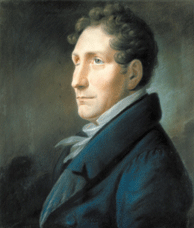
| Pietro Raimondi | 1786 | 1853 | Italian | composer |
| Carl Maria von Weber | 1786 | 1826 | German | |
| Alexander Alyabyev | 1787 | 1851 | Russian | composer, conductor and pianist |
| Franz Xaver Gruber | 1787 | 1863 | Austrian | school teacher, church organist and composer, best known for his Christmas carol, Silent Night |
| Michele Carafa | 1787 | 1872 | Italian | opera composer |
| Johann Peter Pixis | 1788 | 1874 | German | composer and pianist |
| Simon Sechter | 1788 | 1867 | Austrian | prolific composer, renowned music theorist, teacher, organist and conductor |
| Elena Asachi | 1789 | 1877 | Romanian | composer of Austrian birth, pianist and singer |
| Nicolas-Charles Bochsa | 1789 | 1856 | French | composer and musician |
| Friedrich Ernst Fesca | 1789 | 1826 | German | composer of instrumental music and violinist |
| Maria Szymanowska | 1789 | 1831 | Polish | composer and virtuoso pianist |
| Harriet Browne | 1790 | 1858 | English | composer and writer |
| Isaac Nathan | 1790 | 1864 | English | composer, musicologist, journalist and self-publicist known as "the father of Australian music" |
| Carl Czerny | 1791 | 1857 | Austrian | |
| Ferdinand Hérold | 1791 | 1833 | French | |
| Giacomo Meyerbeer | 1791 | 1864 | German | |
| Franz Xaver Wolfgang Mozart | 1791 | 1844 | Austrian | |
| Carlo Evasio Soliva | 1791 | 1853 | Swiss-Italian | composer |
| Jan Václav Voříšek | 1791 | 1825 | Czech | composer, pianist and organist |
| Gioachino Rossini | 1792 | 1868 | Italian | |
| Hedda Wrangel | 1792 | 1833 | Swedish | composer |
| Cipriani Potter | 1792 | 1871 | English | composer, teacher and pianist |
| Gertrude van den Bergh | 1793 | 1840 | Dutch | composer and pianist |
| Bernhard Klein | 1793 | 1832 | German | composer |
| Caroline Ridderstolpe | 1793 | 1878 | Swedish | composer and singer |
| Princess Amalie of Saxony | 1794 | 1870 | German | composer |
| Ignaz Moscheles | 1794 | 1870 | Czech | |
| Heinrich Marschner | 1795 | 1861 | German | |
| Saverio Mercadante | 1795 | 1870 | Italian | |
| Nikolaos Mantzaros | 1795 | 1872 | Italian-Greek | composer |
| Helene Liebmann | 1795 | 1835 | German | composer and pianist |
| Franz Berwald | 1796 | 1868 | Swedish | composer, little known in his lifetime, but his works, including his four symphonies are better known today |
| Carl Loewe | 1796 | 1869 | German | |
| Mathilda d'Orozco | 1796 | 1863 | Swedish | composer, noble, salonist, poet, writer, singer, amateur actress and harpsichordist |
| Giovanni Pacini | 1796 | 1867 | Italian | composer |
| Emilie Zumsteeg | 1796 | 1857 | German | composer, pianist, songwriter and choir conductor |
| Luigi Castellacci | 1797 | 1845 | Italian | virtuoso on the mandolin and guitar, instrumental composer and author of popular French romances with guitar and piano accompaniments |
| Gaetano Donizetti | 1797 | 1848 | Italian | |
| Franz Schubert | 1797 | 1828 | Austrian | |
| Annette von Droste-Hülshoff | 1797 | 1848 | German | composer and writer |
| Antonio Rolla | 1798 | 1837 | Italian | composer and violin and viola virtuoso |
| Olivia Buckley | 1799 | 1847 | English | composer, harpist and organist |
| Marie von Stedingk | 1799 | 1868 | Swedish | composer and courtier |
| Fromental Halévy | 1799 | 1862 | French | |
| Oscar I of Sweden | 1799 | 1859 | Swedish | |
| Alexey Verstovsky | 1799 | 1862 | Russian |
Repertoire key: B=In Classical Net's basic Timeline of Major Composers 1600–present [1]
| Name | Date born | Date died | Nationality | Comments |
|---|---|---|---|---|
| Vincenzo Bellini | 1801 | 1835 | Italian | |
| Tomasz Padura | 1801 | 1871 | Ukrainian-Polish | |
| Jean-Baptiste Duvernoy | 1802 | 1880 | French | composer and pianist |
| Amédée Méreaux | 1802 | 1874 | French | |
| Cesare Pugni | 1802 | 1870 | Italian | |
| Eliza Flower | 1803 | 1846 | English | composer |
| Friedrich Theodor Fröhlich | 1803 | 1836 | Swiss | |
| Adolphe Adam | 1803 | 1856 | French | |
| Hector Berlioz | 1803 | 1869 | French | |
| Henri Herz | 1803 | 1888 | Austrian | composer and pianist |
| Franz Lachner | 1803 | 1890 | German | composer and conductor, brother of Ignaz Lachner and Vinzenz Lachner |
| Louise Farrenc | 1804 | 1875 | French | composer of three symphonies and many chamber works including the earliest known sextet for piano and wind quintet (1852) |
| Mikhail Glinka | 1804 | 1857 | Russian | |
| Johann Strauss I | 1804 | 1849 | Austrian | |
| Fanny Mendelssohn | 1805 | 1847 | German | composer and pianist, sister of Felix Mendelssohn, mainly known for her vocal compositions and chamber music |
| Leopold von Zenetti | 1805 | 1892 | Austrian | composer, mainly known for being one of Anton Bruckner's masters |
| Napoléon Coste | 1805 | 1883 | French | virtuoso guitarist, teacher and composer |
| Juan Crisóstomo Arriaga | 1806 | 1826 | Spanish | composer who died at nineteen and by which time he had already been nicknamed the "Spanish Mozart" for his Symphony in D and three string quartets |
| Johann Kaspar Mertz | 1806 | 1856 | Hungarian | composer, known for his guitar pieces |
| Johann Friedrich Franz Burgmüller | 1806 | 1874 | German | composer and pianist |
| Carlo Curti | 1807 | 1872 | Italian | cellist, performer and educator at Royal School of Music in Parma who composed cello and piano music |
| Ignaz Lachner | 1807 | 1895 | German | conductor, composer and organist, a prolific composer, notable for his chamber music such as his string quartets and trios |
| Michael William Balfe | 1808 | 1870 | Irish | conductor and composer, remembered for his opera, The Bohemian Girl |
| Sebastián Iradier | 1809 | 1865 | Spanish | composer, best known for La Paloma |
| Felix Mendelssohn | 1809 | 1847 | German | |
| Otto Lindblad | 1809 | 1864 | Swedish | composer |
| Frédéric Chopin | 1810 | 1849 | Polish-French | |
| Ferenc Erkel | 1810 | 1893 | Hungarian | composer of grand opera |
| Otto Nicolai | 1810 | 1849 | German | opera composer and conductor, best known for The Merry Wives of Windsor |
| Norbert Burgmüller | 1810 | 1836 | German | composer and brother of Friedrich Burgmüller, praised by Robert Schumann |
| Robert Schumann | 1810 | 1856 | German | |
| Ludwig Schuncke | 1810 | 1834 | German | composer and pianist |
| Ferdinand David | 1810 | 1873 | German | composer and violinist |
| Vinzenz Lachner | 1811 | 1893 | German | composer, brother of Franz Lachner and Ignaz Lachner |
| Franz Liszt | 1811 | 1886 | Hungarian | |
| Ferdinand Hiller | 1811 | 1885 | German | composer, conductor, writer and music-director, close friend of Felix Mendelssohn. Robert Schumann dedicated his Piano Concerto (Schumann) to him in 1845. |
| Wilhelm Taubert | 1811 | 1891 | German | pianist, composer and conductor whose early works received praise from Felix Mendelssohn |
| Ambroise Thomas | 1811 | 1896 | French | |
| Spyridon Xyndas | 1812 | 1896 | Greek | opera composer and guitarist |
| Sigismond Thalberg | 1812 | 1871 | Austrian | composer and one of the most distinguished pianists of the Romantic era |
| Louis-Antoine Jullien | 1812 | 1860 | French | conductor and composer of light music, king of promenade concerts in England |
| Emilie Mayer | 1812 | 1883 | German | |
| Friedrich von Flotow | 1812 | 1883 | German | |
| Alexandre Dubuque | 1812 | 1898 | Russian-French | composer, known for teaching |
| Johann Rufinatscha | 1812 | 1893 | Austrian | composer |
| Alexander Dargomyzhsky | 1813 | 1869 | Russian | |
| Semen Hulak-Artemovsky | 1813 | 1873 | Ukrainian | |
| George Alexander Macfarren | 1813 | 1887 | English | major opera composer, best known for Robin Hood, She Stoops to Conquer and Helvellyn, also known as a teacher |
| Stephen Heller | 1813 | 1888 | Hungarian | composer, highly affected the late Romantic composers |
| Richard Wagner | 1813 | 1883 | German | |
| Ernst Haberbier | 1813 | 1869 | German | composer |
| Giuseppe Verdi | 1813 | 1901 | Italian | |
| Charles-Valentin Alkan | 1813 | 1888 | French | composer and virtuoso pianist |
| Andonios Liveralis | 1814 | 1842 | Greek | opera composer and conductor |
| Giuseppe Lillo | 1814 | 1863 | Italian | composer, best known for his operas among which is worth noting Odda di Bernaver and Caterina Howard |
| Adolf von Henselt | 1814 | 1889 | German | composer and pianist |
| Josephine Lang | 1815 | 1880 | German | composer and pianist |
| Ferdinand Praeger | 1815 | 1891 | German | composer and pianist |
| Robert Volkmann | 1815 | 1883 | German | composer, companion of Johannes Brahms |
| Józef Władysław Krogulski | 1815 | 1842 | Polish | composer and pianist |
| William Sterndale Bennett | 1816 | 1875 | English | composer, conductor and editor |
| Charles Dancla | 1817 | 1907 | French | violinist, composer and teacher |
| Émile Prudent | 1817 | 1863 | French | pianist and composer |
| Károly Thern | 1817 | 1886 | Hungarian | composer, conductor and teacher |
| Niels Gade | 1817 | 1890 | Danish | composer, violinist and organist |
| Henry Litolff | 1818 | 1891 | British | pianist, composer and music publisher, best known for his five Concerto Symphoniques |
| Charles Gounod | 1818 | 1893 | French | |
| Antonio Bazzini | 1818 | 1897 | Italian | violinist, composer and teacher, best known for The Dance of the Goblins |
| Alexander Dreyschock | 1818 | 1869 | Czech | pianist and composer |
| Jacques Offenbach | 1819 | 1880 | French | |
| Franz von Suppé | 1819 | 1895 | Austrian | |
| Stanisław Moniuszko | 1819 | 1872 | Polish | composer, best known as the Father of Polish National Opera |
| Clara Schumann | 1819 | 1896 | German | composer and pianist, wife of Robert Schumann, one of the leading pianists of the Romantic era |
| Vatroslav Lisinski | 1819 | 1854 | Croatian | composer, famous for his first Croatian opera, Love and Malice and his second Croatian opera, Porin |
| Name | Date born | Date died | Nationality | Comments |
|---|---|---|---|---|
| Henri Vieuxtemps | 1820 | 1881 | Belgian | |
| Giovanni Bottesini | 1821 | 1889 | Italian | conductor, composer and double bass virtuoso |
| Josip Runjanin | 1821 | 1878 | Croatian | composer |
| Emilie Hammarskjöld | 1821 | 1854 | Swedish | composer, concert pianist and organist |
| Joachim Raff | 1822 | 1882 | Swiss-born German | |
| César Franck | 1822 | 1890 | Belgian-born French | |
| Luigi Arditi | 1822 | 1903 | Italian | composer, violinist and conductor |
| Édouard Lalo | 1823 | 1892 | French | |
| Theodor Kirchner | 1823 | 1903 | German | composer and pianist, he wrote over 1,000 piano pieces |
| Kurmangazy Sagyrbaev | 1823 | 1896 | Kazakhstani | composer |
| Anton Bruckner | 1824 | 1896 | Austrian | |
| Bedřich Smetana | 1824 | 1884 | Czech | |
| Carl Reinecke | 1824 | 1910 | German | composer, conductor and pianist, best known for his attachment to classical forms and conducted Gewandhausorchester for nearly 35 years |
| Jean-Baptiste Arban | 1825 | 1889 | French | composer and virtuoso cornetist, wrote the "Grande méthode complète pour cornet à pistons et de saxhorn" now referred to as the "Trumpeter's Bible" |
| Johann Strauss II | 1825 | 1899 | Austrian | |
| Richard Hol | 1825 | 1904 | Dutch | organ composer |
| Stephen Foster | 1826 | 1864 | American | composer and songwriter known as "the father of American music", best known for "Oh! Susanna", "Camptown Races", "Old Folks at Home", "My Old Kentucky Home", "Jeanie with the Light Brown Hair", "Old Black Joe" and "Beautiful Dreamer" |
| Ivar Hallström | 1826 | 1901 | Swedish | opera composer |
| Ludwig Minkus | 1826 | 1917 | Austrian | composer of ballet music |
| Prince Gustaf, Duke of Uppland | 1827 | 1852 | Swedish | composer and the second son of Oscar I of Sweden |
| Josef Strauss | 1827 | 1870 | Austrian | composer and younger brother of Johann Strauss II |
| Adolphe Blanc | 1828 | 1885 | French | composer of chamber music |
| Adrien Barthe | 1828 | 1898 | French | composer |
| Eduard Rohde | 1828 | 1883 | German | composer and organist |
| Johann Dubez | 1828 | 1891 | Austrian | composer and mandolinist |
| Jacques Blumenthal | 1829 | 1908 | German | composer |
| Patrick Gilmore | 1829 | 1892 | Irish-born American | composer and bandleader, best known for his song, When Johnny Comes Marching Home |
| Louis Moreau Gottschalk | 1829 | 1869 | American | composer, famous for performing his own romantic piano works |
| Anton Rubinstein | 1829 | 1894 | Russian | conductor, composer and pianist |
| Karl Goldmark | 1830 | 1915 | Hungarian | |
| Hans von Bülow | 1830 | 1894 | German | conductor, composer and virtuoso pianist |
| Theodor Leschetizky | 1830 | 1915 | Polish | pianist, professor and composer |
| Ivan Larionov | 1830 | 1889 | Russian | composer, writer and folklorist |
| Kornelije Stanković | 1831 | 1865 | Serbian | composer |
| Jan Gerard Palm | 1831 | 1906 | Curaçaoan | composer, best known for his mazurkas, waltzes, danzas, tumbas, fantasies and serenades |
| Hiromori Hayashi | 1831 | 1896 | Japanese | composer, known for the Japanese national anthem, Kimigayo |
| Joseph Joachim | 1831 | 1907 | Hungarian | composer, violinist, conductor and teacher |
| Eduardo Mezzacapo | 1832 | 1898 | Italian | mandolin virtuoso, composer and teacher, known for Aubade for Mandolin, Violin and Guitar and Tarantella "Napoli" |
| August Söderman | 1832 | 1876 | Swedish | composer, best known for his lieder and choral works |
| Ivan Zajc | 1832 | 1914 | Croatian | composer, conductor, director and teacher, best known for his opera, Nikola Šubić Zrinski and his Croatian patriotic song, U boj, u boj |
| Francis Edward Bache | 1833 | 1858 | English | composer and organist |
| Alexander Borodin | 1833 | 1887 | Russian | chemist and nationalist composer, part of the Russian Five, wrote the opera, Prince Igor |
| Johannes Brahms | 1833 | 1897 | German | |
| Amilcare Ponchielli | 1834 | 1886 | Italian | |
| Tekla Bądarzewska-Baranowska | 1834 | 1861 | Polish | composer |
| Julius Reubke | 1834 | 1858 | German | |
| Peter Benoit | 1834 | 1901 | Belgian | composer |
| Giuseppe Branzoli | 1835 | 1909 | Italian | mandolinist, violinist, composer and music historian |
| Felix Draeseke | 1835 | 1913 | German | composer |
| Camille Saint-Saëns | 1835 | 1921 | French | |
| Henryk Wieniawski | 1835 | 1880 | Polish | |
| Eduard Strauss | 1835 | 1916 | Austrian | composer and younger brother of Johann Strauss II and Josef Strauss |
| César Cui | 1835 | 1918 | Russian | |
| Davorin Jenko | 1835 | 1914 | Slovenian-born Serbian | composer and conductor |
| Friedrich Baumfelder | 1836 | 1916 | German | piano, choral, and orchestra composer, in his day known for his 'Tirocinium musicae' and today known for his 'Melody in F major' |
| Léo Delibes | 1836 | 1891 | French | composer, one of the first significant ballet composers since the Baroque music, known for Coppélia , Sylvia , and Lakmé |
| Antônio Carlos Gomes | 1836 | 1896 | Brazilian | opera composer, praised by Franz Liszt and Giuseppe Verdi whose Il Guarany premiered at La Scala in 1870, a first opera ballo for the composer from the New World |
| Bertha Tammelin | 1836 | 1915 | Swedish | composer, concert pianist and opera singer |
| Julius Weissenborn | 1837 | 1888 | German | bassoonist, composer and music teacher, famous for his Practical Bassoon School |
| Tigran Chukhajian | 1837 | 1898 | Turkish-Armenian | composer, conductor, public activist and the founder of the first opera institution in the Ottoman Empire |
| Émile Waldteufel | 1837 | 1915 | French | |
| Mily Balakirev | 1837 | 1910 | Russian | |
| Georges Bizet | 1838 | 1875 | French | |
| Max Bruch | 1838 | 1920 | German | |
| Modest Mussorgsky | 1839 | 1881 | Russian | |
| John Knowles Paine | 1839 | 1906 | American | first native-born American composer to acquire international fame for his large-scale orchestral music |
| Josef Rheinberger | 1839 | 1901 | German | composer and organist, born in Liechtenstein, primarily noted for his organ music including 20 sonatas |
| Eduard Nápravník | 1839 | 1916 | Czech |
| Name | Date born | Date died | Nationality | Comments |
|---|---|---|---|---|
| Pyotr Ilyich Tchaikovsky | 1840 | 1893 | Russian | |
| John Stainer | 1840 | 1901 | English | composer and organist |
| Louis-Albert Bourgault-Ducoudray | 1840 | 1910 | French | composer |
| Johan Svendsen | 1840 | 1911 | Norwegian | composer, conductor and violinist |
| Louis Brassin | 1840 | 1884 | Belgian | pianist, composer and music educator, best known for his piano transcription of the Magic Fire Music from Wagner's Die Walküre |
| Emmanuel Chabrier | 1841 | 1894 | French | |
| Felip Pedrell | 1841 | 1922 | Spanish | composer of opera, zarzuela and church music who taught and influenced Isaac Albéniz, Enrique Granados and Manuel de Falla |
| Giovanni Sgambati | 1841 | 1914 | Italian | composer, conductor and pianist |
| Antonín Dvořák | 1841 | 1904 | Czech | |
| Giuseppe Silvestri | 1841 | 1921 | Italian | composer and mandolin virtuoso |
| Arrigo Boito | 1842 | 1918 | Italian | |
| Mykola Lysenko | 1842 | 1912 | Ukrainian | |
| Johann Nepomuk Fuchs | 1842 | 1899 | Austrian | composer, conductor, teacher and editor |
| Jules Massenet | 1842 | 1912 | French | |
| Arthur Sullivan | 1842 | 1900 | English | |
| Calixa Lavallée | 1842 | 1891 | Canadian | composer, known for the Canadian national anthem, O Canada |
| Émile Bernard | 1843 | 1902 | French | composer and organist, known for his Divertissement For Doubled Wind Quintet |
| Edvard Grieg | 1843 | 1907 | Norwegian | |
| David Popper | 1843 | 1913 | Czech | composer and virtuoso cellist, known for his 40 etudes, 4 concertos and Hungarian Rhapsody for cello and orchestra |
| Paul Taffanel | 1844 | 1908 | French | |
| Nikolai Rimsky-Korsakov | 1844 | 1908 | Russian | |
| Pietro Armanini | 1844 | 1895 | Italian | composer, virtuoso mandolinist and teacher, known for his performances and two dances, La cigale polka pour (The Grasshopper Polka) and L'éventail polka-mazurka (The Range Mazurka) |
| Pablo de Sarasate | 1844 | 1908 | Spanish | virtuoso violinist and composer, best known for Zigeunerweisen , Carmen Fantasy and his showpieces for the violin |
| Charles-Marie Widor | 1844 | 1937 | French | composer, known for his works for the organ |
| Friedrich Nietzsche | 1844 | 1900 | German | philologist, philosopher, cultural critic, poet and composer |
| Ion Ivanovici | 1845 | 1902 | Romanian | composer, known for his waltz, Waves of the Danube |
| Gabriel Fauré | 1845 | 1924 | French | |
| Oscar Hammerstein I | 1846 | 1919 | German-born American | opera composer, businessman and impresario |
| Ignaz Brüll | 1846 | 1907 | Austrian | composer and pianist, famous for his opera, Das goldene Kreuz |
| Luigi Denza | 1846 | 1922 | Italian | opera composer, composed and played for mandolin and guitar |
| Ferdinando de Cristofaro | 1846 | 1890 | Italian | mandolin virtuoso, pianist, composer and music teacher |
| Zygmunt Noskowski | 1846 | 1909 | Polish | composer, conductor and teacher |
| Robert Fuchs | 1847 | 1927 | Austrian | composer and music teacher |
| Chiquinha Gonzaga | 1847 | 1935 | Brazilian | composer, pianist, and conductor |
| Augusta Holmès | 1847 | 1903 | French | composer of Irish descent |
| Philipp Scharwenka | 1847 | 1917 | German-Polish | composer and music teacher, brother of Xaver Scharwenka |
| Henri Duparc | 1848 | 1933 | French | composer, noted for seventeen melodies |
| Hubert Parry | 1848 | 1918 | English | |
| Benjamin Godard | 1849 | 1895 | French | composer and violinist |
| Ernesto Köhler | 1849 | 1907 | Italian | flautist and composer, known by flautists for his instructional work, Progress in Flute Playing |
| Calogero Adolfo Bracco | 1850 | 1903 | Italian | mandolinist, violinist, composer and conductor, known for I mandolini a congresso |
| Zdeněk Fibich | 1850 | 1900 | Czech | |
| Xaver Scharwenka | 1850 | 1924 | German-Polish | composer, pianist and music teacher, brother of Philipp Scharwenka |
| Alexandre Luigini | 1850 | 1906 | French | composer and conductor |
| Max Josef Beer | 1851 | 1908 | Austrian | composer |
| Josif Marinković | 1851 | 1931 | Serbian | composer |
| Vincent d'Indy | 1851 | 1931 | French | |
| Francisco Tárrega | 1852 | 1909 | Spanish | composer and virtuoso classical guitarist, known as 'the Father of modern classical guitar playing' |
| Hans Huber | 1852 | 1921 | Swiss | composer |
| Charles Villiers Stanford | 1852 | 1924 | Irish | |
| Ciprian Porumbescu | 1853 | 1883 | Romanian | composer |
| Teresa Carreño | 1853 | 1917 | Venezuelan | composer and pianist |
| Engelbert Humperdinck | 1854 | 1921 | German | opera composer, influenced by Richard Wagner, famous for Hänsel und Gretel |
| Leoš Janáček | 1854 | 1928 | Czech | composer, known for his two operas, Káťa Kabanová and Jenůfa and his two orchestral pieces, Sinfonietta and Taras Bulba |
| Alfredo Catalani | 1854 | 1893 | Italian | |
| Moritz Moszkowski | 1854 | 1925 | German | composer and pianist who wrote prolifically for the piano, also composed a piano concerto and a violin concerto |
| John Philip Sousa | 1854 | 1932 | American | |
| Bernard Zweers | 1854 | 1924 | Dutch | |
| George Whitefield Chadwick | 1854 | 1931 | American | composer |
| Ernest Chausson | 1855 | 1899 | French | |
| Jean Pietrapertosa | 1855 | 1940 | Italian-French | composer and mandolin virtuoso |
| Julius Röntgen | 1855 | 1932 | German-Dutch | composer, influenced by Johannes Brahms, close friend to Edvard Grieg |
| Anatoly Lyadov | 1855 | 1914 | Russian | |
| Arnold Mendelssohn | 1855 | 1933 | German | composer and music teacher |
| Stevan Mokranjac | 1856 | 1914 | Serbian | composer |
| Giuseppe Martucci | 1856 | 1909 | Italian | composer and music teacher |
| Frank White Meacham | 1856 | 1909 | American | composer and arranger of Tin Pan Alley, best known for his popular march, American Patrol |
| Sergei Taneyev | 1856 | 1915 | Russian | |
| Christian Sinding | 1856 | 1941 | Norwegian | |
| Edward Elgar | 1857 | 1934 | English | |
| Cécile Chaminade | 1857 | 1944 | French | composer and pianist |
| Ruggero Leoncavallo | 1857 | 1919 | Italian | |
| Edwin Eugene Bagley | 1857 | 1922 | American | composer, most famous for composing the march, National Emblem |
| Mathilde Kralik | 1857 | 1944 | Austrian | |
| Giacomo Puccini | 1858 | 1924 | Italian | |
| Jenő Hubay | 1858 | 1937 | Hungarian | violinist, composer and music teacher, also known by his German name Eugen Huber |
| Eugène Ysaÿe | 1858 | 1931 | Belgian | |
| Hans Rott | 1858 | 1884 | Austrian | composer and organist, favorite student of Anton Bruckner and praised by Gustav Mahler |
| Carlo Curti | 1859 | 1926 | Italian | |
| Mikhail Ippolitov-Ivanov | 1859 | 1935 | Russian | composer, conductor and teacher |
| Victor Herbert | 1859 | 1924 | Irish-born American | composer, cellist and conductor, best known for his 1903 operetta, Babes in Toyland |
| Sergei Lyapunov | 1859 | 1924 | Russian | composer and pianist |
| Per Lasson | 1859 | 1883 | Norwegian | composer, brother of Norwegian painter, Oda Krohg |
| Name | Date born | Date died | Nationality | Comments |
|---|---|---|---|---|
| Isaac Albéniz | 1860 | 1909 | Spanish | |
| Valborg Aulin | 1860 | 1928 | Swedish | Female pianist and composer |
| Gustave Charpentier | 1860 | 1956 | French | |
| Gustav Mahler | 1860 | 1911 | Austrian | |
| Edward MacDowell | 1860 | 1908 | American | |
| Hugo Wolf | 1860 | 1903 | Austrian | |
| Ignacy Jan Paderewski | 1860 | 1941 | Polish | pianist and composer |
| Anton Arensky | 1861 | 1906 | Russian | composer, pianist and music teacher |
| Spyridon Samaras | 1861 | 1917 | Greek | opera composer, widely known for his composition of the song, "Olympic Hymn" |
| Wilhelm Berger | 1861 | 1911 | German | composer, pianist and conductor |
| Georgy Catoire | 1861 | 1926 | Russian | composer |
| Václav Suk | 1861 | 1933 | Czech-born Russian | composer, violinist and conductor |
| Euphemia Allen | 1861 | 1948 | British | composer, known for her song, Chopsticks |
| Claude Debussy | 1862 | 1918 | French | |
| Frederick Delius | 1862 | 1934 | English | |
| Edward German | 1862 | 1936 | English | |
| Alberto Williams | 1862 | 1952 | Argentine | composer and conductor |
| Emil von Sauer | 1862 | 1942 | German | composer, pianist, editor and teacher |
| Pietro Mascagni | 1863 | 1945 | Italian | |
| Horatio Parker | 1863 | 1919 | American | |
| Gabriel Pierné | 1863 | 1937 | French | composer, conductor and organist |
| Ricardo Castro | 1864 | 1907 | Mexican | composer, works include piano music |
| Sakunosuke Koyama | 1864 | 1927 | Japanese | composer and music teacher |
| Alberto Nepomuceno | 1864 | 1920 | Brazilian | |
| Clarence L. Partee | 1864 | 1915 | American | |
| Guy Ropartz | 1864 | 1955 | French | composer and conductor |
| Richard Strauss | 1864 | 1949 | German | |
| Paul Dukas | 1865 | 1935 | French | |
| Eduardo di Capua | 1865 | 1917 | Italian | composer, known for his song, "’O sole mio" |
| Herbert J. Ellis | 1865 | 1903 | English | musician (banjo, mandolin and guitar), wrote method books, more than 1000 compositions |
| Paul Gilson | 1865 | 1942 | Belgian | musician and composer |
| Alexander Glazunov | 1865 | 1936 | Russian | |
| Albéric Magnard | 1865 | 1914 | French | |
| Carl Nielsen | 1865 | 1931 | Danish | |
| Jean Sibelius | 1865 | 1957 | Finnish | |
| Vasily Kalinnikov | 1866 | 1901 | Russian | composer of two symphonies |
| Tor Aulin | 1866 | 1914 | Swedish | violinist, conductor and composer |
| Ferruccio Busoni | 1866 | 1924 | Italian | |
| Francesco Cilea | 1866 | 1950 | Italian | composer, particularly known for his two operas, L'arlesiana and Adriana Lecouvreur |
| Vladimir Rebikov | 1866 | 1920 | Russian | composer and pianist |
| Erik Satie | 1866 | 1925 | French | |
| Johann Strauss III | 1866 | 1939 | Austrian | composer, son of Eduard Strauss |
| Learmont Drysdale | 1866 | 1909 | Scottish | composer |
| Samuel Maykapar | 1867 | 1938 | Russian | composer |
| Amy Beach | 1867 | 1944 | American | |
| Umberto Giordano | 1867 | 1948 | Italian | |
| Enrique Granados | 1867 | 1916 | Spanish | |
| Wilhelm Peterson-Berger | 1867 | 1942 | Swedish | |
| Charles Koechlin | 1867 | 1950 | French | composer, teacher and writer on music |
| Scott Joplin | 1868 | 1917 | American | |
| Granville Bantock | 1868 | 1946 | British | composer |
| Hermann Bischoff | 1868 | 1936 | German | composer |
| Hamish MacCunn | 1868 | 1916 | Scottish | composer, conductor and teacher, most famous for The Land of the Mountain and the Flood |
| Vittorio Monti | 1868 | 1922 | Italian | composer, violinist and conductor, most famous for Csárdás |
| José Vianna da Motta | 1868 | 1948 | Portuguese | pianist, teacher and composer, most famous for Symphony 'À Pátria', Op. 13 |
| Juventino Rosas | 1868 | 1894 | Mexican | |
| Jan Brandts Buys | 1868 | 1933 | Dutch-Austrian | composer |
| Tokichi Setoguchi | 1868 | 1941 | Japanese | composer, music educator, conductor and clarinetist, famous for Warship March |
| Seth Weeks | 1868 | 1953 | American | |
| Siegfried Wagner | 1869 | 1930 | German | opera composer, conductor and the son of Richard Wagner |
| Demetrios Lialios | 1869 | 1940 | Greek | composer of chamber music |
| Julius Conus | 1869 | 1942 | Russian | composer and violinist |
| Albert Roussel | 1869 | 1937 | French | |
| Armas Järnefelt | 1869 | 1958 | Finnish | composer and conductor |
| Harry Lawrence Freeman | 1869 | 1954 | American | opera composer, conductor, impresario and teacher, best known for his African-American opera, Voodoo |
| Alfred Hill | 1869 | 1960 | Australian-New Zealand | composer, conductor and teacher |
| John Nicholas Klohr | 1869 | 1956 | American | composer of band music, most famous for The Billboard March |
| Leopold Godowsky | 1870 | 1938 | Polish | composer, pianist and teacher |
| Zygmunt Stojowski | 1870 | 1946 | Polish | composer and pianist |
| Franz Lehár | 1870 | 1948 | Hungarian | composer, mainly known for his operettas |
| Florent Schmitt | 1870 | 1958 | French | composer |
| Luigi von Kunits | 1870 | 1931 | Serbian-born Austrian | composer and conductor, founder of the Pittsburg and Toronto symphony orchestras |
| Guillaume Lekeu | 1870 | 1894 | Belgian | composer, known for his violin sonata |
| Nobu Kōda | 1870 | 1946 | Japanese | composer, violinist and music teacher |
| Alfredo D'Ambrosio | 1871 | 1914 | Italian | violinist and composer |
| Giacomo Balla | 1871 | 1958 | Italian | futurist composer and artist |
| Zacharia Paliashvili | 1871 | 1933 | Georgian | |
| Henry Kimball Hadley | 1871 | 1937 | American | composer and conductor, known for the opera, Cleopatra's Night |
| Oreste Ravanello | 1871 | 1938 | Italian | composer, known for works for choir and for organ |
| Wilhelm Stenhammar | 1871 | 1927 | Swedish | |
| Alexander von Zemlinsky | 1871 | 1942 | Austrian | |
| Stanislav Binički | 1872 | 1942 | Serbian | composer |
| Hugo Alfvén | 1872 | 1960 | Swedish | |
| Julius Fučík | 1872 | 1916 | Czech | |
| Rubin Goldmark | 1872 | 1936 | American | composer, pianist, educator and nephew of Karl Goldmark |
| Alexander Scriabin | 1872 | 1915 | Russian | |
| Ralph Vaughan Williams | 1872 | 1958 | English | |
| Salvator Léonardi | 1872 | 1938 | Italian | composer, performer and teacher, known for Souvenir de Catania, Souvenir de Napoli, Souvenir de Sicile and Angeli e Demoni |
| William Henry Bell | 1873 | 1946 | English | composer, conductor and lecturer |
| Leo Fall | 1873 | 1925 | Austrian | composer of operettas |
| Pascual Marquina Narro | 1873 | 1948 | Spanish | prolific orchestral and operatic composer |
| Sergei Rachmaninoff | 1873 | 1943 | Russian | |
| Max Reger | 1873 | 1916 | German | prolific composer, known for his Variations and Fugue on a Theme by Mozart |
| Reynaldo Hahn | 1874 | 1947 | Venezuelan | composer, known for his strikingly beautiful and unabashedly tonal melodies |
| Gustav Holst | 1874 | 1934 | English | |
| Charles Ives | 1874 | 1954 | American | composer, member of the American Five, best known for The Unanswered Question and his Concord Sonata |
| Arnold Schoenberg | 1874 | 1951 | Austrian-American | |
| Josef Suk | 1874 | 1935 | Czech | |
| Franz Schmidt | 1874 | 1939 | Austrian | composer, influenced by Anton Bruckner and Johannes Brahms |
| Giovanni Kwartnik | 1875 | 1939 | Hungarian | composer, pianist, violinist, cellist, violist, trumpeter And conductor, influenced by Johann Strauss II and Pyotr Ilyich Tchaikovsky |
| Reinhold Glière | 1875 | 1956 | Russian | |
| Julián Carrillo | 1875 | 1965 | Mexican | composer, conductor, violinist and music theorist |
| Fritz Kreisler | 1875 | 1962 | Austrian | composer and virtuoso violinist, known for his sweet sound, composed short showpieces for the violin |
| Richard Wetz | 1875 | 1935 | German | composer, influenced by Anton Bruckner |
| Maurice Ravel | 1875 | 1937 | French | |
| Franco Alfano | 1875 | 1954 | Italian | composer and pianist |
| Albert Ketèlbey | 1875 | 1959 | English | composer, conductor and pianist |
| Samuel Coleridge-Taylor | 1875 | 1912 | English | composer, known for his trilogy of cantatas, The Song of Hiawatha |
| Alexander Koshetz | 1875 | 1944 | Ukrainian | |
| Mikalojus Konstantinas Čiurlionis | 1875 | 1911 | Lithuanian | painter and composer |
| Henriette Renié | 1875 | 1956 | French | harpist and composer |
| Edgar Bara | 1876 | 1962 | French | mandolinist and composer, conducted mandolin orchestra |
| John Alden Carpenter | 1876 | 1951 | American | composer |
| Manuel de Falla | 1876 | 1946 | Spanish | |
| Flor Alpaerts | 1876 | 1954 | Belgian | composer, notable students include the two composers, Denise Tolkowsky and Ernest Schuyten |
| Mieczysław Karłowicz | 1876 | 1909 | Polish | |
| Filippo Tommaso Marinetti | 1876 | 1944 | Italian | futurist composer, poet, and editor |
| Fermo Dante Marchetti | 1876 | 1940 | Italian | composer, best known for the song, "Fascination" |
| Ludolf Nielsen | 1876 | 1939 | Danish | composer, violinist, conductor and pianist |
| Carl Ruggles | 1876 | 1971 | American | composer, painter and the member of the American Five, best known for his orchestral work, Sun-Treader |
| Ermanno Wolf-Ferrari | 1876 | 1948 | Italian | |
| Nakao Tozan | 1876 | 1956 | Japanese | performer and prolific composer, known for his works of the Tozan school |
| Petar Krstić | 1877 | 1957 | Serbian | composer and conductor |
| Antonio Russolo | 1877 | 1942 | Italian | futurist composer and brother of Luigi Russolo |
| Ernst von Dohnányi | 1877 | 1960 | Hungarian | conductor, composer and pianist |
| Elisabeth Kuyper | 1877 | 1953 | Dutch | composer and conductor |
| Paul Ladmirault | 1877 | 1944 | French | composer |
| Mykola Leontovych | 1877 | 1921 | Ukrainian | |
| Sergei Bortkiewicz | 1877 | 1952 | Ukrainian | |
| Isidor Bajić | 1878 | 1915 | Serbian | composer, conductor, teacher and publisher |
| Gabriel Dupont | 1878 | 1914 | French | |
| Joseph Holbrooke | 1878 | 1958 | English | composer, conductor and pianist |
| Franz Schreker | 1878 | 1934 | Austrian | conductor, composer and music teacher, primarily a composer of operas |
| Teiichi Okano | 1878 | 1941 | Japanese | composer |
| Frank Bridge | 1879 | 1941 | English | |
| Viggo Brodersen | 1879 | 1965 | Danish | composer and pianist |
| Joseph Canteloube | 1879 | 1957 | French | |
| Hamilton Harty | 1879 | 1941 | Irish | composer and conductor, best known for An Irish Symphony |
| John Ireland | 1879 | 1962 | English | composer, whose Piano Concerto is representative |
| Alma Mahler | 1879 | 1964 | Austrian | composer and wife of Gustav Mahler |
| Otto Olsson | 1879 | 1964 | Swedish | composer |
| Ottorino Respighi | 1879 | 1936 | Italian | composer, known for his three symphonic poems, Fountains of Rome , Pines of Rome , and Roman Festivals |
| Rudolf Sieczyński | 1879 | 1952 | Austrian | |
| Cyril Scott | 1879 | 1970 | English | composer, writer and poet |
| Rentarō Taki | 1879 | 1903 | Japanese |


The Classical period was an era of classical music between roughly 1730 and 1820.
Figured bass, also called thoroughbass, is a kind of musical notation in which numerals and symbols indicate intervals, chords, and non-chord tones that a musician playing piano, harpsichord, organ, lute play in relation to the bass note that these numbers and symbols appear above or below. Figured bass is closely associated with basso continuo, a historically improvised accompaniment used in almost all genres of music in the Baroque period of Classical music, though rarely in modern music.
Impressionism in music was a movement among various composers in Western classical music whose music focuses on mood and atmosphere, "conveying the moods and emotions aroused by the subject rather than a detailed tone‐picture". "Impressionism" is a philosophical and aesthetic term borrowed from late 19th-century French painting after Monet's Impression, Sunrise. Composers were labeled impressionists by analogy to the impressionist painters who use starkly contrasting colors, effect of light on an object, blurry foreground and background, flattening perspective, etc. to make the observer focus his attention on the overall impression.
Music is the art of arranging sounds in time to produce a composition through the elements of melody, harmony, rhythm, and timbre. It is one of the universal cultural aspects of all human societies. General definitions of music include common elements such as pitch, rhythm, dynamics, and the sonic qualities of timbre and texture. Different styles or types of music may emphasize, de-emphasize or omit some of these elements. Music is performed with a vast range of instruments and vocal techniques ranging from singing to rapping; there are solely instrumental pieces, solely vocal pieces and pieces that combine singing and instruments. The word derives from Greek μουσική ; see § Etymology and glossary of musical terminology.
Renaissance music is vocal and instrumental music written and performed in Europe during the Renaissance era. Consensus among music historians has been to start the era around 1400, with the end of the medieval era, and to close it around 1600, with the beginning of the Baroque period, therefore commencing the musical Renaissance about a hundred years after the beginning of the Renaissance as it is understood in other disciplines.
Romantic music is a stylistic movement in Western orchestral music associated with the period of the nineteenth century commonly referred to as the Romantic era. It is closely related to the broader concept of Romanticism—the intellectual, artistic and literary movement that became prominent in Europe from approximately 1800 until 1910.
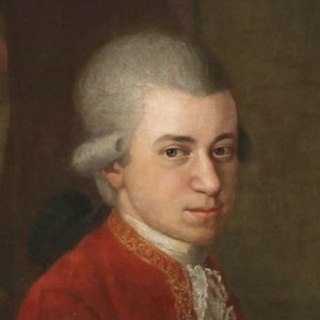
Wolfgang Amadeus Mozart, baptised as Johannes Chrysostomus Wolfgangus Theophilus Mozart, was a prolific and influential composer of the Classical period.
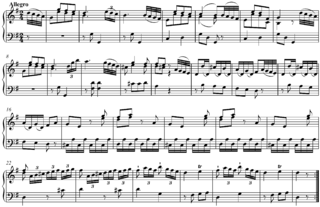
Sonata, in music, literally means a piece played as opposed to a cantata, a piece sung. The term evolved through the history of music, designating a variety of forms until the Classical era, when it took on increasing importance. Sonata is a vague term, with varying meanings depending on the context and time period. By the early 19th century, it came to represent a principle of composing large-scale works. It was applied to most instrumental genres and regarded—alongside the fugue—as one of two fundamental methods of organizing, interpreting and analyzing concert music. Though the musical style of sonatas has changed since the Classical era, most 20th- and 21st-century sonatas still maintain the same structure.
Sonata form is a musical structure consisting of three main sections: an exposition, a development, and a recapitulation. It has been used widely since the middle of the 18th century.
Music is found in every known society, past and present, and is considered to be a cultural universal. Since all people of the world, including the most isolated tribal groups, have a form of music, it may be concluded that music is likely to have been present in the ancestral population prior to the dispersal of humans around the world. Consequently, the first music may have been invented in Africa and then evolved to become a fundamental constituent of human life, using various different materials to make various instruments.

A string trio is a group of three string instruments or a piece written for such a group. The term is generally used with reference to works of chamber music from the Classical period to the present. From at least the 19th century on, the term "string trio" with otherwise unspecified instrumentation normally refers to the combination violin, viola and cello. This is how the term is used by major catalogs, including IMSLP.
A composer is a person who writes music, especially classical music in any form, including vocal music, instrumental music, electronic music, and music which combines multiple forms. A composer may create music in any music genre, including, for example, classical music, musical theatre, blues, folk music, jazz, and popular music. Composers often express their works in a written musical score using musical notation.
A chord, in music, is any harmonic set of pitches/frequencies consisting of multiple notes that are heard as if sounding simultaneously. For many practical and theoretical purposes, arpeggios and broken chords, or sequences of chord tones, may also be considered as chords in the right musical context.
Charles Welles Rosen was an American pianist and writer on music. He is remembered for his career as a concert pianist, for his recordings, and for his many writings, notable among them the book The Classical Style.
Chromaticism is a compositional technique interspersing the primary diatonic pitches and chords with other pitches of the chromatic scale. Chromaticism is in contrast or addition to tonality or diatonicism and modality. Chromatic elements are considered, "elaborations of or substitutions for diatonic scale members".
Not only at the beginning of a composition but also in the midst of it, each scale-step [degree] manifests an irresistible urge to attain the value of the tonic for itself as that of the strongest scale-step. If the composer yields to this urge of the scale-step within the diatonic system of which this scale-step forms part, I call this process tonicalization and the phenomenon itself chromatic.
Chromaticism is almost by definition an alteration of, an interpolation in or deviation from this basic diatonic organization.
Throughout the nineteenth century, composers felt free to alter any or all chord members of a given tertian structure [chord built from thirds] according to their compositional needs and dictates. Pronounced or continuous chordal alteration [and 'extension'] resulted in chromaticism. Chromaticism, together with frequent modulations and an abundance of non-harmonicism [non-chord tones], initially effected an expansion of the tertian system; the overuse of the procedures late in the century forewarned the decline and near collapse [atonality] of the system [tonality].
Chromaticism is the name given to the use of tones outside the major or minor scales. Chromatic tones began to appear in music long before the common-practice period, and by the beginning of that period were an important part of its melodic and harmonic resources. Chromatic tones arise in music partly from inflection [alteration] of scale degrees in the major and minor modes, partly from secondary dominant harmony, from a special vocabulary of altered chords, and from certain nonharmonic tones.... Notes outside the scale do not necessarily affect the tonality....tonality is established by the progression of roots and the tonal functions of the chords, even though the details of the music may contain all the tones of the chromatic scale.
Sometimes...a melody based on a regular diatonic scale is laced with many accidentals, and although all 12 tones of the chromatic scale may appear, the tonal characteristics of the diatonic scale are maintained. ... Chromaticism [is t]he introduction of some pitches of the chromatic scale into music that is basically diatonic in orientation, or music that is based on the chromatic scale instead of the diatonic scales.
Giovanni Maria Artusi was an Italian theorist, composer, and writer.
Post-romanticism or Postromanticism refers to a range of cultural endeavors and attitudes emerging in the late nineteenth and early twentieth centuries, after the period of Romanticism.
Classical music is art music produced or rooted in the traditions of Western culture, including both liturgical (religious) and secular music. Historically, the term 'classical music' refers specifically to the musical period from 1750 to 1820. In a more general sense classical music refers to Western musical traditions considered to be apart from or a refinement of western folk music traditions and encompasses the broad span of time from before the 6th century AD to the present day, which includes the Classical period and various other periods. The central norms of this tradition became codified between 1650 and 1900, which is known as the common-practice period.
In musical form and analysis, exposition is the initial presentation of the thematic material of a musical composition, movement, or section. The use of the term generally implies that the material will be developed or varied.
The transition from the classical period of Western art music, which lasted around 1750 to 1820, to Romantic music, which lasted around 1815 to 1910, took place in the eighteenth and nineteenth centuries. Composers began transitioning their compositional and melodic techniques into a new musical form which became known as the Romantic Era or Romanticism due to the implementation of lyrical melodies as opposed to the linear compositional style of Classical music.
Notes
Sources