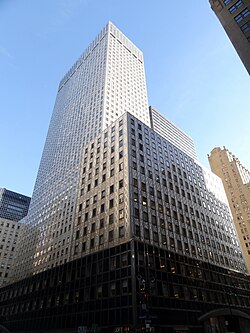
The Chrysler Building is an Art Deco–style skyscraper located on the East Side of Midtown Manhattan in New York City, at the intersection of 42nd Street and Lexington Avenue in the Turtle Bay neighborhood of Manhattan. At 1,046 feet (318.9 m), the structure was the world's tallest building for 11 months before it was surpassed by the Empire State Building in 1931. It is the tallest brick building in the world with a steel framework. As of 2018, the Chrysler is the eighth-tallest building in the city, tied with The New York Times Building.

The Empire State Building is a 102-story Art Deco skyscraper in Midtown Manhattan, New York City. Designed by Shreve, Lamb & Harmon and completed in 1931, the building has a roof height of 1,250 feet (380 m) and stands a total of 1,454 feet (443.2 m) tall, including its antenna. Its name is derived from "Empire State", the nickname of New York, which is of unknown origin. As of 2017 the building is the 5th-tallest completed skyscraper in the United States and the 28th-tallest in the world. It is also the 6th-tallest freestanding structure in the Americas. The Empire State Building stood as the world's tallest building for nearly 40 years until the completion of the World Trade Center's North Tower in Lower Manhattan in late 1970. Following the September 11 attacks in 2001, it was again the tallest building in New York until the new One World Trade Center was completed in April 2012.

The Woolworth Building is an early American skyscraper located at 233 Broadway in Manhattan, New York City. Designed by architect Cass Gilbert, it was the tallest building in the world from 1913 to 1930, with a height of 792 feet (241 m). More than a century after its construction, it remains one of the 100 tallest buildings in the United States as well as one of the 30 tallest buildings in New York City.

The Singer Building or Singer Tower was a 47-story office building in Lower Manhattan, New York City, completed in 1908 as the headquarters of the Singer Manufacturing Company. It was located at Liberty Street and Broadway in the Financial District of Lower Manhattan.

The Seagram Building is a skyscraper, located at 375 Park Avenue, between 52nd Street and 53rd Street in Midtown Manhattan, New York City. The integral plaza, building, stone faced lobby and distinctive glass and bronze exterior were designed by German-American architect Ludwig Mies van der Rohe. Philip Johnson designed the interior of The Four Seasons and Brasserie restaurants. Kahn & Jacobs were associate architects. Severud Associates were the structural engineering consultants. The Seagram building was completed in 1958.

40 Wall Street, also known as the Trump Building, is a 71-story neo-gothic skyscraper between Nassau Street and William Street in Manhattan, New York City. Erected by The Manhattan Company as its headquarters, the building was originally known as the Bank of Manhattan Trust Building, and also as the Manhattan Company Building, until its founding tenant merged to form the Chase Manhattan Bank. The structure was completed in 1930 after 11 months of construction.

The Park Row Building is a building on Park Row bordering TriBeCa and the Financial District of the New York City borough of Manhattan also known as 15 Park Row. The building was designed by R. H. Robertson, a pioneer in steel skyscraper design, and engineered by the firm of Nathaniel Roberts.

28 Liberty Street, formerly known as One Chase Manhattan Plaza, is a banking skyscraper located in the downtown Manhattan Financial District of New York City, between Pine, Liberty, Nassau, and William Streets. Construction on the building was completed in 1961. It has 60 floors, with 5 basement floors, and is 248 meters (813 ft) tall, making it the 26th tallest building in New York City, the 43rd tallest in the United States, and the 200th tallest building in the world.

Lever House is a glass-box skyscraper at 390 Park Avenue in Midtown Manhattan, New York City. Built in the International Style according to the design principles of Ludwig Mies van der Rohe, the building was designed by Gordon Bunshaft of Skidmore, Owings and Merrill. Completed in 1952, it was the second curtain wall skyscraper in New York City after the United Nations Secretariat Building. The 307-foot-tall (94 m) building features a courtyard and public space.

One Wall Street, is an Art-Deco-style skyscraper in Lower Manhattan, New York City. It is located in Manhattan's Financial District on the corner of Wall Street and Broadway. Up until September 30, 2015, it served as the global headquarters of The Bank of New York Mellon Corporation. In May, 2014, the bank sold the building to a joint venture led by Harry B. Macklowe's Macklowe Properties for $585 million.

The Bayard–Condict Building at 65 Bleecker Street between Broadway and Lafayette Street, at the head of Crosby Street in the NoHo neighbourhood of Manhattan, New York City is the only work of architect Louis Sullivan in New York City. It was built between 1897 and 1899 in the Chicago School style; the associate architect was Lyndon P. Smith. The building was originally known as the Condict Building before being renamed the Bayard Building. The building was considered to be a radical design for its time, since it contravened the strictures of American Renaissance architecture which were the accepted status quo, but had little influence on architectural design in New York City, because of its location in the industrial area that Bleecker Street was during that period. It is located in the NoHo Historic District.
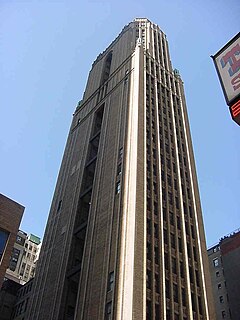
Bush Tower, also called the Bush Terminal International Exhibit Building and formerly as the Bush Terminal Sales Building, is a historic 30-story, 433-foot-tall (132 m) skyscraper located in Midtown Manhattan, New York City, just east of Times Square. The building occupies a plot at 130-132 West 42nd Street between Broadway and Sixth Avenue. It was built in 1916–1918 for Irving T. Bush's Bush Terminal Company, which operated Bush Terminal in the Sunset Park neighborhood of Brooklyn, New York City.

20 Exchange Place is a 57-story Art Deco building in the Financial District of Lower Manhattan, New York City. Formerly known as the City Bank-Farmers Trust Building, it was built between 1930–1931, for the newly merged National City Bank of New York and the Farmers' Loan and Trust Company, predecessor firms of Citigroup. It remained the company's headquarters until 1956 and was ultimately sold in 1979.
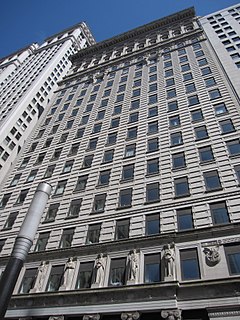
The American Surety Building is a historic skyscraper located at 100 Broadway, New York City, New York, opposite Trinity Church. It has been declared a landmark as one of Manhattan's most influential early skyscrapers.
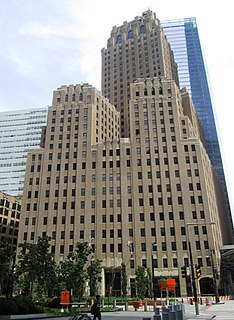
The Verizon Building – previously known as the Barclay-Vesey Building and the New York Telephone Company Building – is a 32-story building located at 140 West Street between Barclay and Vesey Streets, going through to Washington Street, in the TriBeCa neighborhood of Manhattan, New York City. The building was constructed from 1923 to 1927, and was designed in the Art Deco style by Ralph Walker of the firm McKenzie, Voorhees & Gmelin. The building is adjacent to the World Trade Center site and 7 World Trade Center, and it experienced major damage in the September 11 attacks. Its thick masonry exterior and use of masonry to protect steel columns and structural elements helped the building withstand the attacks. Restoration of the building and damaged communications infrastructure after the attacks took three years, at a cost of $1.4 billion.
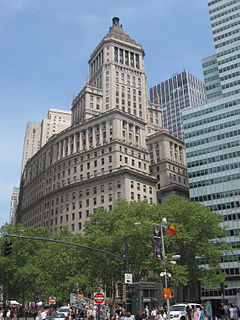
26 Broadway, also known as the Standard Oil Building, is a 31-story, 520-foot-tall (160 m) landmarked office building located at Bowling Green in the Financial District of New York City. As of 2017, the structure is the 220th tallest building in New York City and the 650th tallest building in the United States. 26 Broadway was also the home address in the late 18th century of Alexander Hamilton, his wife Elizabeth Schuyler Hamilton, and their family.

The Corbin Building is a historic office building located at 13 John Street at the corner of Broadway – where it is numbered as 192 – in the Financial District of Manhattan, New York City. It was built in 1888-89 and was designed by Francis H. Kimball in the Romanesque Revival style with French Gothic detailing. The building was named for Austin Corbin, a president of the Long Island Rail Road who also founded several banks. It was built as a speculative venture for use as office space or housing.
8 Spruce Street, originally known as Beekman Tower and currently marketed as New York by Gehry, is a 76-story skyscraper designed by architect Frank Gehry in the New York City borough of Manhattan at 8 Spruce Street, between William and Nassau Streets, in Lower Manhattan, just south of City Hall Park and the Brooklyn Bridge.

The Morse Building, also known as the Nassau-Beekman Building, is a high-rise building located in Manhattan, New York City. The Morse Building was one of the world's first prismatically shaped skyscrapers and, at 140 feet, one of the tallest buildings in New York when built. Its sheer walls and flat roof were a departure from designs of previous buildings topped by step-backs, mansard roofs, or towers. It was developed by G. Livingston and Sidney E. Morse, nephews of telegraph inventor Samuel F. B. Morse. The building was designated a New York City landmark in September, 2006.