Plastics that can be decomposed by the action of living organisms
For plastics derived from renewable resources, see Bioplastic. For plastics that biodegrade in the human body, see Biodegradable polymer.
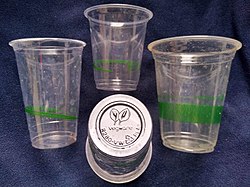
Disposable plastic cups made from biodegradable plastic
Biodegradable plastics are plastics that can be decomposed by the action of living organisms.[1][2] Biodegradable plastics can be derived from renewable raw materials, petrochemicals, or combinations thereof.[1]
While the words "bioplastic" and "biodegradable plastic" are similar, they are not synonymous.[3] Not all bioplastics (plastics derived partly or entirely from biomass) are biodegradable, and some biodegradable plastics are fully petroleum based.[4] As more companies are keen to be seen as having "green" credentials, solutions such as using bioplastics are being investigated and implemented more. The definition of bioplastics is still up for debate. The phrase is frequently used to refer to a wide range of diverse goods that may be biobased, biodegradable, or both. This could imply that polymers made from oil can be branded as "bioplastics" even if they have no biological components at all.[5] However, there are many skeptics who believe that bioplastics will not solve problems as others expect.[6]
History
The earliest work on biodegradable plastics preceded the era of petrochemicals and hence the era of synthetic polymers. This early work focused on natural polymers or their derivatives. Biodegradability was (and remains) more of a liability than an asset for most materials. In the 1830's, cellulose was converted to gun cotton (cellulose nitrate) and then cellulose acetates, which are probably the first biodegradable (semi-synthetic) polymers.[7] Early studies on the biopolymerspolyhydroxyalkanoate (PHA)[8] provided the groundwork for its commercial production.[9] Follow-up efforts by W.R. Grace & Co. (USA) failed.[9] When OPEC halted oil exports to the US to boost global oil prices in 1973,[10] Efforts to produce PHB using the strain Alcaligenes latus by Imperial Chemical Industries (ICI UK) also collapsed.[9] The specific PHA produced in this instance was a scl-PHA.[9] Efforts continue.[11] Related to PHA is polylactic acid (PLA). Studies on its polymerization of lactic acid and its derivatives began at DuPont in the 1930's. In the 1970's, a copoiymer of PLA and polyglycolic acid led to the commercialization of Vicryl, resorbable suturing material.[12]
Industrial production of biodegradable polymers commenced on scale in the late 1990's.[1]
Application
Biodegradable polymers and plastics are of great interest for medical applications. Drugs are encapsulated inside of containers that must degrade in very particular ways. Sutures and other prosthetics must endure for a particular function, often requiring strength, and then disappear without further intervention.[13]
Otherwise biodegradable polymers and plastics are also commonly used for disposable items, such as waste bags, shopping bags, some packaging, and food service containers.[14][1]
Types of biodegradable polymers
Most biodegradable polymers are polyesters. The ester group (RC(O)OR') is susceptible to hydrolysis by both chemical (i.e. simply exposure to water) and enzymatic action.
Bio-based polymers
Development of biodegradable containers made from wheat starchDevelopment of an edible casein film overwrap at USDA
Biologically synthesized polymers are produced from natural origins, such as plants, animals, or micro-organisms.[16]
Polyhydroxyalkanoates (PHAs)
Polyhydroxyalkanoates are a class of biodegradable plastic naturally produced by various micro-organisms (example: Cuprividus necator). Specific types of PHAs include poly-3-hydroxybutyrate (PHB), polyhydroxyvalerate (PHV) and polyhydroxyhexanoate (PHH). The biosynthesis of PHA is usually driven by depriving organisms of certain nutrients (e.g. lack of macro elements such as phosphorus, nitrogen, or oxygen) and supplying an excess of carbon sources.[17] PHA granules are then recovered by rupturing the micro-organisms.[18]
PHA can be further classified into two types:
scl-PHA from hydroxy fatty acids with short chain lengths including three to five carbon atoms are synthesized by numerous bacteria, including Cupriavidus necator and Alcaligenes latus (PHB).
mcl-PHA from hydroxy fatty acids with medium chain lengths including six to 14 carbon atoms, can be made for example, by Pseudomonas putida.[19]
PLA is compostable, but non-biodegradable according to American and European standards because it does not biodegrade outside of artificial composting conditions (see §Compostable plastics).
Starch blends
Starch blends are thermoplastic polymers produced by blending starch with plasticizers. Because starch polymers on their own are brittle at room temperature, plasticizers are added in a process called starch gelatinization to augment its crystallization.[22] While all starches are biodegradable, not all plasticizers are. Thus, the biodegradability of the plasticizer determines the biodegradability of the starch blend.
The most widely used petroleum-based plastics are polyethylene terephthalate (PET), polyethylene (PE), polypropylene (PP), and polystyrene (PS), polyvinyl chloride (PVC) are not biodegradable. In fact, they are desirable for their resilience. For example, PVC plumbing is used extensively for sewage, which is corrosive. Otherwise many petrochemicals are use to produce biodegradable polymers.
Polyesters
Polyglycolic acid (PGA) is a thermoplastic polymer derived from the hydroxycarboxylic acidglycolic acid. PGA is often used in medical applications such as PGA sutures for its biodegradability. The ester linkage in the backbone of polyglycolic acid gives it hydrolytic instability. Thus polyglycolic acid can degrade into its nontoxic monomer, glycolic acid, through hydrolysis, This process can be expedited with esterases (enzymes that facilitate hydrolysis of esters). In the body, glycolic acid can enter the tricarboxylic acid cycle, after which can be excreted as water and carbon dioxide.[26] Closely related to PGA is polylactic acid (and PLA-PGA blends). Since lactic acid is obtained biologically, it is discussed as a bio-derived biodegradable material.
Polybutylene succinate (PBS) is derived from succinic acid and 1,4-butanediol. It a thermoplastic polymer resin that is used in packaging films for food and cosmetics. In the agricultural field, PBS is used as a biodegradable mulching film.[27] PBS can be degraded by Amycolatopsis sp. HT-6 and Penicillium sp. strain 14-3. In addition, Microbispora rosea, Excellospora japonica and E. viridilutea have been shown to consume samples of emulsified PBS.[28]
A prominent omission from the list of biodegradable polyesters is polyethylene terephthalate (PET), of which >80M tons/y are produced. Bacteria and their associated enzymes that degrade PET have been identified, but the conversions are slow.[29]
Poly(vinyl alcohol) (PVA, PVOH)
Poly(vinyl alcohol) is one of the few biodegradable vinyl polymers that is soluble in water. Due to its solubility in water (an inexpensive and harmless solvent), PVA has a wide range of applications including 3d printing, food packaging, textiles coating, paper coating, and healthcare products.[30]
No international standard has been established to define home-compostable plastics (i.e. those which do not rely on industrial composting facilities), but national standards have been created in Australia (AS 5810 "biodegradable plastics suitable for home composting") and in France (NF T 51-800 "Specifications for plastics suitable for home composting"). The French standard is based on the "OK compost home certification scheme", developed by Belgian certifier TÜV Austria Belgium.[31] The following are examples of plastics that have conformed to an established national standard for home compostability:[32]
BioPBS FD92 resin, maximum thickness 85 microns
BWC BF 90A resin, maximum thickness 81 microns
Ecopond Flex 162 resin, maximum thickness 65 microns
HCPT-1 triple laminate, maximum thickness 119 microns
HCFD-2 duplex laminate, maximum thickness 69 microns
Torise TRBF90 resin, maximum thickness 43 microns
Many biodegradable plastics are designed to degrade in industrial composting systems. However, this requires a well-managed waste system to ensure that this actually happens. If products made from these plastics are discarded into conventional waste streams such as landfill, or find their way into the open environment such as rivers and oceans, potential environmental benefits are not realised and evidence indicates that this can actually worsen, rather than reduce, the problem of plastic pollution.[33]
Biodegradation pathways and mechanisms
Most biodegradable polymers are polyesters. They break down by hydrolysis, i.e., a cleavage (lysis) with water to give a carboxylic acid (RCO2H) and an alcohol (ROH):
(RCO2R')n + n H2O → n RCO2H + n R'OH
The cases of polyesters derived from hydroxyl carboxylic acids (PLA, PCA, PHB), the alcohol and the carboxylic acid are part of the same monomer, so the equation for hydrolysis is simplified:
(OCHRCO2')n + n H2O → n HOCHRCO2H
To be even more precise, at neutral pH, the carboxylic acid exists as the carboxylate:
(OCHRCO2)n + n H2O → n HOCHRCO−2 + n H+
Hydrolysis can induced by "chemical" routes (no enzymes) or enzyme-catalyzed. These enzymes are exported from a cell or result from the rupture of some cell. Polymers are too large to enter cells. Chemical hydrolysis can be very slow, but the presence of acids, bases, and mineral surfaces promote the process. Once the polyesters are fully hydrolyzed, the monomers are suited for complete degradation by entering the cellular environment and being metabolized.[1] Microbial degradation is sometimes considered as a 3-step process. Ultimately the biodegradation affords H2O and CO2.[28]
When considering a sample of plastic, biodegradability is a "system property". That is, whether a particular plastic item will biodegrade depends not only on the intrinsic properties of the item, but also on the conditions in the environment in which it ends up. The rate at which plastic biodegrades depends on a wide range of environmental conditions, including temperature, its physical size, and the presence of specific microorganisms. Synthetic polyolefins (polyethylene, etc) are some of the least degradable.[34][33]
Controversy
Although the terms "compostable", "bioplastics", and "oxo-degradative plastics" are often used in place of "biodegradable plastics", these terms are not synonymous. The waste management infrastructure currently recycles regular plastic waste, incinerates it, or places it in a landfill. Mixing biodegradable plastics into the regular waste infrastructure poses some dangers to the environment.[35] Thus, it is crucial to identify how to correctly decompose alternative plastic materials.
Plastic items that only break down into smaller pieces like microplastics may not be truly biodegradable[33]
A 2009 study found that the use of biodegradable plastics was financially viable only in the context of specific regulations which limit the usage of conventional plastics.[36] For example, biodegradable plastic bags have been compulsory in Italy since 2011 with the introduction of a specific law.[37]
Compostable plastics
Both compostable plastics and biodegradable plastics are materials that break down into their organic constituents; however, composting of some compostable plastics requires strict control of environmental factors, including higher temperatures, pressure and nutrient concentration, as well as specific chemical ratios. These conditions can only be recreated in industrial composting plants, which are few and far between.[38] Thus, some plastics that are compostable can degrade only under highly controlled environments.[39] Additionally, composting typically takes place in aerobic environments, while biodegradation may take place in anaerobic environments.[40] Biologically-based polymers, sourced from non-fossil materials, can decompose naturally in the environment, whereas some plastics products made from biodegradable polymers require the assistance of anaerobic digesters or composting units to break down synthetic material during organic recycling processes.[41][33]
Contrary to popular belief, non-biodegradable compostable plastics do indeed exist. These plastics will undergo biodegradation under composting conditions but will not begin degrading until they are met. In other words, these plastics cannot be claimed as "biodegradable" (as defined by both American and European Standards) due to the fact that they cannot biodegrade naturally in the biosphere. An example of a non-biodegradable compostable plastic is polylactic acid (PLA).[42][43]
The ASTM standard definition outlines that a compostable plastic has to become "not visually distinguishable" at the same rate as something that has already been established as being compostable under the traditional definition.[44]
Oxo-degradable plastics
In addition, oxo-degradable plastics are commonly perceived to be biodegradable. However, they are simply conventional plastics with additives called prodegredants that accelerate the oxidation process. While oxo-degradable plastics rapidly break down through exposure to sunlight and oxygen, they persist as huge quantities of microplastics rather than any biological material.[45]
Oxo-degradable plastics cannot be classified as biodegradable under American and European standards because they take too long to break down and leave plastic fragments not capable of being consumed by microorganisms. Although intended to facilitate biodegradation, oxo-degradable plastics often do not fragment optimally for microbial digestion.[46]
All materials are inherently biodegradable, whether it takes a few weeks or a million years to break down into organic matter and mineralize.[47] Therefore, products that are classified as "biodegradable" but whose time and environmental constraints are not explicitly stated are misinforming consumers and lack transparency.[48] Normally, credible companies convey the specific biodegradable conditions of their products, highlighting that their products are in fact biodegradable under national or international standards. Additionally, companies that label plastics with oxo-biodegradable additives as entirely biodegradable contribute to misinformation. Similarly, some brands may claim that their plastics are biodegradable when, in fact, they are non-biodegradable bioplastics.
Labelling plastic items as 'biodegradable', without explaining what conditions are needed for them to biodegrade, causes confusion among consumers and other users. It could lead to contamination of waste streams and increased pollution or littering. Clear and accurate labelling is needed so that consumers can be confident of what to expect from plastic items, and how to properly use and dispose of them.
In response, the European Commission's Group of Chief Scientific Advisors recommended in 2021 to develop "coherent testing and certification standards for biodegradation of plastic in the open environment", including "testing and certification schemes evaluating actual biodegradation of biodegradable plastics in the context of their application in a specific receiving open environment".[33]
Environmental impacts
Environmental benefits
The primary purpose of biodegradable plastics is to replace traditional plastics that persist in landfills and minimize plastic pollution. According to a 2010 report of the United States Environmental Protection Agency (EPA) the US had 31 million tons of plastic waste, representing 12.4% of all municipal solid waste. Of that, 2.55 million tons were recovered. This 8.2% recovery was much less than the 34.1% overall recovery percentage for municipal solid waste.[49]
Depressed plastics recovery rates can be attributed to conventional plastics are often commingled with organic wastes (food scraps, wet paper, and liquids), leading to accumulation of waste in landfills and natural habitats.[50] On the other hand, composting of these mixed organics (food scraps, yard trimmings, and wet, non-recyclable paper) is a potential strategy for recovering large quantities of waste and dramatically increasing community recycling goals. As of 2015, food scraps and wet, non-recyclable paper respectively comprise 39.6 million and 67.9 million tons of municipal solid waste.[51]
Biodegradable plastics can replace the non-degradable plastics in these waste streams, making municipal composting a significant tool to divert large amounts of otherwise nonrecoverable waste from landfills.[16] Compostable plastics combine the utility of plastics (lightweight, resistance, relative low cost) with the ability to completely and fully compost in an industrial compost facility. Rather than worrying about recycling a relatively small quantity of commingled plastics, proponents argue that certified biodegradable plastics can be readily commingled with other organic wastes, thereby enabling composting of a much larger portion of nonrecoverable solid waste.
The use of biodegradable plastics, therefore, is seen as enabling the complete recovery of large quantities of municipal solid waste (via aerobic composting and feedstocks) that have heretofore been unrecoverable by other means except land filling or incineration.[52]
Environmental concerns
Oxo-biodegradation
There are allegations that biodegradable plastic bags may release metals, and may require a great deal of time to degrade in certain circumstances[53] and that OBD (oxo-biodegradable) plastics may produce tiny fragments of plastic that do not continue to degrade at any appreciable rate regardless of the environment.[54][55] The response of the Oxo-biodegradable Plastics Association (www.biodeg.org) is that OBD plastics do not contain metals.[citation needed] They contain salts of metals, which are not prohibited by legislation and are in fact necessary as trace-elements in the human diet. Oxo-biodegradation of low-density polyethylene containing a proprietary manganese-salt-based additive showed 91% biodegradation in a soil environment after 24 months.[56]
Energy costs for production
Various researchers have undertaken extensive life cycle assessments of biodegradable polymers to determine whether these materials are more energy efficient than polymers made by conventional fossil fuel-based means. Research done by Gerngross, et al. estimates that the fossil fuel energy required to produce a kilogram of polyhydroxyalkanoate (PHA) is 50.4 MJ/kg,[57][58] which coincides with another estimate by Akiyama, et al.,[59] who estimate a value between 50-59 MJ/kg. This information does not take into account the feedstock energy, which can be obtained from non-fossil fuel based methods. Polylactide (PLA) was estimated to have a fossil fuel energy cost of 54-56.7 from two sources,[60] but recent developments in the commercial production of PLA by NatureWorks has eliminated some dependence of fossil fuel-based energy by supplanting it with wind power and biomass-driven strategies. They report making a kilogram of PLA with only 27.2 MJ of fossil fuel-based energy and anticipate that this number will drop to 16.6 MJ/kg in their next generation plants. In contrast, polypropylene and high-density polyethylene require 85.9 and 73.7 MJ/kg, respectively,[61] but these values include the embedded energy of the feedstock because it is based on fossil fuel.
Gerngross reports a 2.65kg total fossil fuel energy equivalent (FFE) required to produce a single kilogram of PHA, while polyethylene only requires 2.2kg FFE.[58] Gerngross assesses that the decision to proceed forward with any biodegradable polymer alternative will need to take into account the priorities of society with regard to energy, environment, and economic cost.
Furthermore, it is important to realize the youth of alternative technologies. Technology to produce PHA, for instance, is still in development today, and energy consumption can be further reduced by eliminating the fermentation step, or by utilizing food waste as feedstock.[62] The use of alternative crops other than maize, such as sugar cane from Brazil, are expected to lower energy requirements. For instance, "manufacturing of PHAs by fermentation in Brazil enjoys a favorable energy consumption scheme where bagasse is used as source of renewable energy."[63]
Many biodegradable polymers that come from renewable resources (i.e. starch-based, PHA, PLA) also compete with food production, as the primary feedstock is currently corn. For the US to meet its current output of plastics production with BPs, it would require 1.62 square meters per kilogram produced.[64]
Regulations/standards
To ensure the integrity of products labelled as "biodegradable", the following standards have been established:
United States
The Biodegradable Products Institute (BPI) is the primary certification organization in the US. ASTM International defines methods to test for biodegradable plastic, both anaerobically and aerobically, as well as in marine environments. The specific subcommittee responsibility for overseeing these standards falls on the Committee D20.96 on Environmentally Degradable Plastics and Bio based Products.[65] The current ASTM standards are defined as standard specifications and standard test methods. Standard specifications create a pass or fail scenario whereas standard test methods identify the specific testing parameters for facilitating specific time frames and toxicity of biodegradable tests on plastics.
Anaerobic conditions
Test methodology
Title
ASTMD5511-18
Standard Test Method for Determining Anaerobic Biodegradation of Plastic Materials Under High-Solids Anaerobic-Digestion Conditions
ASTMD5526-18
Standard Test Method for Determining Anaerobic Biodegradation of Plastic Materials Under Accelerated Landfill Conditions
Both standards above indicate that a minimum of 70% of the material should have biodegraded by 30 days (ASTM D5511-18) or the duration of the testing procedure (ASTM D5526-18) to be considered biodegradable under anaerobic conditions. Test methodologies provide guidelines on testing but provide no pass/fail guidance on results.[66]
Aerobic conditions
Specification
Title
ASTMD6400
Standard Specification for Labeling of Plastics Designed to be Aerobically Composted in Municipal or Industrial Facilities
ASTMD6868
Standard Specification for Labeling of End Items that Incorporate Plastics and Polymers as Coatings or Additives with Paper and Other Substrates Designed to be Aerobically Composted in Municipal or Industrial Facilities
Both standards above outline procedures for testing and labelling biodegradability in aerobic composting conditions. Plastics can be classified as biodegradable in aerobic environments when 90% of the material is fully mineralized into CO2 within 180 days (~6 months). Specifications carry pass/fail criteria and reporting.[66]
European Union standards
Anaerobic conditions
Standard
Title
EN13432:2000
Packaging: requirements for packaging recoverable through composting and biodegradation[67]
Similar to the US standards, the European standard requires that 90% of the polymer fragments be fully mineralized into CO2 within 6 months.[67]
Aerobic conditions
Standard
Title
EN14046:2004
Evaluation of the ultimate aerobic biodegradability and disintegration of packaging materials under controlled composting conditions.[68]
Future European standards
In 2021, the European Commission's Scientific Advice Mechanism recommended to the Commission to develop new certification and testing standards for biodegradation of plastic in the open environment,[33] including:
evaluation of actual biodegradation performance, and assessment of environmental risks, in specific open environments such as soils, rivers and oceans
testing of biodegradation under laboratory and simulated environmental conditions
development of a materials catalogue and relative biodegradation rates in a range of environments
"clear and effective labelling"[33] for consumers, manufacturers and vendors to ensure proper disposal of biodegradable plastics.
In October 2020 British Standards published new standards for biodegradable plastic. In order to comply with the standards biodegradable plastic must degrade to a wax which contains no microplastics or nanoplastics within two years. The breakdown of the plastics can be triggered by exposure to sunlight, air and water. Chief executive of Polymateria, Niall Dunne, said his company had created polyethylene film which degraded within 226 days and plastic cups which broke down in 336 days.[70]
1234Philip, S.; Keshavarz, T.; Roy, I. (March 2007). "Polyhydroxyalkanoates: biodegradable polymers with a range of applications". Journal of Chemical Technology & Biotechnology. 82 (3): 233–247. Bibcode:2007JCTB...82..233P. doi:10.1002/jctb.1667.
↑Chen, Guo-Qiang (2009). "A microbial polyhydroxyalkanoates (PHA) based bio- and materials industry". Chemical Society Reviews. 38 (8): 2434–2446. doi:10.1039/b812677c. PMID19623359.
↑Khouri, Nadia G.; Bahú, Juliana O.; Blanco-Llamero, Cristina; Severino, Patricia; Concha, Viktor O.C.; Souto, Eliana B. (2024). "Polylactic acid (PLA): Properties, synthesis, and biomedical applications – A review of the literature". Journal of Molecular Structure. 1309 138243. doi:10.1016/j.molstruc.2024.138243.
↑Chen, Guo-Qiang; Patel, Martin K. (11 April 2012). "Plastics Derived from Biological Sources: Present and Future: A Technical and Environmental Review". Chemical Reviews. 112 (4): 2082–2099. doi:10.1021/cr200162d. PMID22188473.
↑Kim, Young Baek; Lenz, Robert W. (2001), Babel, Wolfgang; Steinbüchel, Alexander (eds.), "Polyesters from Microorganisms", Biopolyesters, vol.71, Springer Berlin Heidelberg, pp.51–79, doi:10.1007/3-540-40021-4_2, ISBN978-3-540-41141-3, PMID11217417{{citation}}: CS1 maint: work parameter with ISBN (link)
↑Jacquel, Nicolas; Lo, Chi-Wei; Wei, Yu-Hong; Wu, Ho-Shing; Wang, Shaw S. (April 2008). "Isolation and purification of bacterial poly(3-hydroxyalkanoates)". Biochemical Engineering Journal. 39 (1): 15–27. Bibcode:2008BioEJ..39...15J. doi:10.1016/j.bej.2007.11.029.
↑Philip, S.; Keshavarz, T.; Roy, I. (March 2007). "Polyhydroxyalkanoates: biodegradable polymers with a range of applications". Journal of Chemical Technology & Biotechnology. 82 (3): 233–247. Bibcode:2007JCTB...82..233P. doi:10.1002/jctb.1667.
↑Bohmert-Tatarev, Karen; McAvoy, Susan; Daughtry, Sean; Peoples, Oliver P.; Snell, Kristi D. (2011). "High Levels of Bioplastic Are Produced in Fertile Transplastomic Tobacco Plants Engineered with a Synthetic Operon for the Production of Polyhydroxybutyrate". Plant Physiology. 155 (4): 1690–1708. doi:10.1104/pp.110.169581. PMID21325565.
↑Xu, Jun; Guo, Bao-Hua (2010), Chen, George Guo-Qiang (ed.), "Microbial Succinic Acid, Its Polymer Poly(butylene succinate), and Applications", Plastics from Bacteria, Microbiology Monographs, vol.14, Springer Berlin Heidelberg, pp.347–388, doi:10.1007/978-3-642-03287-5_14, ISBN978-3-642-03286-8{{citation}}: CS1 maint: work parameter with ISBN (link)
↑Oda, Kohei; Wlodawer, Alexander (2024). "Development of Enzyme-Based Approaches for Recycling PET on an Industrial Scale". Biochemistry acs.biochem.3c00554. doi:10.1021/acs.biochem.3c00554. PMID38285602.
↑Chiellini, Emo; Corti, Andrea; D'Antone, Salvatore; Solaro, Roberto (June 2003). "Biodegradation of poly (vinyl alcohol) based materials". Progress in Polymer Science. 28 (6): 963–1014. doi:10.1016/S0079-6700(02)00149-1.
↑Yaradoddi, Jayachandra S.; Hugar, Shoba; Banapurmath, Nagaraj Rhok S. (2019), Martínez, Leticia Myriam Torres; Kharissova, Oxana Vasilievna; Kharisov, Boris Ildusovich (eds.), "Alternative and Renewable Bio-based and Biodegradable Plastics", Handbook of Ecomaterials, Springer International Publishing, pp.2935–2954, doi:10.1007/978-3-319-68255-6_150, ISBN978-3-319-68255-6{{citation}}: CS1 maint: work parameter with ISBN (link)
↑Bonhomme, S; Cuer, A; Delort, A-M; Lemaire, J; Sancelme, M; Scott, G (January 2003). "Environmental biodegradation of polyethylene". Polymer Degradation and Stability. 81 (3): 441–452. doi:10.1016/S0141-3910(03)00129-0.
↑Jakubowicz, Ignacy; Yarahmadi, Nazdaneh; Arthurson, Veronica (May 2011). "Kinetics of abiotic and biotic degradability of low-density polyethylene containing prodegradant additives and its effect on the growth of microbial communities". Polymer Degradation and Stability. 96 (5): 919–928. doi:10.1016/j.polymdegradstab.2011.01.031.
↑Gerngross, Tillman U. (1999). "Can biotechnology move us toward a sustainable society?". Nature Biotechnology. 17 (6): 541–544. doi:10.1038/9843. PMID10385316. S2CID36258380.
↑Akiyama, Minoru; Tsuge, Takeharu; Doi, Yoshiharu (2003). "Environmental life cycle comparison of polyhydroxyalkanoates produced from renewable carbon resources by bacterial fermentation". Polymer Degradation and Stability. 80 (1): 183–194. doi:10.1016/S0141-3910(02)00400-7.
↑Vink, Erwin T.H.; Rábago, Karl R.; Glassner, David A.; Gruber, Patrick R. (January 2003). "Applications of life cycle assessment to NatureWorks™ polylactide (PLA) production". Polymer Degradation and Stability. 80 (3): 403–419. doi:10.1016/S0141-3910(02)00372-5.
↑Frischknecht, R.; Suter, P. Oko-inventare von Energiesystemen, third ed., 1997.[pageneeded]
↑Vink, Erwin T.H.; Glassner, David A.; Kolstad, Jeffrey J.; Wooley, Robert J.; O'Connor, Ryan P. (March 2007). "ORIGINAL RESEARCH: The eco-profiles for current and near-future NatureWorks® polylactide (PLA) production". Industrial Biotechnology. 3 (1): 58–81. doi:10.1089/ind.2007.3.058.
This page is based on this Wikipedia article Text is available under the CC BY-SA 4.0 license; additional terms may apply. Images, videos and audio are available under their respective licenses.