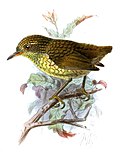
| Gliciphila | |
|---|---|
| | |
| Barred honeyeater (Gliciphila undulata) | |
| Scientific classification | |
| Kingdom: | Animalia |
| Phylum: | Chordata |
| Class: | Aves |
| Order: | Passeriformes |
| Family: | Meliphagidae |
| Genus: | Gliciphila Swainson, 1837 |
| Type species | |
| Certhia fulvifrons Lewin, 1808=Certhia melanops Latham, 1801 | |
| Synonyms | |
Glycifohia Mathews, 1829 | |
Gliciphila is a genus of honeyeaters endemic to Australia, New Caledonia and Vanuatu.
The genus Gliciphila was introduced in 1837 by the English zoologist William Swainson to accommodate a single species, Certhia fulvifrons Lewin, 1808. This is the type species. The name is a junior synonym of Certhia melanops Latham, 1801, the tawny-crowned honeyeater. [1] [2] [3] The genus name combines the Ancient Greek γλυκυς/glukus meaning "sweet" or "sweet tasting" with φιλος/philos meaning "lover". [4]
Molecular genetic studies found that the tawny-crowned honeyeater in the genus Gliciphila was embedded in a clade containing the two species in the genus Glycifohia. To resolve the polyphyly the three species are now placed together in Gliciphila. [5] [6] [7]
The genus contains three species: [7]
| Image | Common name | Scientific name | Distribution |
|---|---|---|---|
| | Barred honeyeater | Gliciphila undulata | montane forest of New Caledonia |
| | Tawny-crowned honeyeater | Gliciphila melanops | south Australia and Tasmania |
| | White-bellied honeyeater | Gliciphila notabilis | Vanuatu |