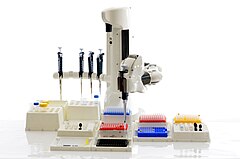
A pipette is a laboratory tool commonly used in chemistry, biology and medicine to transport a measured volume of liquid, often as a media dispenser. Pipettes come in several designs for various purposes with differing levels of accuracy and precision, from single piece glass pipettes to more complex adjustable or electronic pipettes. Many pipette types work by creating a partial vacuum above the liquid-holding chamber and selectively releasing this vacuum to draw up and dispense liquid. Measurement accuracy varies greatly depending on the instrument.

Digital microfluidics (DMF) is a platform for lab-on-a-chip systems that is based upon the manipulation of microdroplets. Droplets are dispensed, moved, stored, mixed, reacted, or analyzed on a platform with a set of insulated electrodes. Digital microfluidics can be used together with analytical analysis procedures such as mass spectrometry, colorimetry, electrochemical, and electrochemiluminescense.
The term dispenser typically imply a machine or container which is designed to release a specific amount of its content, usually liquids or powders/fine granular materials.

Laboratory robotics is the act of using robots in biology, chemistry or engineering labs. For example, pharmaceutical companies employ robots to move biological or chemical samples around to synthesize novel chemical entities or to test pharmaceutical value of existing chemical matter. Advanced laboratory robotics can be used to completely automate the process of science, as in the Robot Scientist project.

A liquid handling robot is used to automate workflows in life science laboratories. It is a robot that dispenses a selected quantity of reagent, samples or other liquid to a designated container.

An eye dropper, also called Pasteur pipette or simply dropper, is a device used to transfer small quantities of liquids. They are used in the laboratory and also to dispense small amounts of liquid medicines. A very common use was to dispense eye drops into the eye. The commonly recognized form is a glass tube tapered to a narrow point and fitted with a rubber bulb at the top, although many styles of both plastic and glass droppers exist. The combination of the pipette and rubber bulb has also been referred to as a teat pipette. The Pasteur pipette name is from the French scientist Louis Pasteur, who used a variant of them extensively during his research. In the past, there was no equipment to transfer a chemical solution without exposing it to the external environment. The hygiene and purity of chemical compounds is necessary for the expected result of each experiment. The eye dropper, both glass and plastic types, can be sterilized and plugged with a rubber bulb at the open end of the pipette preventing any contamination from the atmosphere. Generally, they are considered cheap enough to be disposable, however, so long as the glass point is not chipped, the eye dropper may be washed and reused indefinitely.
Acoustic droplet ejection (ADE) uses a pulse of ultrasound to move low volumes of fluids without any physical contact. This technology focuses acoustic energy into a fluid sample in order to eject droplets as small as a picoliter. ADE technology is a very gentle process, and it can be used to transfer proteins, high molecular weight DNA and live cells without damage or loss of viability. This feature makes the technology suitable for a wide variety of applications including proteomics and cell-based assays.
The in-gel digestion step is a part of the sample preparation for the mass spectrometric identification of proteins in course of proteomic analysis. The method was introduced in 1992 by Rosenfeld. Innumerable modifications and improvements in the basic elements of the procedure remain.

Drum pump, barrel pump, and transfer pump refer to pumps that are used to empty barrels, tanks, IBCs and drums. Many liquids used on manufacturing and processing plants are delivered in 100 or 200 litre barrels and are too heavy to tip to empty the liquids inside. Drum pumps range from simple siphon based devices to sophisticated highly-engineered machinery.

Piston-driven air displacement pipettes are a type of micropipette, which are tools to handle volumes of liquid in the microliter scale. They are more commonly used in biology and biochemistry, and less commonly in chemistry; the equipment is susceptible to damage from many organic solvents.
Pharmacy automation involves the mechanical processes of handling and distributing medications. Any pharmacy task may be involved, including counting small objects ; measuring and mixing powders and liquids for compounding; tracking and updating customer information in databases ; and inventory management. This article focuses on the changes that have taken place in the local, or community pharmacy since the 1960s.
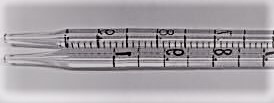
A graduated pipette is a pipette with its volume, in increments, marked along the tube. It is used to accurately measure and transfer a volume of liquid from one container to another. It is made from plastic or glass tubes and has a tapered tip. Along the body of the tube are graduation markings indicating volume from the tip to that point. A small pipette allows for more precise measurement of fluids; a larger pipette can be used to measure volumes when the accuracy of the measurement is less critical. Accordingly, pipettes vary in volume, with most measuring between 0 and 25.0 millilitres.
Automated patch clamping is beginning to replace manual patch clamping as a method to measure the electrical activity of individual cells. Different techniques are used to automate patch clamp recordings from cells in cell culture and in vivo. This work has been ongoing since the late 1990s by research labs and companies trying to reduce its complexity and cost of patch clamping manually. Patch clamping for a long time was considered an art form and is still very time consuming and tedious, especially in vivo. The automation techniques try to reduce user error and variability in obtaining quality electrophysiology recordings from single cells.
Boom method is a solid phase extraction method for isolating nucleic acid from a biological sample. This method is characterized by "absorbing the nucleic acids (NA) to the silica beads".
Forward pipetting is a technique to dispense a measured quantity of liquid by means of air displacement pipette. The technique is mainly recommended for aqueous solutions, such as buffers, or diluted acids or alkalis. In case of solutions with a high viscosity or a tendency to foam, reverse pipetting is more suitable.
Reverse pipetting is a technique to dispense a measured quantity of liquid by means of air displacement pipette. The technique is mainly recommended for solutions with a high viscosity or a tendency to foam: as it reduces the risk of splashing, foam or bubble formation. Reverse pipetting is more precise in dispensing small volumes of liquids containing proteins and biological solutions compared to forward pipetting, which is mostly used for aqueous solutions, such as buffers, diluted acids or alkalis.

A media dispenser or a culture media dispenser is a device for repeatedly delivering small fixed volumes of liquid such as a laboratory growth medium like molten agar or caustic or volatile solvents like toluene into a series of receptacles. It is often important that such dispensers operate without biological or chemical contamination, and so must be internally sealed from the environment and designed for easy cleaning and sterilization before use. At a minimum, a media dispenser consists of some kind of pump connected to a length of discharge tubing or a spout. Dispensers used in laboratories are also frequently connected to microcontrollers to regulate the speed and volume of the medium as it leaves the pump.

Heinrich Schnitger was a German physician. He is considered the inventor of the piston stroke Micropipette, a laboratory device for dispensing small amounts of liquid.
Positive displacement pipettes are a type of pipette that operates via piston-driven displacement. Unlike an air displacement pipette, which dispenses liquid using an air cushion in the pipette tip, the piston in a positive displacement pipette makes direct contact with the sample, allowing the aspiration force to remain constant.
A cloud laboratory is a heavily automated, centralized research laboratory where scientists can run an experiment from a computer in a remote location. Cloud laboratories offer the execution of life science research experiments as a service, allowing researchers to retain full control over experimental design. Users create experimental protocols through a high-level API and the experiment is executed in the cloud laboratory, with no need for the user to be involved.