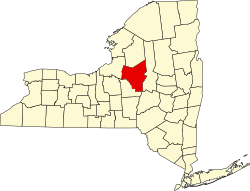
The Erie Canal passes along the southern part of the town.
History
The area was first settled around 1790. The Town of Floyd was founded in 1796 from the Town of Steuben. William Floyd, for whom the town is named, became a resident of Oneida County in 1794.
The population of Floyd was 1,227 in 1865[5] but only 663 in 1920.
In the 19th century, Floyd was known for "Masonic, scholarly, political and anti-slavery activities."[6]
The town was briefly mentioned in the 1996 film "City Hall," in which the two main characters are stuck in Floyd while waiting for snow to clear off the train tracks.
Geography
According to the United States Census Bureau, the town has a total area of 34.8 square miles (90km2), of which 34.6 square miles (90km2) is land and 0.2 square miles (0.52km2) (0.46%) is water.
The Mohawk River defines the southern town line. The town has rolling hills ascending to the north, which reach about 200–300 feet above the river. Nine Mile Creek, which flows through the southeast part of the town, was originally known as Te-ya-nun-sak, or Teyanunsoke, "a beech tree standing."[5][6]
As of the census[9] of 2000, 3,869 people, 1,394 households, and 1,091 families reside in the town. The population density was 111.8 inhabitants per square mile (43.2/km2). There were 1,483 housing units at an average density of 42.9 per square mile (16.6/km2). The town's racial makeup was 97.49% White, 0.36% African American, 0.18% Native American, 0.41% Asian, 0.08% Pacific Islander, 0.18% from other races, and 1.29% from two or more races. Hispanic or Latino of any race were 1.03% of the population.
There were 1,394 households, out of which 38.8% had children under the age of 18 living with them, 63.0% were married couples living together, 10.4% had a female householder with no male present, and 21.7% were non-families. 17.3% of all households comprised individuals, and 7.4% had someone who was 65 or older living alone. The average household size was 2.78 and the average family size was 3.11.
The town's population was spread out, with 28.0% under 18, 6.7% from 18 to 24, 29.7% from 25 to 44, 24.8% from 45 to 64, and 10.6% who were 65 years or older. The median age was 36 years. For every 100 females, there were 97.6 males. For every 100 females age 18 and over, there were 93.3 males.
The median income for a household in the town was $40,192, and the median income for a family was $44,583. Males had a median income of $33,151 versus $22,718 for females. The per capita income for the town was $17,405. About 2.8% of families and 4.2% of the population were below the poverty line, including 5.1% of those under age 18 and 5.6% of those age 65 or over.
Communities and locations in Floyd, NY
Camroden– A hamlet in the northwestern part of the town named by Welsh immigrants. Welsh was the predominant language here from 1825 until the late 1880s.[6]
East Floyd– A hamlet in the northeastern part of the town.
This page is based on this Wikipedia article Text is available under the CC BY-SA 4.0 license; additional terms may apply. Images, videos and audio are available under their respective licenses.