It was known to the Choctaws, Chickasaws, and Creeks who lived in the area as Tiyuk Hekia (Standing Pine); many years later, when it was incorporated, it became known as Overton.
The town was named after Major Frank Overton, an early settler and landowner who donated some of his land for the town site. It was platted in 1873 and a post office was granted that year.
Overton was originally intended to be a crossroads for two railroads. In 1875, the Henderson and Overton Branch Railroad, 16 miles (26km) long, was completed and was later joined by the International-Great Northern. When the nearby communities of Bellview, Jamestown, Rocky Mount, and Salem were all bypassed by the railroad, Overton gained the businesses and people who wanted to benefit from the railroad lines. The town offered lots for businesses to relocate, and many took the offer.
The Masons and Odd Fellows built the first school, and a church was constructed in 1875. By 1888 the population had increased to 500 and had all essential businesses, including a newspaper. Overton prospered as an agricultural community, and in 1904 the population had reached 568.
OklahomanwildcatterC. M. "Dad" Joiner was drilling his third well in 1930,[5] and the town of Overton helped raise the funds he needed to drill. When the well came in, Overton shared in Joiner's success, as churches, schools, and a refinery were built. Hubbard College was founded during this time as well. The town's once agrarian-based economy suddenly revolved entirely around the production of oil.
Overton's population skyrocketed from 426 in 1931 to 3,000 in 1933. By 1936 it was up to 4,500 and the town went through the Great Depression relatively unscathed. But by the end of World War II the population had declined by half—reaching just 2,000 in the 1950s and remaining at that level through the 1970s. In the 1980s Overton was Rusk County's "second city" with a population of 2,430 in 1983. By the 1990s Overton extended into neighboring Smith County.
Overton has a historical voting base consisting primarily of older, Republican-leaning voters.[6]
The "Republic of Texas" Secessionist Movement
In 2003, the City of Overton became home to the headquarters of only surviving faction of the Texan secessionist group, the Republic of Texas led by Daniel Miller[7]. The group was founded on the belief that the United States never legally annexed the Republic of Texas and that Texas is therefore an independent nation, repudiating the Texas State Government and the federal government of the United States' authority over Texas.[8]
The group was considered controversial by the residents of Overton, especially with the group's checkered past, which includes a week-long hostage situation after the incarceration of two members (leading to one death after the siege) with the hostages being called "prisoners of war". Another event occurred involving the arrest and conviction of two members who planned to assassinate then President, Bill Clinton, and other high ranking officials. Both events are listen in the group's Terrorist Organization Profile[8]. Although, Daniel Miller's faction was separated when these events occurred, there was still a stigma in Overton around the faction as they still retained the core beliefs that the other factions shared, including advocacy for illegal activities such as bank fraud and paper terrorism. The group is also accused of practicing white-supremacy.
The Republic of Texas also minted their own currency which included a one gram silver coin with a Texas star and the word "Overton" emblazoned around it, with members attempting to purchase goods with the currency instead of the United States dollar in Overton.[7] Edward J. Williams, Overton's then chief of police, described several run-ins with the group, including a violent altercation between two members over an AR-15 automatic rifle, members using Republic of Texas passports instead of a driver's license; driving unregistered vehicles; and illegally redesigning license plates to show the original Republic of Texas' territorial claims prior to its annexation which includes territory in New Mexico and narrow strips of land in Oklahoma, Colorado and Wyoming. Diana Sieber, a resident and business owner in Overton, would comment: "No one really approves of them," and "They're not the best kind of publicity for our community."[7]
The Republic of Texas operated in a former hospital within the city limits up until the headquarters mysteriously burned down in August 31, 2005; one person was moderately injured[9]. This led to the group leaving Overton and rebranding as the Texas Nationalist Movement.
Geography
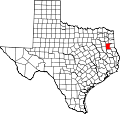
According to the United States Census Bureau, the city has a total area of 6.8square miles (17.5km2), of which 6.7square miles (17.4km2) is land and 0.04square mile (0.1km2) (0.59%) is water. Most of the city lies in Rusk County, with a small portion extending into Smith County.
As of the 2020 United States census, there were 2,275 people, 826 households, and 580 families residing in the city.
As of the census[4] of 2010, there were 2,554 people, 935 households, and 639 families residing in the city. The population density was 375.6 people per square mile. There were 1,086 housing units at an average density of 159.7 per square mile. The racial makeup of the city was 80% White, 16.1% African American, 0.4% Native American, 1.4% from other races, and 2.1% from two or more races. 4% of the population are Hispanic or Latino of any race.
There were 935 households, out of which 32.8% had children under the age of 18 living with them, 47.7% were married couples living together, 15.6% had a female householder with no husband present, and 31.7% were non-families. 27.7% of all households were made up of individuals, and 13.2% had someone living alone who was 65 years of age or older. The average household size was 2.6 and the average family size was 3.18.
In the city, the population was spread out, with 26.9% under the age of 18, 5.8% from 20 to 24, 25.2% from 25 to 44, 23.5% from 45 to 64, and 15.2% who were 65 years of age or older. The median age was 35.2 years.
The median income for a household in the city was $32,292, and the median income for a family was $55,261. The per capita income for the city was $18,987. Males had a median income of $28,496 versus $17,237 for females.
At the federal level, the two U.S. Senators from Texas are Republicans John Cornyn and Ted Cruz; Overton is part of Texas' US Congressional 1st District, which is currently represented by Republican Nathaniel Moran.
The Overton Economic Development Corporation (EDC) is a community team made up of resident executives and business owners, responsible for attracting new investment and helping expand existing businesses within the city. With a seven-member board, the Overton EDC is funded by a $.0025 sales tax that allows the EDC to accomplish its goals.
Business assistance
Overton EDC provides business assistance to qualifying companies. They evaluate incentives for businesses to locate or expand in the Overton area and base their findings on taxes assessed and paid, the number of jobs created or retained, wages paid, local purchases of products and services, indirect employment gains and the general benefit of furthering the mission of the city of Overton Economic Development Corporation.
They primarily seek businesses in manufacturing, production, medical/health, hospitality and distribution. Funds may be used in land lease/purchase, building lease/purchase, rehabilitation or construction, capital equipment purchase, infrastructure improvements or employee training.
Funds may not be used for venture or equity capital, working capital/inventories or personal loans. Forms of business assistance include loans/loan guarantees, SBA 504, SBA 7(A) guaranteed and direct loan, and the rural economic development fund.
↑Note: the US Census treats Hispanic/Latino as an ethnic category. This table excludes Latinos from the racial categories and assigns them to a separate category. Hispanics/Latinos can be of any race.[12][13]
This page is based on this Wikipedia article Text is available under the CC BY-SA 4.0 license; additional terms may apply. Images, videos and audio are available under their respective licenses.


 United States
  Texas
Texas