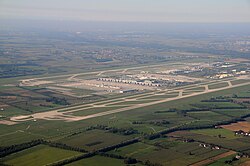
Munich Airport (Flughafen München „Franz Josef Strauß“) (IATA: MUC, ICAO: EDDM) is an international airport serving Munich and the surrounding region of Upper Bavaria. Located 28.5km (17.7mi) northeast of Munich near the town of Freising, it is named after former Bavarian minister-president Franz Josef Strauss. According to the German Aeronautical Information Publication, the airport's official name is Muenchen Airport.[4]
Munich Airport is a hub for Lufthansa and also hosts several of its subsidiaries. It has two passenger terminals, a midfield terminal, two runways, and extensive cargo and maintenance facilities capable of handling wide-body aircraft such as the Airbus A380.
History
Foundation
An Air ToulouseSud Aviation Caravelle at Munich Airport in 1993. The construction site of today’s Hilton Munich Airport is visible in the background.
Munich Airport was named after Franz Josef Strauss, Minister-President of Bavaria from 1978 until 1988, who had supported the project and promoted Bavaria as an aviation hub. Strauss, a private pilot, also served as the first chairman of the Airbus supervisory board.[7]
Operations
Terminal 1 in 2001, before Terminal 2 opened
Passenger traffic more than doubled between 1995 and 2006, from under 15 million to over 30 million annually, despite the impact of the September 11 attacks.[8]
To accommodate growth, Terminal 2 opened in June 2003 as a dedicated facility for Lufthansa and its Star Alliance partners. In 2015, more than 40 million passengers passed through Munich Airport for the first time.[9] In 2018 the airport recorded 46.2 million passengers and 413,000 aircraft movements, serving 266 destinations.[10]
In 2015 Condor announced a new long-haul base at Munich, followed later that year by Transavia opening a base with four aircraft; Transavia closed the operation in 2017.[11] In 2016 Eurowings established a base with routes operated by Air Berlin under a wet-lease agreement.[citation needed] In 2021, Lufthansa announced it would take over most of Eurowings’ Munich services.[12]
Corporate identity
In November 2013 the airport introduced a new corporate design. The stylized "M" remained but adopted a different typeface and a colored dash, with animated versions installed at prominent locations such as the Terminal 2 satellite.[13]
Terminals and facilities
Munich Airport covers 1,575 hectares (3,892 acres) of land.[14] Most facilities are located in the central area between the two parallel runways. The western zone contains cargo and maintenance facilities, administrative buildings, parking areas, and the Visitors’ Centre. Moving east are the west apron, Terminal 1, the Munich Airport Center (MAC), Terminal 2, and the east apron. The airport has two passenger terminals, each designed to handle tens of millions of passengers annually.[15]
Map of Munich Airport (including planned expansion)
Terminal 1
Check-in area at Terminal 1B
Terminal1 is the older of the two passenger terminals and began operation when the airport opened on 17 May 1992. It is subdivided into five modules (A–E). Modules A–D provide facilities for both departures and arrivals, while moduleE handles arrivals only, making each module a largely self-contained unit. Modules A and D are used for flights within the Schengen Area, while modules B and C handle non-Schengen destinations. A separate facility, HallF, is located near Terminal2 and serves flights requiring additional security measures, such as those to Israel. Some check-in counters for Terminal1 flights are also located in the central area Z (German: Zentralbereich), which houses much of the terminal’s shopping, dining, and the airport’s suburban railway station.[citation needed]
Boarding gate area at Terminal 1D
The terminal’s pier is 1,081-metre (3,547-foot) long and has 21 jet bridges, including one gate equipped with three jet bridges for the Airbus A380, used by Emirates. There are also around 60 apron stands, some with specially designed bridges that allow boarding via bus transfer.[citation needed]
Terminal 2 opened on 29 June 2003 with an initial capacity of about 25 million passengers per year.[16][needs update] In January 2009 an additional transfer level was introduced in response to new European Union security requirements, allowing separation of passenger flows.[17]
The terminal is primarily used by Lufthansa and its Star Alliance partners. Luxair also operates from the building, while some other airlines such as Etihad Airways use Terminal 1.[17]
Terminal 2 is arranged around a central plaza rather than modules, as in Terminal 1. It has two main departure levels: Level 4 (G) for Schengen flights and Level 5 (H) for non-Schengen flights, plus bus gates on Level 3. The main pier is about 980m (3,220ft) long and includes 24 jet bridges, with more than 70 aircraft stands on the east apron. Additional west apron stands are sometimes used, with passengers transferred by bus. The terminal is equipped to handle large aircraft such as the Airbus A380, particularly after the opening of the Terminal 2 Satellite building.[17][needs update]
The facility is operated by Terminal-2-Betriebsgesellschaft (Terminal 2 Operating Company), a joint venture between Flughafen München GmbH (60%) and Lufthansa (40%), making it the first German terminal co-operated by an airline.[17]
Terminal 2 Satellite
Terminal 2 Satellite under construction, February 2016
Terminal 2 was projected to reach full capacity of about 27.5 million passengers per year by 2013. Plans for an expansion were developed in cooperation with Lufthansa and its Star Alliance partners. The design allowed for additional capacity while retaining shared facilities such as check-in and baggage claim in Terminal 2, to simplify transfers within the Lufthansa and Star Alliance network.[18][19] Preparations for the project began soon after Terminal 2 opened in 2003.[citation needed]
The €650 million project was funded 60% by Munich Airport and 40% by Lufthansa.[20] Construction was approved in 2010 and began in 2012. The building was completed in late 2015, followed by trial operations in January 2016. It was inaugurated on 22 April 2016 and opened for passengers on 26 April 2016.[21][22][23][24]
The satellite building is 609 m long and has 125,000 m² of floor space. It provides 52 additional gates and 27 aircraft stands, 11 of which can accommodate wide-body aircraft including the Airbus A380. Facilities are divided by function: Level K for Schengen flights, Level L for non-Schengen, and a J area for apron bus boarding. The terminal includes 44 passport control stations, 24 security lanes for transfer passengers, five Lufthansa lounges, and additional restaurants and shops. As an airside-only facility, all check-in, baggage claim and public arrivals functions remain in Terminal 2. A fully automated underground people mover system by Bombardier Transportation connects Terminal 2 and the satellite.[25][26] The terminal handled its one millionth passenger in July 2016, less than three months after opening.[27][needs update]
Plans for further expansion include extending the satellite into a T-shaped layout and a possible third terminal to the east.[28] In December 2019 Lufthansa and Flughafen München GmbH signed a letter of intent to expand the facility, with goals of supporting fuel-efficient aircraft and reaching carbon neutrality by 2030.[29][needs update]
The Munich Airport Center (MAC) is a shopping, business and recreation complex that links the terminals. The older Central Area (Zentralbereich), originally built as part of Terminal 1, contains a shopping mall and the Munich S-Bahn station. The newer MAC Forum, completed with Terminal 2, is a covered outdoor area with a large transparent roof.[citation needed]
The MAC also houses a supermarket that is permitted to trade daily from 05:30 until midnight, including Sundays, as an exemption to Bavarian retail hour restrictions (Ladenschlussgesetz).[30][needs update]
Runways
The airport has two parallel concrete runways, 08R/26L and 08L/26R, each 4,000m (13,000ft) long and 60m (200ft) wide, as well as one helipad.[31][needs update]
Plans for a third runway have been proposed but remain subject to political and legal debate.[32]
Parking areas
Parking garage in front of Terminal 1
Munich Airport provides five parking garages and six underground car parks with a total capacity of around 30,000 spaces, of which about 16,500 are covered.[33][needs update] The largest facility, garage P20 at Terminal 2, opened in 2003 with 6,400 spaces on eleven levels (four underground) and was the largest in Germany until surpassed by the car park at Allianz Arena in 2005.[34]
A parking guidance system directs drivers to available spaces. Additional premium options are offered, including valet parking, hotel-and-parking packages, oversized spaces, and secure parking areas. Short-term spaces are available east of the central area, with 30 minutes of free parking, and seasonal discounted rates are provided in the P8 garage.[35][needs update]
A second viewing facility is located on the roof of Terminal 2. This free observation deck features a wide glassed balcony with seating areas, offering views of the eastern apron and the Terminal 2 Satellite building. The terrace is accessible from the public (landside) area of the terminal.[37]
Airlines and destinations
Passenger
The following airlines offer regular scheduled and charter flights at Munich Airport:
Historic aircraft at the Visitors ParkMaintenance hangar of Lufthansa TechnikControl tower at Munich AirportLufthansa aircraft at Terminal 2Headquarters of Flughafen München GmbH
Munich Airport hosts several aviation-related operations. Lufthansa maintains a Flight Operations Center for crews based at its secondary hub,[262] and its subsidiary Lufthansa CityLine moved its administration offices from Cologne to the airport in 2014.[263]Lufthansa Technik operates a maintenance facility able to service wide-body aircraft, including the Boeing 747.[264]
Two hotels are located on the airport grounds. The Hilton Munich Airport, originally opened as the Kempinski Hotel Airport Munich and rebranded on 31 December 2014,[265] is situated near Terminal 2, while a Novotel serves the long-term parking area.[266] Additional accommodation is available in nearby communities.
In 2010 Audi opened a training facility for its retailers on airport property, with designated apron areas used for driving instruction.[267]
The German airline DBA, originally Deutsche BA, previously maintained its head office at the airport and in nearby Hallbergmoos.[268]
The helicopter operations division of the Bavarian State Police (Hubschrauberstaffel Bayern) is based at the airport.[269]
Since November 2005, Munich Airport has held a certified environmental management system under ISO 14001 and the Eco-Management and Audit Scheme (EMAS). The airport also participated in the Air Transport Initiative for Germany alongside Fraport, Deutsche Flugsicherung and Lufthansa. Within this framework it developed a "four-pillar strategy" aimed at reducing emissions, improving infrastructure efficiency, optimizing operations and creating economic incentives.[270][needs update]
Landscape
Environmental and nature-conservation aspects were incorporated into the original planning of the site. At the time of opening, about 70% of the grounds were landscaped; today roughly 925 of the airport’s 1,575 hectares remain planted (around 60%).[271][needs update] The design took account of the surrounding Erdinger Moos wetlands while also limiting features that attract birds in order to reduce bird strike risk. A 230-acre (93 ha) green belt was established as part of the required compensation areas, which today extend to more than 600 acres (240 ha).[272] Environmental groups, however, have criticised the overall land consumption of the airport and argue that compensation areas are insufficient.[273]
Water
Construction in the Erdinger Moos required lowering local groundwater levels through drainage works, while existing streams were redirected around or under the site. Airport wastewater and rainwater are returned to the water cycle through an extensive system of sewers, pumping stations and treatment facilities. De-icing chemicals such as glycol are collected in winter and treated biologically before release.[274][needs update]
Noise
Runways were built to 4,000 metres to reduce the need for thrust reversal on landing, though this is partly offset by longer taxi times. A dedicated test hall is used for engine runs, and tests after 23:00 require approval by air traffic control. Airport charges are linked to aircraft noise levels, and 16 fixed monitoring stations track compliance.[275][needs update]
Night flights are subject to restrictions. Arrivals and departures are banned between 22:00 and 06:00, with exemptions for mail services, emergency operations and flights authorised by the Bavarian Ministry for Economic Affairs. Limited scheduled flights are permitted under specific conditions between 22:00–24:00 and 05:00–06:00.[276] Local residents have long protested against aircraft noise, particularly at night.[needs update]
Energy
Most of the airport’s electricity and heat is supplied by a combined heat and power plant with a generating capacity of 18.5 MW. Surplus heat is stored and reused, and in summer drives absorption chillers. The airport also connects to the regional district heating network.[270][needs update]
A photovoltaic system installed on the roof of Terminal 2 in 2003 generates about 445,000 kWh annually, equivalent to the usage of roughly 150 households.[277][needs update] Additional facilities include a biofuel filling station for airport and service vehicles.[270][needs update]
Despite preventive measures, conflicts persist between aviation safety and wildlife protection, and rare birds are occasionally killed by aircraft movements. Plans for a third runway would reduce areas of open grassland within the sanctuary, a proposal criticised by conservation groups.[278][needs update]
Emergency services
Police
Eurocopter EC135 of the Bavarian State Police at Munich Airport
Responsibility for passenger and operational security lies with the Federal Police, units of the Bavarian State Police (Munich Airport Police Inspection, Police Headquarters Upper Bavaria North), and the security department of Flughafen München GmbH.[279] The airport police station is located at Nordallee 6. Officers are trained for aviation-related incidents.[citation needed]
The airport maintains its own fire department with two stations near the runways and a fleet of 32 fire engines. The service is positioned to provide rapid response across the airfield. In major incidents, fire departments from surrounding municipalities can provide additional support; the airport fire service also assists local fire departments in large-scale incidents.
Fire department missions
Year
Total missions*
Fires
Technical assistance
False alarms
2013
3,997
104
1,754
2,139
2012
3,613
107
1,717
1,789
2011
3,582
118
1,831
1,633
2010
3,946
128
2,070
1,748
2009
3,254
118
1,599
1,537
2008
2,999
107
1,389
1,503
2007
2,651
116
1,328
1,207
2006
3,011
123
1,052
1,209
2005
2,095
127
1,103
1,116
2004
2,704
119
950
1,103
*Includes other deployments such as training exercises and guided tours.[needs update]
Emergency medical services at the airport are provided by the Malteser Hilfsdienst under a public service contract. A rescue vehicle is available around the clock and may also respond to calls outside the airport area. Additional regional or supraregional rescue services are dispatched by the regional control center, which coordinates emergency responses across the area.
An emergency physician from the airport medical center is available on site.
Ground transportation
Road
Munich Airport is accessible via nearby Motorway A 92, which connects to motorway A9 (towards Nuremberg) and Munich's ring motorway A99. Bavarian State Road St. 2584 connects A 92's exit 6 (Flughafen München)—an incomplete interchange that can only be used by traffic to and from the west—to the terminals. Access from the east is possible via exit 8 (Freising Ost) and Bavarian State Road St. 2580, which connects to St. 2584 in the east of the airport.[citation needed]
The north-southbound so-called "Flughafentangente Ost" ( literally: airport tangential road east) between A92 and A94 was finally opened in 2010 [280] with a single lane in each direction. Originally, it was planned to be opened as expressway simultaneously with the new Airport. Gradually, the accident-prone road shall be selectively upgraded from 2021 on to two alternating lanes per direction.[281]
It can be reached by bicycle on national highway 301 ("B301") and an airport road branching from this highway into the airport area.[citation needed]
Suburban railway
A S-Bahn train leaving the tunnel beneath the apron of Terminal 1
There are two railway stations on the grounds of Munich Airport: Munich Airport Terminal station is located in a tunnel directly beneath the central area between both passenger terminals. A second station called Besucherpark (German for Visitors' Park) is located in the area that contains the cargo and maintenance areas, long-term parking, administrative buildings and the Visitors' Park from which the station gets its name.[citation needed]
The airport is connected to the city by Munich suburban railway (S-Bahn) lines S1 and S8. The ride takes approximately 45 minutes to the Marienplatz station in the city centre. Line S1 runs from the airport through the northwestern suburbs and reaches the city centre from the west (Hauptbahnhof – Marienplatz – München Ost), while line S8 comes in from the eastern suburbs passing the stations from the opposite direction. The S-Bahn from the airport to the city runs approximately 20 hours a day with a short break between 1:30a.m. and 4 a.m.[282]
Furthermore, a scheduled regional bus service 635 connects the airport within 20 minutes to the Freising railway station, providing access to regional trains towards Munich as well as to Nuremberg, Regensburg and Prague.
A second tunnel beneath the terminals is currently unused. Originally, there were plans to use it for intercity railway, then for a Transrapidmaglev train making the trip to München Hauptbahnhof in 10 minutes. However, this project was cancelled in March 2008 due to cost escalation. Discussions regarding a faster connection between Munich city centre and the airport have fruitlessly taken place for several years, as the journey time of 40–60 minutes faces ongoing criticism.[283] Even a rudimentary express suburban railway service is not in sight.[284]
Regional railway services
As of September 2015, construction works to connect the airport with regional railway services of Deutsche Bahn to and from the north-east had started.[285] This project, called Neufahrner Kurve (Neufahrn curve after the nearby town of Neufahrn bei Freising), saw the existing southwest-bound S-Bahn tracks being expanded with a curve leading to the north, connecting them with the already existing tracks of the Munich-Regensburg line. This new connection enabled hourly regional express train services from Regensburg via Landshut directly to the airport without the need to use a connecting bus coming from the north or to go to Munich city center at first and then backtracking to the airport. The entire project was completed in November 2018.[286] On 9 December 2018, the new hourly service, Flughafenexpress (airport express) between Regensburg and Munich Airport commenced.[citation needed]
Since the early 1990s, several proposals have aimed to improve rail access to Munich Airport. Deutsche Bundesbahn initially studied four concepts for connecting the airport to the ICE network at a cost of 500 million to 2 billion Deutsche Mark, but these plans were abandoned in favor of strengthening regional rail links to Munich Hauptbahnhof.[289]
Airport Express (S-Bahn)
After the cancellation of the proposed Transrapid maglev link, alternative concepts were developed using existing railway infrastructure with limited upgrades.[citation needed]
One such plan, colloquially known as the "Humpel-Express," would have operated on the Munich–Regensburg railway and S1 line with few intermediate stops.[290] Trains were intended to run at speeds up to 200 kilometres per hour (120mph) every 15 minutes between Hauptbahnhof and the airport. The proposal faced obstacles including extended road closures at level crossings in Fasanerie and Feldmoching, the need for a new alignment through several municipalities, and the construction of a viaduct over the federal highway B471. Public opposition and funding concerns led to the project being abandoned.[291]
A revised Airport Express service is now planned in conjunction with the construction of the second S-Bahn trunk line. Trains would stop only at Marienhof between Hauptbahnhof and Ostbahnhof, reducing travel time to about 30 minutes. Deutsche Bahn has also proposed a four-track underground extension from Leuchtenbergring to Hallbergmoos, which would eliminate bottlenecks at intermediate stations and further reduce journey times to an estimated 15–18 minutes.[292]
U-Bahn connections
Extensions of the Munich U-Bahn to connect with S-Bahn lines serving the airport have also been considered. These would shorten travel times from northern districts of Munich by providing faster access to the S1 line.[citation needed]
In 1996 the opening of the U2 terminus at Feldmoching improved access from Milbertshofen-Am Hart and Feldmoching-Hasenbergl. In 1998 an additional connection was completed near Neufahrn, and in 2010 the extension of the U3 to Moosach linked Schwabing-West and Neuhausen-Nymphenburg directly to the S1 line.[293] A further extension of the U6 from Garching to Neufahrn remains under discussion.[citation needed]
Erdinger Ring connections
Map of the Erdinger Ring connections with the Walpertskirchen link and Neufahrn LinkConstruction work on the Neufahrn Link
The Erdinger Ring project extends the S2 line from Erding towards the airport and provides a connection to Freising via the Neufahrn Link. It is intended to create a regional rail link between eastern Bavaria—including cities such as Moosburg and Landshut—and Munich Airport. Although the project does not reduce travel time to the city center, it establishes a direct link to Messe München by routing the S2 north of the exhibition center.[citation needed]
Formal planning for both projects began in 2006. In October 2012 approval was granted for the Neufahrn Link, and on 29 August 2013 the Bavarian Administrative Court dismissed legal challenges, clearing the way for construction. A financing agreement was signed in April 2013, and the 2.5km electrified double-track section was completed by December 2018, when direct services to Regensburg and Landshut commenced.[294]
Proposed third runway
Plans have been advanced for the construction of a third runway at Munich Airport. The new 4,000-metre (13,000ft) runway would run parallel to the existing ones and be located northeast of the current north runway.[citation needed]
Rationale
Between 1997 and 2006 air traffic at Munich grew on average by about 7% per year, and capacity at the two existing runways was reported to be exhausted during peak hours. Airlines seeking new slots at Munich were often denied.[295] A forecast by Intraplan Consult GmbH projected 58.2 million passengers by 2025, assuming continued growth.[296]
According to Flughafen München GmbH (FMG), the operator, a third runway would increase maximum capacity from about 90 to 120 aircraft movements per hour and help position Munich as Germany’s second major hub after Frankfurt Airport.[297]
The plan approval decision by the government of Upper Bavaria in 2011 was supported by the airport’s shareholders (the State of Bavaria, the Federal Republic of Germany, and the City of Munich) and by several business associations, who argued that the expansion was important for regional transport and the economy.[298]
Opposition
The proposal has been controversial, especially in the districts of Freising and Erding, but also in other surrounding counties.[299][300] Critics questioned the airport’s traffic forecasts, arguing that demand could be met by operating larger aircraft rather than building new infrastructure.[301]
Opponents formed the alliance *aufgeMUCkt*, an umbrella organization of more than 80 groups including citizens’ initiatives, church groups, and environmental organizations. The campaign was supported by the Bavarian branch of BUND.[302] Demonstrations have been held regularly, including a protest in Munich’s Marienplatz on 29 October 2011 with an estimated 7,000 participants.[303] The Catholic Church, which owns some affected land, also announced that it would not sell property for the project.[304]
Planning and legal process
The airport operator submitted its application for planning approval in 2007. During the public review period, more than 60,000 objections were filed. In July 2011 the government of Upper Bavaria granted zoning approval, confirming the need for additional capacity. At the same time, the Bavarian Administrative Court rejected lawsuits against the decision, allowing the plan to proceed. The permit is valid for up to 15 years.[305]
In 2012 a local referendum in Munich rejected the project, leading the city (one of the airport’s three shareholders) to withhold approval. In 2015 Germany’s Federal Administrative Court dismissed all remaining complaints and confirmed the legal validity of the expansion plans.[306] However, construction cannot begin without the consent of all three shareholders: the State of Bavaria, the Federal Republic of Germany, and the City of Munich.[citation needed]
In September 2020 the Bavarian government suspended all progress on the third runway until at least 2028, citing the sharp decline in passenger numbers during the COVID-19 pandemic.[307]
If built, the new runway would be designated 08L/26R under ICAO rules (renaming the current north runway 08C/26C). Plans also include a satellite terminal at Terminal 2, which opened in April 2016.[citation needed]
See also
Memmingen Airport, an airport 110km (68mi) from Munich that serves the city with low-cost flights
↑"ADV Monthly Traffic Report 12/2022"(PDF). adv.aero (in German). Arbeitsgemeinschaft Deutscher Verkehrsflughäfen e.V. 13 February 2023. Retrieved 17 February 2023.
↑"AIP VFR online". dfs.de. DFS Deutsche Flugsicherung GmbH. Retrieved 21 February 2023.
↑"AD 1.3-2". AIP Germany. Langen: DFS Deutsche Flugsicherung GmbH. Retrieved 4 December 2025.
↑"Daten und Fakten zum Satelliten"[Data and Facts about the Satellite Terminal]. munich-airport.de (in German). Archived from the original on 23 October 2015. Retrieved 6 December 2015.
↑Exklusiv-München (4 June 2023). "KLM feiert 75 Jahre in München". Exklusiv München | Szene, Society & Shopping in München (in German). Retrieved 4 February 2026.
This page is based on this Wikipedia article Text is available under the CC BY-SA 4.0 license; additional terms may apply. Images, videos and audio are available under their respective licenses.