| | |
| Overview | |
|---|---|
| Service type | Shinkansen (Limited-stop) |
| Status | Operational |
| Locale | Honshu, Japan |
| First service |
|
| Current operator | |
| Former operator | Japan National Railway |
| Route | |
| Termini | Tokyo Morioka |
| Distance travelled | 496.5 km (308.5 mi) |
| Line used | Tōhoku Shinkansen |
| On-board services | |
| Classes | Ordinary, Green, Gran Class [a] |
| Seating arrangements |
|
| Technical | |
| Rolling stock | E2 and E5 series |
| Track gauge | 1,435 mm (4 ft 8+1⁄2 in) standard gauge |
| Electrification | Overhead line, 25 kV 50 Hz AC |
| Operating speed | 275–320 km/h (171–199 mph) [b] |
| Track owner | JR East |
The Yamabiko (Japanese: やまびこ; lit. 'echo') [1] is a limited-stop high-speed Shinkansen service operated on the Tōhoku Shinkansen between Tokyo and Morioka by East Japan Railway Company (JR East) in Japan. [2]
On 1 February 1959, the name Yamabiko was introduced on a semi-express (準急, junkyū) service between Fukushima and Morioka on the Tōhoku Main Line. This service operated until 30 September 1963. [4]
From 1 October 1965, the name was reintroduced for limited express services operating between Ueno in Tokyo and Morioka. These services continued until 22 June 1982, the day before the Tōhoku Shinkansen opened. [4]
From the start of services on the newly opened Tōhoku Shinkansen on 23 June 1982, Yamabiko became the name used for the limited-stop shinkansen services operating initially between Ōmiya and Morioka, later between Ueno and Morioka, and eventually between Tokyo and Morioka. [4]
Since 1 July 1992, some Yamabiko services have run coupled with Tsubasa services (as of 2025 formed of E3 series or E8 Series sets) between Tokyo and Fukushima. [2]
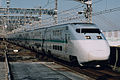
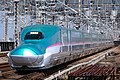
From 19 November 2011, E5 series trainsets were introduced on some Yamabiko services, replacing the remaining 200 series-operated services. [5] [6]
On 30 March 2013, a special Sayonara 200 series Yamabiko (さよなら200系やまびこ号) train operated from Morioka to Tokyo, as a farewell run for the 200 series on Yamabiko services, following the withdrawal of 200 series trains from regular scheduled services on 16 March. [3]