This article has multiple issues. Please help improve it or discuss these issues on the talk page . (Learn how and when to remove these messages)
|
| | |
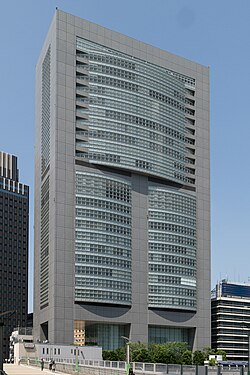
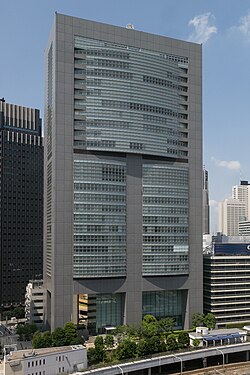
| Headquarters in Shibuya ward, Tokyo | |
Native name | 東日本旅客鉄道株式会社 |
|---|---|
Romanized name | Higashi-Nihon Ryokaku Tetsudō kabushiki gaisha lit. 'East Japan Passenger Railway Share Company' |
| Company type | Public |
| |
| Industry | Rail transport |
| Predecessor | Japanese National Railways (JNR) |
| Founded | 1 April 1987, privatization of JNR |
| Headquarters | 2-2-2 Yoyogi, Shibuya, Tokyo , Japan |
Area served | Kanto and Tōhoku regions Niigata, Nagano, Yamanashi and Shizuoka prefectures |
Key people | Tetsuro Tomita (chairman of the board) Masaki Ogata (vice chairman of the board) Yuji Fukasawa (president, Representative Director) [1] |
| Products | Suica (a rechargeable contactless smart card) |
| Services | Passenger railways freight services bus transportation other related services [2] |
| Revenue | |
| Total assets | |
| Total equity | |
| Owner | JTSB investment trusts (8.21%) Mizuho Bank (4.07%) TMTBJ investment trusts (3.97%) MUFG Bank (2.75%) Repurchased shares (2.67%) (as of 30 September 2018) |
Number of employees | 73,017 (as of 31 March 2013) [1] |
| Divisions | Railway operations [5] Life-style business [5] IT & Suica business [5] |
| Subsidiaries | 83 companies, [6] [7] including Tokyo Monorail and J-TREC |
| Website | www |
| Footnotes /references [8] [9] | |
The East Japan Railway Company [a] is a major passenger railway company in Japan and the largest of the seven Japan Railways Group companies. The company name is officially abbreviated as JR East in English, and as JR Higashi-Nihon [b] in Japanese. The company's headquarters are in Yoyogi, Shibuya, Tokyo, next to Shinjuku Station. [2] It is listed in the Tokyo Stock Exchange (it formerly had secondary listings in the Nagoya and Osaka stock exchanges), is a constituent of the TOPIX Large70 index, and is one of three Japan Railways Group constituents of the Nikkei 225 index, the others being JR Central and JR West.
JR East was incorporated on 1 April 1987 after being spun off from the government-run Japanese National Railways (JNR). [10] The spin-off was nominally "privatization", as the company was actually a wholly owned subsidiary of the government-owned JNR Settlement Corporation for several years, and was not completely sold to the public until 2002.
Following the breakup, JR East ran the operations on former JNR lines in the Greater Tokyo Area, the Tōhoku region, and surrounding areas.
Railway lines of JR East primarily serve the Kanto and Tohoku regions, along with adjacent areas in Kōshin'etsu region (Niigata, Nagano, Yamanashi) and Shizuoka prefectures. [11]
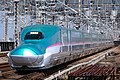
JR East operates all of the Shinkansen high-speed rail lines north of Tokyo, with the exception of the Hokkaido Shinkansen which is operated by JR Hokkaido. [12]
The Tokyo–Osaka Tōkaidō Shinkansen is owned and operated by the Central Japan Railway Company (JR Central), although it stops at several JR East stations. [13] | |
These lines have sections inside the Tokyo suburban area (Japanese: 東京近郊区間) designated by JR East. This does not necessarily mean that the lines are fully inside the Greater Tokyo Area.
| |
| |
| |
Below is the full list of limited express and express train services operated on JR East lines as of 2025.
JR East operates "Hakobyun", a priority cargo transport service on its Shinkansen lines. The service is intended for high-value, delicate, and time-sensitive goods such as precision equipment and premium fresh seafood, offering faster delivery times and smoother handling than conventional freight trains. Any Shinkansen train can carry up to 40 boxes of commercial cargo using storage areas located between cars. On selected services, one or more cars may be closed to passengers and used for cargo transport, with boxes loaded onto specially designed carts that fit between seats. JR East also operates a converted E3 series trainset with all seating removed for dedicated cargo use. Hakobyun services operate on the Akita, Hokuriku, Hokkaidō, Jōetsu, Tōhoku, and Yamagata Shinkansen lines. Small consignments can be loaded and unloaded at any station along the route, while larger volumes must be handled at designated cargo terminals. [15] [16] [17] [18]
During Japanese fiscal year 2024, the busiest stations in the JR East network by average daily passenger count were: [19]
JR East co-sponsors the JEF United Chiba J-League football club [ citation needed ], which was formed by a merger between the JR East and Furukawa Electric company teams.
JR East aims to reduce its carbon emissions by half, as measured over the period 1990–2030. This would be achieved by increasing the efficiency of trains and company-owned thermal power stations and by developing hybrid trains. [21]
The Tokyo Metropolitan Police Department has stated that JR East's official union is a front for a revolutionary political organization called the Japan Revolutionary Communist League (Revolutionary Marxist Faction). An investigation of this is ongoing.[ when? ] [22]
The East Japan Railway Culture Foundation is a non-profit organization established by JR East for the purpose of developing a "richer railway culture". [23] The Railway Museum in Saitama is operated by the foundation.
JR East held a 15% shareholding in West Midlands Trains with Abellio and Mitsui that commenced operating the West Midlands franchise in England in December 2017. [24] [25] JR East sold their stake to Abellio in September 2021. [26] The same consortium were also listed to be bidding for the South Eastern franchise. [27] [28]
{{cite web}}: CS1 maint: url-status (link)