Green politics, or ecopolitics, is a political ideology that aims to foster an ecologically sustainable society rooted in environmentalism, nonviolence, social justice and grassroots democracy. It began taking shape in the western world in the 1970s; since then Green parties have developed and established themselves in many countries around the globe and have achieved some electoral success.

The Greens is Poland's Green Party. It was founded in September 2003 under the name "Greens 2004" and formally registered in February 2004. The party was represented in the Sejm between 2014-2015 by Anna Grodzka, but had no Senators. In 2019, as part of Civic Coalition, it won 3 seats in Sejm.
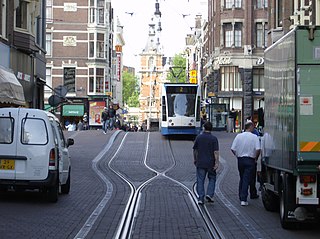
Sustainable transport refers to the broad subject of transport that is sustainable in the senses of social, environmental and climate impacts. Components for evaluating sustainability include the particular vehicles used for road, water or air transport; the source of energy; and the infrastructure used to accommodate the transport. Transport operations and logistics as well as transit-oriented development are also involved in evaluation. Transportation sustainability is largely being measured by transportation system effectiveness and efficiency as well as the environmental and climate impacts of the system.

Sustainable energy or clean energy is the practice of using energy in a way that "meets the needs of the present without compromising the ability of future generations to meet their own needs."

Waste minimisation is a set of processes and practices intended to reduce the amount of waste produced. By reducing or eliminating the generation of harmful and persistent wastes, waste minimisation supports efforts to promote a more sustainable society. Waste minimisation involves redesigning products and processes and/or changing societal patterns of consumption and production.
Sustainable cities, urban sustainability, or eco-city is a city designed with consideration for social, economic, environmental impact, and resilient habitat for existing populations, without compromising the ability of future generations to experience the same. These cities are inhabited by people whom are dedicated towards minimization of required inputs of energy, water, food, waste, output of heat, air pollution - CO
2, methane, and water pollution. Richard Register first coined the term "ecocity" in his 1987 book Ecocity Berkeley: Building Cities for a Healthy Future, where he offers innovative city planning solutions that would work anywhere. Other leading figures who envisioned the sustainable city are architect Paul F Downton, who later founded the company Ecopolis Pty Ltd, as well as authors Timothy Beatley and Steffen Lehmann, who have written extensively on the subject. The field of industrial ecology is sometimes used in planning these cities.
The Estonian Greens is an Estonian green political party. Founded in 1989, the party held six seats in the Riigikogu from 2007 to 2011. Its objective is to ensure that Estonia's development is environmentally friendly, sustainable, politically stable and economically efficient.
Procurement is the process of finding, acquiring, buying goods, services or works from an external source, often via a tendering or competitive bidding process. The process is used to ensure the buyer receives goods, services or works the best possible price, when aspects such as quality, quantity, time, and location are compared. Procurement is considered sustainable when organizations broadens this framework by meeting their needs for goods, services, works, and utilities in a way that achieves value for money and promotes positive outcomes not only for the organization itself but for the economy, environment, and society. This framework is also known as the triple bottom line.

The Ecologist Green Party, formerly known as the Ecologist Party of Moldova "Green Alliance" is a green political party in Moldova.
A low-carbon economy (LCE), low-fossil-fuel economy (LFFE), or decarbonised economy is an economy based on low carbon power sources that therefore has a minimal output of greenhouse gas (GHG) emissions into the biosphere, but specifically refers to the greenhouse gas carbon dioxide. GHG emissions due to anthropogenic (human) activity are the dominant cause of observed global warming since the mid-20th century. Continued emission of greenhouse gases may cause long-lasting changes around the world, increasing the likelihood of severe, pervasive and irreversible impacts for people and ecosystems.
Indoor air pollution in developing nations is a significant form of indoor air pollution (IAP) that is little known to those in the developed world.

Sustainability is the ability to exist constantly. In the 21st century, it refers generally to the capacity for the biosphere and human civilization to coexist. It is also defined as the process of people maintaining change in a homeostasis balanced environment, in which the exploitation of resources, the direction of investments, the orientation of technological development and institutional change are all in harmony and enhance both current and future potential to meet human needs and aspirations. For many in the field, sustainability is defined through the following interconnected domains or pillars: environment, economic and social, which according to Fritjof Capra is based on the principles of Systems Thinking. Sub-domains of sustainable development have been considered also: cultural, technological and political. According to Our Common Future, Sustainable development is defined as development that "meets the needs of the present without compromising the ability of future generations to meet their own needs." Sustainable development may be the organizing principle of sustainability, yet others may view the two terms as paradoxical.
Information and communication technologies for environmental sustainability or Green ICT as per the International Federation of Global & Green ICT "IFGICT" is a general term referring to the application of information and communication technologies (ICTs) within the field of environmental sustainability. Information and communication technologies are acting as integrating and enabling technologies for the economy and they profoundly affect our society. Recent changes in ICT use globally have damaged the environment but also have the potential to support environmental sustainability activities, such as the targets set within the Millennium Development Goal (MDG) number 7 (MDG7) to "ensure environmental sustainability".
Environmentally Sustainable design is the philosophy of designing physical objects, the built environment, and services to comply with the principles of ecological sustainability.
A sustainability organization is (1) an organized group of people that aims to advance sustainability and/or (2) those actions of organizing something sustainably. Unlike many business organizations, sustainability organizations are not limited to implementing sustainability strategies which provide them with economic and cultural benefits attained through environmental responsibility. For sustainability organizations, sustainability can also be an end in itself without further justifications.
Sustainable consumer behavior is consumers’ behaviors that improve social and environmental performance as well as meet their needs. It studies why and how consumers do or do not incorporate sustainability issues into their consumption behavior. Also, it studies what products consumers do or do not buy, how they use them and what they do with them afterwards. One mechanism to spread information about sustainable consumer behavior is word of mouth.
Life cycle thinking is an approach to becoming mindful of how everyday life affects the environment. This approach evaluates how both consuming products and engaging in activities impacts the environment but it not only evaluates them at one single step, but takes a holistic picture of an entire product or activity system.
Environmental certification is a form of environmental regulation and development where a company can voluntarily choose to comply with predefined processes or objectives set forth by the certification service. Most certification services have a logo which can be applied to products certified under their standards. This is seen as a form of corporate social responsibility allowing companies to address their obligation to minimise the harmful impacts to the environment by voluntarily following a set of externally set and measured objectives.
The Papua New Guinea Greens Party or PNG Greens are a minor political party in Papua New Guinea. Founded in 2001, the party took part in the 2002, 2007 and 2012 general elections, without winning a seat. They are a member of the Global Greens and of the Asia Pacific Greens Federation.
Sustainable Materials Management is a systemic approach to using and reusing materials more productively over their entire lifecycles. It represents a change in how a society thinks about the use of natural resources and environmental protection. By looking at a product's entire lifecycle new opportunities can be found to reduce environmental impacts, conserve resources, and reduce costs. U.S. and global consumption of materials increased rapidly during the last century. According to the Annex to the G7 Leaders’ June 8, 2015 Declaration, global raw material use rose during the 20th century at about twice the rate of population growth. For every 1 percent increase in gross domestic product, raw material use has risen by 0.4 percent. This increasing consumption has come at a cost to the environment, including habitat destruction, biodiversity loss, overly stressed fisheries and desertification. Materials management is also associated with an estimated 42 percent of total U.S. greenhouse gas emissions. Failure to find more productive and sustainable ways to extract, use and manage materials, and change the relationship between material consumption and growth, has grave implications for our economy and society.


