This article needs additional citations for verification .(April 2021) |
Nankana Sahib | |
|---|---|
| | |
| Coordinates: 31°27′0″N73°42′24″E / 31.45000°N 73.70667°E | |
| Country | |
| Province | |
| Division | Lahore |
| District | Nankana Sahib |
| Government | |
| Elevation | 187 m (614 ft) |
| Population (2023) | |
• City | 130,041 |
| District Council | 3 seats |
| Nankana Sahib | |
|---|---|
| Punjabi language | |
| Transliteration | nankāṇā sāhib |
| Shahmukhi | نَنکاݨا صَاحِب |
| Transliteration | nankāna ṣāḥib |
| IPA | [nə̃nə̆käːɳa‿s̪äː˧ɪb] |
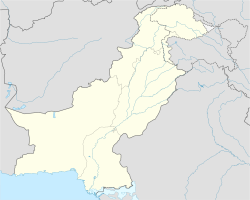
Nankana Sahib [a] is a city in the central part of Punjab, Pakistan, serving as the headquarters of its eponymous district. It is named after Guru Nanak, the founder of Sikhism, who was born and based here; with his birthplace gurdwara being a nationally 'Protected Heritage Monument' making Nankana Sahib among the holiest sites for Sikhs. [1] [2] It is located about 91 km (57 mi) west of Lahore and about 75 km (47 mi) east of Faisalabad. [3] The city had a population of 130,041 in 2023. [4]
Until 2005, it was a part of the Sheikhupura District.
Originally, the locality was founded by a Hindu ruler named Raja Vairat and was originally named Raipur but it was destroyed during the Muslim conquests in the Indian subcontinent. [5] A town on the site of the first settlement was founded during the Delhi Sultanate rule by Rai Bhoi, a Rajput of Bhati stock whose Hindu ancestor had converted to Islam under the influence of Sufism, and thus was known as Rai-Bhoi-Di-Talwandi. [5] [6] His great-grand son Rai Bular Bhatti, renamed it as 'Nankana Sahib' after the birth of Guru Nanak. The Gurdwara Nankana Sahib, originally constructed by the Sikhs during the Mughal-era in around 1600 CE was renovated in 1819–20 CE by the Sikh Maharaja Ranjit Singh. [7]
During the Akali movement, on 20 February 1921, Narain Das, the Udasi mahant (clergy) of the gurdwara at Nankana Sahib, ordered his men to fire on Akali protesters, leading to the Nankana massacre. The firing was widely condemned, and an agitation was launched until the control of this historic Janam Asthan Gurdwara was restored to the Sikhs. [8] Again in the 1930s and 1940s the Sikhs added more buildings and more architectural design.
Nankana Sahib and it surroundings were formerly a tehsil of Sheikhupura District. In May 2005, the provincial government raised the status of Nankana Sahib to a district [9] for promoting development in the area. The present District has three tehsils: Nankana Sahib, Shah Kot, and Sangla Hill. Before December 2008, District Nankana Sahib also included Safdarabad Tehsil. [10]
There are plans to construct a 100 acres (40 ha) university as well as hospitals and health care facilities by the district government with mutual interest of local communities and family of Rai Bular. [11]
In 2007, the Pakistan government announced a plan to set up a university on Sikh religion and culture at Nankana Sahib, the birthplace of Guru Nanak. Chairman of Pakistan's Evacuee Trust Property Board (ETPB), Gen (R) Zulfikar Ali Khan, said that "The international Guru Nanak University planned at Nankana Sahib would have the best architecture, curricula and research centre on Sikh religion and culture". [12]
The partition of India and Pakistan significantly changed the demographic composition of Pakistan's cities with the vast majority of Hindus and Sikhs having to leave Pakistan and vice versa for Muslims in India. [18] The 2023 Pakistani Census however showed that while still overwhelmingly Muslim at 97%, there is now a re-established Sikh community in the holy city their founder was born in. This can be attributed to the migration of the Pashtun Sikhs to the city fleeing from the Taliban insurgency in Khyber Pakhtunkhwa. [19]
Data from the 2023 census shows that the city of Nankana Sahib has a Sikh population of 1,875 out of a total population of 130,041. Nankana Sahib is the only city in Pakistan where Sikhs are the largest minority religion comprising just under 1.5% of the population. There is also a significant Christian population of 1,734 in the city making up 1.3% of the population. [20]
The city is overwhelmingly Punjabi speaking, with Punjabi speakers comprising over 96.3% of the population. 2.5% also stated Urdu as their mother tongue. [21]
The average household size in 2023 was 6.3 per household while the 2017-2023 average annual growth rate was 2.82%. [22]
Nankana Sahib is home to several educational institutions, including:
Nankana Sahib is home to several schools. A notable institution is:
Talwandi is said to have been originally built by a Hindu king, Raja Vairat. It was sacked and destroyed by fire and crowbar, like most Hindu towns and cities, during the Muslim invasions. Rai Bhullar restored Talwandi (earlier known as Raipur) and built a fort on the summit of the tumulus (ancient burial mound), in which he lived as the secure and happy ruler of a small village, some limited acres of cultivated land, and a boundless wilderness. The Bhatti clan is known to have founded the cities of Bathinda and Jaisalmer, among others. Rai Jaisal Bhatti (who lived around 1000 AD) founded Jaisalmer. One of the descendants of Rai Jaisal Bhatti came out of Jaisalmer, moved towards Punjab and settled down in Lahore. From within the same clan a gentleman named Rai Addel Bhatti (1265–1350), the grandson of Rai Jaisal Bhatti adopted the Islam faith due to the influence of Sufism, but did not leave his Hindu Rajput traditions and culture and Rai Bhoi Bhatti, one of his descendants, established Talwandi Rai Bhoi Khan Ki (today's Nankana Sahib).
Bhagat Singh was a well-read, articulate young man who significantly impacted Indian history and left behind a legacy that even 80 years after his martyrdom is still very much a part of our cultural ethos
{{cite web}}: Missing or empty |title= (help)