Prime Minister's Office (India)

Last updated

Prime Minister's Office
Pradhānamantrī Kāryālaya
PMO India Logo.svg
Prime Minister's Office
Delhi India Government.jpg
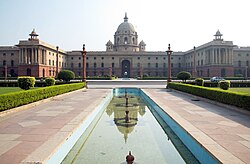
Secretariat Building, South Block
Agency overview
Formed1977;49 years ago (1977)
Jurisdiction Government of India
Headquarters Secretariat Building, New Delhi, India
Annual budget 44.13 crore (US$5.2 million) [1] (2017–18 est.) [a]
Minister responsible
Deputy Minister responsible
Agency executives
Child agencies
Website www.pmindia.gov.in

The Prime Minister's Office (PMO) consists of the immediate staff of the Prime Minister of India, as well as multiple levels of support staff reporting to the Prime Minister. The PMO is headed by the Principal Secretary to the Prime Minister of India, currently Pramod Kumar Mishra. The PMO was originally called the Prime Minister's Secretariat until 1977, when it was renamed during the premiership of Morarji Desai. It is located in the South Block of the Secretariat Building.

Contents

History

During the tenure of Jawaharlal Nehru as Prime Minister, the then Prime Minister's Secretariat was headed by a Joint Secretary to Government of India until his death. [2] The post of Principal Secretary to Prime Minister was created during the tenure of Indira Gandhi as Prime Minister. [2] The Principal Secretary to PM is the head of the Prime Minister's Office.

Function

The PMO provides secretarial assistance to the Prime Minister. It is headed by the Principal Secretary to the Prime Minister. The PMO includes the anti-corruption unit and the public wing dealing with grievances. The office houses the Prime Minister and few selected officers of Indian Civil Service who work with him to manage and coordinate government and his office. The Prime Minister through his office coordinates with all ministers in the central union cabinet, minister of independent charges and governors and ministers of state government. The PMO is located at the South Block of the Secretariat Building.

The subject-matter of files required to be submitted to the Prime Minister depends on whether he is holding direct charge of the Ministry or whether there is a Cabinet Minister or Minister of State (Independent Charge) in charge of the Ministry. In the case of the latter, most matters are dealt with by the Cabinet Minister / Minister of State-in-charge. Only important policy issues, which the Minister concerned feels should be submitted to the Prime Minister for orders or information, are received in the PMO.

In cases where the Prime Minister is the Minister-in-charge, matters requiring Ministerial approval which are not delegated to the Minister of State/Deputy Minister, if any, are submitted for orders. The Prime Minister has traditionally been the Minister-in-charge of the Ministry of Personnel, Public Grievances and Pensions and the Departments of Space and Atomic Energy.

Some of the important matters that require the Prime Minister's personal attention include the following:

  1. Important defence-related issues;
  2. Decorations, both civilian and defence, where Presidential approval is required;
  3. All important policy issues;
  4. Proposals for appointment of Indian Heads of Missions abroad and requests for grant of agreement for foreign Heads of Missions posted to India;
  5. All important decisions relating to the Cabinet Secretariat;
  6. Appointments to State Administrative Tribunals and the Central Administrative Tribunal, UPSC, Election Commission, Appointment of members of statutory/constitutional Committees, Commissions attached to various Ministries;
  7. All policy matters relating to the administration of the Indian Administrative Service and other Civil Services and administrative reforms;
  8. Special Packages announced by the Prime Minister for States are monitored in the PMO and periodical reports submitted to Prime Minister; and

Parliament Questions

Parliament Questions relating to the Ministries and Departments of which Prime Minister is the Minister-in-charge are answered by a Minister of State nominated for the purpose or by Prime Minister himself.

PM's Funds

The Prime Minister's National Relief Fund (PMNRF) and the National Defence Fund (NDF) are operated directly from the PMO. The Prime Minister's National Relief Fund was established in January 1948 as Trust, by then Prime Minister, Jawaharlal Nehru, with public contributions to assist displaced persons from Pakistan, due to partition of India. In the year 2013–2014, the Fund received donations worth 377.04 crore (equivalent to 602 croreorUS$71 million in 2023). [3]

The Office

Agencies under the Prime Minister of India. PM India org.png
Agencies under the Prime Minister of India.

The Prime Minister's Office (PMO) located in South Block, overlooking the grandeur of Rashtrapati Bhawan. Though in the 1990s I.K. Gujral and some of his predecessors, used Prime Minister's Residence (PMR) spread over a 10-acre complex as office. [4]

Current officials in the PMO

OfficialDesignationRank
Pramod Kumar Mishra, IAS Principal Secretary to the Prime Minister of India Cabinet Minister
Shaktikanta Das, IAS Principal Secretary to the Prime Minister of India Cabinet Minister
Ajit Kumar Doval, IPS, KC National Security Adviser Cabinet Minister
Tarun Kapoor, IAS Advisor to the Prime Minister Secretary to the Government of India
Atish Chandra, IAS Special Secretary, PMO Secretary to the Government of India
Ashish Vachhani, IAS Additional Secretary, PMOAdditional Secretary to the Government of India
M. S. Srikar, IAS Additional Secretary, PMOAdditional Secretary to the Government of India
Amit Singh Negi, IAS Additional Secretary, PMOAdditional Secretary to the Government of India
Subhasish Panda, IAS Additional Secretary, PMOAdditional Secretary to the Government of India
Yadav Manharsinh Laxmanbhai, IFS Joint Secretary, PMOJoint Secretary to the Government of India
C. Sridhar, IAS Joint Secretary, PMOJoint Secretary to the Government of India
Saurabh Shukla, IA&AS Joint Secretary, PMOJoint Secretary to the Government of India
Nidhi Tewari, IFS Private Secretary to the Prime Minister Joint Secretary to Government of India
Vivek Kumar, IFS Private Secretary to the Prime Minister Joint Secretary to Government of India
Hardik Shah, IAS Private Secretary to the Prime Minister Joint Secretary to Government of India

Organisation

Department of Atomic Energy (DAE)

SectorAgency / InstitutionLocation
Regulatory Boards Atomic Energy Commission (AEC) Mumbai
Atomic Energy Regulatory Board (AERB) Mumbai
Board of Radiation and Isotope Technology (BRIT) Mumbai
Research & Development Bhabha Atomic Research Centre (BARC) Mumbai
Atomic Minerals Directorate for Exploration and Research (AMD) Hyderabad
Indira Gandhi Centre for Atomic Research (IGCAR) Kalpakkam, Tamil Nadu
Raja Ramanna Centre for Advanced Technology Indore
Variable Energy Cyclotron Centre (VECC) Kolkata
Global Centre for Nuclear Energy Partnership (GCNEP) Bahadurgarh, Haryana
Aided Sector Atomic Energy Education Society (AEES) Mumbai
Tata Institute of Fundamental Research Mumbai
Tata Institute of Fundamental Research, Hyderabad Hyderabad
Tata Memorial Centre Mumbai
Center for Excellence in Basic Sciences Mumbai
Saha Institute of Nuclear Physics (SINP) Kolkata
Institute of Physics Bhubaneswar
Harish-Chandra Research Institute (HRI) Allahabad
Institute of Mathematical Sciences (IMSc) Chennai
Institute for Plasma Research Gandhinagar
National Institute of Science Education and Research Bhubaneswar
Public Sector Electronics Corporation of India (ECIL) Hyderabad
Indian Rare Earths Limited (IREL) Mumbai
Nuclear Power Corporation of India (NPCIL) Mumbai
Bharatiya Nabhikiya Vidyut Nigam Limited (BHAVINI) Kalpakkam, Tamil Nadu
Uranium Corporation of India (UCIL) Singhbhum
Industry & Mining Nuclear Fuel Complex (NFC) Hyderabad
Heavy Water Board (HWB) Hyderabad

Department of Space

SectorAgency / InstitutionLocation
Primary Organisation Indian Space Research Organisation (ISRO) Bengaluru
ISRO Centres / Units Vikram Sarabhai Space Centre (VSSC) Thiruvananthapuram
Liquid Propulsion Systems Centre (LPSC) Thiruvananthapuram
Satish Dhawan Space Centre (SDSC-SHAR) Sriharikota
U R Rao Satellite Centre (URSC) Bengaluru
Space Applications Centre (SAC) Ahmedabad
National Remote Sensing Centre (NRSC) Hyderabad
Human Space Flight Centre (HSFC) Bengaluru
ISRO Propulsion Complex (IPRC) Mahendragiri
ISRO Inertial Systems Unit (IISU) Thiruvananthapuram
Indian Institute of Remote Sensing (IIRS) Dehradun
Master Control Facility (MCF) Hassan
ISRO Telemetry, Tracking and Command Network (ISTRAC) Bengaluru
Laboratory for Electro-Optics Systems (LEOS) Bengaluru
Development and Educational Communication Unit (DECU) Ahmedabad
Public Sector / Commercial Arms Antrix Corporation Bengaluru
NewSpace India Limited (NSIL) Bengaluru
Autonomous Institutions Physical Research Laboratory (PRL) Ahmedabad
National Atmospheric Research Laboratory (NARL) Tirupati
North-Eastern Space Applications Centre (NE-SAC)Umiam, Meghalaya
Indian Institute of Space Science and Technology (IIST) Thiruvananthapuram

[5]

Project Monitoring Group

In June 2013, a cell within the Cabinet Secretariat called the Project Monitoring Group was created to track stalled investment projects, both in the public and private sectors and to remove the implementation bottlenecks in these projects on a fast-track basis. [6] An online portal open to the public was created where projects worth over 1,000 crore (US$120 million) were to be tracked. [6]

The Project Monitoring Group was moved to the Prime Minister's Office in 2014. [7] [8]

Notes

  1. Budgets of child agencies like Department of Atomic Energy (DAE), Department of Space (DoS), Performance Management Division (PMD) and National Security Council are not included.

References

  1. "Ministry of Home Affairs - Cabinet Secretariat" (PDF). Ministry of Finance, Government of India . Archived from the original (PDF) on 19 January 2018. Retrieved 18 January 2018.
  2. 1 2 Handbook Of Public Relations in India. Allied Publishers. 1968. ISBN   9788170233343.
  3. PM National Relief Fund PMO.
  4. Prabhu Chawla (8 September 1997). "Race Course Road: PMO Shifts to PMR". India Today. Archived from the original on 24 September 2015. Retrieved 17 September 2014.
  5. "DoS structure". Department of Space, Government of India. Archived from the original on 27 September 2014. Retrieved 22 September 2014.
  6. 1 2 "Prime Minister sets up a Project Monitoring Group to Track Large Investment Projects". Press Information Bureau of India . 13 June 2013. Retrieved 18 January 2018.
  7. Makkar, Sahil (28 December 2014). "Monitoring group under PMO to push 225 pending big-ticket projects worth Rs 13 lakh cr". Business Standard . New Delhi . Retrieved 18 January 2018.
  8. Nair, Rupam Jain; Das, Krishna N. (18 December 2014). Chalmers, John; Birsel, Robert (eds.). "India's Modi moves in to speed up $300 billion stuck projects". Reuters . New Delhi. Archived from the original on 18 January 2018. Retrieved 18 January 2018.