| Part of a series on the |
| Culture of Benin |
|---|
| |
| People |
| Languages |
| Mythology |
| Cuisine |
| Religion |
| Art |
| Literature |
| Music |
| Sport |
Beninese cuisine involves many fresh meals served with a variety of sauces. Meat is usually quite expensive, and meals are generally light on meat and generous on vegetable fat.
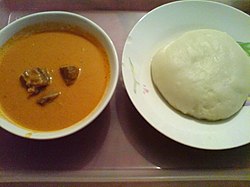
In southern Benin cuisine, the most common ingredient is corn, often used to prepare dough which is mainly served with peanut- or tomato-based sauces. Fish and chicken are the most common meats used in southern Beninese cuisine, but beef, pork, goat and bush rat are also consumed. Meats are often fried in palm or peanut oil. Rice, beans, tomatoes and couscous are also significant staple foods. Fruits are common in this region, including mangoes, mandarin oranges, oranges, bananas, kiwifruit, avocados, pineapples and peanuts.
Yams are the main staple in northern Benin, and are also often served with peanut- or tomato-based sauces. The population in the northern provinces uses beef and pork meat which is also fried in palm or peanut oil or cooked in sauces. Cheese is also frequently used in some dishes.
Before colonialism, the region now known as Benin was home to various kingdoms and ethnic groups, including the Fon, Yoruba, Adja and other West African communities. Their diets were primarily based on locally grown crops, with dishes shaped by the availability of ingredients.
During the late 19th century, Dahomey became a French colony. Colonial rule, which lasted until 1960, had a significant impact on the country's culinary landscape, introducing European ingredients, cooking styles, and food preservation techniques.
After gaining independence in 1960, the Republic of Dahomey began to assert its cultural identity, reflecting its cuisine. The continued use of traditional cooking methods alongside the incorporation of international ingredients and techniques marked the evolution of Beninese cuisine.
As Benin is a multiethnic country with various groups like the Fon, Yoruba and Bariba, the cuisine of Benin varies greatly depending on the region. In the south, palm oil and cassava-based dishes are predominant, while in the north, millet and maize are more common.
Frying in palm or peanut oil is the most common meat preparation, and smoked fish is also commonly prepared in Benin. Grinders are used to prepare corn flour, which is made into a dough and served with sauces. "Chicken on the spit" is a traditional recipe in which chicken is roasted over fire on wooden sticks. Palm roots are sometimes tenderized by soaking in a jar with saltwater and sliced garlic, then used in various dishes.[ citation needed ]
Many people have mud stoves for cooking and also mud pots which are used to preserve the meal, and mud pots are used to store water; these pots are usually kept outside the home.[ citation needed ]
Wagasi is a specialty cows'-milk cheese of northern Benin made by the Fulani people, and is abundantly available in cities such as Parakou. [1] It is a soft cheese with a mild flavor and a red rind, and used often in Beninese cooking.
Àkàrà is a dish made from peeled black-eyed peas formed into a ball and then deep-fried in red palm oil. It is found in most parts of Benin, Nigeria and Ghana.
Other Beninese dishes include: [1]
Choukoutou or "chouk" is a Beninese millet beer [1] commonly consumed in northern Benin, and shipped to southern Benin by railway and roadways. Sodabi is a liquor made from wine palm, and often consumed at events and ceremonies. [1]