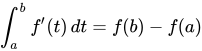
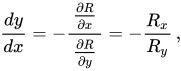
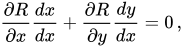
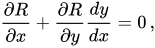
In calculus, implicit differentiation is a method of finding the derivative of an implicit function using the chain rule. To differentiate an implicit function y(x), defined by an equation R(x, y) = 0, it is not generally possible to solve it explicitly for y and then differentiate it. Instead, one can totally differentiateR(x, y) = 0 with respect to x and y and then solve the resulting linear equation for dy/dx, to get the derivative explicitly in terms of x and y. Even when it is possible to explicitly solve the original equation, the formula resulting from total differentiation is, in general, much simpler and easier to use.
which, when solved for dy/dx, gives the expression above.
Examples
Example 1
Consider
This equation is easy to solve for y, giving
where the right side is the explicit form of the function y(x). Differentiation then gives dy/dx = −1.
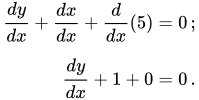
Alternatively, one can totally differentiate the original equation:
Solving for dy/dx gives
the same answer as obtained previously.
Example 2
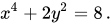
An example of an implicit function for which implicit differentiation is easier than using explicit differentiation is the function y(x) defined by the equation
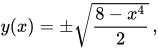
To differentiate this explicitly with respect to x, one has first to get
and then differentiate this function. This creates two derivatives: one for y ≥ 0 and another for y < 0.
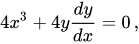
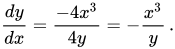
It is substantially easier to implicitly differentiate the original equation:
giving
Example 3
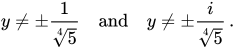
Often, it is difficult or impossible to solve explicitly for y, and implicit differentiation is the only feasible method of differentiation. An example is the equation
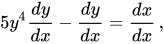
It is impossible to algebraically expressy explicitly as a function of x, and therefore one cannot find dy/dx by explicit differentiation. Using the implicit method, dy/dx can be obtained by differentiating the equation to obtain
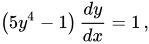
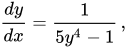
where dx/dx = 1. Factoring out dy/dx shows that
This page is based on this Wikipedia article Text is available under the CC BY-SA 4.0 license; additional terms may apply. Images, videos and audio are available under their respective licenses.