Ca' de Sass in Milan, head office of Intesa SanpaoloUniCredit Tower (center), head office in MilanBanco BPM head office, MilanBPER group services center, ModenaMonte dei Paschi head office, SienaBanca Nazionale del Lavoro head office, Rome
The following list of banks in Italy is to be understood within the framework of the European single market and European banking union, which means that Italy's banking system is more open to cross-border banking operations than peers outside of the EU.
European banking supervision distinguishes between significant institutions (SIs) and less significant institutions (LSIs), with SI/LSI designations updated regularly by the European Central Bank (ECB). Significant institutions are directly supervised by the ECB using joint supervisory teams that involve the national competent authorities (NCAs) of individual participating countries. Less significant institutions are supervised by the relevant NCA on a day-to-day basis, under the supervisory oversight of the ECB.[1] In Italy's case, the NCA is the Bank of Italy.[2]
Significant institutions
As of 1 September 2025, the ECB had the following 12 banking groups based in Italy in its list of significant institutions.[3]
A study published in 2024 assessed that the bank with by far most aggregate assets in Italy (as opposed to total consolidated assets) as of end-2023 was Intesa Sanpaolo at €869 billion, followed by UniCredit (€274 billion), Banco BPM (€202 billion), the Iccrea Group (€175 billion), Crédit Agricole (€160 billion, via Crédit Agricole Italia), BPER (€142 billion), Monte dei Paschi di Siena (€122 billion), BNP Paribas (€103 billion, via Banca Nazionale del Lavoro), the Cassa Centrale group (€90 billion), Mediobanca (€84 billion), Banca Mediolanum (€78 billion), and Credito Emiliano (€68 billion).[4] Italy is also home to subsidiaries of three other euro-area significant institutions, namely Deutsche Bank (via Deutsche Bank SpA), Santander, and Société Générale.[3]
Less significant institutions
As of 1 September 2025, the ECB's list of supervised institutions included 142 Italian LSIs.[3]
High-impact LSIs
Of these, six were designated by the ECB as "high-impact" on the basis of several criteria including size:
39 Italian LSIs, all bearing the name Cassa Raiffeisen, were bound together with the Cassa Centrale Raiffeisen dell'Alto Adige (also known as Raiffeisen Landesbank Südtirol) into the institutional protection scheme (IPS) of the South Tyrolean Raiffeisen Group, one of six IPSs in the euro area.[5]:12
Other Italian LSIs
The other 91 domestic Italian LSIs on the ECB list were:
AideXa Holding SpA
Banca AideXa SpA
Allianz Bank Financial Advisors SpA, subsiidary of Allianz
As of 13 October 2025, the following banks established outside the European Economic Area had branches in Italy ("third-country branches" in EU parlance):[7]
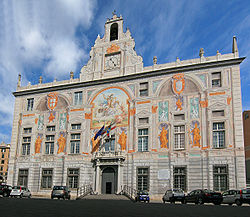
Palazzo San Giorgio in GenoaRialto Square in Venice, former seat of Banco della Piazza di Rialto and of Banco del GiroFormer seat of the Monte di Pietà di VicenzaPalazzo Donghi Ponti in Padua, former seat of Cassa di RisparmioPalazzo Maffei Marescotti in Rome, former seat of Banca RomanaPalazzo della Borsa in Florence, former seat of Banca Nazionale ToscanaFormer temporary seat of the National Bank of the Kingdom of Italy in Florence
Numerous former Italian banks, defined as having been headquartered in the present-day territory of Italy, are documented on Wikipedia in English. They are listed below in chronological order of establishment, divided into two categories depending on whether or not they qualified at some point as early central banks and/or banks of issue.[9] In mainstream narratives of the history of banking, Italy is widely viewed as the birthplace of modern European financial practices during the High Middle Ages and Renaissance, first in the form of family banks and later through municipal public banks known as mount of piety. Moreover, many local savings banks were established in the second and third quarters of the 19th century and, unlike in most other European countries, did not consolidate into a single national network.
This page is based on this Wikipedia article Text is available under the CC BY-SA 4.0 license; additional terms may apply. Images, videos and audio are available under their respective licenses.