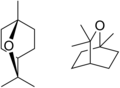
A fragrance compound (or fragrance) is a chemical compound with a pleasant odor. Fragrances affect only the sense of smell, whereas flavors can affect both the sense of taste and smell. Fragrances are often mixtures of individual fragrance compounds. Although many fragrances are derived from natural sources, many are synthetic. Fragrances are widely used in cosmetics and are the basis for a large industry.[2]
Stench compounds have unpleasant odors. Some are used as odorizer or an odorant usually have an intense odor, which may be pleasant or not. They are sometimes used to confer a detectable odor to an odorless substance, like propane, natural gas, or hydrogen, as a safety measure.[3]
Occurrence
For an individual chemical or class of chemical compounds to impart a smell or fragrance, it must be sufficiently volatile for transmission via the air to the olfactory system in the upper part of the nose. Generally, fragrance compounds have molecular weights of less than 310.[4]
Fragrance compounds are found in various foods, such as fruits and their peels, wine, spices, floral scent, perfumes, fragrance oils, and essential oils. For example, many form during the ripening of fruits and other crops.[5] Wines have more than 100 aromas that form as byproducts of fermentation.[6] Also, many of the aroma compounds play a significant role in the production of compounds used in the food service industry to flavor, improve, and generally increase the appeal of their products.[2]
History, biochemistry, economics
Fragrance bottles
The technology of fragrances came with the invention of distillation, which allowed to be concentrated and sometimes even separated into individual components. The purification of cinnamaldehyde, the first single component fragrance, marked the beginning of the fragrance and flavor industries. Other single component fragrance compounds that were purified in the 19th century include benzaldehyde, methyl salicylate (oil of wintergreen), and vanillin. Somewhat in step with the synthetic dye industry, the fragrance and flavor industry was established. Many fragrance compounds were prepared synthetically. Spectroscopic methods coupled with various separation techniques allowed the identification of traces of aroma compounds (e.g. in wines, flower extracts, etc).[2] Another relevant invention is gas chromatography, especially when coupled to detection by humans, i.e. gas chromatography-olfactometry. Techniques were also developed to characterize and synthesize individual enantiomers of chiral aromatic compounds. [7]
Animals, by the process of olfaction, detect aromas using olfactory receptors located on the surface of the olfactory epithelium in the nasal cavity.[5] Of commercial importance, aroma compounds are identified by gas chromatography, sometimes coupled to olfactometry, which involves a human operator sniffing the GC effluent.[8] Studies on cyclopentadecanone ("musk-ketone") reveal that the odors of some compounds are noticeably affected by deuteration.[9]
Fragrance compounds classified by chemical structure
In 2010, the International Fragrance Association published a list of 3,059 chemicals used in 2011 based on a voluntary survey of its members, identifying about 90% of the world's production volume of fragrances.[11][12]
Fragrances are detected by the nose when the movement of inspired air contacts olfactory sensory neurons, which in humans, number between 6 and 10 million over a surface area of 2.5cm2 (0.39sqin) of olfactory epithelium.[14] Fragrance signals are conveyed from the epithelium to the olfactory nerves, and then to the olfactory bulbs, which relay neural impulses about fragrance properties into the primary olfactory cortex of the brain.[14] In the olfactory cortex, fragrance characteristics are integrated to evaluate the safety and appeal of compounds to be ingested, and to recognize environmental and social factors associated by memory with the fragrance.[14][15]
In 2005–06, fragrance mix was the third-most-prevalent allergen in patch tests (11.5%).[16] 'Fragrance' was voted Allergen of the Year in 2007 by the American Contact Dermatitis Society. An academic study in the United States published in 2016 has shown that "34.7% of the population reported health problems, such as migraine headaches and respiratory difficulties, when exposed to fragranced products".[17]
The composition of fragrances is usually not disclosed in the label of the products, hiding the actual chemicals of the formula, which raises concerns among some consumers.[18] In the United States, this is because the law regulating cosmetics protects trade secrets.[19]
In the United States, fragrances are regulated by the Food and Drug Administration if present in cosmetics or drugs, by the Consumer Product Safety Commission if present in consumer products.[19] No pre-market approval is required, except for drugs. Fragrances are also generally regulated by the Toxic Substances Control Act of 1976 that "grandfathered" existing chemicals without further review or testing and put the burden of proof that a new substance is not safe on the EPA. The EPA, however, does not conduct independent safety testing but relies on data provided by the manufacturer.[20]
A 2019 study of the top-selling skin moisturizers found 45% of those marketed as "fragrance-free" contained fragrance.[21]
↑Buettner A.; Schieberle P. (1999). "Characterization of the Most Odor-Active Volatiles in Fresh, Hand-Squeezed Juice of Grapefruit (Citrus paradisi Macfayden)". J. Agric. Food Chem. 47 (12): 5189–5193. doi:10.1021/jf990071l. PMID10606593.
↑Lehmann D.; Dietrich A.; Hener U.; Mosandl A. (1994). "Stereoisomeric flavor compounds. LXX: 1-p-menthene-8-thiol: separation and sensory evaluation of the enantiomers by enantioselective gas chromatography-olfactometry". Phytochemical Analysis. 6 (5): 255–257. doi:10.1002/pca.2800060506.
↑Branigan B, Tadi P (May 1, 2023). "Physiology, Olfactory". StatPearls, US National Library of Medicine. Retrieved December 31, 2025.
↑Zug, Kathryn A.; Warshaw, Erin M.; Fowler, Joseph F.; etal. (2009). "Patch-test results of the North American Contact Dermatitis Group 2005-2006". Dermatitis: Contact, Atopic, Occupational, Drug. 20 (3): 149–160. doi:10.2310/6620.2009.08097. ISSN2162-5220. PMID19470301.
This page is based on this Wikipedia article Text is available under the CC BY-SA 4.0 license; additional terms may apply. Images, videos and audio are available under their respective licenses.