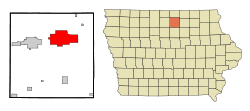
Mason City is a city in and the county seat of Cerro Gordo County, Iowa, United States.[3] The population was 27,338 in the 2020 census.[4] Mason City is known for its musical and masonry heritage, as well as being home to a significant collection of Prairie School style architecture. The city forms a regional hub for north-central Iowa with nearby Clear Lake.
Surrounded by the expansive and flat prairies of north-central Iowa, the land upon which Mason City now sits was previously a dense grove of trees situated between Lime Creek (now the Winnebago River) and Willow Creek. In the years immediately preceding the east-to-west expansion of the United States, this land was inhabited by the people of the Ho-Chunk, Meskwaki, and DakotaNative American tribes. [6] The first White settlers arrived in the area in 1853, and they were John Long and John Bilford, who hailed from LaSalle, Illinois. Long was a member of a Free Masonic Order, and they initially named the dense wood thicket as Masonic Grove. The next year, in 1854, more settlers involved in Free Masonic groups arrived, and platted a town, first known as Shibboleth and Masonville. In 1854, John McMillin opened the first store, and Dr. Silas Card opened the first medical practice in the area. Furthermore, the name was changed in 1855 to differentiate from another Masonville in Iowa. Coincidentally, the present-name of Mason City was adopted by the town in 1855, as proposed by John Long to honor his son, Mason Long.[7][8]
Until 1855, Mason City was without local county government, and Cerro Gordo County (named for the Battle of Cerro Gordo during the contemporaneous Mexican–American War) was attached to the Floyd County government and commission. In August 1855, Cerro Gordo County citizens voted to organize their county government, and three commissionors were appointed to decide on the county-seat. The commission had selected Mason City as its preferred county seat. However, in December 1856, the Iowa General Assembly voted to relocate the seat of government closer to Clear Lake, then known as Livonia. In April 1858, county citizens voted against relocating the seat back to Mason City, where it has remained ever since.
Early Growth: 1850-1900
The United States Post Office Department started service to the town in 1857.[9] In 1870, Mason City, Iowa was officially incorporated as a town with Darius B. Mason as the first mayor.[5] Industry first reached Mason City in 1866, when the Mason City & Fort Dodge Railroad was completed, opening transportation corridors and allowing for further municipal growth. Historically, the largest industry in the city was brick and tile manufacturing, limestone quarrying, and cement production. The land in the vicinity of Mason City, is rich in clay and limestone deposits that allowed the growth of a large masonry-based industry.[10] Much of the success of the Mason City Brick and Tile industry was achieved under the leadership of O.T. Denison, who was a proprietor in three of the many of the brick yards, including the largest, the Mason City Brick and Tile Works. Under his direction, the company came to own most of the brick works in town, the North Iowa Brick and Tile Works being an exception. Until about 1934, Iowa used more drain tile than any other area of equal size in the world, and Mason City was the center of this manufacturing.[11]
Stratified clays in clay pit located in Mason City, IA. Circa 1895.
Downtown Mason City, IA. Circa 1883.
Clay Pit of the Mason City Brick-and-Tile Co. Circa 1890.
In 1903, Mason City was described as, "a thriving city of industry which distributes its products over a vast area of rich territory. It has a population of about 12,000 and it is conveniently situated on the Chicago & Northwestern, the Chicago Great Western, and the Chicago, Milwaukee & St. Paul railroads, and also served by the Iowa Central. It has a good street railway service which extends as far as Clear Lake and makes the city in summer time a fashionable holiday resort. Its industries are varied, it has foundry and machine shops, large sash and door factories, planing mills, stone quarries, lime kilns and three extensive brick and tile yards. Its educational facilities are good and it has very fine public buildings such as the Military College and the Memorial University. It is, however, with the clay industries of the city that we are interested." [12]
Era of Sustained Growth: 1900-1970
At the turn of the 20th century, in 1907, renowned architect Frank Lloyd Wright visited Mason City to complete design work for a prominent businessman. Mason City was fortunate to have Wright and several of his associates, including Walter Burley Griffin, Marion Mahony Griffin, and Barry Byrne, leave behind several notable examples of their distinctive prairie school architectural style. Among Wright's contributions to the community are the first Prairie School-designed home in Iowa, the Frank Lloyd WrightStockman House constructed in 1908; the Park Inn Hotel, the sole surviving hotel designed by Wright, built in 1910; and the City National Bank building, completed concurrently with the hotel. Also, the First National Bank was robbed by John Dillinger and his gang on March 13, 1934. They escaped with $52,000 despite the fact the bank actually had more than $300,000 on hand that day. Furthermore, the Rock Crest and Rock Glen area witnessed the development of the largest collection of Prairie School-style designed homes on a unified site.[8][13]
Mason City Postcard, 1950.
In 1954 a new breed of horse was introduced in Mason City. The Pony of the Americas (POA) grew to be one of the most popular breeds of horses in the country. Gentle and easy to train the POAs were especially suited for young people. This special breed of horse can be seen along with a variety of horses at the many equine events held at the North Iowa Events Center in Mason City throughout the year. In the 1950s and 1960s, the addition of the sugar beet industry and the pork packing industry helped Mason City to become the largest urban center between Des Moines and Minneapolis/St. Paul at the time.[14][8]
Modern Era: 1970-Present Day
During the 1970s, the originally dominant brick and tile industry began to decline, prompting Mason City to diversify its economy. Further challenges emerged in the 1980s with the Farm Crisis, which severely impacted the Upper Midwest agricultural economy and the economic prospects of nearby farms. This led to a state-wide downturn and migration out of the area. Since the 1990s, Mason City has revitalized its downtown area, constructed the Southbridge Mall, a hockey arena, and developed a robust retail economy as a regional hub. [15] In 1995, Mason City was also the site of a national investigation, following the disappearance of KIMT reporter and news-anchor, Jodi Huisentruit. [16] Since the turn of the 21st century, Mason City has experienced steady community development, and has completed a revitalization of its previously dilapidated but architecturally significant Park Inn Hotel and First National Bank.[17]
Geography
According to the United States Census Bureau, the city has a total area of 28.10 square miles (72.78km2), of which 27.81 square miles (72.03km2) is land and 0.29 square miles (0.75km2) is water.[18][19]
As of the census of 2020,[23] there were 27,338 people, 12,271 households, and 6,838 families residing in the city. The population density was 981.4 inhabitants per square mile (378.9/km2). There were 13,584 housing units at an average density of 487.7 per square mile (188.3/km2). The racial makeup of the city was 87.0% White, 2.9% Black or African American, 0.5% Native American, 1.5% Asian, 0.5% Pacific Islander, 1.9% from other races and 5.7% from two or more races. Hispanic or Latino of any race comprised 6.7% of the population.
Of the 12,271 households, 23.3% of which had children under the age of 18 living with them, 40.1% were married couples living together, 8.0% were cohabitating couples, 30.6% had a female householder with no spouse or partner present and 21.3% had a male householder with no spouse or partner present. 44.3% of all households were non-families. 37.5% of all household were made up of individuals, 16.3% had someone living alone who was 65 years old or older.
The median age in the city was 42.7 years. 22.6% of the residents were under the age of 20; 6.3% were between the ages of 20 and 24; 23.6% were from 25 and 44; 25.3% were from 45 and 64; and 22.2% were 65 years of age or older. The gender makeup of the city was 48.3% male and 51.7% female.
2010 census
As of the census[24] of 2010, there were 28,079 people, 12,366 households, and 7,210 families living in the city. The population density was 1,009.7 inhabitants per square mile (389.8/km2). There were 13,352 housing units at an average density of 480.1 unitsper square mile (185.4 units/km2). The racial makeup of the city was 93.8% White, 1.8% African American, 0.3% Native American, 0.9% Asian, 1.3% from other races, and 1.9% from two or more races. Hispanic or Latino of any race were 5.1% of the population.
There were 12,366 households, of which 26.8% had children under the age of 18 living with them, 43.2% were married couples living together, 10.8% had a female householder with no husband present, 4.3% had a male householder with no wife present, and 41.7% were non-families. Of all households, 35.0% were made up of individuals, and 13.4% had someone living alone who was 65 years of age or older. The average household size was 2.20 and the average family size was 2.83.
The median age in the city was 40.9 years. 21.9% of residents were under the age of 18; 9.7% were between the ages of 18 and 24; 23.1% were from 25 to 44; 28.2% were from 45 to 64, and 17.1% were 65 years of age or older. The gender makeup of the city was 48.2% male and 51.8% female.
2000 census
As of the census[25] of 2000, there were 29,172 people, 12,368 households, and 7,507 families living in the city. The population density was 1,131.3 inhabitants per square mile (436.8/km2). There were 13,029 housing units at an average density of 505.3 unitsper square mile (195.1 units/km2). The racial makeup of the city was 95.40% White, 1.17% African American, 0.18% Native American, 0.77% Asian, 0.01% Pacific Islander, 1.07% from other races, and 1.40% from two or more races. Hispanic or Latino of any race were 3.45% of the population.
There were 12,368 households, out of which 28.4% had children under the age of 18 living with them, 47.4% were married couples living together, 10.3% had a female householder with no husband present, and 39.3% were non-families. Of all households, 33.5% were made up of individuals, and 14.6% had someone living alone who was 65 years of age or older. The average household size was 2.27 and the average family size was 2.90.
In the city the population was spread out, with 23.6% under the age of 18, 10.2% from 18 to 24, 26.7% from 25 to 44, 21.7% from 45 to 64, and 17.9% who were 65 years of age or older. The median age was 38 years. For every 100 females, there were 90.0 males. For every 100 females age 18 and over, there were 85.8 males.
The median income for a household in the city was $33,852, and the median income for a family was $45,160. Males had a median income of $32,451 versus $21,756 for females. The per capita income for the city was $18,899. About 7.2% of families and 10.0% of the population were below the poverty line, including 10.9% of those under age 18 and 10.1% of those age 65 or over.
The largest employer is MercyOne North Iowa Medical Center, formerly known as Mercy Medical Center-North Iowa, and before that as St. Joseph Mercy Hospital, is the region's largest hospital. The facility serves 14 counties across northern Iowa. In June 2019, the hospital opened a new $10.6 million behavioral center. The new center will help MercyOne to increase the number of behavioral health-care services it can offer to those in the community it serves who are struggling with mental illness and substance abuse issues.[26]
In March 2016, North Carolina–based company Prestage Farms proposed to build a $240 million pork processing plant or slaughterhouse in Mason City,[29] employing about 1,800 people. In May, the Mason City Council cast a tie vote rejecting the proposed project.[30] Plant opponents raised environmental issues and expressed concern about possible harm to property values.[31]
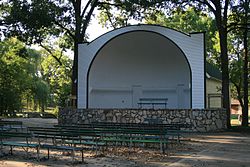
The city's "favorite son," Meredith Willson, grew up in Mason City and played in the Mason City Symphonic Band as a high school student. Willson's crowning achievement was the famous stage musical The Music Man. Many of the characters in it were based on people Willson knew from his childhood in Mason City.[33] Mason City also features the Parker's Opera House and the region's largest theater, the North Iowa Auditorium, situated on the campus of North Iowa Area Community College. In 1934, both the band and orchestra of Mason City High School were the state champions in both categories.
Music Man Square is located near downtown and features multiple exhibits related to Meredith Willson and The Music Man, including Willson's boyhood home, the Meredith Willson Museum, and a replica streetscape from the musical.[34]
Events and festivals
In late May or early June Mason City holds an annual celebration of its musical heritage called The North Iowa Band Festival. School bands from across the Midwest compete during the parade to be named the best band. The home bands, Mason City High School and Newman Catholic High School Marching Bands, do not compete but do perform in the parade.[35] Meredith Willson returned to participate in the festival many times.
Landmarks
Mason City is widely known for its collection of Prairie School architecture. The Rock Crest-Rock Glen Historic District is the largest concentration of any city in Iowa. At least 32 houses and one commercial building were built in the Prairie Style between 1908 and 1922, 17 of which are listed on the National Register of Historic Places and eight more are contributing properties to a historic district.[36][37]
Both the Park Inn Hotel and Stockman House suffered from neglect and unsympathetic alterations before they were saved by community organizations. In 1989, the Stockman House was moved four blocks to prevent its demolition; it was subsequently restored and opened to the public by the River City Society for Historic Preservation.[39] Likewise, Wright on the Park, Inc. began restoration on the Park Inn Hotel in 2005 and the former City National Bank building in 2007. The organization reopened both buildings as a boutique hotel in August 2011.[40][41] The Park Inn Hotel is last remaining of the few hotels that Wright completed during his career and is considered a prototype for Wright's Imperial Hotel.[42]
The Rock Glen and Rock Crest National Historic district is a small enclave of single-family homes situated along the banks of Willow Creek five blocks east of downtown. It is the largest collection of prairie-style homes in a natural setting in the world. It features both Prairie School and Usonian design. Five of these houses were designed by Walter Burley Griffin and Marion Mahony Griffin, two by Francis Barry Byrne, and others by William Drummond, Einar Broaten, and Curtis Besinger. [43][44]
The Len Jus Building on North Federal Avenue has an extremely rare sheet-metal facade, it had been placed on the Iowa Historic Preservation Alliance's Most Endangered list because of its poor repair and indifferent ownership,[46][47] but is now being rehabilitated by the new owner.
Public Art
Since 2014, Mason City has hosted River City Sculptures on Parade, an annual public art walk featuring rotating artists.[48] Each year, the city purchases the most-popular rotating sculpture to add to the permanent collection.[49]
Sports
Mason City has some history of minor league and amateur sports teams despite its relatively small size.
College Football Hall of Fame coach Barry Alvarez led Mason City High School to the 1978 Class 4A state football championship with a 15–13 victory over Dubuque Hempstead.
River City Rugby Football Club was established in Mason City in 1972. The club competes in two separate two-month seasons, April and May, and September and October. The club celebrated its 40th anniversary in June 2012. Over 250 players have played for the club since it first began. The club competes against teams from Iowa, Minnesota, and Nebraska in the Midwest Division 3.
Education
Primary and secondary schools
Mason City Community School District operates the following schools: Harding Elementary School, Hoover Elementary School, Jefferson Elementary School, Roosevelt Elementary School, Lincoln Intermediate School (5–6), John Adams Junior High School (7–8), Mason City High School, (9–12), Mason City Alternative High School, Madison Early Childhood Center. Past schools include Lincoln, Washington, Grant, Central Heights, Central, McKinley, Wilson, Jackson, Monroe and Garfield elementary schools, and Monroe and Roosevelt junior high schools.
Newman Catholic Elementary/Middle School, Newman Catholic High School, and North Iowa Christian School. Mason City is also the home of the Worldwide College of Auctioning founded in 1933 by the well-known auctioneer Col. Joe Reisch and subsequently owned/operated for many years by Col. Gordon E. Taylor.
Mason City served as the inspiration for the fictional town of River City, Iowa, in The Music Man, a musical that was composed and written by Mason City native son Meredith Willson (although the 1962 film, which had its world premiere in Mason City, was shot entirely at Warner Bros. Studios in Burbank, California).[53]
Television
Mason City is paired with Rochester, MN and Austin, MN to form a media market than spans five Southern Minnesota counties, and seven in Northern Iowa.[54]
Mason City is home to the Iowa Traction Railway. The IATR is one of the last surviving electric interurban railroads in the U. S., and the only one that still uses electric locomotives to haul freight in regular service.
While the Iowa Northern Railway does not operate in the city of Mason City, it does serve other communities in the Mason City micropolitan statistical area. The Iowa Northern has facilities in Manly, Iowa.
Airports
The city also hosts Mason City Municipal Airport, (MCW) with commercial service by United Airlines. It is the airport from which early rock and roll stars Buddy Holly, Ritchie Valens and The Big Bopper (J.P. Richardson) took off on the night of February 3, 1959, after a concert at the Surf Ballroom in nearby Clear Lake, Iowa, en route to Fargo, N.D. The plane crashed a few miles west of the airport in an historic event later referred to as the Day the Music Died. Holly, Valens, Richardson and pilot Roger Peterson all died in the accident.
↑"Station: Mason City Muni AP, IA". U.S. Climate Normals 2020: U.S. Monthly Climate Normals (1991–2020). National Oceanic and Atmospheric Administration. Retrieved June 27, 2021.
This page is based on this Wikipedia article Text is available under the CC BY-SA 4.0 license; additional terms may apply. Images, videos and audio are available under their respective licenses.