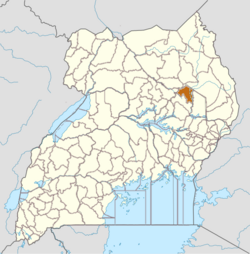
Kapelebyong District

Last updated

Kapelebyong District
Interactive map of Kapelebyong District
Coordinates: 2°12′N33°46′E / 2.200°N 33.767°E / 2.200; 33.767
CountryFlag of Uganda.svg Uganda
Region Eastern Region
Sub-region Teso sub-region
Established1 July 2018 [1]
Headquarters Kapelebyong (Town Council) [2]
Area
  Total
1,203 [3]  km2 (464 sq mi)
Population
 (2024 census)
  Total
143,367 [4]
  Density119/km2 (310/sq mi)
Time zone UTC+3 (East Africa Time)
Kapelebyong District, Uganda UgandadistrictsKapelebyong.png
Kapelebyong District, Uganda

Kapelebyong District is a district in the Teso sub-region of the Eastern Region of Uganda. The district headquarters are in Kapelebyong Town Council. [5]

Contents

History

Kapelebyong District became operational on 1 July 2018 after being created from Amuria District. [6] [7]

In the 2014 national census, Amuria District recorded a population of 270,601 before the later creation of Kapelebyong District from its territory. [8]

Geography

The district headquarters (Kapelebyong Town Council) lie at about 2°17′36″N, 33°49′51″E. [9]

Kapelebyong District borders Katakwi District to the east, Amuria District to the south, Otuke District to the north, and Napak District to the north-east. [10] The district headquarters are about 81 km by road from Soroti via Amuria road. [11]

According to UBOS census reporting, the district land area is 1,203 square kilometres. [12]

Administration

Kapelebyong District is governed through a district council structure. The district website describes the council as the supreme organ, supported by an executive committee and sectoral committees. [13]

Lower local governments listed by the district include the sub-counties of Kapelebyong, Akoromit, Obalanga, Okungur, Acowa, Alito, and Acinga, and the town councils of Kapelebyong, Acowa, Obalanga, and Akore. [14] A district profile document also reports 56 parishes or wards and 345 villages or cells. [15]

Demographics

In the 2024 National Population and Housing Census preliminary results, Kapelebyong District recorded a total population of 143,367, made up of 71,517 males and 71,850 females. [16]

Using the 2024 census preliminary reporting, population density is 119 persons per square kilometre. [17]

Economy

District documentation describes agriculture as the main livelihood for most residents. It reports that over 87 percent of the population depends on agriculture, and that 86 percent of households were engaged in subsistence farming (figures reported by the district for local planning). [18]

The same source lists key crops grown in the district, including finger millet, sorghum, groundnuts, cowpeas, sweet potatoes, cassava, maize, sesame, green grams, sunflower, vegetables, and beans, with rice cultivation reported in some wetland areas. [19] It also reports livestock production as a key activity, and provides district estimates for local cattle, goats, sheep, pigs, and poultry (reported as 2019 status estimates by district offices). [20]

See also

Districts of Uganda Eastern Region Teso sub-region

References

  1. Kapelebyong District Situation on Production, Markets, Nutrition, Child and Maternal Health (PDF) (Report). Kapelebyong District Local Government. Retrieved 16 December 2025.
  2. "Location & Size". Kapelebyong District Local Government. Retrieved 16 December 2025.
  3. National Population and Housing Census 2024: Preliminary Report (PDF) (Report). Uganda Bureau of Statistics (UBOS). July 2025. Retrieved 16 December 2025.
  4. National Population and Housing Census 2024: Preliminary Report (PDF) (Report). Uganda Bureau of Statistics (UBOS). July 2025. Retrieved 16 December 2025.
  5. "Location & Size". Kapelebyong District Local Government. Retrieved 16 December 2025.
  6. Kapelebyong District Situation on Production, Markets, Nutrition, Child and Maternal Health (PDF) (Report). Kapelebyong District Local Government. Retrieved 16 December 2025.
  7. FY 2018/19 Approved Workplan: Vote 565 Amuria District (PDF) (Report). Ministry of Finance, Planning and Economic Development (Uganda). 30 July 2018. Retrieved 16 December 2025.
  8. National Population and Housing Census 2014: Provisional Results (PDF) (Report). Uganda Bureau of Statistics (UBOS). November 2014. Retrieved 16 December 2025.
  9. "Location & Size". Kapelebyong District Local Government. Retrieved 16 December 2025.
  10. "Location & Size". Kapelebyong District Local Government. Retrieved 16 December 2025.
  11. "Location & Size". Kapelebyong District Local Government. Retrieved 16 December 2025.
  12. National Population and Housing Census 2024: Preliminary Report (PDF) (Report). Uganda Bureau of Statistics (UBOS). July 2025. Retrieved 16 December 2025.
  13. "Political and Administrative Structure". Kapelebyong District Local Government. Retrieved 16 December 2025.
  14. "Political and Administrative Structure". Kapelebyong District Local Government. Retrieved 16 December 2025.
  15. Kapelebyong District Situation on Production, Markets, Nutrition, Child and Maternal Health (PDF) (Report). Kapelebyong District Local Government. Retrieved 16 December 2025.
  16. National Population and Housing Census 2024: Preliminary Report (PDF) (Report). Uganda Bureau of Statistics (UBOS). July 2025. Retrieved 16 December 2025.
  17. National Population and Housing Census 2024: Preliminary Report (PDF) (Report). Uganda Bureau of Statistics (UBOS). July 2025. Retrieved 16 December 2025.
  18. Kapelebyong District Situation on Production, Markets, Nutrition, Child and Maternal Health (PDF) (Report). Kapelebyong District Local Government. Retrieved 16 December 2025.
  19. Kapelebyong District Situation on Production, Markets, Nutrition, Child and Maternal Health (PDF) (Report). Kapelebyong District Local Government. Retrieved 16 December 2025.
  20. Kapelebyong District Situation on Production, Markets, Nutrition, Child and Maternal Health (PDF) (Report). Kapelebyong District Local Government. Retrieved 16 December 2025.

https://kapelebyong.go.ug/