Operation Juno (Unternehmen Juno) was a sortie by a German Kriegsmarine flotilla on 8 June 1940, into the Norwegian Sea during the Norwegian Campaign. The sortie was intended to help the German Army to drive the Allies out of northern Norway and to recapture Narvik.
Gneisenau and Scharnhorst made repairs in Trondheim and rejoined the flotilla. From 10 and 12 June, Gneisenau, Admiral Hipper and the destroyers sortied. On 13 June, Skua dive-bombers of the Fleet Air Arm, attacked Scharnhorst at Trondheim and achieved one hit with a dud bomb for the loss of eight Skuas.
Scharnhorst departed for Germany with the four destroyers, reaching Kiel on 23 June. To cover the withdrawal, Marschall sortied with Gneisenau and Admiral Hipper from Trondheim on 20 June but Gneisenau was torpedoed by HMSClyde. Scharnhorst and Gneisenau remained under repair until the end of 1940.
After the German invasion of Norway on 9 April 1940, the French and British had begun the Namsos campaign in central Norway and landings in Harstad in northern Norway. Towards the end of May, the Allies evacuated central Norway but had captured the important town of Narvik in northern Norway. German forces under the command of General Eduard Dietl had retreated into the mountains around Narvik and the commander of the Kriegsmarine, Admiral Erich Raeder, ordered the German navy to assist the army in northern Norway.[2]
No capital ships were available to oppose the Allied landings but at the end of May, a battle group was assembled, comprising the battleships Scharnhorst and Gneisenau that had completed their repairs, the heavy cruiser Admiral Hipper and the destroyersZ20 Karl Galster, Z10 Hans Lody, Z15 Erich Steinbrinck and Z7 Hermann Schoemann. The force was put under the command of FlottenchefVizeadmiralWilhelm Marschall who received the orders to assist Dietl by attacking the Allies at their naval base in Harstad and by supporting German forces advancing overland to Narvik. To make continuous operations possible, the German force was to operate from Trondheim, where a naval base had been set up.[3]
Operation
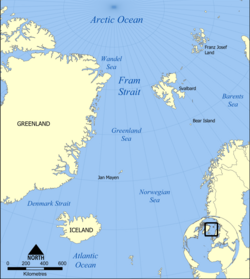
Map of the Norwegian Sea, showing Jan Mayen
The ships departed from Kiel on 4 June and steamed undetected at high speed through the Skagerrak, along the Norwegian coast and into the Arctic. During the night of 6 June two destroyers refuelled from the battleships and on 7 June Admiral Hipper and the two other destroyers refuelled from the replenishment oiler Dithmarschen near Jan Mayen island.[4][5] In the evening of 7 June Marschall held a conference aboard Gneisenau to organize the attack on Harstad. Air reconnaissance had reported convoys and two carriers steaming westwards but no information about Harstad was available. Marschall suspected the Allies were evacuating Norway and he decided to abandon the attack on Harstad and destroy the convoys. At 05:00 on 8 June, the German ships formed line abreast in search of the convoys.[6][7]
Hans Lody rescuing survivors from the troop transport Orama
At 06:45 Admiral Hipper sighted a tanker and an escorting trawler. Hipper sank the escort HMTJuniper with her secondary armament and rescued a survivor. Marschall, aboard Gneisenau, closed in on the scene and Gneisenau shelled the tanker Oil Pioneer (5,666GRT) at 67°44′N, 03°52′E that caught fire and was finished off with a torpedo from Hermann Schoemann, the destroyer rescued eleven survivors but twenty crew were killed. After this engagement, the German ships resumed their position in the patrol line, searching for the convoy. At 08:45 Admiral Hipper and Scharnhorst launched their Arado Ar 196 reconnaissance floatplanes, that found two ships but no convoy.[8][9][10]
The first ship was the empty troop transport Orama (19,840GRT) which was sunk by Admiral Hipper and Hans Lody at 12:10, nineteen members of the crew were killed and 280 men were taken prisoner.[11][12][a] The second ship was the hospital ship Atlantis which refrained from reporting the attack and the Germans respected its immunity.[13] Marschall decided to abandon the search for the convoy and ordered Admiral Hipper and the destroyers to Trondheim to comply with the second part of his operational orders, to support the German troops at Trondheim. The battleships remained in the Arctic and steamed northwards to refuel from Dithmarschen.[14]
Marschall wanted to operate with the two battleships against ships reported by the B-Dienst section aboard his ship, that had intercepted signals from the carriers HMSArk Royal, HMSGlorious and the Town-class light cruiser HMSSouthampton.[15] The weather was excellent with unlimited visibility and at 16:45 a lookout on Scharnhorst reported a faint cloud; upon investigation with the optic rangefinder the top of a mast was noticed at a distance of 25nmi (46km). The German battleships gave chase and at 17:13 they identified a carrier, first thought to be Ark Royal and two escorting destroyers, HMSAcasta and Ardent.[16][17][18]
Sinking of HMS Glorious
Example of a Gloster Gladiator Mk 1 in Norwegian service
On the night of 7/8 June, the aircraft carrier Glorious (Captain Guy D'Oyly-Hughes), took on board ten Gladiator fighters of 263 SquadronRoyal Air Force (RAF) and eight Hurricane fighters of 46 Squadron, the first landing of modern aircraft without arrester hooks on an aircraft carrier. The fighters had flown from land bases to avoid being destroyed in the evacuation. Glorious was part of a troop convoy headed for Scapa Flow, also including the carrier Ark Royal but in the early hours of 8 June, D'Oyly-Hughes requested permission to proceed independently with Acasta and Ardent.[19]
Glorious was in a low state of readiness. The crow's nest lookout was not manned, leaving the observation task to the destroyers with much lower observation angles. Only twelve out of 18 boilers were in use, so she could not develop quickly full speed [from 17kn (31km/h; 20mph) to 30kn (56km/h; 35mph)].[20]Glorious carried the seven Hurricanes and ten Gladiators of the RAF along with six Swordfish of 823 Naval Air Squadron and the Sea Gladiators of 802 Naval Air Squadron.[19] A Swordfish and three Sea Gladiators were at ten minutes' notice below deck but the previous commander always had some aircraft in the air. D'Oyly-Hughes failed to launch aircraft for a Combat Air Patrol around the carrier group, reportedly to give the aircrews a rest.[21]
Scharnhorst firing her forward 283 mm guns during the engagement with Glorious and her escorts
While sailing through the Norwegian Sea on 8 June, the carrier, Acasta and Ardent were intercepted by the German battleships Scharnhorst and Gneisenau off Norway at about 69°N, 00° E. Scharnhorst turned towards Glorious immediately upon her sighting, without waiting for an order from Marschall aboard Gneisenau. Scharnhorst was well ahead of Gneisenau and opened fire first at 17:32 with a salvo from her forward turrets at a distance of 26km (14nmi; 16mi)[b]
After 52 seconds the salvo fell short and then Scharnhorst fired three ranging salvoes with one turret each. Having found the range with the second salvo, hits were gained with the fourth salvo. Scharnhorst obtained its first hit at 17:38 at the extreme range of 24,000m (26,000yd), before Glorious could launch her torpedo-bombers. At 17:46 Gneisenau opened fire with her main battery.[23] The destroyers had begun to make smoke to protect Glorious which was effective at first but receded around 18:20, exposing Glorious again.[24]
Ardent and Acasta made continual attempts to launch torpedoes at the German ships. At about 18:39, Scharnhorst was hit by one of four torpedoes launched by Acasta; fifty sailors were killed, 2,500 long tons (2,500t) of water flooded into her and her aft turret was put out of action. Ardent was sunk at around 18:20, having made seven attacks with torpedoes. The approximate sinking position based on last transmission from Glorious is 69°0′N04°0′E / 69.000°N 4.000°E / 69.000; 4.000.[25] Marschall, aboard Gneisenau, ordered Scharnhorst to cease wasting ammunition on Glorious. Gneisenau was 4,374yd (2.160nmi; 2.485mi; 4.000km) closer to Glorious than Scharnhorst.[26]
Aftermath
Analysis
Despite the apparent success of the operation, Marschall was roundly criticised by Raeder for not sticking to the letter of his operational orders and not having attacked Harstad. Marschall, who believed that he had received some degree of operational freedom and who firmly believed that a commander at sea should have some, was sacked and replaced as Fleet commander by Admiral Günther Lütjens.[27]
Casualties
Due to their exposed position, the German ships were not able to stop to rescue survivors of any of the ships. Thirty-three officers were killed and another forty-two were missing in Glorious, seventy-two ratings killed or died of wounds and 865 were missing. Nineteen Royal Marines were killed and eighty missing; a Maltese rating was killed and another thirty missing along with six NAAFI staff. Five RAF personnel were killed and thirty-six were missing and eighteen RAF pilots of 46 Squadron and 263 Squadron were killed or missing; the total number of men killed or missing in Glorious was 1,207. Acasta suffered two officers killed and six missing, twelve ratings killed or died of wounds and 139 ratings missing and one NAAFI staff member missing, a total of 160 killed or missing. In Ardent ten officers were missing presumed killed, two ratings were killed or died of wounds and 139 ratings and one NAAFI staff member were missing, for a total of 152 killed or missing. Casualties for all three ships were 1,519 men killed or missing.[28] There were 45 survivors, the survivor from Acasta was rescued by the Norwegian steam merchant ship Borgund which also saved 38 men from one of Glorious' lifeboats. The men saved by Borgund were set ashore at Tórshavn in the Faroe Islands on 14 June. The steamship Svalbard II took four survivors and one man who had died of wounds to Norway, thence to prison camps in Germany.[29]
Subsequent operations
Gneisenau and Scharnhorst made for Trondheim for repairs, where they joined Admiral Hipper and the four destroyers. Between 10 and 12 June Marschall sortied with Gneisenau, Admiral Hipper and the destroyers; due to a lack of air reconnaissance and the presence of the British fleet he returned to Trondheim.[12] On 13 June, 15 Skua bombers of the Fleet Air Arm, from Ark Royal, attacked Scharnhorst in harbour. One dud bomb struck her for the loss of eight Skuas.[30] After emergency repairs in Trondheim of the torpedo damage, Scharnhorst departed for Germany escorted by the four destroyers, reaching Kiel on 23 June to go into dry dock. To cover the withdrawal of Scharnhorst, Marschall sortied with Gneisenau and Admiral Hipper from Trondheim on 20 June but Gneisenau was torpedoed and damaged in the bows by the British submarine HMSClyde.[31]Scharnhorst and Gneisenau remained under repair until the end of 1940.[32]
Bekker, Cajus (1971). Verdammte See[Damned Sea] (in German). Oldenburg: Gerhard Stalling Verlag. ISBN3-548-03057-2.
Bredemeier, Heinrich (1997). Schlachtschiff Scharnhorst[Battleship Scharnhorst] (in German) (5thed.). Hamburg: Koehler. ISBN3-7822-0592-8.
Brennecke, Jochen (2003). Eismeer, Atlantik, Ostsee. Die Einsätze des Schweren Kreuzers 'Admiral Hipper'[Arctic Ocean, Atlantic, Baltic Sea. The missions of the heavy cruiser 'Admiral Hipper'] (in German). München: Pavillon. ISBN3-453-87084-0.
Busch, Fritz-Otto (1980). Het drama van de Scharnhorst[The Story of the Scharnhorst] (in Dutch). Amsterdam: Omega Boek B.V. ISBN90-6057-197-5.
Chorlton, Peter, ed. (2014). "British Aircraft Carriers of World War 2". Ships Illustrated. Ships Monthly. Cudham: Kelsey Media Group. ISBN978-1-909786-27-1.
Hobbs, David (2022). The Fleet Air Arm and the War in Europe 1939–1945. Barnsley: Seaforth (Pen & Sword). ISBN978-1-5267-9980-7.
Jordan, Roger W. (2006) [1999]. The World's Merchant Fleets 1939: The Particulars and Wartime Fates of 6,000 Ships (2nded.). London: Chatham/Lionel Leventhal. ISBN978-1-86176-293-1.
Rhys-Jones, Graham (2008). Churchill and the Norway Campaign 1940. Barnsley: Pen & Sword Military. ISBN978-1-84415-753-2.
Rohwer, Jürgen; Hümmelchen, Gerhard (2005) [1972]. Chronology of the War at Sea, 1939–1945: The Naval History of World War Two (3rd rev.ed.). London: Chatham. ISBN1-86176-257-7.
Roskill, S. W. (1957) [1954]. Butler, J. R. M. (ed.). The Defensive(online scan). History of the Second World War United Kingdom Military Series: The War at Sea 1939–1945. Vol.I (4th impr.ed.). London: HMSO. OCLC881709135– via Archive Foundation.
Winton, John (2022) [1986]. Carrier Glorious: The Life and Death of an Aircraft Carrier (Facs. repr. Sapere Books, Leedsed.). Barnsley: Leo Cooper. ISBN978-1-80055-416-0.
Kiszely, John (2019). Anatomy of a Campaign: The British Fiasco in Norway, 1940. Cambridge Military Histories. Cambridge: Cambridge University Press. ISBN978-1-316-64642-7.
Maier, Klaus A.; Rohde, Horst; Stegemann, Bernd; Umbreit, Hans (2015) [1991]. Falla, P. S. (ed.). Germany and the Second World War: Germany's Initial Conquests in Europe. Vol.II. Translated by McMurry, Dean S.; Osers, Ewald (trans. pbk. Clarendon Press, Oxforded.). Freiburg im Breisgau: Militärgeschichtliches Forschungsamt [Research Institute for Military History]. ISBN978-0-19-873834-3.
This page is based on this Wikipedia article Text is available under the CC BY-SA 4.0 license; additional terms may apply. Images, videos and audio are available under their respective licenses.