Napoleonville | |
|---|---|
| Village of Napoleonville | |
| St. Anne Catholic Church off St. Joseph St. | |
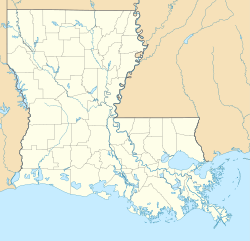
| Location of Napoleonville in Assumption Parish, Louisiana. | |
| Coordinates: 29°56′16″N91°01′36″W / 29.93778°N 91.02667°W | |
| Country | |
| State | |
| Parish | Assumption |
| Named after | Napoleon Bonaparte |
| Government | |
| • Mayor | Ron Animashaun (D) |
| Area | |
• Total | 0.17 sq mi (0.44 km2) |
| • Land | 0.17 sq mi (0.44 km2) |
| • Water | 0 sq mi (0.00 km2) |
| Population (2020) | |
• Total | 540 |
| • Density | 3,205.0/sq mi (1,237.47/km2) |
| Time zone | UTC-6 (CST) |
| • Summer (DST) | UTC-5 (CDT) |
| ZIP code | 70390 |
| Area code | 985 |
Napoleonville, is a village and the parish seat of Assumption Parish, in the U.S. state of Louisiana. [2] The population was 660 at the 2010 census. [3] It is part of the Pierre Part Micropolitan Statistical Area. The village is best known[ citation needed ] as the location where the film Because of Winn-Dixie , based on Kate DiCamillo's Newbery Prize-winning novel, was shot. The book was set in (fictional) Naomi, Florida.
As early as 1807, the community that later became Napoleonville was known as Canal, a name derived from a man-made waterway that extended west from the settlement to Lake Verret. [4] This canal served as an important transportation link for goods and people in the early 19th century.
The village was later named Napoleonville by a former French soldier, Pierre Charlet, who had served under Napoleon Bonaparte. Charlet immigrated to Louisiana after the Napoleonic Wars and settled in Assumption Parish; he is buried in the cemetery of Our Lady of the Assumption Catholic Church in nearby Plattenville. [5]
The first permanent European settlements in this region were established by French and Spanish colonists (including Isleños) during the mid-18th century along Bayou Lafourche, between the present towns of Donaldsonville and Napoleonville. [6] From 1755 to 1785, the population grew significantly due to the arrival of Acadians, exiled during the Great Upheaval, who cleared land and built homes along the bayou. [7]
Napoleonville became the parish seat when Assumption Parish was created on March 31, 1807, from Lafourche County. [8] The town was officially incorporated on March 11, 1878, following an act of the Louisiana Legislature. [9]
Throughout the 19th century, Napoleonville grew as a center of commerce and culture along Bayou Lafourche. Sugarcane cultivation became the dominant economic activity in the region by the 1860s and remains important today. [10] The town also served as a hub for French-language journalism; the Pionnier de l’Assomption newspaper, founded in 1850, later became the Pioneer of Assumption and documented local life for decades. [11]
A historical marker near the Assumption Parish Courthouse notes that Napoleonville lies on an early travel route (1730–1770) used by French and Acadian settlers moving between St. James Parish and the Attakapas region near Lake Verret. [12]
Napoleonville is located at 29°56′16″N91°1′36″W / 29.93778°N 91.02667°W (29.937778, -91.026750). [13] According to the United States Census Bureau, the village has a total area of 0.15 square miles (0.4 km2), all land. [3]
| Census | Pop. | Note | %± |
|---|---|---|---|
| 1880 | 497 | — | |
| 1890 | 723 | 45.5% | |
| 1900 | 945 | 30.7% | |
| 1910 | 1,201 | 27.1% | |
| 1920 | 1,171 | −2.5% | |
| 1930 | 1,180 | 0.8% | |
| 1940 | 1,301 | 10.3% | |
| 1950 | 1,260 | −3.2% | |
| 1960 | 1,148 | −8.9% | |
| 1970 | 1,008 | −12.2% | |
| 1980 | 829 | −17.8% | |
| 1990 | 802 | −3.3% | |
| 2000 | 686 | −14.5% | |
| 2010 | 660 | −3.8% | |
| 2020 | 540 | −18.2% | |
| U.S. Decennial Census [14] | |||
| Race | Number | Percentage |
|---|---|---|
| White (non-Hispanic) | 84 | 15.56% |
| Black or African American (non-Hispanic) | 428 | 79.26% |
| Native American | 1 | 0.19% |
| Other/Mixed | 12 | 2.22% |
| Hispanic or Latino | 15 | 2.78% |
As of the 2020 United States census, there were 540 people, 229 households, and 137 families residing in the village.
The village is home to the 928th Sapper Company, a combat engineer unit of the 769th Engineer Battalion of the Louisiana Army National Guard which in turn is headquartered at Baton Rouge. Both of these units belong to the 225th Engineer Brigade headquartered at Louisiana National Guard Training Center Pineville near Pineville.
The town maintains twinning links with:
Pontivy (Napoléonville in 1804), France since 1989