Related Research Articles
Mongolian is the official language of Mongolia and both the most widely spoken and best-known member of the Mongolic language family. The number of speakers across all its dialects may be 5.2 million, including the vast majority of the residents of Mongolia and many of the ethnic Mongol residents of the Inner Mongolia Autonomous Region of the People's Republic of China. In Mongolia, the Khalkha dialect is predominant, and is currently written in both Cyrillic, traditional Mongolian script and Latin. In Inner Mongolia, the language is dialectally more diverse and is written in the traditional Mongolian script.

The Mongolic languages are a language family spoken by the Mongolic peoples in Eastern Europe, Central Asia, North Asia and East Asia, mostly in Mongolia and surrounding areas and in Kalmykia and Buryatia. The best-known member of this language family, Mongolian, is the primary language of most of the residents of Mongolia and the Mongol residents of Inner Mongolia, with an estimated 5.7+ million speakers.
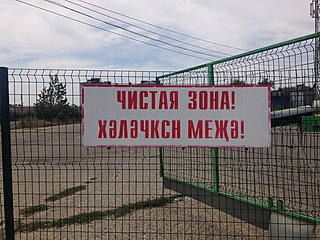
Kalmyk Oirat, commonly known as the Kalmyk language, is a variety of the Oirat language, natively spoken by the Kalmyk people of Kalmykia, a federal subject of Russia. In Russia, it is the standard form of the Oirat language, which belongs to the Mongolic language family. The Kalmyk people of the Northwest Caspian Sea of Russia claim descent from the Oirats from Eurasia, who have also historically settled in Mongolia and Northwest China. According to UNESCO, the language is "Definitely endangered". According to the Russian census of 2010, there are 80,500 speakers of an ethnic population consisting of 183,000 people.

Buryat, or Buriat, known in foreign sources as the Bargu-Buryat dialect of Mongolian, and in pre-1956 Soviet sources as Buryat-Mongolian, is a variety of the Mongolic languages spoken by the Buryats and Bargas that is classified either as a language or major dialect group of Mongolian.
The Monguor language is a Mongolic language of its Shirongolic branch and is part of the Gansu–Qinghai sprachbund. There are several dialects, mostly spoken by the Monguor people. A written script was devised for Huzhu Monguor (Mongghul) in the late 20th century but has been little used.
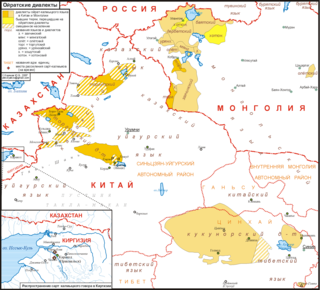
Oirat is a Mongolic language spoken by the descendants of Oirat Mongols, now forming parts of Mongols in China, Kalmyks in Russia and Mongolians. Largely mutually intelligible to other core Central Mongolic languages, scholars differ as to whether they regard Oirat as a distinct language or a major dialect of the Mongolian language. Oirat-speaking areas are scattered across the far west of Mongolia, the northwest of China and Russia's Caspian coast, where its major variety is Kalmyk. In China, it is spoken mainly in Xinjiang, but also among the Deed Mongol of Qinghai and Subei County in Gansu.
The Khalkha dialect is a dialect of central Mongolic widely spoken in Mongolia. According to some classifications, the Khalkha dialect includes Southern Mongolian varieties such as Shiliin gol, Ulaanchab and Sönid. As it was the basis for the Cyrillic orthography of Mongolian, it is de facto the national language of Mongolia. The name of the dialect is related to the name of the Khalkha Mongols and the Khalkha river.

Mongols in China or Mongolian Chinese are ethnic Mongols who were integrated into the nation-building of the Republic of China (1912–1949) after the fall of Qing Empire (1636–1911). Those not integrated broke away in the Mongolian Revolution of 1911 and again in 1921. The Republic of China recognized Mongols to be part of the Five Races Under One Union. Its successor, the People's Republic of China (1949-), recognized Mongols to be one of the 55 ethnic minorities in China.
Darkhad is a dialect in-between Central Mongolian and Oirat still variously seen as closer to Oirat or as a dialect of Khalkha Mongolian with some Oirat features. However, it seems to have substantially assimilated to the Khalkha dialect since it first was described by Sanžeev, and some classificational differences seem to be due to what historical state got classified. A population of 20,000 was reported in 2000. Speakers live mainly in the west of Lake Khövsgöl in the sums Bayanzürkh, Ulaan-Uul and Rinchinlkhümbe in the Khövsgöl Province of Mongolia.
The Dagur, Daghur, Dahur, or Daur language, is a Mongolic language, as well as a distinct branch of the Mongolic language family, and is primarily spoken by members of the Dagur ethnic group.
Middle Mongol or Middle Mongolian, was a Mongolic koiné language spoken in the Mongol Empire. Originating from Genghis Khan's home region of Northeastern Mongolia, it diversified into several Mongolic languages after the collapse of the empire. In comparison to Modern Mongolian, it is known to have had no long vowels, different vowel harmony and verbal systems and a slightly different case system.
Ordos Mongolian is a variety of Central Mongolic spoken in the Ordos City region in Inner Mongolia and historically by Ordos Mongols. It is alternatively classified as a language within the Mongolic language family or as a dialect of the standard Mongolian language. Due to the research of Antoine Mostaert, the development of this dialect can be traced back 100 years.
Chakhar is a variety of Mongolian spoken in the central region of Inner Mongolia. It is phonologically close to Khalkha and is the basis for the standard pronunciation of Mongolian in Inner Mongolia.
The Khorchin dialect is a variety of Mongolian spoken in the east of Inner Mongolia, namely in Hinggan League, in the north, north-east and east of Hinggan and in all but the south of the Tongliao region. There were 2.08 million Khorchin Mongols in China in 2000, so the Khorchin dialect may well have more than one million speakers, making it the largest dialect of Inner Mongolia.
Alasha, or Alaša-Eǰen-e, is a Mongolic variety with features of both Oirat and Mongolian that historically used to belong to Oirat but has come under the influence of Mongolian proper. It has more than 40,000 speakers in Alxa League, Inner Mongolia, China and consists of two sub-dialects, Alasha proper and Eǰene.
Southern Mongolian or Inner Mongolian is a proposed major dialect group within the taxonomy of the Mongolian language.
Baarin is a dialect of Mongolian spoken mainly in Inner Mongolia.
Standard languages of Mongolian are the following:
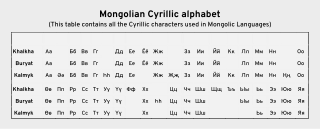
The Mongolian Cyrillic alphabet is the writing system used for the standard dialect of the Mongolian language in the modern state of Mongolia. It has a largely phonemic orthography, meaning that there is a fair degree of consistency in the representation of individual sounds. Cyrillic has not been adopted as the writing system in the Inner Mongolia region of China, which continues to use the traditional Mongolian script.
References
- ↑ Oirat at Ethnologue (16th ed., 2009)
- ↑ Bläsing 2003: 229
- ↑ Sečenbaγatur et al. 2005: 398
- ↑ Bulaγ-a 2005: 11ff.
- ↑ Svantesson et al. 2005: 148
- ↑ Coloo 1988: 3
- ↑ Svantesson et al. 2005: 141
- ↑ Sečenbaγatur et al. 2005: 397. Sečenbaγatur et al. talk about the distribution of Oirat in China in general, but following Svantesson et al. 2005: 148, it is presumed here that Xinjiang Oirat is Torgut. Sečenbaγatur et al. 2005: 187-188 also point to the fact that the Oirat spoken in Xinjiang is separate in that it is less influenced by Mongolian proper than other dialects of Oirat spoken in China. In the above article, it was assumed that "Qaranusu" which is either a county or a city (Mongolian "siyen qota") is the original Mongolian name of "Wusu".
- ↑ Bläsing 2003: 229, Birtalan 2003: 210
- ↑ This analysis follows Sečenbaγatur et al. 2005. Svantesson et al. 2005 would instead claim that there are phonemic and non-phonemic vowels in non-initial syllables.
- ↑ Sečenbaγatur et al. 2005: 399, but we write /o/ and /u/ instead of /ɔ/ and /ʊ/ in accordance with an observation by Bulaγ-a 2005: 27 who nevertheless keeps on writing /ɔ/ and /ʊ/. The notation /o/ and /u/ is more in line with Svantesson et al. 2005: 149, 179
- ↑ Sečenbaγatur et al. 2005: 405-408
- ↑ Sečenbaγatur et al. 2005: 408. Bulaγ-a 2005: 48-51 also gives /p/ and /ɢ/, but she doesn't present any evidence for /p/ and evidence from Coloo 1988: 71, 373 suggests that ɢ is phonemic in Dörbet and some other varieties, but not in Torgut (as spoken in Mongolia). Furthermore, it is not clear whether there is indeed a distinction of voicing or, as Svantesson et al. 2005: 149 speculate, rather of aspiration.
- ↑ Ubushaev, N.N. (1979). Fonetika torgutskogo govora kalmytskogo yazyka. Elista: Kalmyk book publishing house.
- ↑ cp. Coloo 1965: 74, Birtalan 2003: 216
- ↑ Sečenbaγatur et al. 2005: 412-413. As a convention, only one form of a suffix is given, as it is understood that almost all suffixes are subject to vowel harmony.
- ↑ Birtalan 2003: 217, Sečenbaγatur et al. 2005: 413
- ↑ Birtalan 2003: 217, Sečenbaγatur et al. 2005: 414
- ↑ Bulaγ-a 2005: 70-72
- ↑ Bulaγ-a 2005: 75
- ↑ Sečenbaγatur et al. 2005: 422
- ↑ Sečenbaγatur et al. 2005: 423-424

