Hainanese

Last updated
Hainanese
Qiongwen, Hainan Min
海南話, Hhai3 nam2 ue1, Hái-nâm-oe
Pronunciation[hai˨˩˧nam˨˩ue˨˧] (Haikou dialect)
Native to China, Malaysia, Singapore, Thailand
Region Hainan
Ethnicity Hainanese (Han Chinese subgroup)
Native speakers
Around 5 million in China (2002) [1]
Early forms
Dialects
Chinese characters [ citation needed ]

Hainanese Pinyin

Hainan Romanized
Language codes
ISO 639-3 hnm
Glottolog hain1238
Linguasphere 79-AAA-k
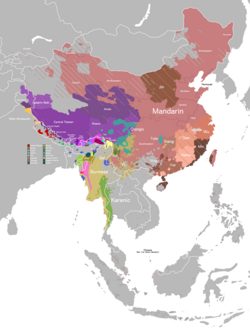
Min dialect map.svg
  Hainanese
Hainan Dialect Variation Map.png
Varieties of the Hainanese spoken in Hainan.
This article contains IPA phonetic symbols. Without proper rendering support, you may see question marks, boxes, or other symbols instead of Unicode characters. For an introductory guide on IPA symbols, see Help:IPA.
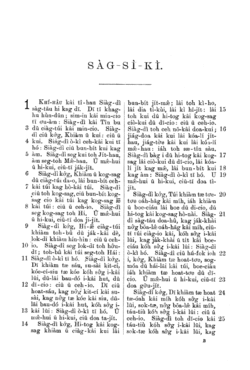
The Book of Genesis in Baeh-oe-tu, published by the Bible Society of Great Britain HainanBible1.gif
The Book of Genesis in Bǽh-oe-tu, published by the Bible Society of Great Britain

Hainanese [b] is a variety of Min Chinese spoken in the island of Hainan and regional overseas Chinese communities in Thailand especially.

Contents

In the classification by Yuan Jiahua, it was added to the Southern Min group by Him despite being mutually unintelligible with Southern Min varieties such as Hokkien and Teochew. [6] In the classification of Li Rong, used by the Language Atlas of China , it was treated as a separate Min subgroup. [7] Hou Jingyi combined it with Leizhou Min, spoken on the Leizhou Peninsula, in a Qiong–Lei group. [8] "Hainanese" is also used for the language of the Li people living in Hainan, but generally refers to Min varieties spoken in Hainan.

Phonology

The phonologies of the different varieties of Hainanese are highly divergent, [9] with the Wenchang dialect being the prestige dialect, and often used as a reference. [10]

Consonants

Below is a table for the consonants of Hainanese across the dialects of Wenchang, Haikou and the dialect of Banqiao Town, in Dongfang. [9] For more information on a specific variety, please consult the relevant article.

Labial Dental Alveolo-
palatal
Velar Glottal
Plosive voiceless /p/ [i]
pa
/t/
toi
/k/
kong
/ʔ/
a
aspirated // [i] [ii]
pho
// [i]
// [i] [ii]
khu
voiced /b/ [iii]
/d/ [iii]
/g/ [iv]
gua
implosive /ɓ/ [iii] [ii]
ɓak
/ɗ/ [iii] [ii]
ɗei
(/ɠ/) [v]
Affricate voiceless /ts/ [i] [ii] // [iv]
tsia
aspirated /tsʰ/ [i]
voiced /dz/ [i]
// [iv]
jit
Fricative voiceless /ɸ/ [iv]
fi
/θ/ [i]
/s/
sei
/ɕ/ [iv] [ii] /x/
/h/
hai
voiced /v/ [i] [ii]
vun
/z/ [ii]
zok
/ɦ/ [iv]
Nasal /m/
mak
/n/
niam
/ŋ/
ngak
Approximant /w/ [iv]
wat
/l/
lao
/j/ [iv]
yok
  1. 1 2 3 4 5 6 7 8 9 Present in the Banqiao dialect.
  2. 1 2 3 4 5 6 7 8 Present in the Haikou dialect.
  3. 1 2 3 4 Present in the Wenchang dialect, where there is a phonemic distinction between voiced and implosive stop consonants.
  4. 1 2 3 4 5 6 7 8 Present in the Wenchang dialect.
  5. Not usually transcribed as /ɠ/, and not phonemically distinct from /g/ in the Wenchang dialect or from /ŋ/ in other Hainanese varieties. [11]

Many of the most widely spoken varieties of Hainanese notably have a series of implosive consonants, /ɓ/ and /ɗ/, which were acquired through contact with surrounding languages, probably Hlai. However, more conservative varieties of Hainanese such as Banqiao remain closer to Leizhou Peninsula Min and other varieties, lack them. [9]

The consonant system of Hainanese corresponds well with that of Leizhou Peninsula Min, but it has had some restructuring. In particular: [9]

Additionally, [ʑ] is an allophone of /j/.

These changes also make Hainanese fairly close to Sino-Vietnamese vocabulary.

English meaningHainamese Standard Chinese Taiwanese Hokkien
eyemakjɛnbak tsiu
stickyniamniɛnliam
lowɗɔitite

Vowels

Hainanese has seven phonemic vowels.[ citation needed ]

Front Central Back
Close /i//u/
Close-mid /e//o/
Open-mid /ɛ//ɔ/
Open /a/

Tones

Tone chart of the Hainan dialect
Tone number Tone name Tone contour Example
1yin ping (阴平)˨˦ (24)
2yang ping (阳平)˨˩ (21)
3yin shang (阴上)˨˩˩ (211)
4yin qu (阴去)˧˥ (35)
5yang qu (阳去)˧ (33)
6yin ru (阴入)˥ (5)
7yang ru (阳入)˧ (3)
8chang ru (长入)˥ (55)

Romanization

Hainanese Pinyin

Hainanese Pinyin (海南话拼音方案) is a phonetic system announced by the Education Administration Department of Guangdong Province in September 1960. It marks tones with numbers.

Initials

IPA Hainanese Pinyin Bǽh-oe-tu Example
/ɓ/bb
/p/bp
//pph
/ɸ/pf
/m/mm
/b/vb?
/v/vv
/t/dt
/ɗ/ddd
/n/nn
/l/ll
/k/gk
/ŋ/ngg
/x/hkh
/h/hhh
/ɠ/ghg
/ts/zc
/s/ss
/z/yj

Finals

IPA Hainanese Pinyin Bǽh-oe-tu Example
/a/aa
/o/oo
/ɛ/ee
/i/ii
/u/uu
aiaiai
ɔioioi
auaoau
iaiaia
ioio
uauaoa
ueueoe
uiuioi
uaiuaioai
ɔuouou
iuiuiu
iauiaoiau
iamiamiam
imimim
amamam
ananan
ininin
ununun
uanuanoan
angag
engeg
ɔŋongog
iaŋiangiag
uaŋuangoag
iɔŋiongiog
ipibib
iapiabiab
atadat
itidit
utudut
uatuadoat
akagak
ekegek
okogok
iokiogiok
uakuagoak
-h-h

Grammar

Hainanese is known for having post-verbal locative prepositional phrases, [12] as opposed to having such phrases in the pre-verbal position, as is common in most other varieties of Chinese. For example:

ʔi24

3SG

大聲

ɗua24tia24

loudly

hi21

cry

ɗu33

in

房裡

ɓaŋ21-lɛ33

room-LOC


(Haikou)


大聲房裡

ʔi24ɗua24tia24hi21ɗu33ɓaŋ21-lɛ33

3SG loudly cry in room-LOC

He was crying loudly in the room.

This has been attributed to contact with the Kra–Dai languages of Hainan, such as Hlai and Be. [12]

See also

Notes

  1. Min is believed to have split from Old Chinese, rather than Middle Chinese like other varieties of Chinese. [2] [3] [4]
  2. or Hainamese (Hainan Romanised: Hái-nâm-oe, Hainanese Pinyin: Hhai3 nam2 ue1, simplified Chinese :海南话; traditional Chinese :海南話; pinyin :Hǎinánhuà), also known as Kengbun/Kengvun (simplified Chinese :琼文话; traditional Chinese :瓊文話), Keng language (琼语; 瓊語) or Hainam Min (海南闽语; 海南閩語) [5]

References

  1. Hou, Jingyi 侯精一 (2002). Xiàndài Hànyǔ fāngyán gàilùn现代汉语方言概论[An Introduction to Modern Chinese Dialects]. Shanghai Educational Press 上海教育出版社. pp. 207–208.
  2. Mei, Tsu-lin (1970), "Tones and prosody in Middle Chinese and the origin of the rising tone", Harvard Journal of Asiatic Studies, 30: 86–110, doi:10.2307/2718766, JSTOR   2718766
  3. Pulleyblank, Edwin G. (1984), Middle Chinese: A study in Historical Phonology, Vancouver: University of British Columbia Press, p. 3, ISBN   978-0-7748-0192-8
  4. Hammarström, Harald; Forkel, Robert; Haspelmath, Martin; Bank, Sebastian (2023-07-10). "Glottolog 4.8 - Min". Glottolog . Leipzig: Max Planck Institute for Evolutionary Anthropology. doi: 10.5281/zenodo.7398962 . Archived from the original on 2023-10-13. Retrieved 2023-10-13.
  5. "为新加坡琼属"寻根"的热心人——王振春". Hainan.gov (in Chinese). 中新海南网. Archived from the original on 22 March 2020. Retrieved 22 March 2020. 他组织演出琼语话剧《海南四条街》,搬上新琼舞台,引起两地海南人的共鸣。
  6. Simons, Gary F.; Fennig, Charles D., eds. (2017). Ethnologue: Languages of the World (20th ed.). Dallas, Texas: SIL International. Chinese, Min Nan.
  7. Kurpaska, Maria (2010). Chinese Language(s): A Look Through the Prism of "The Great Dictionary of Modern Chinese Dialects". Walter de Gruyter. pp. 54–55, 86. ISBN   978-3-11-021914-2.
  8. Hou, Jingyi 侯精一 (2002). Xiàndài Hànyǔ fāngyán gàilùn现代汉语方言概论[An Introduction to Modern Chinese Dialects]. Shanghai Educational Press 上海教育出版社. p. 238.
  9. 1 2 3 4 Huang, Karen (2006). "Contact-induced changes in the languages of Hainan". Annual Student Conference of the College of Languages, Linguistics, and Literature. University of Hawaii.
  10. "其中文昌话语音清晰,影响较大,被视为海南话的标准语,是海南广播电台、电视台与社会使用的主要方言。" From "《文昌县志·第二十九编 社会习俗·第三章 方言》". Archived from the original on 2015-05-18. Retrieved 2023-10-23.
  11. "Amaravati: Abode of Amritas: 08.6.20.23:50: HAINANESE 缩气音 'SHRUNKEN BREATH SOUNDS'". www.amritas.com. *Xu and Yang regard [g] (their gz) as an implosive, but it sounds like a regular [g] to me. I presume Li Fang-kuei also heard a regular [g], as he only reported two implosives in Haina[n]ese: [ɓ ɗ].
  12. 1 2 曾 [Zeng], 綉薇 [Xiuwei]; 郭 [Kwok], 必之 [Bit-chee] (6 August 2024). "從海南閩語動詞後的{在}類介詞短語看語言接觸中的句法借移" . Cahiers de Linguistique Asie Orientale (in Chinese). 54 (1): 60–96. doi:10.1163/19606028-bja10043 . Retrieved 16 April 2025.

Further reading