Iron County, Michigan

Last updated

Iron County, Michigan
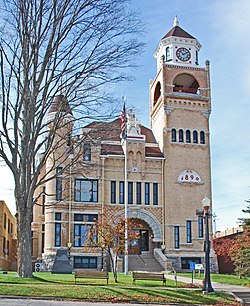
Courthouse Crystal Falls MI.jpg
Map of Michigan highlighting Iron County.svg
Location within the U.S. state of Michigan
Coordinates: 46°13′N88°31′W / 46.21°N 88.51°W / 46.21; -88.51
CountryFlag of the United States.svg United States
StateFlag of Michigan.svg Michigan
FoundedApril 3, 1885 [1] [2]
Named after Iron ore
Seat Crystal Falls
Largest city Iron River
Area
  Total
1,211 sq mi (3,140 km2)
  Land1,166 sq mi (3,020 km2)
  Water45 sq mi (120 km2)  3.7%
Population
 (2020)
  Total
11,631
  Estimate 
(2024)
11,709 Decrease2.svg
  Density10/sq mi (3.9/km2)
Time zone UTC−6 (Central)
  Summer (DST) UTC−5 (CDT)
Congressional district 1st
Website ironmi.com

Iron County is one of two landlocked counties in the Upper Peninsula of the U.S. state of Michigan. As of the 2020 census, the population was 11,631. [3] The county seat is Crystal Falls. [4]

Contents

History

Iron County was organized in 1885, with territory partitioned from Marquette and Menominee counties. In 1890, the county's population was 4,432. [1] [5] It was named for the valuable iron ore found within its borders. [1] [6]

Geography

According to the U.S. Census Bureau, the county has an area of 1,211 square miles (3,140 km2), of which 1,166 square miles (3,020 km2) is land and 45 square miles (120 km2) (3.7%) is water. [7] Along with its southeastern neighbor Dickinson County, it is one of only two landlocked counties in the Upper Peninsula.

Major highways

Entering Iron County on US 2 / US 141 IronCountyMichiganSignUS2US141.jpg
Entering Iron County on US 2 / US 141

Adjacent counties

National protected area

Communities

Cities

Village

Census-designated place

Unincorporated communities

Townships

Demographics

Historical population
CensusPop.Note
1890 4,432
1900 8,990102.8%
1910 15,16468.7%
1920 22,10745.8%
1930 20,805−5.9%
1940 20,243−2.7%
1950 17,692−12.6%
1960 17,184−2.9%
1970 13,813−19.6%
1980 13,635−1.3%
1990 13,175−3.4%
2000 13,138−0.3%
2010 11,817−10.1%
2020 11,631−1.6%
2024 (est.)11,709 [9] Increase2.svg0.7%
US Decennial Census [10]
1790-1960 [11] 1900-1990 [12]
1990-2000 [13] 2010-2018 [3]

2020 census

As of the 2020 census, the county had a population of 11,631, a median age of 53.6 years, and 17.4% of residents under the age of 18 while 29.7% of residents were 65 years of age or older. [14]

For every 100 females there were 101.1 males, and for every 100 females age 18 and over there were 103.7 males age 18 and over. [14]

The racial makeup of the county was 94.0% White, 0.2% Black or African American, 0.8% American Indian and Alaska Native, 0.4% Asian, <0.1% Native Hawaiian and Pacific Islander, 0.5% from some other race, and 4.2% from two or more races. Hispanic or Latino residents of any race comprised 1.8% of the population. [15]

<0.1% of residents lived in urban areas, while 100.0% lived in rural areas. [16]

There were 5,521 households in the county, of which 18.7% had children under the age of 18 living in them. Of all households, 43.2% were married-couple households, 25.6% were households with a male householder and no spouse or partner present, and 24.2% were households with a female householder and no spouse or partner present. About 37.5% of all households were made up of individuals and 19.9% had someone living alone who was 65 years of age or older. [14]

There were 8,878 housing units, of which 37.8% were vacant. Among occupied housing units, 81.3% were owner-occupied and 18.7% were renter-occupied. The homeowner vacancy rate was 2.4% and the rental vacancy rate was 10.2%. [14]

2010 census

The 2010 United States census indicates Iron County had a population of 11,817, 5,577 households, and 3,284 families, for a population density of 10 people per square mile (3.9 people/km2). There were 9,197 housing units at an average density of 8 per square mile (3.1/km2). This decrease of 1,321 people from the 2000 United States census represents a 10.1% population decrease. [17]

In 2010, 97.1% of the population were White, 2.9% Native American, 0.3% Asian, 0.1% Black or African American, 0.2% of some other race, and 1.4% of two or more races; 1.4% were Hispanic or Latino (of any race). Culturally, 14.3% were of German, 11.5% Finnish, 11.3% Italian, 8.6% French, French Canadian or Cajun, 8.0% Swedish, 6.5% English, 5.8% American and 5.4% Irish ancestry. [18]

In 2010, there were 5,577 households, out of which 18.1% had children under the age of 18 living with them, 46.6% were married couples living together, 8.3% had a female householder with no husband present, and 41.1% were non-families. 36.8% of all households were made up of individuals, and 19.1% had someone living alone who was 65 years of age or older. The average household size was 2.06 and the average family size was 2.65. [17]

The county population contained 17.1% under the age of 18, 5.4% from 18 to 24, 17.2% from 25 to 44, 34.1% from 45 to 64, and 26.3% who were 65 years of age or older. The median age was 51.9 years. 49.3% of the population was male, 50.7% was female. [17]

In 2010, the median income for a household in the county was $35,390, and the median income for a family was $46,337. The per capita income for the county was $20,099. About 6.5% of families and 11.7% of the population were below the poverty line, including 18.0% of those under age 18 and 8.8% of those age 65 or over. [17]
Government

Iron County was reliably Republican during its first three decades. However, since 1936 its voters have selected the Democratic Party nominee in 16 (out of 23) of the national elections through 2024, though it has voted Republican in the four most recent elections and five of the last six.

United States presidential election results for Iron County, Michigan [19]
Year Republican Democratic Third party(ies)
No.%No.%No.%
1888 59853.39%52046.43%20.18%
1892 91859.26%58737.90%442.84%
1896 1,04879.70%23617.95%312.36%
1900 1,56184.88%25713.97%211.14%
1904 1,62090.50%1397.77%311.73%
1908 2,05585.63%26010.83%853.54%
1912 1,03145.24%2189.57%1,03045.20%
1916 2,13967.54%87727.69%1514.77%
1920 3,51582.80%49711.71%2335.49%
1924 2,80265.06%2475.73%1,25829.21%
1928 4,10363.96%2,26235.26%500.78%
1932 4,34753.56%3,41642.09%3534.35%
1936 3,83441.99%5,21657.13%800.88%
1940 4,76649.33%4,80849.77%870.90%
1944 3,94546.16%4,53753.09%640.75%
1948 3,65944.56%4,12550.23%4285.21%
1952 4,56449.52%4,59749.88%550.60%
1956 4,95552.39%4,49047.47%130.14%
1960 3,91942.76%5,23257.09%140.15%
1964 2,39928.48%6,01171.36%130.15%
1968 3,29242.36%4,13053.14%3504.50%
1972 3,63049.21%3,51247.61%2343.17%
1976 3,22441.77%4,40157.02%931.20%
1980 3,50745.36%3,74248.40%4836.25%
1984 3,46849.15%3,55950.44%290.41%
1988 2,86642.94%3,77456.55%340.51%
1992 1,97128.16%3,64852.11%1,38119.73%
1996 2,01433.24%3,23253.34%81313.42%
2000 2,96747.95%3,01448.71%2073.35%
2004 3,22449.52%3,21549.38%721.11%
2008 2,94747.83%3,08049.98%1352.19%
2012 3,22453.63%2,68744.69%1011.68%
2016 3,67561.66%2,00433.62%2814.71%
2020 4,21662.05%2,49336.69%861.27%
2024 4,50164.00%2,44134.71%911.29%
United States Senate election results for Iron County, Michigan1 [20]
Year Republican Democratic Third party(ies)
No.%No.%No.%
2024 4,32862.69%2,40434.82%1722.49%
Michigan Gubernatorial election results for Iron County
Year Republican Democratic Third party(ies)
No.%No.%No.%
2022 3,28258.40%2,23639.79%1021.81%

Iron County operates the County jail, maintains rural roads, operates the major local courts, records deeds, mortgages, and vital records, administers public health regulations, and participates with the state in the provision of social services. The county board of commissioners controls the budget and has limited authority to make laws or ordinances. In Michigan, most local government functions – police and fire, building and zoning, tax assessment, street maintenance etc. – are the responsibility of individual cities and townships.

Education

See also

References

  1. 1 2 3 "Bibliography on Iron County". Clarke Historical Library, Central Michigan University . Retrieved June 29, 2013.
  2. "jengod.com". Archived from the original on June 20, 2006. Retrieved June 16, 2006.
  3. 1 2 "State & County QuickFacts". US Census Bureau. Retrieved September 15, 2021.
  4. "Find a County". National Association of Counties. Retrieved June 7, 2011.
  5. Michigan Department of State (1893). Michigan and Its Resources, pp. 241-42. Robert Smith & Co.
  6. Gannett, Henry (1905). The Origin of Certain Place Names in the United States. Govt. Print. Off. p. 166.
  7. "2010 Census Gazetteer Files". US Census Bureau. August 22, 2012. Retrieved September 25, 2014.
  8. 1 2 3 4 Iron County MI Google Maps (accessed 18 September 2018)
  9. "Population and Housing Unit Estimates Tables". United States Census Bureau. Retrieved July 24, 2025.
  10. "US Decennial Census". US Census Bureau. Retrieved September 25, 2014.
  11. "Historical Census Browser". University of Virginia Library. Retrieved September 25, 2014.
  12. "Population of Counties by Decennial Census: 1900 to 1990". US Census Bureau. Retrieved September 25, 2014.
  13. "Census 2000 PHC-T-4. Ranking Tables for Counties: 1990 and 2000" (PDF). US Census Bureau. Archived (PDF) from the original on March 27, 2010. Retrieved September 25, 2014.
  14. 1 2 3 4 "2020 Decennial Census Demographic Profile (DP1)". United States Census Bureau. 2021. Retrieved January 1, 2026.
  15. "2020 Decennial Census Redistricting Data (Public Law 94-171)". United States Census Bureau. 2021. Retrieved January 1, 2026.
  16. "2020 Decennial Census Demographic and Housing Characteristics (DHC)". United States Census Bureau. 2023. Retrieved January 1, 2026.
  17. 1 2 3 4 "U.S. Census website" . Retrieved July 6, 2013.
  18. Data Access and Dissemination Systems (DADS). "U.S. Census website". census.gov.
  19. Leip, David. "US Election Atlas". uselectionatlas.org. Retrieved April 9, 2018.
  20. "2024 Senate Election (Official Returns)". Commonwealth of Michigan by county. November 5, 2024. Retrieved December 5, 2024.

46°13′N88°31′W / 46.21°N 88.51°W / 46.21; -88.51