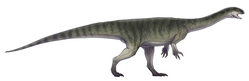
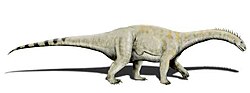
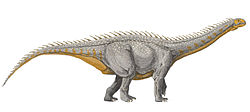
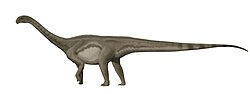
| Dasosaurus Temporal range: Early Cretaceous, | |
|---|---|
| Scientific classification | |
| Kingdom: | Animalia |
| Phylum: | Chordata |
| Class: | Reptilia |
| Clade: | Dinosauria |
| Clade: | Saurischia |
| Clade: | † Sauropodomorpha |
| Clade: | † Sauropoda |
| Clade: | † Macronaria |
| Clade: | † Somphospondyli |
| Genus: | † Dasosaurus Mayer et al., 2026 |
| Type species | |
| †Dasosaurus tocantinensis Mayer et al., 2026 | |
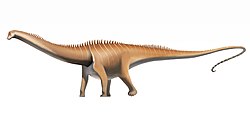
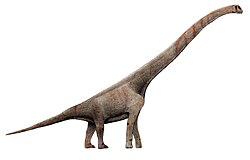
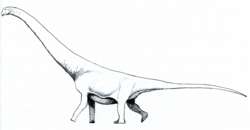
Dasosaurus is an extinct genus of somphospondylan sauropod dinosaurs known from the Early Cretaceous (Aptian) Brazil. The genus is monotypic with Dasosaurus tocantinensis, being the only known species. Its morphology is similar to the titanosauriformes, Garumbatitan , from Early Cretaceous of Spain. [1]
The holotype of Dasosaurus, CPHNAM VT 1600, is a partial skeleton, which consists of phalanges, ribs, ulna, radius, tibia, fibula, femur, pubic, ischium and at least 10 disarticulated caudal vertebrae, discovered in the Parnaíba Tectonic Province of Brazil.
In 2026, Elver L. Mayer and colleagues described Dasosaurus tocantinensis as a new genus and species of somphospondylan sauropod dinosaurs on the basis of these fossil remains, establishing CPHNAM VT 1600 as the holotype specimen.
The generic name, Dasosaurus, combines the Greek word dasos, meaning 'forest' in reference to the type locality which is in Amazônia Legal, a division of Brazil that includes majority of Amazon rainforest, with another Greek word saurus, meaning 'lizard'. The specific name, tocantinensis, is after the Tocantins where the type locality is situated.