
Ahmedabad is the largest city and former capital of the Indian state of Gujarat. It is the administrative headquarters of the Ahmedabad district and the seat of the Gujarat High Court. Ahmedabad's population of 5,633,927 makes it the fifth-most populous city in India, and the encompassing urban agglomeration population estimated at 6,357,693 is the seventh-most populous in India. Ahmedabad is located on the banks of the Sabarmati River, 23 km (14 mi) from the state capital Gandhinagar, which is its twin city.

Namma Metro, also known as Bangalore Metro or Bengaluru Metro, is a rapid transit system serving the city of Bangalore, India. Upon its inauguration, it became the first metro system in South India. The metro has a mix of underground, at grade, and elevated stations. The system runs on standard-gauge tracks.

The Chennai Metro is a rapid transit system serving the city of Chennai, Tamil Nadu, India. It is the second largest metro system in India after Delhi Metro. The system commenced service in 2015 after partially opening the first phase of the project. The network consists of two colour-coded lines covering a length of 45.1 kilometres (28.0 mi). The Chennai Metro Rail Limited (CMRL), a joint venture between Government of India and the Government of Tamil Nadu built and operates the Chennai Metro. The system has a mix of underground and elevated stations and uses standard gauge. The services operate daily between 4:30 and 23:00 with a varying frequency of 5 to 14 minutes. As of November 2019, about 121,000 people use the service on a daily basis. There are 42 trains with four coaches each, making a total of 168 coaches, operating in the first phase.

The Hyderabad Metro is a rapid transit system, serving the city of Hyderabad, Telangana, India. It is the second longest operational metro network in India after the Delhi Metro with 57 stations and the lines are arranged in a secant model. It is being funded by a Public Private Partnership (PPP), with the state government holding a minority equity stake. A special purpose vehicle company, L&T Metro Rail Hyderabad Ltd (L&TMRHL) was established by the construction company L&T to develop Hyderabad metro rail project under Public Private Partnership (PPP) mode. A 30 kilometres (19 mi) stretch from Miyapur to Nagole with 24 stations, was inaugurated on 28 November 2017 by Prime Minister Narendra Modi. This was the longest rapid transit metro line opened in one go in India. It is estimated to cost ₹18,800 crore (US$2.6 billion). As of February 2020, about 490, 000 people use the Metro per day. Trains are crowded during the morning and evening rush hours. A ladies only coach was introduced on all the trains from 7 May 2018.
Mumbai Monorail is a monorail system in the city of Mumbai, Maharashtra, built as part of a major expansion of public transport in the city. The project is implemented by the Mumbai Metropolitan Region Development Authority (MMRDA). It is the first monorail in India since the Kundala Valley Railway and Patiala State Monorail Trainways were closed in the 1920s. The system started commercial operation after partially opening its Phase 1 to the public in 2014. And as of 2019, the Mumbai Monorail is the third largest monorail system in the world.
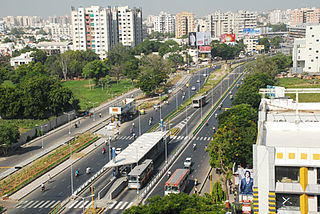
Janmarg, also known as Ahmedabad BRTS, is a bus rapid transit system in Ahmedabad, Gujarat, India. It is operated by Ahmedabad Janmarg Limited, a subsidiary of Ahmedabad Municipal Corporation and others. It is designed by CEPT University. It was inaugurated in October 2009. The network expanded to 89 kilometres (55 mi) by December 2017 with daily ridership of 3,49,000 passengers. BRTS won several nation and international awards for design, implementation and operation. It was rated Silver on BRT Standard in 2013.

Lucknow Metro is a rapid transit system serving the city of Lucknow in the Indian state of Uttar Pradesh. Construction of the line begun on 27 September 2014 with the 8.5 km (5.3 mi) stretch from Transport Nagar to Charbagh Railway Station which began its commercial operation on 5 September 2017, making it the fastest built metro rail system in the country. Full operation on Red Line stretch from Chaudhary Charan Singh International Airport metro station to Munshi Pulia metro station began operation on 9 March 2019.

Ahmedabad Metro is a rapid transit system for the cities of Ahmedabad, Gandhinagar in Gujarat, India. It is being built by Gujarat Metro Rail Corporation (GMRC) Limited, a Special Purpose Vehicle company constituted in 2018 to implement all metro projects in Gujarat.

Urban rail transit in India consists of suburban rail, rapid transit, monorail, light rail, and tram systems.

The Delhi Metro is a rapid transit system serving Delhi and its satellite cities of Ghaziabad, Faridabad, Gurugram, Noida, Bahadurgarh and Ballabhgarh, in the National Capital Region of India. It is by far the largest and busiest metro in India, and second oldest after the Kolkata Metro. The network consists of 10 colour-coded lines serving 253 stations with a total length of 389 kilometres (242 mi), 285 stations, including the Gurugram Metro and Noida Metro. The system has a mix of underground, at-grade, and elevated stations using both broad-gauge and standard-gauge. Delhi Metro operates over 2,700 trips daily, starting at around 05:00 and ending at 23:30.
Mumbai–Ahmedabad High Speed Rail Corridor is an under-construction high-speed rail line connecting the cities of Ahmedabad and India's economic hub Mumbai. When completed, it will be India's first high-speed rail line.

The Noida Metro is a rapid transit system connecting the twin cities of Noida and Greater Noida in Gautam Buddh Nagar, Uttar Pradesh, India. The metro network consists of one line, with a total length of 29.7 kilometres (18.5 mi) serving 21 stations. A second line is planned. The system has all elevated stations using standard-gauge tracks.
The East-West Corridor of the Ahmedabad Metro is a metro route of mass rapid transit system in Ahmedabad, India. It consists of 18 metro stations from Thaltej Gam to Vastral Gam with a total distance of 21.16 km (13.15 mi). Most of the line is elevated.


