List of gerbillines

Last updated

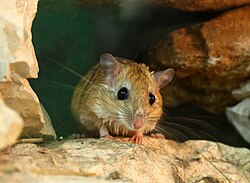
Cheesman's gerbil (Gerbillus cheesmani) Gerbillus cheesmani 327698887.jpg
Cheesman's gerbil (Gerbillus cheesmani)

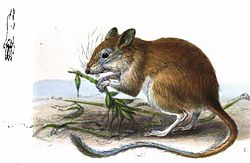
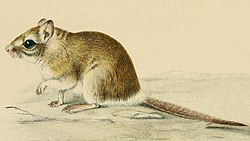
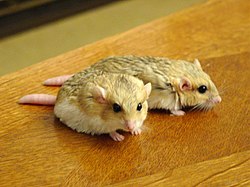
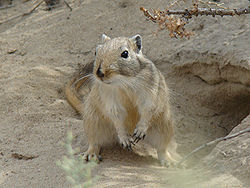
Gerbillinae is a subfamily of mammals in the rodent family Muridae, which in turn is part of the Myomorpha suborder in the order Rodentia. Members of this subfamily are called gerbillines and include gerbils, jirds, and sand rats. They are found in Africa and Asia, primarily in shrublands, grasslands, savannas, and deserts, though some species can be found in forests and coastal areas. They range in size from the pouched gerbil, at 5 cm (2 in) plus a 3 cm (1 in) tail, to the large Aden gerbil, at 22 cm (9 in) plus a 11 cm (4 in) tail. Gerbillines generally eat seeds, roots, nuts, grass, and insects, as well as grain and other vegetation. Few gerbillines have population estimates, but the western gerbil is categorized as endangered, and Dahl's jird is categorized as critically endangered, with a population of below 2,000.

Contents

The 102 extant species of Gerbillinae are divided into 14 genera, with 49—nearly half—in the Gerbillus genus. The Mongolian gerbil, as well as some other species such as the fat-tailed gerbil, are kept as pets. [1] Several extinct prehistoric gerbilline species have been discovered, though due to ongoing research and discoveries, the exact number and categorization are not fixed. [2]

Conventions

IUCN Red List categories
Conservation status
 EX  Extinct (0 species)
 EW  Extinct in the wild (0 species)
 CR  Critically endangered (1 species)
 EN  Endangered (1 species)
 VU  Vulnerable (2 species)
 NT  Near threatened (0 species)
 LC  Least concern (74 species)
Other categories
 DD  Data deficient (19 species)
 NE  Not evaluated (5 species)

The author citation for the species or genus is given after the scientific name; parentheses around the author citation indicate that this was not the original taxonomic placement. Conservation status codes listed follow the International Union for Conservation of Nature (IUCN) Red List of Threatened Species. Range maps are provided wherever possible; if a range map is not available, a description of the gerbilline's range is provided. Ranges are based on the IUCN Red List for that species unless otherwise noted.

Classification

Gerbillinae is a subfamily of the rodent family Muridae consisting of 102 extant species in 14 genera. These genera range in size from 1 to 49 species, with the latter, Gerbillus, making up almost half of the subfamily. This does not include hybrid species or extinct prehistoric species.

Subfamily Gerbillinae

Gerbillinae [3]

Gerbillines

The following classification is based on the taxonomy described by the reference work Mammal Species of the World (2005), with augmentation by generally accepted proposals made since using molecular phylogenetic analysis, as supported by both the IUCN and the American Society of Mammalogists. [4]

Genus Ammodillus Thomas, 1904 – one species
Common nameScientific name and subspeciesRangeSize and ecologyIUCN status and estimated population
Ammodile


A. imbellis
(De Winton, 1898)
Ethiopia and Somalia Size: 8–11 cm (3–4 in) long, plus 12–15 cm (5–6 in) tail [5]

Habitat: Grassland [6]

Diet: Plant material and invertebrates [7]
 DD 


Unknown Steady2.svg [6]

Genus Brachiones Thomas, 1925 – one species
Common nameScientific name and subspeciesRangeSize and ecologyIUCN status and estimated population
Przewalski's gerbil

Brachiones.jpg

B. przewalskii
(Büchner, 1889)
Northern ChinaSize: 6–11 cm (2–4 in) long, plus 5–8 cm (2–3 in) tail [8]

Habitat: Desert [9]

Diet: Plant material and invertebrates [7]
 LC 


Unknown Blue question mark (italic).svg [9]

Genus Desmodilliscus Wettstein, 1916 – one species
Common nameScientific name and subspeciesRangeSize and ecologyIUCN status and estimated population
Pouched gerbil


D. braueri
Wettstein, 1916
Western and northern Africa (all colors)
Distribution of Desmodilliscus braueri.png
Size: 5–8 cm (2–3 in) long, plus 3–5 cm (1–2 in) tail [8]

Habitat: Savanna [10]

Diet: Grain [11]
 LC 


Unknown Steady2.svg [10]

Genus Desmodillus Thomas & Schwann, 1904 – one species
Common nameScientific name and subspeciesRangeSize and ecologyIUCN status and estimated population
Cape short-eared gerbil

Desmodillus auricularis.jpg

D. auricularis
(Smith, 1834)
Southern AfricaSize: 8–13 cm (3–5 in) long, plus 7–10 cm (3–4 in) tail [5]

Habitat: Desert [12]

Diet: Seeds, grain, and insects [13]
 LC 


Unknown Steady2.svg [12]

Genus Gerbilliscus Thomas, 1897 – sixteen species
Common nameScientific name and subspeciesRangeSize and ecologyIUCN status and estimated population
Black-tailed gerbil


G. nigricaudus
(Peters, 1878)
Eastern AfricaSize: 13–20 cm (5–8 in) long, plus 17–21 cm (7–8 in) tail [14]

Habitat: Shrubland, savanna, and forest [15]

Diet: Roots, bulbs, seeds, vegetation, and insects [16]
 LC 


Unknown Steady2.svg [15]

Boehm's gerbil


G. boehmi
(Noack, 1887)
Central AfricaSize: 13–18 cm (5–7 in) long, plus 19–23 cm (7–9 in) tail [5]

Habitat: Shrubland and savanna [17]

Diet: Roots, bulbs, seeds, vegetation, and insects [16]
 LC 


Unknown Steady2.svg [17]

Bushveld gerbil

Gerbilliscus leucogaster 228171969.jpg

G. leucogaster
(Peters, 1852)
Southern AfricaSize: 8–16 cm (3–6 in) long, plus 12–18 cm (5–7 in) tail [5]

Habitat: Grassland, shrubland, savanna, and desert [18]

Diet: Roots, bulbs, seeds, vegetation, and insects [16]
 LC 


Unknown Steady2.svg [18]

Bushy-tailed hairy-footed gerbil


G. vallinus
Thomas, 1918
Namibia and South Africa Size: 9–11 cm (4–4 in) long, plus 11–16 cm (4–6 in) tail [14]

Habitat: Savanna, grassland, and desert [19]

Diet: Seeds [20]
 LC 


Unknown Steady2.svg [19]

Cape gerbil

Gerbilliscus afer.jpg

G. afra
(Gray, 1830)
South AfricaSize: 12–16 cm (5–6 in) long, plus 13–18 cm (5–7 in) tail [5]

Habitat: Desert and shrubland [21]

Diet: Roots, bulbs, seeds, vegetation, and insects [16]
 LC 


Unknown Blue question mark (italic).svg [21]

Dune hairy-footed gerbil


G. tytonis
Bauer & Niethammer, 1960
NamibiaSize: 9–11 cm (4–4 in) long, plus 11–15 cm (4–6 in) tail [5]

Habitat: Desert [22]

Diet: Seeds [20]
 LC 


Unknown Steady2.svg [22]

Fringe-tailed gerbil


G. robustus
(Cretzschmar, 1826)
Eastern AfricaSize: 12–19 cm (5–7 in) long, plus 12–21 cm (5–8 in) tail [14]

Habitat: Savanna and grassland [23]

Diet: Roots, bulbs, seeds, vegetation, and insects [16]
 LC 


Unknown Steady2.svg [23]

Gorongoza gerbil


G. inclusus
(Thomas & Wroughton, 1908)
Southeastern AfricaSize: 15–17 cm (6–7 in) long, plus 13–20 cm (5–8 in) tail [5]

Habitat: Savanna [24]

Diet: Roots, bulbs, seeds, vegetation, and insects [16]
 LC 


Unknown Blue question mark (italic).svg [24]

Guinean gerbil


G. guineae
(Thomas, 1910)
Western AfricaSize: 10–18 cm (4–7 in) long, plus 15–20 cm (6–8 in) tail [5]

Habitat: Savanna, rocky areas, forest, and shrubland [25]

Diet: Roots, bulbs, seeds, vegetation, and insects [16]
 LC 


Unknown Steady2.svg [25]

Hairy-footed gerbil

Hairy-footed Gerbil, Benede Oranje, South Africa imported from iNaturalist photo 169574421.jpg

G. paeba
Smith, 1836
Southern AfricaSize: 8–11 cm (3–4 in) long, plus 10–13 cm (4–5 in) tail [14]

Habitat: Savanna, desert, and shrubland [26]

Diet: Seeds [20]
 LC 


Unknown Steady2.svg [26]

Highveld gerbil

Highveld Gerbil, Klippan, Eastvaal District Council, South Africa imported from iNaturalist photo 23046283.jpg

G. brantsii
(Smith, 1836)
Southern Africa
Gerbilliscus brantsii Distribution.png
Size: 9–17 cm (4–7 in) long, plus 10–19 cm (4–7 in) tail [5]

Habitat: Savanna, shrubland, desert, and grassland [27]

Diet: Roots, bulbs, seeds, vegetation, and insects [16]
 LC 


Unknown Blue question mark (italic).svg [27]

Kemp's gerbil

Gerbilliscus kempi SierraLeone.jpg

G. kempi
(Wroughton, 1906)
Western and central AfricaSize: 14–19 cm (6–7 in) long, plus 14–18 cm (6–7 in) tail [5]

Habitat: Savanna, forest, and shrubland [28]

Diet: Roots, bulbs, seeds, vegetation, and insects [16]
 LC 


Unknown Blue question mark (italic).svg [28]

Namib brush-tailed gerbil


G. setzeri
Schlitter, 1973
Namibia and Angola Size: 10–12 cm (4–5 in) long, plus 11–15 cm (4–6 in) tail [14]

Habitat: Desert [29]

Diet: Seeds [20]
 LC 


Unknown Steady2.svg [29]

Phillips's gerbil


G. phillipsi
(De Winton, 1898)
Eastern AfricaSize: 11–15 cm (4–6 in) long, plus 16–19 cm (6–7 in) tail [14]

Habitat: Shrubland [30]

Diet: Roots, bulbs, seeds, vegetation, and insects [16]
 LC 


Unknown Blue question mark (italic).svg [30]

Sahelo-Sudanian gerbil


G. gambiana
Thomas, 1910
Western AfricaSize: 12–20 cm (5–8 in) long, plus 13–18 cm (5–7 in) tail [5]

Habitat: Savanna and forest [31]

Diet: Roots, bulbs, seeds, vegetation, and insects [16]
 LC 


Unknown Steady2.svg [31]

Savanna gerbil


G. validus
(Bocage, 1890)
Central AfricaSize: 13–20 cm (5–8 in) long, plus 11–19 cm (4–7 in) tail [5]

Habitat: Savanna [32]

Diet: Roots, bulbs, seeds, vegetation, and insects [16]
 LC 


Unknown Steady2.svg [32]

Genus Gerbillus Desmarest, 1804 – 49 species
Common nameScientific name and subspeciesRangeSize and ecologyIUCN status and estimated population
Agag gerbil


G. agag
Thomas, 1903
Central AfricaSize: 9–14 cm (4–6 in) long, plus 10–15 cm (4–6 in) tail [33]

Habitat: Unknown [34]

Diet: Seeds, roots, nuts, grass, and insects [35]
 DD 


Unknown Blue question mark (italic).svg [34]

Algerian gerbil


G. garamantis
(Lataste, 1881)
Northern Africa [36] Size: 7–8 cm (3–3 in) long, plus about 11 cm (4 in) tail [36]

Habitat: Desert, shrubland, and savanna [37]

Diet: Seeds, roots, nuts, grass, and insects [35]
 NE 


Unknown Blue question mark (italic).svg

Anderson's gerbil


G. andersoni
De Winton, 1902
Northeastern Africa and western Middle EastSize: 7–12 cm (3–5 in) long, plus 9–14 cm (4–6 in) tail [33]

Habitat: Desert and coastal marine [38]

Diet: Seeds, roots, nuts, grass, and insects [35]
 LC 


Unknown Blue question mark (italic).svg [38]

Balochistan gerbil

GerbillusNanus.jpg

G. nanus
Blanford, 1875
Northern Africa and western AsiaSize: 7–11 cm (3–4 in) long, plus 8–15 cm (3–6 in) tail [5]

Habitat: Desert, shrubland, and savanna [37]

Diet: Seeds, roots, nuts, grass, and insects [35]
 LC 


Unknown Steady2.svg [37]

Berbera gerbil


G. acticola
Thomas, 1918
SomaliaSize: 9–11 cm (4–4 in) long, plus 12–15 cm (5–6 in) tail [33]

Habitat: Unknown [39]

Diet: Seeds, roots, nuts, grass, and insects [35]
 DD 


Unknown Blue question mark (italic).svg [39]

Black-tufted gerbil


G. famulus
Yerbury & Thomas, 1895
Yemen Size: 8–11 cm (3–4 in) long, plus 12–15 cm (5–6 in) tail [36]

Habitat: Desert, shrubland, and savanna [40]

Diet: Seeds, roots, nuts, grass, and insects [35]
 LC 


Unknown Blue question mark (italic).svg [40]

Botta's gerbil


G. bottai
(Lataste, 1882)
Sudan Size: 8–10 cm (3–4 in) long, plus 10–11 cm (4–4 in) tail [36]

Habitat: Unknown [41]

Diet: Seeds, roots, nuts, grass, and insects [35]
 DD 


Unknown Blue question mark (italic).svg [41]

Brockman's gerbil


G. brockmani
(Thomas, 1910)
SomaliaSize: 7–9 cm (3–4 in) long, plus 10–12 cm (4–5 in) tail [36]

Habitat: Unknown [42]

Diet: Seeds, roots, nuts, grass, and insects [35]
 DD 


Unknown Blue question mark (italic).svg [42]

Burton's gerbil

Gerbillus burtoni.jpg

G. burtoni
(F. Cuvier, 1838)
SudanSize: Unknown [33]

Habitat: Unknown [43]

Diet: Seeds, roots, nuts, grass, and insects [35]
 DD 


Unknown Blue question mark (italic).svg [43]

Cheesman's gerbil

Cheesman's Gerbil 2.JPG

G. cheesmani
Thomas, 1919
Middle EastSize: 7–11 cm (3–4 in) long, plus 9–15 cm (4–6 in) tail [36]

Habitat: Shrubland and desert [44]

Diet: Seeds, roots, nuts, grass, and insects [35]
 LC 


Unknown Steady2.svg [44]

Cushioned gerbil


G. pulvinatus
Rhoads, 1896
Eastern AfricaSize: 8–11 cm (3–4 in) long, plus 11–15 cm (4–6 in) tail [33]

Habitat: Rocky areas, savanna, desert, grassland, and shrubland [45]

Diet: Seeds, roots, nuts, grass, and insects [35]
 LC 


Unknown Blue question mark (italic).svg [45]

Darfur gerbil


G. muriculus
Thomas & Hinton, 1923
SudanSize: About 7 cm (3 in) long, plus about 8 cm (3 in) tail [36]

Habitat: Unknown [46]

Diet: Seeds, roots, nuts, grass, and insects [35]
 DD 


Unknown Blue question mark (italic).svg [46]

Dunn's gerbil


G. dunni
Thomas, 1904
Eastern AfricaSize: 9–11 cm (4–4 in) long, plus 13–15 cm (5–6 in) tail [33]

Habitat: Desert, rocky areas, grassland, and savanna [47]

Diet: Seeds, roots, nuts, grass, and insects [35]
 LC 


Unknown Blue question mark (italic).svg [47]

Flower's gerbil


G. floweri
(Thomas, 1919)
EgyptSize: 9–13 cm (4–5 in) long, plus 13–16 cm (5–6 in) tail [33]

Habitat: Desert, shrubland, and rocky areas [48]

Diet: Seeds, roots, nuts, grass, and insects [35]
 LC 


Unknown Steady2.svg [48]

Greater Egyptian gerbil

Gerbillus pyramidum Museum de Geneve.JPG

G. pyramidum
Geoffroy, 1803
Northern AfricaSize: 10–14 cm (4–6 in) long, plus 12–18 cm (5–7 in) tail [33]

Habitat: Desert [49]

Diet: Seeds, roots, nuts, grass, and insects [35]
 LC 


Unknown Steady2.svg [49]

Greater short-tailed gerbil


G. maghrebi
(Schlitter & Setzer, 1972)
Morocco Size: 10–12 cm (4–5 in) long, plus 10–12 cm (4–5 in) tail [36]

Habitat: Shrubland and grassland [50]

Diet: Seeds, roots, nuts, grass, and insects [35]
 LC 


Unknown Blue question mark (italic).svg [50]

Grobben's gerbil


G. grobbeni
Klaptocz, 1909
Northern Libya Size: About 8 cm (3 in) long, plus about 12 cm (5 in) tail [36]

Habitat: Coastal marine [51]

Diet: Seeds, roots, nuts, grass, and insects [35]
 DD 


Unknown Blue question mark (italic).svg [51]

Harrison's gerbil


G. mesopotamiae
Harrison, 1956
Middle EastSize: 7–10 cm (3–4 in) long, plus 8–13 cm (3–5 in) tail [36]

Habitat: Desert [52]

Diet: Seeds, roots, nuts, grass, and insects [35]
 LC 


Unknown Decrease2.svg [52]

Harwood's gerbil


G. harwoodi
(Thomas, 1901)
Kenya and Tanzania Size: 6–9 cm (2–4 in) long, plus 8–12 cm (3–5 in) tail [36]

Habitat: Savanna, grassland, and forest [53]

Diet: Seeds, roots, nuts, grass, and insects [35]
 LC 


Unknown Steady2.svg [53]

Hoogstraal's gerbil

Gerbillus hoogstraali.jpg

G. hoogstraali
(Lay, 1975)
MoroccoSize: 8–10 cm (3–4 in) long, plus 10–13 cm (4–5 in) tail [33]

Habitat: Desert and coastal marine [54]

Diet: Seeds, roots, nuts, grass, and insects [35]
 VU 


Unknown Blue question mark (italic).svg [54]

Indian hairy-footed gerbil


G. gleadowi
(Murray, 1886)
Pakistan and IndiaSize: 7–11 cm (3–4 in) long, plus 11–15 cm (4–6 in) tail [33]

Habitat: Desert [55]

Diet: Seeds, roots, nuts, grass, and insects [35]
 LC 


Unknown Decrease2.svg [55]

James's gerbil


G. jamesi
(Harrison, 1867)
Tunisia Size: About 8 cm (3 in) long, plus about 11 cm (4 in) tail [36]

Habitat: Unknown [56]

Diet: Seeds, roots, nuts, grass, and insects [35]
 DD 


Unknown Blue question mark (italic).svg [56]

Khartoum gerbil


G. stigmonyx
(Heuglin, 1877)
Sudan Size: 8–10 cm (3–4 in) long, plus 9–11 cm (4–4 in) tail [36]

Habitat: Shrubland, rocky areas, and grassland [57]

Diet: Seeds, roots, nuts, grass, and insects [35]
 DD 


Unknown Blue question mark (italic).svg [57]

Large Aden gerbil


G. poecilops
Yerbury & Thomas, 1895
Western Saudi Arabia and western YemenSize: 15–22 cm (6–9 in) long, plus 7–11 cm (3–4 in) tail [5]

Habitat: Shrubland and desert [58]

Diet: Seeds, roots, nuts, grass, and insects [35]
 LC 


Unknown Blue question mark (italic).svg [58]

Lataste's gerbil


G. latastei
Thomas, 1903
TunisiaSize: 9–12 cm (4–5 in) long, plus 11–15 cm (4–6 in) tail [33]

Habitat: Shrubland and desert [59]

Diet: Seeds, roots, nuts, grass, and insects [35]
 DD 


Unknown Blue question mark (italic).svg [59]

Least gerbil


G. pusillus
Peters, 1878
Eastern AfricaSize: 5–8 cm (2–3 in) long, plus 8–12 cm (3–5 in) tail [5]

Habitat: Grassland, rocky areas, and shrubland [60]

Diet: Seeds, roots, nuts, grass, and insects [35]
 LC 


Unknown Blue question mark (italic).svg [60]

Lesser Egyptian gerbil

Gerbillus gerbillus 242402179 1.jpg

G. gerbillus
(Olivier, 1801)
Northern Africa
Gerbillus gerbillus distribution.png
Size: 7–11 cm (3–4 in) long, plus 9–14 cm (4–6 in) tail [33]

Habitat: Coastal marine and desert [61]

Diet: Seeds, roots, nuts, grass, and insects [35]
 LC 


Unknown Steady2.svg [61]

Lesser short-tailed gerbil

Gerbillus simoni.jpg

G. simoni
Lataste, 1881
Northern AfricaSize: 6–11 cm (2–4 in) long, plus 5–10 cm (2–4 in) tail [36]

Habitat: Shrubland [62]

Diet: Seeds, roots, nuts, grass, and insects [35]
 LC 


Unknown Blue question mark (italic).svg [62]

Lowe's gerbil


G. lowei
(Thomas & Hinton, 1923)
Western SudanSize: 8–12 cm (3–5 in) long, plus 14–16 cm (6–6 in) tail [36]

Habitat: Rocky areas [63]

Diet: Seeds, roots, nuts, grass, and insects [35]
 DD 


Unknown Blue question mark (italic).svg [63]

Mackilligin's gerbil


G. mackilligini
(Thomas, 1904)
Southern Egypt and Northern SudanSize: 7–9 cm (3–4 in) long, plus 9–14 cm (4–6 in) tail [36]

Habitat: Desert and shrubland [64]

Diet: Seeds, roots, nuts, grass, and insects [35]
 LC 


Unknown Steady2.svg [64]

Mauritanian gerbil


G. mauritaniae
Heim de Balsac, 1943
Northern Mauritania [36] Size: About 6 cm (2 in) long, plus about 8 cm (3 in) tail [36]

Habitat: Savanna and grassland [65]

Diet: Seeds, roots, nuts, grass, and insects [35]
 NE 


Unknown Blue question mark (italic).svg

Nigerian gerbil


G. nigeriae
Thomas & Hinton, 1920
Western MauritaniaSize: 7–11 cm (3–4 in) long, plus 10–16 cm (4–6 in) tail [33]

Habitat: Savanna, grassland, desert, and shrubland [66]

Diet: Seeds, roots, nuts, grass, and insects [35]
 LC 


Unknown Steady2.svg [66]

North African gerbil

Dipodillus campestris - North African Gerbil.jpg

G. campestris
Loche, 1867
Northern Africa
Gerbillus campestris distribution.png
Size: 9–12 cm (4–5 in) long, plus 11–16 cm (4–6 in) tail [36]

Habitat: Rocky areas and desert [67]

Diet: Seeds, roots, nuts, grass, and insects [35]
 LC 


Unknown Blue question mark (italic).svg [67]

Occidental gerbil


G. occiduus
Lay, 1975
Morocco Size: 7–10 cm (3–4 in) long, plus 9–13 cm (4–5 in) tail [33]

Habitat: Coastal marine and desert [68]

Diet: Seeds, roots, nuts, grass, and insects [35]
 DD 


Unknown Blue question mark (italic).svg [68]

Pale gerbil

Perpallidus.jpg

G. perpallidus
Setzer, 1958
Northern EgyptSize: 9–13 cm (4–5 in) long, plus 13–16 cm (5–6 in) tail [33]

Habitat: Coastal marine and desert [69]

Diet: Seeds, roots, nuts, grass, and insects [35]
 LC 


Unknown Steady2.svg [69]

Pleasant gerbil


G. amoenus
(De Winton, 1902)
Scattered northern AfricaSize: 7–11 cm (3–4 in) long, plus 9–15 cm (4–6 in) tail [36]

Habitat: Savanna, desert, and coastal marine [70]

Diet: Seeds, roots, nuts, grass, and insects [35]
 LC 


Unknown Blue question mark (italic).svg [70]

Principal gerbil


G. principulus
Thomas & Hinton, 1923
Western SudanSize: About 7 cm (3 in) long, plus about 12 cm (5 in) tail [36]

Habitat: Grassland and shrubland [71]

Diet: Seeds, roots, nuts, grass, and insects [35]
 DD 


Unknown Blue question mark (italic).svg [71]

Pygmy gerbil

Pygmy Gerbil imported from iNaturalist photo 260302397 on 14 February 2024.jpg

G. henleyi
De Winton, 1903
Northern Africa and Middle EastSize: 5–8 cm (2–3 in) long, plus 7–11 cm (3–4 in) tail [5]

Habitat: Desert, shrubland, and rocky areas [72]

Diet: Seeds, roots, nuts, grass, and insects [35]
 LC 


Unknown Blue question mark (italic).svg [72]

Rosalinda gerbil


G. rosalinda
St. Leger, 1929
SudanSize: 8–11 cm (3–4 in) long, plus 10–13 cm (4–5 in) tail [33]

Habitat: Grassland [73]

Diet: Seeds, roots, nuts, grass, and insects [35]
 LC 


Unknown Blue question mark (italic).svg [73]

Rupicolous gerbil


G. rupicola
(Granjon, Aniskin, Volobouev, & Sicard, 2002)
Mali Size: 9–11 cm (4–4 in) long, plus 13–15 cm (5–6 in) tail [36]

Habitat: Savanna and rocky areas [74]

Diet: Seeds, roots, nuts, grass, and insects [35]
 LC 


Unknown Blue question mark (italic).svg [74]

Sand gerbil


G. syrticus
(Misonne, 1974)
Northeastern Libya [5] Size: About 5 cm (2 in) long, plus about 5 cm (2 in) tail [5]

Habitat: Desert, shrubland, and rocky areas [72]

Diet: Seeds, roots, nuts, grass, and insects [35]
 NE 


Unknown Blue question mark (italic).svg

Somalian gerbil


G. somalicus
(Thomas, 1910)
Eastern AfricaSize: 8–9 cm (3–4 in) long, plus 11–13 cm (4–5 in) tail [36]

Habitat: Grassland, desert, and shrubland [75]

Diet: Seeds, roots, nuts, grass, and insects [35]
 DD 


Unknown Blue question mark (italic).svg [75]

Sudan gerbil


G. nancillus
Thomas & Hinton, 1923
Northern AfricaSize: 5–7 cm (2–3 in) long, plus 7–9 cm (3–4 in) tail [36]

Habitat: Savanna and grassland [65]

Diet: Seeds, roots, nuts, grass, and insects [35]
 DD 


Unknown Blue question mark (italic).svg [65]

Swarthy gerbil


G. aquilus
Schlitter & Setzer, 1972
West-central AsiaSize: 9–11 cm (4–4 in) long, plus 12–16 cm (5–6 in) tail [36]

Habitat: Grassland and forest [76]

Diet: Seeds, roots, nuts, grass, and insects [35]
 LC 


Unknown Blue question mark (italic).svg [76]

Tarabul's gerbil

Riggenbach's Gerbil, Oued el Dahab, EH imported from iNaturalist photo 478112274.jpg

G. tarabuli
(Thomas, 1902)
Northwestern AfricaSize: 8–12 cm (3–5 in) long, plus 10–16 cm (4–6 in) tail [33]

Habitat: Desert, coastal marine, and savanna [77]

Diet: Seeds, roots, nuts, grass, and insects [35]
 LC 


Unknown Steady2.svg [77]

Vivacious gerbil


G. vivax
(Thomas, 1902)
Northern Africa and western Asia [36] Size: About 8 cm (3 in) long, plus about 11 cm (4 in) tail [36]

Habitat: Desert, shrubland, savanna, and coastal marine [37] [70]

Diet: Seeds, roots, nuts, grass, and insects [35]
 NE 


Unknown Blue question mark (italic).svg

Wagner's gerbil

Gerbillus dasyurus.jpg

G. dasyurus
(Wagner, 1842)
Egypt and Middle EastSize: 7–11 cm (3–4 in) long, plus 8–14 cm (3–6 in) tail [36]

Habitat: Rocky areas, desert, and shrubland [78]

Diet: Seeds, roots, nuts, grass, and insects [35]
 LC 


Unknown Steady2.svg [78]

Waters's gerbil

Gerbillus watersi 1901.jpg

G. watersi
De Winton, 1901
Sudan and EgyptSize: 7–10 cm (3–4 in) long, plus 9–13 cm (4–5 in) tail [36]

Habitat: Shrubland, desert, and grassland [79]

Diet: Seeds, roots, nuts, grass, and insects [35]
 LC 


Unknown Blue question mark (italic).svg [79]

Western gerbil


G. hesperinus
Cabrera, 1936
MoroccoSize: 9–12 cm (4–5 in) long, plus 9–12 cm (4–5 in) tail [33]

Habitat: Coastal marine [80]

Diet: Seeds, roots, nuts, grass, and insects [35]
 EN 


Unknown Decrease2.svg [80]

Genus Meriones Illiger, 1811 – seventeen species
Common nameScientific name and subspeciesRangeSize and ecologyIUCN status and estimated population
Arabian jird

Meriones arimalius 479598443 (cropped).jpg

M. arimalius
Cheesman & Hinton, 1924
Arabian PeninsulaSize: About 13 cm (5 in) long, plus about 16 cm (6 in) tail [8]

Habitat: Desert [81]

Diet: Vegetation, roots, bulbs, seeds, grain, fruit, and insects [82]
 LC 


Unknown Blue question mark (italic).svg [81]

Buxton's jird

mryvn KHvlvt bngb hTSpvny, TSylvm- Andrh z`rvr.jpg

M. sacramenti
Thomas, 1922
Egypt and Middle EastSize: 13–17 cm (5–7 in) long, plus 12–18 cm (5–7 in) tail [8]

Habitat: Desert, grassland, and shrubland [83]

Diet: Vegetation, roots, bulbs, seeds, grain, fruit, and insects [82]
 VU 


Unknown Decrease2.svg [83]

Cheng's jird


M. chengi
Wang, 1964
Northwestern ChinaSize: 11–15 cm (4–6 in) long, plus 8–12 cm (3–5 in) tail [33]

Habitat: Shrubland and grassland [84]

Diet: Vegetation, roots, bulbs, seeds, grain, fruit, and insects [82]
 LC 


Unknown Blue question mark (italic).svg [84]

Dahl's jird


M. dahli
Shidlovski, 1962
Western AsiaSize: 10–14 cm (4–6 in) long, plus 7–14 cm (3–6 in) tail [85]

Habitat: Desert [86]

Diet: Vegetation, roots, bulbs, seeds, grain, fruit, and insects [82]
 CR 


1600–2000 Decrease2.svg [86]

Indian desert jird

Indian Desert Jird.jpeg

M. hurrianae
Jerdon, 1867
Southern AsiaSize: 11–15 cm (4–6 in) long, plus 10–16 cm (4–6 in) tail [8]

Habitat: Savanna, shrubland, desert, and grassland [87]

Diet: Vegetation, roots, bulbs, seeds, grain, fruit, and insects [82]
 LC 


Unknown Blue question mark (italic).svg [87]

King jird

King Jird, Ahad Rafidah Saudi Arabia imported from iNaturalist photo 260302363.jpg

M. rex
Yerbury & Thomas, 1895
Saudi Arabia and YemenSize: 13–18 cm (5–7 in) long, plus 10–20 cm (4–8 in) tail [8]

Habitat: Desert, shrubland, and savanna [88]

Diet: Vegetation, roots, bulbs, seeds, grain, fruit, and insects [82]
 LC 


Unknown Blue question mark (italic).svg [88]

Libyan jird

Libyan Jird.jpg

M. libycus
Lichtenstein, 1823
Northern Africa and western and central AsiaSize: 12–17 cm (5–7 in) long, plus 11–19 cm (4–7 in) tail [8]

Habitat: Inland wetlands, shrubland, and desert [89]

Diet: Vegetation, roots, bulbs, seeds, grain, fruit, and insects [82]
 LC 


Unknown Steady2.svg [89]

Midday jird

Meriones meridianus in Mongolia (cropped).jpg

M. meridianus
(Pallas, 1773)
Southwestern RussiaSize: 10–14 cm (4–6 in) long, plus 7–14 cm (3–6 in) tail [33]

Habitat: Desert [90]

Diet: Vegetation, roots, bulbs, seeds, grain, fruit, and insects [82]
 LC 


Unknown Blue question mark (italic).svg [90]

Mongolian gerbil

Meriones unguiculatus (wild).jpg

M. unguiculatus
(A. Milne-Edwards, 1867)
East-central AsiaSize: 9–14 cm (4–6 in) long, plus 8–11 cm (3–4 in) tail [8]

Habitat: Grassland, shrubland, and desert [91]

Diet: Vegetation, roots, bulbs, seeds, grain, fruit, and insects [82]
 LC 


Unknown Blue question mark (italic).svg [91]

Moroccan jird


M. grandis
Cabrera, 1907
Northwestern AfricaSize: 15–20 cm (6–8 in) long, plus 16–18 cm (6–7 in) tail [8]

Habitat: Shrubland [92]

Diet: Vegetation, roots, bulbs, seeds, grain, fruit, and insects [82]
 LC 


Unknown Steady2.svg [92]

Persian jird

Meriones persicus.jpg

M. persicus
(Blanford, 1875)
West-central AsiaSize: 12–17 cm (5–7 in) long, plus 12–19 cm (5–7 in) tail [33]

Habitat: Shrubland, rocky areas, and grassland [93]

Diet: Vegetation, roots, bulbs, seeds, grain, fruit, and insects [82]
 LC 


Unknown Blue question mark (italic).svg [93]

Shaw's jird

Shaw's Jird, El Achir, Algerie imported from iNaturalist photo 261672326.jpg

M. shawi
(Duvernoy, 1842)
Northern AfricaSize: 13–18 cm (5–7 in) long, plus 11–18 cm (4–7 in) tail [8]

Habitat: Shrubland [94]

Diet: Vegetation, roots, bulbs, seeds, grain, fruit, and insects [82]
 LC 


Unknown Steady2.svg [94]

Sundevall's jird

Sundevall's Jird, Bechar, Bechar, Algerie imported from iNaturalist photo 265557363.jpg

M. crassus
Sundevall, 1842
Northern Africa and western AsiaSize: 10–16 cm (4–6 in) long, plus 9–16 cm (4–6 in) tail [8]

Habitat: Desert [95]

Diet: Vegetation, roots, bulbs, seeds, grain, fruit, and insects [82]
 LC 


Unknown Blue question mark (italic).svg [95]

Tamarisk jird

Meriones tamariscinus 259506815.jpg

M. tamariscinus
(Pallas, 1773)
Southwestern RussiaSize: 13–19 cm (5–7 in) long, plus 11–15 cm (4–6 in) tail [33]

Habitat: Desert and grassland [96]

Diet: Vegetation, roots, bulbs, seeds, grain, fruit, and insects [82]
 LC 


Unknown Blue question mark (italic).svg [96]

Tristram's jird

Meriones tristrami - full body.jpg

M. tristrami
Thomas, 1892
Western AsiaSize: 10–18 cm (4–7 in) long, plus 10–17 cm (4–7 in) tail [8]

Habitat: Shrubland [97]

Diet: Vegetation, roots, bulbs, seeds, grain, fruit, and insects [82]
 LC 


Unknown Steady2.svg [97]

Vinogradov's jird


M. vinogradovi
Geptner, 1931
Western AsiaSize: 14–17 cm (6–7 in) long, plus 13–17 cm (5–7 in) tail [8]

Habitat: Shrubland and rocky areas [98]

Diet: Vegetation, roots, bulbs, seeds, grain, fruit, and insects [82]
 LC 


Unknown Blue question mark (italic).svg [98]

Zarudny's jird


M. zarudnyi
Geptner, 1937
Central AsiaSize: About 16 cm (6 in) long, plus about 16 cm (6 in) tail [8]

Habitat: Desert [99]

Diet: Vegetation, roots, bulbs, seeds, grain, fruit, and insects [82]
 DD 


Unknown Blue question mark (italic).svg [99]

Genus Microdillus Thomas, 1910 – one species
Common nameScientific name and subspeciesRangeSize and ecologyIUCN status and estimated population
Somali pygmy gerbil


M. peeli
(De Winton, 1898)
SomaliaSize: 6–8 cm (2–3 in) long, plus 5–7 cm (2–3 in) tail [33]

Habitat: Grassland and shrubland [100]

Diet: Seeds, roots, nuts, grass, and insects [101]
 DD 


Unknown Blue question mark (italic).svg [100]

Genus Pachyuromys Lataste, 1880 – one species
Common nameScientific name and subspeciesRangeSize and ecologyIUCN status and estimated population
Fat-tailed gerbil

Pachyuromys-duprasi PeterMaas.jpg

P. duprasi
Lataste, 1880
Northern AfricaSize: 9–12 cm (4–5 in) long, plus 5–7 cm (2–3 in) tail [8]

Habitat: Shrubland and desert [102]

Diet: Insects [11]
 LC 


Unknown Steady2.svg [102]

Genus Psammomys Cretzschmar, 1828 – two species
Common nameScientific name and subspeciesRangeSize and ecologyIUCN status and estimated population
Fat sand rat

Fat sand rat.jpg

P. obesus
Cretzschmar, 1828
Northern Africa and Middle EastSize: 11–19 cm (4–7 in) long, plus 8–14 cm (3–6 in) tail [8]

Habitat: Shrubland, inland wetlands, desert, and other [103]

Diet: Succulents and other plants [104]
 LC 


Unknown Steady2.svg [103]

Thin sand rat


P. vexillaris
Thomas, 1925
Northern AfricaSize: 11–13 cm (4–5 in) long, plus 8–12 cm (3–5 in) tail [8]

Habitat: Inland wetlands, shrubland, and other [105]

Diet: Succulents and other plants [104]
 DD 


Unknown Blue question mark (italic).svg [105]

Genus Rhombomys Wagner, 1841 – one species
Common nameScientific name and subspeciesRangeSize and ecologyIUCN status and estimated population
Great gerbil

Rhombomys opimus 1.jpg

R. opimus
(Lichtenstein, 1823)
Central AsiaSize: 15–19 cm (6–7 in) long, plus 13–16 cm (5–6 in) tail [8]

Habitat: Desert, grassland, and shrubland [106]

Diet: Variety of desert plants [107]
 LC 


Unknown Steady2.svg [106]

Genus Sekeetamys Ellerman, 1947 – one species
Common nameScientific name and subspeciesRangeSize and ecologyIUCN status and estimated population
Bushy-tailed jird

Sekeetamys calurus.JPG

S. calurus
(Thomas, 1892)
Egypt and Middle EastSize: 9–13 cm (4–5 in) long, plus 11–17 cm (4–7 in) tail [33]

Habitat: Rocky areas and desert [108]

Diet: Plants and insects [108]
 LC 


Unknown Steady2.svg [108]

Genus Tatera Lataste, 1882 – one species
Common nameScientific name and subspeciesRangeSize and ecologyIUCN status and estimated population
Indian gerbil

Tatera-indica.jpg

T. indica
(Hardwicke, 1807)
Southern and western AsiaSize: 14–21 cm (6–8 in) long, plus 15–20 cm (6–8 in) tail [14]

Habitat: Forest, desert, grassland, and shrubland [109]

Diet: Roots, bulbs, seeds, vegetation, insects, eggs, and birds [16]
 LC 


Unknown Blue question mark (italic).svg [109]

Genus Taterillus Thomas, 1910 – nine species
Common nameScientific name and subspeciesRangeSize and ecologyIUCN status and estimated population
Congo gerbil


T. congicus
Thomas, 1915
Central AfricaSize: 9–15 cm (4–6 in) long, plus 13–19 cm (5–7 in) tail [5]

Habitat: Savanna and shrubland [110]

Diet: Grain and insects [111]
 LC 


Unknown Blue question mark (italic).svg [110]

Emin's gerbil

Emin's Gerbil.jpg

T. emini
(Thomas, 1892)
Eastern AfricaSize: 10–11 cm (4–4 in) long, plus 15–16 cm (6–6 in) tail [5]

Habitat: Grassland, savanna, and shrubland [112]

Diet: Grain and insects [111]
 LC 


Unknown Blue question mark (italic).svg [112]

Gracile tateril


T. gracilis
(Thomas, 1892)
Western AfricaSize: 9–13 cm (4–5 in) long, plus 13–18 cm (5–7 in) tail [5]

Habitat: Savanna, forest, and shrubland [113]

Diet: Grain and insects [111]
 LC 


Unknown Steady2.svg [113]

Harrington's gerbil


T. harringtoni
(Thomas, 1906)
Eastern Africa [5] Size: 10–11 cm (4–4 in) long, plus 15–16 cm (6–6 in) tail [5]

Habitat: Shrubland and savanna [111]

Diet: Grain and insects [111]
 NE 


Unknown Blue question mark (italic).svg

Lake Chad gerbil


T. lacustris
(Thomas & Wroughton, 1907)
North-central AfricaSize: 10–14 cm (4–6 in) long, plus 13–17 cm (5–7 in) tail [5]

Habitat: Shrubland and savanna [114]

Diet: Grain and insects [111]
 LC 


Unknown Blue question mark (italic).svg [114]

Petter's gerbil


T. petteri
Sicard, Tranier, & Gautun, 1988
Western AfricaSize: 10–14 cm (4–6 in) long, plus 12–17 cm (5–7 in) tail [5]

Habitat: Savanna and shrubland [115]

Diet: Grain and insects [111]
 LC 


Unknown Steady2.svg [115]

Robbins's tateril


T. arenarius
Robbins, 1974
Western AfricaSize: 11–15 cm (4–6 in) long, plus 14–16 cm (6–6 in) tail [5]

Habitat: Shrubland and savanna [116]

Diet: Grain and insects [111]
 LC 


Unknown Blue question mark (italic).svg [116]

Senegal gerbil


T. pygargus
(F. Cuvier, 1838)
Western AfricaSize: 10–14 cm (4–6 in) long, plus 12–17 cm (5–7 in) tail [5]

Habitat: Shrubland and savanna [117]

Diet: Grain and insects [111]
 LC 


Unknown Steady2.svg [117]

Tranier's tateril


T. tranieri
Dobigny, Granjon, Aniskin, Ba, & Volobouev, 2003
Southern Mauritania and western MaliSize: 11–14 cm (4–6 in) long, plus 15–18 cm (6–7 in) tail [5]

Habitat: Savanna and shrubland [118]

Diet: Grain and insects [111]
 LC 


Unknown Blue question mark (italic).svg [118]

References

  1. Fisher, M. F.; Llewellyn, G. C. (1978). "The Mongolian Gerbil: Natural History, Care, and Maintenance". The American Biology Teacher. 40 (9): 557–560. doi:10.2307/4446413. JSTOR   4446413.
  2. "Subfamily Gerbillinae Gray 1825 (gerbil)". Paleobiology Database . University of Wisconsin–Madison. Archived from the original on April 13, 2023. Retrieved January 3, 2026.
  3. Steppan, S. J.; Schenk, J. J. (2017). "Muroid rodent phylogenetics: 900-species tree reveals increasing diversification rates". PLOS One . 12 (8) e0183070. doi: 10.1371/journal.pone.0183070 . PMC   5559066 . PMID   28813483.
  4. Wilson; Reeder, pp. 1210-1245
  5. 1 2 3 4 5 6 7 8 9 10 11 12 13 14 15 16 17 18 19 20 21 22 23 24 25 26 27 28 Chernasky; Motis; Burgin, pp. 286–287
  6. 1 2 Granjon, L.; Gerrie, R.; Kennerley, R. (2017). "Ammodillus imbellis". IUCN Red List of Threatened Species . 2017 e.T1140A22410374. doi: 10.2305/IUCN.UK.2017-2.RLTS.T1140A22410374.en .
  7. 1 2 Nowak, p. 1346
  8. 1 2 3 4 5 6 7 8 9 10 11 12 13 14 15 16 17 18 Chernasky; Motis; Burgin, pp. 292–293
  9. 1 2 Smith, A. T.; Johnston, C. H. (2017) [errata version of 2016 assessment]. "Brachiones przewalskii". IUCN Red List of Threatened Species . 2016 e.T2957A115064935. doi: 10.2305/IUCN.UK.2016-3.RLTS.T2957A22450134.en .
  10. 1 2 Granjon, L. (2017) [errata version of 2016 assessment]. "Desmodilliscus braueri". IUCN Red List of Threatened Species . 2016 e.T6508A115082294. doi: 10.2305/IUCN.UK.2016-3.RLTS.T6508A22414995.en .
  11. 1 2 Nowak, p. 1453
  12. 1 2 Cassola, F. (2017) [errata version of 2016 assessment]. "Desmodillus auricularis". IUCN Red List of Threatened Species . 2016 e.T6509A115082435. doi: 10.2305/IUCN.UK.2016-3.RLTS.T6509A22419394.en .
  13. Nowak, p. 1452
  14. 1 2 3 4 5 6 7 Chernasky; Motis; Burgin, p. 285
  15. 1 2 Schlitter, D.; Granjon, L. (2017). "Gerbilliscus nigricaudus". IUCN Red List of Threatened Species . 2017 e.T21517A22426315. doi: 10.2305/IUCN.UK.2017-2.RLTS.T21517A22426315.en .
  16. 1 2 3 4 5 6 7 8 9 10 11 12 13 Nowak, p. 1450
  17. 1 2 Cassola, F. (2017) [errata version of 2016 assessment]. "Gerbilliscus boehmi". IUCN Red List of Threatened Species . 2016 e.T21510A115161658. doi: 10.2305/IUCN.UK.2016-3.RLTS.T21510A22426978.en .
  18. 1 2 Cassola, F. (2017) [errata version of 2016 assessment]. "Gerbilliscus leucogaster". IUCN Red List of Threatened Species . 2016 e.T21516A115162110. doi: 10.2305/IUCN.UK.2016-3.RLTS.T21516A22426404.en .
  19. 1 2 Cassola, F. (2017) [errata version of 2016 assessment]. "Gerbilliscus vallinus". IUCN Red List of Threatened Species . 2016 e.T9095A115089696. doi: 10.2305/IUCN.UK.2016-3.RLTS.T9095A22461148.en .
  20. 1 2 3 4 Nowak, p. 1449
  21. 1 2 Cassola, F. (2016). "Gerbilliscus afer". IUCN Red List of Threatened Species . 2016 e.T21509A22427174. doi: 10.2305/IUCN.UK.2016-2.RLTS.T21509A22427174.en .
  22. 1 2 Cassola, F. (2016). "Gerbilliscus tytonis". IUCN Red List of Threatened Species . 2016 e.T9094A22461255. doi: 10.2305/IUCN.UK.2016-2.RLTS.T9094A22461255.en .
  23. 1 2 Granjon, L. (2017) [errata version of 2016 assessment]. "Gerbilliscus robustus". IUCN Red List of Threatened Species . 2016 e.T21519A115162285. doi: 10.2305/IUCN.UK.2016-3.RLTS.T21519A22426137.en .
  24. 1 2 Cassola, F. (2017) [errata version of 2016 assessment]. "Gerbilliscus inclusus". IUCN Red List of Threatened Species . 2016 e.T21513A115161988. doi: 10.2305/IUCN.UK.2016-3.RLTS.T21513A22426690.en .
  25. 1 2 Granjon, L. (2016). "Gerbilliscus guineae". IUCN Red List of Threatened Species . 2016 e.T21512A22426756. doi: 10.2305/IUCN.UK.2016-3.RLTS.T21512A22426756.en .
  26. 1 2 Cassola, F. (2017) [errata version of 2016 assessment]. "Gerbilliscus paeba". IUCN Red List of Threatened Species . 2016 e.T9092A115089556. doi: 10.2305/IUCN.UK.2016-3.RLTS.T9092A22461375.en .
  27. 1 2 Cassola, F. (2017) [errata version of 2016 assessment]. "Gerbilliscus brantsii". IUCN Red List of Threatened Species . 2016 e.T21511A115161824. doi: 10.2305/IUCN.UK.2016-3.RLTS.T21511A22426862.en .
  28. 1 2 Granjon, L. (2019). "Gerbilliscus kempi". IUCN Red List of Threatened Species . 2019 e.T21515A22426529. doi: 10.2305/IUCN.UK.2019-1.RLTS.T21515A22426529.en .
  29. 1 2 Cassola, F. (2016). "Gerbilliscus setzeri". IUCN Red List of Threatened Species . 2016 e.T9093A22461311. doi: 10.2305/IUCN.UK.2016-2.RLTS.T9093A22461311.en .
  30. 1 2 Schlitter, D. (2016). "Gerbilliscus phillipsi". IUCN Red List of Threatened Species . 2016 e.T21518A22426255. doi: 10.2305/IUCN.UK.2016-2.RLTS.T21518A22426255.en .
  31. 1 2 Granjon, L. (2017). "Gerbilliscus gambiana". IUCN Red List of Threatened Species . 2017 e.T45076A22427087. doi: 10.2305/IUCN.UK.2017-2.RLTS.T45076A22427087.en .
  32. 1 2 Schlitter, D. (2016). "Gerbilliscus validus". IUCN Red List of Threatened Species . 2016 e.T21520A22426020. doi: 10.2305/IUCN.UK.2016-2.RLTS.T21520A22426020.en .
  33. 1 2 3 4 5 6 7 8 9 10 11 12 13 14 15 16 17 18 19 20 21 22 23 24 Chernasky; Motis; Burgin, pp. 290–291
  34. 1 2 Granjon, L. (2017). "Gerbillus agag". IUCN Red List of Threatened Species . 2017 e.T9102A22465443. doi: 10.2305/IUCN.UK.2017-2.RLTS.T9102A22465443.en .
  35. 1 2 3 4 5 6 7 8 9 10 11 12 13 14 15 16 17 18 19 20 21 22 23 24 25 26 27 28 29 30 31 32 33 34 35 36 37 38 39 40 41 42 43 44 45 46 47 48 49 Nowak, p. 1447
  36. 1 2 3 4 5 6 7 8 9 10 11 12 13 14 15 16 17 18 19 20 21 22 23 24 25 26 27 28 29 Chernasky; Motis; Burgin, pp. 288–289
  37. 1 2 3 4 Shenbrot, G. (2018) [errata version of 2016 assessment]. "Gerbillus nanus". IUCN Red List of Threatened Species . 2016 e.T9136A135436781. doi: 10.2305/IUCN.UK.2016-2.RLTS.T9136A22463551.en .
  38. 1 2 Granjon, L. (2016). "Gerbillus andersoni". IUCN Red List of Threatened Species . 2016 e.T9105A22465232. doi: 10.2305/IUCN.UK.2016-3.RLTS.T9105A22465232.en .
  39. 1 2 Granjon, L. (2017). "Gerbillus acticola". IUCN Red List of Threatened Species . 2017 e.T9096A22465965. doi: 10.2305/IUCN.UK.2017-2.RLTS.T9096A22465965.en .
  40. 1 2 Cassola, F. (2017). "Gerbillus famulus". IUCN Red List of Threatened Species . 2017 e.T9120A22464514. doi: 10.2305/IUCN.UK.2017-2.RLTS.T9120A22464514.en .
  41. 1 2 Granjon, L. (2017). "Gerbillus bottai". IUCN Red List of Threatened Species . 2017 e.T9109A22465062. doi: 10.2305/IUCN.UK.2017-2.RLTS.T9109A22465062.en .
  42. 1 2 Granjon, L. (2017). "Gerbillus brockmani". IUCN Red List of Threatened Species . 2017 e.T9110A22465123. doi: 10.2305/IUCN.UK.2017-2.RLTS.T9110A22465123.en .
  43. 1 2 Granjon, L. (2017). "Gerbillus burtoni". IUCN Red List of Threatened Species . 2017 e.T9111A22464982. doi: 10.2305/IUCN.UK.2017-2.RLTS.T9111A22464982.en .
  44. 1 2 Shenbrot, G.; Amr, Z. (2017) [errata version of 2016 assessment]. "Gerbillus cheesmani". IUCN Red List of Threatened Species . 2016 e.T9113A115089958. doi: 10.2305/IUCN.UK.2016-3.RLTS.T9113A22464809.en .
  45. 1 2 Schlitter, D. (2016). "Gerbillus pulvinatus". IUCN Red List of Threatened Species . 2016 e.T9143A22462985. doi: 10.2305/IUCN.UK.2016-2.RLTS.T9143A22462985.en .
  46. 1 2 Granjon, L. (2017). "Gerbillus muriculus". IUCN Red List of Threatened Species . 2017 e.T9099A22465697. doi: 10.2305/IUCN.UK.2017-2.RLTS.T9099A22465697.en .
  47. 1 2 Cassola, F. (2017) [errata version of 2016 assessment]. "Gerbillus dunni". IUCN Red List of Threatened Species . 2016 e.T9119A115090368. doi: 10.2305/IUCN.UK.2016-3.RLTS.T9119A22464412.en .
  48. 1 2 Schlitter, D. (2022). "Gerbillus floweri". IUCN Red List of Threatened Species . 2022 e.T9121A22463793. doi: 10.2305/IUCN.UK.2022-2.RLTS.T9121A22463793.en .
  49. 1 2 Aulagnier, S.; Granjon, L. (2016). "Gerbillus pyramidum". IUCN Red List of Threatened Species . 2016 e.T9145A22462196. doi: 10.2305/IUCN.UK.2016-3.RLTS.T9145A22462196.en .
  50. 1 2 Cassola, F. (2022). "Gerbillus maghrebi". IUCN Red List of Threatened Species . 2022 e.T9097A22465795. doi: 10.2305/IUCN.UK.2022-2.RLTS.T9097A22465795.en .
  51. 1 2 Gerrie, R.; Kennerley, R.; Granjon, L. (2017). "Gerbillus grobbeni". IUCN Red List of Threatened Species . 2017 e.T9125A102827250. doi: 10.2305/IUCN.UK.2017-2.RLTS.T9125A102827250.en .
  52. 1 2 Kock, D.; Amori, G. (2017) [errata version of 2016 assessment]. "Gerbillus mesopotamiae". IUCN Red List of Threatened Species . 2016 e.T9135A115091132. doi: 10.2305/IUCN.UK.2016-3.RLTS.T9135A22463714.en .
  53. 1 2 Cassola, F. (2017) [errata version of 2016 assessment]. "Gerbillus harwoodi". IUCN Red List of Threatened Species . 2016 e.T9126A115090690. doi: 10.2305/IUCN.UK.2016-3.RLTS.T9126A22464099.en .
  54. 1 2 Aulagnier, S.; Kennerley, R. (2018). "Gerbillus hoogstraali". IUCN Red List of Threatened Species . 2018 e.T9129A111767935. doi: 10.2305/IUCN.UK.2018-1.RLTS.T9129A111767935.en .
  55. 1 2 Molur, S. (2016). "Gerbillus gleadowi". IUCN Red List of Threatened Species . 2016 e.T9124A22463825. doi: 10.2305/IUCN.UK.2016-2.RLTS.T9124A22463825.en .
  56. 1 2 Gerrie, R.; Granjon, L.; Kennerley, R. (2017). "Gerbillus jamesi". IUCN Red List of Threatened Species . 2017 e.T9130A102828865. doi: 10.2305/IUCN.UK.2017-2.RLTS.T9130A102828865.en .
  57. 1 2 Granjon, L. (2017). "Gerbillus stigmonyx". IUCN Red List of Threatened Species . 2017 e.T9151A22462503. doi: 10.2305/IUCN.UK.2017-2.RLTS.T9151A22462503.en .
  58. 1 2 Cassola, F. (2017). "Gerbillus poecilops". IUCN Red List of Threatened Species . 2017 e.T9141A22462831. doi: 10.2305/IUCN.UK.2017-2.RLTS.T9141A22462831.en .
  59. 1 2 Cassola, F. (2019). "Gerbillus latastei". IUCN Red List of Threatened Species . 2019 e.T9132A22463274. doi: 10.2305/IUCN.UK.2019-1.RLTS.T9132A22463274.en .
  60. 1 2 Granjon, L. (2019). "Gerbillus pusillus". IUCN Red List of Threatened Species . 2019 e.T9144A22463078. doi: 10.2305/IUCN.UK.2019-1.RLTS.T9144A22463078.en .
  61. 1 2 Granjon, L. (2017) [errata version of 2016 assessment]. "Gerbillus gerbillus". IUCN Red List of Threatened Species . 2016 e.T9123A115090506. doi: 10.2305/IUCN.UK.2016-3.RLTS.T9123A22463965.en .
  62. 1 2 Granjon, L. (2017) [errata version of 2016 assessment]. "Gerbillus simoni". IUCN Red List of Threatened Species . 2016 e.T9149A115518404. doi: 10.2305/IUCN.UK.2016-3.RLTS.T9149A22462349.en .
  63. 1 2 Granjon, L. (2017). "Gerbillus lowei". IUCN Red List of Threatened Species . 2017 e.T9133A22463471. doi: 10.2305/IUCN.UK.2017-2.RLTS.T9133A22463471.en .
  64. 1 2 Schlitter, D.; Amori, G.; Hutterer, R.; Kryštufek, B.; Yigit, N.; Mitsain, G.; Palomo, L. J.; Aulagnier, S (2021) [amended version of 2017 assessment]. "Gerbillus mackilligini". IUCN Red List of Threatened Species . 2021 e.T9134A197510149. doi: 10.2305/IUCN.UK.2021-1.RLTS.T9134A197510149.en .
  65. 1 2 3 Granjon, L.; Kennerley, R. (2017). "Gerbillus nancillus". IUCN Red List of Threatened Species . 2017 e.T9100A22465608. doi: 10.2305/IUCN.UK.2017-2.RLTS.T9100A22465608.en .
  66. 1 2 Granjon, L. (2017) [errata version of 2016 assessment]. "Gerbillus nigeriae". IUCN Red List of Threatened Species . 2016 e.T9137A115091253. doi: 10.2305/IUCN.UK.2016-3.RLTS.T9137A22462658.en .
  67. 1 2 Granjon, L. (2016). "Gerbillus campestris". IUCN Red List of Threatened Species . 2016 e.T45088A22465830. doi: 10.2305/IUCN.UK.2016-3.RLTS.T45088A22465830.en .
  68. 1 2 Kennerley, R.; Granjon, L. (2017). "Gerbillus occiduus". IUCN Red List of Threatened Species . 2017 e.T9138A101208498. doi: 10.2305/IUCN.UK.2017-2.RLTS.T9138A101208498.en .
  69. 1 2 Schlitter, D. (2022). "Gerbillus perpallidus". IUCN Red List of Threatened Species . 2022 e.T9140A22462792. doi: 10.2305/IUCN.UK.2022-2.RLTS.T9140A22462792.en .
  70. 1 2 3 Granjon, L. (2016). "Gerbillus amoenus". IUCN Red List of Threatened Species . 2016 e.T9104A22465368. doi: 10.2305/IUCN.UK.2016-3.RLTS.T9104A22465368.en .
  71. 1 2 Granjon, L. (2017). "Gerbillus principulus". IUCN Red List of Threatened Species . 2017 e.T9142A22462902. doi: 10.2305/IUCN.UK.2017-2.RLTS.T9142A22462902.en .
  72. 1 2 3 Granjon, L. (2017) [errata version of 2016 assessment]. "Gerbillus henleyi". IUCN Red List of Threatened Species . 2016 e.T9127A115090818. doi: 10.2305/IUCN.UK.2016-3.RLTS.T9127A22464262.en .
  73. 1 2 Granjon, L. (2016). "Gerbillus rosalinda". IUCN Red List of Threatened Species . 2016 e.T9101A22465525. doi: 10.2305/IUCN.UK.2016-3.RLTS.T9101A22465525.en .
  74. 1 2 Granjon, L. (2017). "Gerbillus rupicola". IUCN Red List of Threatened Species . 2017 e.T45053A22466127. doi: 10.2305/IUCN.UK.2017-2.RLTS.T45053A22466127.en .
  75. 1 2 Granjon, L. (2017). "Gerbillus somalicus". IUCN Red List of Threatened Species . 2017 e.T9150A22462412. doi: 10.2305/IUCN.UK.2017-2.RLTS.T9150A22462412.en .
  76. 1 2 Molur, S. (2017) [errata version of 2016 assessment]. "Gerbillus aquilus". IUCN Red List of Threatened Species . 2016 e.T9106A115089834. doi: 10.2305/IUCN.UK.2016-3.RLTS.T9106A22465287.en .
  77. 1 2 Granjon, L. (2016). "Gerbillus tarabuli". IUCN Red List of Threatened Species . 2016 e.T9153A22462100. doi: 10.2305/IUCN.UK.2016-3.RLTS.T9153A22462100.en .
  78. 1 2 Amori, G.; Hutterer, R.; Kryštufek, B.; Yigit, N.; Mitsain, G.; Palomo, L. J.; Aulagnier, S. (2021) [amended version of 2016 assessment]. "Gerbillus dasyurus". IUCN Red List of Threatened Species . 2021 e.T9116A197509063. doi: 10.2305/IUCN.UK.2021-1.RLTS.T9116A197509063.en .
  79. 1 2 Granjon, L. (2016). "Gerbillus watersi". IUCN Red List of Threatened Species . 2016 e.T9155A22462011. doi: 10.2305/IUCN.UK.2016-3.RLTS.T9155A22462011.en .
  80. 1 2 Aulagnier, S. (2019). "Gerbillus hesperinus". IUCN Red List of Threatened Species . 2019 e.T9128A90823992. doi: 10.2305/IUCN.UK.2019-1.RLTS.T9128A90823992.en .
  81. 1 2 Cassola, F. (2017) [errata version of 2016 assessment]. "Meriones arimalius". IUCN Red List of Threatened Species . 2016 e.T13159A115109703. doi: 10.2305/IUCN.UK.2016-3.RLTS.T13159A22434113.en .
  82. 1 2 3 4 5 6 7 8 9 10 11 12 13 14 15 16 17 Nowak, p. 1456
  83. 1 2 Dando, T. (2021). "Meriones sacramenti". IUCN Red List of Threatened Species . 2021 e.T13168A137369103. doi: 10.2305/IUCN.UK.2021-3.RLTS.T13168A137369103.en .
  84. 1 2 Smith, A. T.; Johnston, C. H. (2016). "Meriones chengi". IUCN Red List of Threatened Species . 2016 e.T13160A22434184. doi: 10.2305/IUCN.UK.2016-2.RLTS.T13160A22434184.en .
  85. 1 2 Dando, T. (2021). "Meriones dahli". IUCN Red List of Threatened Species . 2021 e.T13162A22433617. doi: 10.2305/IUCN.UK.2021-3.RLTS.T13162A22433617.en .
  86. 1 2 Chakraborty, S.; Nameer, P. O.; Molur, S. (2017) [errata version of 2016 assessment]. "Meriones hurrianae". IUCN Red List of Threatened Species . 2016 e.T13163A115109827. doi: 10.2305/IUCN.UK.2016-3.RLTS.T13163A22433767.en .
  87. 1 2 Cassola, F. (2017) [errata version of 2016 assessment]. "Meriones rex". IUCN Red List of Threatened Species . 2016 e.T13167A115110407. doi: 10.2305/IUCN.UK.2016-3.RLTS.T13167A22433348.en .
  88. 1 2 Granjon, L. (2017) [errata version of 2016 assessment]. "Meriones libycus". IUCN Red List of Threatened Species . 2016 e.T13164A115110005. doi: 10.2305/IUCN.UK.2016-3.RLTS.T13164A22433926.en .
  89. 1 2 Amori, G. (2024). "Meriones meridianus". IUCN Red List of Threatened Species . 2024 e.T13165A221781145. doi: 10.2305/IUCN.UK.2024-2.RLTS.T13165A221781145.en .
  90. 1 2 Batsaikhan, N.; Tsytsulina, K. (2017) [errata version of 2016 assessment]. "Meriones unguiculatus". IUCN Red List of Threatened Species . 2016 e.T13171A115110851. doi: 10.2305/IUCN.UK.2016-3.RLTS.T13171A22432999.en .
  91. 1 2 Cassola, F. (2017) [errata version of 2016 assessment]. "Meriones grandis". IUCN Red List of Threatened Species . 2016 e.T136460A115519732. doi: 10.2305/IUCN.UK.2016-3.RLTS.T136460A22433226.en .
  92. 1 2 Molur, S.; Sozen, M. (2016). "Meriones persicus". IUCN Red List of Threatened Species . 2016 e.T13166A22433231. doi: 10.2305/IUCN.UK.2016-2.RLTS.T13166A22433231.en .
  93. 1 2 Granjon, L. (2017) [errata version of 2016 assessment]. "Meriones shawi". IUCN Red List of Threatened Species . 2016 e.T42666A115519601. doi: 10.2305/IUCN.UK.2016-3.RLTS.T42666A22432526.en .
  94. 1 2 Granjon, L. (2016). "Meriones crassus". IUCN Red List of Threatened Species . 2016 e.T13161A22433449. doi: 10.2305/IUCN.UK.2016-3.RLTS.T13161A22433449.en .
  95. 1 2 Amori, G. (2024). "Meriones tamariscinus". IUCN Red List of Threatened Species . 2024 e.T13169A221781953. doi: 10.2305/IUCN.UK.2024-2.RLTS.T13169A221781953.en .
  96. 1 2 Sozen, M.; Bukhnikashvili, A.; Shenbrot, G.; Scott, D.; Amori, G.; Kryštufek, B.; Yigit, N.; Mitsainas, G. (2021) [amended version of 2016 assessment]. "Meriones tristrami". IUCN Red List of Threatened Species . 2021 e.T13170A197517763. doi: 10.2305/IUCN.UK.2021-1.RLTS.T13170A197517763.en .
  97. 1 2 Kryštufek, B.; Yigit, N.; Amori, G. (2017) [errata version of 2016 assessment]. "Meriones vinogradovi". IUCN Red List of Threatened Species . 2016 e.T13172A115110985. doi: 10.2305/IUCN.UK.2016-3.RLTS.T13172A22432910.en .
  98. 1 2 Kennerley, R. (2017). "Meriones zarudnyi". IUCN Red List of Threatened Species . 2017 e.T13173A22432586. doi: 10.2305/IUCN.UK.2017-2.RLTS.T13173A22432586.en .
  99. 1 2 Schlitter, D. (2019). "Microdillus peeli". IUCN Red List of Threatened Species . 2019 e.T13332A22450520. doi: 10.2305/IUCN.UK.2019-1.RLTS.T13332A22450520.en .
  100. Nowak, p. 1448
  101. 1 2 Granjon, L. (2016). "Pachyuromys duprasi". IUCN Red List of Threatened Species . 2016 e.T15865A22411191. doi: 10.2305/IUCN.UK.2016-3.RLTS.T15865A22411191.en .
  102. 1 2 Granjon, L. (2017) [errata version of 2016 assessment]. "Psammomys obesus". IUCN Red List of Threatened Species . 2016 e.T18418A115143282. doi: 10.2305/IUCN.UK.2016-3.RLTS.T18418A22416093.en .
  103. 1 2 Nowak, p. 1458
  104. 1 2 Granjon, L. (2017). "Psammomys vexillaris". IUCN Red List of Threatened Species . 2017 e.T18419A102965932. doi: 10.2305/IUCN.UK.2017-2.RLTS.T18419A102965932.en .
  105. 1 2 Shar, S.; Lkhagvasuren, D.; Molur, S. (2017) [errata version of 2016 assessment]. "Rhombomys opimus". IUCN Red List of Threatened Species . 2016 e.T19686A115153015. doi: 10.2305/IUCN.UK.2016-3.RLTS.T19686A22446507.en .
  106. Nowak, p. 1459
  107. 1 2 3 Schlitter, D.; Shenbrot, G.; Amr, Z.; Kock, D. (2017) [errata version of 2016 assessment]. "Sekeetamys calurus". IUCN Red List of Threatened Species . 2016 e.T20089A115156643. doi: 10.2305/IUCN.UK.2016-3.RLTS.T20089A22422004.en .
  108. 1 2 Kryštufek, B.; Shenbrot, G.; Sozen, M.; Molur, S. (2017). "Tatera indica". IUCN Red List of Threatened Species . 2017 e.T21514A22411969. doi: 10.2305/IUCN.UK.2017-2.RLTS.T21514A22411969.en .
  109. 1 2 Granjon, L. (2016). "Taterillus congicus". IUCN Red List of Threatened Species . 2016 e.T21522A22417269. doi: 10.2305/IUCN.UK.2016-3.RLTS.T21522A22417269.en .
  110. 1 2 3 4 5 6 7 8 9 10 Nowak, p. 1451
  111. 1 2 Granjon, L. (2017) [errata version of 2016 assessment]. "Taterillus emini". IUCN Red List of Threatened Species . 2016 e.T21523A115162568. doi: 10.2305/IUCN.UK.2016-3.RLTS.T21523A22416971.en .
  112. 1 2 Granjon, L. (2017) [errata version of 2016 assessment]. "Taterillus gracilis". IUCN Red List of Threatened Species . 2016 e.T21524A115162729. doi: 10.2305/IUCN.UK.2016-3.RLTS.T21524A22417076.en .
  113. 1 2 Cassola, F. (2017). "Taterillus lacustris". IUCN Red List of Threatened Species . 2017 e.T21526A22416841. doi: 10.2305/IUCN.UK.2017-2.RLTS.T21526A22416841.en .
  114. 1 2 Cassola, F. (2016). "Taterillus petteri". IUCN Red List of Threatened Species . 2016 e.T21527A22416609. doi: 10.2305/IUCN.UK.2016-2.RLTS.T21527A22416609.en .
  115. 1 2 Granjon, L. (2017) [errata version of 2016 assessment]. "Taterillus arenarius". IUCN Red List of Threatened Species . 2016 e.T21521A115162459. doi: 10.2305/IUCN.UK.2016-3.RLTS.T21521A22417204.en .
  116. 1 2 Granjon, L. (2016). "Taterillus pygargus". IUCN Red List of Threatened Species . 2016 e.T21528A22416675. doi: 10.2305/IUCN.UK.2016-3.RLTS.T21528A22416675.en .
  117. 1 2 Granjon, L. (2017). "Taterillus tranieri". IUCN Red List of Threatened Species . 2017 e.T45077A22416906. doi: 10.2305/IUCN.UK.2017-2.RLTS.T45077A22416906.en .

Sources